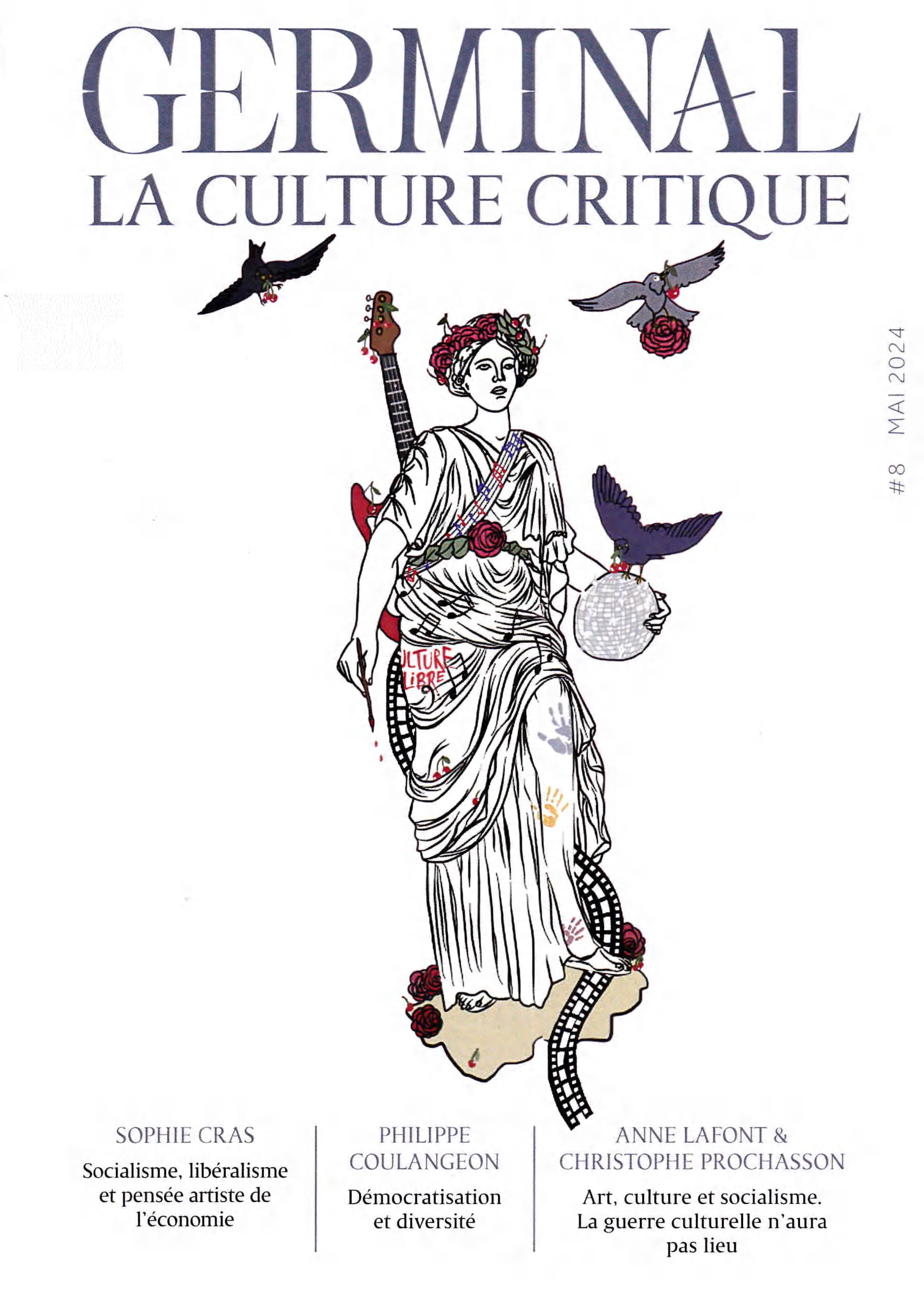
“When it comes to culture, there exists today on the left a philosophically reactionary mode of thought that fails to recognise itself as such”
Cultural rights, work aimed at young people from working-class backgrounds, the use of digital technology: filmmaker and cultural innovation consultant Benoît Labourdette reflects on what he sees as blockages in the way the left thinks about cultural policy today.
The intentions of culture professionals towards young people are commendable, you say, generally being structured around the goal of cultural democratisation. In this view, the aim is to widen access to cultural offerings deemed “of value”, towards which young people supposedly would not turn on their own, in the traditional venues that are the theatre, the cinema, the museum, and to do so above all within a school setting. But your observation is that most of these young people are hardly receptive. Sometimes they even feel rejection or indifference. And this, while they devote enormous amounts of time and attention to other cultural practices on digital networks. Now, you seem to consider that this situation of failure reveals the existence of a problem that lies not with the young people but rather with the professionals. Can you explain how?
The members of the profession I belong to legitimise themselves, consciously or unconsciously, in the lineage of André Malraux, which has the advantage of being very reassuring, because it convinces us of the soundness of the Culture we see ourselves as carrying and guarding within society. This spares us from having to discover new fields of legitimacy and allows us not to question the certainties we have been taught. And it also comforts us in the myth of aesthetic wonder, supposed to produce a major enrichment in the spectator, which is seen as our ultimate goal. Yet it seems to me that this vision does not allow us to take the true measure of how society is changing. It stands in the way of our understanding of reality rather than helping us to act upon it in an emancipatory way.
That is why, in order to understand where we stand, I think it is preferable to set aside our professional doxa for a moment and to return first to what constitutes a major innovation of recent years: the introduction into French legislation of the notion of “cultural rights”. These rights are now enshrined in law (the NOTRe law in 2015 and the LCAP law in 2016) and, since 2021, championed by a new department of the Ministry of Culture (the General Delegation for Transmission, Territories and Cultural Democracy). One of their great merits, in my eyes, is that they invite us to consider culture in its first and foremost anthropological sense: culture is what constitutes us, it is our language, it is our practices, our affiliations, our tastes, our trajectories, our choices, our freedom to exercise our capabilities… And this is why the law requires that the cultural rights of the person (notably their identity, their heritage, their right to participation, and so on) be respected, so that this person can legitimise, in their own eyes, the value of their own culture. The idea is that this is what enables people to participate fully in the life of the community, and that without recognition of their cultural rights, they will never feel entitled to do so.
Cultural rights also invite us to place the person’s experience, participation and cooperation at the centre. This is why they lead us to distinguish very clearly between “cultural democratisation” and “cultural democracy”. In democratisation, “good things” come down from above, whereas in democracy there is a horizontal space of exchange and sharing, within which each person, in their cultural singularity, comes to enrich the common production (the production of experience, artistic, social…). One hears it said that to promote cultural rights would be to debase Culture, that it would be to develop amateur practices at the expense of high-quality professional practice, that it would amount to considering that everything is of equal worth, that it is a demagogic stance. But in reality, it is above all a matter, for professionals, of adopting the posture of taking an interest in the people they address, and in the territory in which they work, and of doing so in a profound way. This is not so easy to put into practice, because it runs counter to the education we have all received. But it can fundamentally change cultural policy and the very nature of artistic projects! And, in my eyes, it is the necessary condition for citizens to recover a sense of meaning in their use of subsidised cultural venues. It is the very meaning of democracy returning to culture.
Once this is borne in mind, I would say that to keep on judging negatively the way young people use digital tools, without even taking an interest in the experiences they have when using these tools, is to stay within one’s comfort zone, and, very quickly, it is to end up stigmatising youth. It is adults, those who hold power, who are responsible for the severing of the bond with young people. It is in no way the young people, who have, it seems to me, a rather healthy reaction when they set aside the proposals of condescending people who hold their culture in contempt. For me, the discourses on cultural democratisation, which claim that one must “bring” young people the “good” culture because their cultural practices would be devoid of any value of their own, are above all revealing of a lack of interest in the cultures that the various youth cultures construct.
Would you go so far as to speak of a conservative, even reactionary attitude? Many of the men and women who adopt it nonetheless sincerely consider themselves won over to progressive ideas, if not to the left.
Indeed, it seems to me that these stances, steeped in good intentions, and often held by people who say they are on the left, reveal a philosophically reactionary mode of thought that fails to recognise itself as such, locked as it is into its old references and certainties. For what do we find at the foundation of these stances, if not the anti-youth stereotypes typical of the most reactionary segments of our societies, those very stereotypes that Salomé Saqué’s fine book Sois jeune et tais-toi [3] has recently analysed? It is probably no coincidence either that, in these stances, the criteria of judgement mobilised to assess the “quality” of works are generally those of the dominant bourgeoisie and of its particular cultural tastes. Such stances must be seriously questioned, in my view, not only because they betray a class ethnocentrism, but above all because they keep us collectively well short of what are now, in our societies, the shared demands in terms of equality, social justice and individual autonomy. It is to these shared demands that the recent legal affirmation of people’s cultural rights bears witness in the highest degree, as I have said.
It also seems to me important to underline how these stances, even when driven by emancipatory and egalitarian goals, can produce, owing to their unconsciously reactionary character, the very opposite of what they aim at. One cannot but be struck, in this respect, by the fact that many young people who, within the school setting, are taken to discover cultural venues, experience this on the mode of obligation and of something imposed on them, and come away convinced that Culture, definitely, does not belong to their own culture, and that it is intended for people other than themselves. Now this situation is explained in large part, it seems to me, by the fact that the social distance separating them from these venues remains all too often an unexamined matter in the thinking of professionals. Teachers themselves are not always trained to prepare their pupils for the very particular kind of social experience that pushing open the door of a cultural venue represents, nor for the possibility of subsequently appropriating such a venue and feeling fully “in their place” there. It goes without saying that there are remarkable exceptions to this, both among culture professionals and among teachers. But I believe that if there are unfortunately not more of them, this is due to a still far too rigid conception of Culture, which results in not doing, for young people, all that would be necessary to make Culture less intimidating and less exclusionary for them.
But what, then, on these questions, would be an authentically left-wing posture, and, to hear you tell it, a more effective one?
I think it is essential, first of all, to admit that responsibility lies here on the side of adults and not of young people. And I am not speaking only here of the responsibility that falls to professionals in education and culture, but indeed of that which falls, more generally, to adults. There are three very concrete aspects of our attitudes that, in my view, we must collectively change, if we truly want to contribute to a freer and more egalitarian relationship between society and culture, which seems to me to be the objective, if one is on the left. The first is that we must question far more our spontaneous lack of interest in, and our contempt for, the cultures of the young. For example, the criticism “he spends too much time in front of screens” makes no sense. What matters is what he does in front of his screen, not the time he spends there. And besides, do we apply the same critical thinking to the time we ourselves spend in front of screens and to what we do there?
The second aspect is that we must remedy our unawareness of the anthropological changes that digital technology introduces. This unawareness is reflected notably in the absence, among the great majority of culture professionals, of any in-depth work on the philosophy of digital technology and on its consequences, which are nonetheless so vast, and present all around us in everyday life. We do not see clearly enough that if we go on using, without questioning them, all the free and so convenient digital tools placed at our disposal, we are ourselves, through our practices, our naivety and what must then be called our “lack of culture”, unravelling freedoms, privacy, heritage, sovereignty, and so on. We are working, without realising it, towards a society of control. Whereas with work, creativity and cooperation, it is possible, and even highly effective, with digital tools, to work in the direction of democracy.
Finally, the third aspect follows from the previous one: we ought to learn to politicise our relationship to digital technology far more. Once it is admitted that the digital revolution is a reality, and that there is no going back on it, we ought to be capable of definitively abandoning, on these matters, any regressive or reactionary stance, and of turning resolutely towards a reflection on how emancipatory and democratic uses of digital tools might be made widespread throughout society. A few decades ago, lifelong political education was very successfully taken on by the trade unions via popular-education methods. On the same model, I believe that today we need genuine spaces for reflection and political construction concerning digital technology, its consequences, and its democratic applications. There are a few such islands, but for the moment they are confined to a small community of “libertarian geeks”.
It is often said of digital platforms that the cultural products whose circulation they enable, and the practices they encourage, are impoverishing and stupefying. You do not seem to share this feeling. You even argue that, by fostering disintermediation and the sharing of experience, the platforms tend to be genuine crucibles of creativity and the site of a “cultural democracy in action”. Isn’t that going a bit far?
Let us take an example: imagine you are on TikTok and you watch the video of a piece of choreography that you like; you only have to tap the title of the song, displayed at the bottom of your phone’s screen, for your camera to start up automatically, allowing you to film your own choreography to that same song right away. This is what is called a trend. Within a few hours, tens of thousands of people can thus take part in a kind of vast choreographic palimpsest, with progressive creative inspirations, on a great many levels. TikTok is above all a creative tool that is both very simple to use and very advanced (corresponding, incidentally, in a strikingly exact way, to the “dream tool” that Jean-Luc Godard had once described), one that puts into action a cultural democracy of impressive vitality, that is to say the possibility of full and complete contribution granted to everyone. Of course, TikTok is not only that; it also has, like any tool, plenty of failings (no fewer than Facebook, Instagram, YouTube, Microsoft, Twitter-X and the rest). The fact remains that the content there is immense and extremely personalised for each user.
I would add this: the most widespread use of TikTok as a viewer happens by moving directly from one video to another, offered automatically. The videos are “pushed” by an algorithm. This algorithm (now copied by the other platforms) is radically new in the way it works. If, for example, you post a video on YouTube, it will be seen very, very little (one need only look at the YouTube channels of cultural institutions!). It is up to you to build a marketing strategy to get people to watch it. If you post a video on TikTok, the algorithm systematically tests it with 100 or 200 people, and depending on people’s interest in that content, your first video may be seen millions of times, which is impossible on the other social networks. Thus TikTok relies above all on content, and the algorithm offers content matching the tastes it has identified, while also always opening onto diversity, which is its development model. The algorithm manufactures democracy in the distribution of content and in the (re)cognition of artists, whether amateur or professional.
But isn’t there nevertheless a risk, in seeking to develop this “cultural democracy in action”, of becoming beholden to platforms owned by major players of global capitalism?
But we are not condemned to go constantly and exclusively through the major players of the web! For example, some of the cultural projects I lead consist in creating, on various media, collective works to which the inhabitants of a neighbourhood, or the students of an art school or of a vocational training centre, contribute. Well, in such projects, for ten years now, I have systematically used digital platforms that I develop autonomously, without any dependence on the major web industries. They are hosted on my own server (located at a provider in Clermont-Ferrand), backed up in several places to ensure the durability of the data, and in part by the BnF as well. The creations, whether visual, audio or video, the rushes, the photographic and written documentation of the work, and so on, are deposited in a space specific to each project, and will always remain accessible there. In this way, it creates a thread for the participants, and if there are several sessions, it allows them to have access to everything all the time. This content is theirs and belongs to them. They can also delete anything that might cause them image-related problems, for example. These platforms, for me, have several virtues: they legitimise the participants’ productions, through their symbolic inscription within this “official” space (which is not, however, public, unless we decide otherwise); they create a thread from one session to the next, and make it easy to “bring back on board” those who cannot be there all the time. They are therefore a powerful factor of integration for those who are most fragile in terms of participation; they allow those who wish to do so to let their ideas mature, in a very concrete way, because they have access to all their content wherever they want and whenever they want; and they make it possible to create a “digital heritage”, that is, elements that leave a trace. And it is indispensable to have a trace of the actions, because it is through tools for the narration of actions that one grasps, oneself and others, their full measure, their full importance. The participants can also freely share with whomever they wish whatever they wish; it belongs to them. I would add that these platforms are of various kinds: sometimes they are simple “clouds” for managing files, sometimes they are fairly sophisticated, co-built websites, sometimes they are collaborative writing spaces meant to foster collective intelligence (in the context of vocational training, for example).
You point to another issue raised by the shift to digital techniques as regards cultural democracy, namely that it allows a stepping-back from immediate consumption and encourages consumption over the long term, according to the model known as the “long tail”. This may seem counter-intuitive, given how readily digital technology is associated with the instantaneous and the ephemeral.
The concept of the “long tail” was developed by the American Chris Anderson [4] to define the economic models specific to the Web. It draws our attention to the fact that in the cultural economy, the sale of books in a conventional bookshop for example, it is the 80/20 rule that applies: 20% of titles, the new releases and the best-sellers, account for 80% of turnover; thus every year, at the start of the literary season, low-selling books must be cleared out to make room for the new ones, because one cannot push back the walls. By contrast, the same books on sale online obey a different model, owing to the fact that there is no shelf-space limit, and therefore no reason to take books off the shelves. Of course, new releases and best-sellers also represent very large sales online, but that is only 50%. The remaining 50% of turnover consists of the sale of this immense mass of infinitely diverse cultural objects. And in this diversity, the economy builds itself over the long term. For if a book (or a film) of which only a single copy is sold in a year in a bookshop may perhaps sell as much via a platform, it nonetheless remains one a year, which, over ten years, makes ten times as many! The platform YouTube, for instance, generates half of its audiences (and therefore of its advertising revenue) over a period of about ten years.
Digital platforms could therefore, far from enslaving us to consumer society, on the contrary free us from its grip?
Once again, it all depends on the policy one develops with regard to the tools and the systems. In this case, the central question seems to me to be that of the way in which one intends to regulate the distribution of works, so that this has favourable rather than negative effects, in terms both of democratisation and of respect for creators. Let me explain. Soon after the advent of the Internet, the downloading of content appeared (audio first, then video). Owing to the fact that there was at the time no economic and legal organisation or structuring of legal downloading of cultural content, lovers of works had no choice but illegal downloading, which also constitutes a fairly flourishing economy (via the illegal subscription-based downloading platforms, financed by advertising), whose revenues do not, of course, go to the authors, which is a real problem for the respect and renewal of creative work. It is worth noting that the same phenomenon had occurred, twenty-five years earlier, at the end of the 1970s, with the appearance of cassette tape recorders and VHS video recorders. These technologies made it possible to copy records and films, to record radio or television freely, and to do so quite illegally, hence with risks for users and immense losses in terms of authors’ rights. In 1985, in France, the authors’ societies and the public authorities put in place several major, virtuous changes, still in force today: the law on copyright was amended, and it became legal (the “private copying exception”) to make copies of the radio, of television, or of friends’ records; a tax on blank media was introduced, levied directly at the points of sale, the “private copying levy”; this collected tax is then set against the audiences of radio and television stations, and each author receives their share of this levy, on the basis of this approximate assessment. Thus, faced with a new illegal use, made possible by a new technology, the strategy was not penalisation but, on the contrary, decriminalisation accompanied by the regulation of practices through the establishment of a levy.
The bill known as the “global licence”, proposed by François Hollande during the 2012 campaign, proceeded from the same logic. This bill, which had taken ten years to construct, was written and claimed as a left-wing digital policy, intended to replace the Hadopi law, introduced in 2007 under Nicolas Sarkozy, which is a law of repressive inspiration, in whose preparation major distributors of cultural products, such as Denis Olivennes, then president of the Fnac, had a hand. The new law envisaged in 2012 proposed levying a tax (probably €10 per month) on Internet subscriptions. We would thus have paid €40 per month, instead of €30 per month, to access the Internet. Downloading would have become a legal act, the quantity of downloads of each work would have been measured precisely, and authors would have been remunerated proportionally. Had this law passed, we would have had the legal means to develop a democratic economy of exchange on the Internet.
But this law… did not pass. And the Hadopi law is unfortunately still in force. Illegal piracy, then streaming, therefore went on growing, with no remuneration whatsoever for authors, and with no relevant commercial offerings for music and film enthusiasts. The professionals’ only response will have been to criminalise their own fans! Whereas what is at stake is a demand, a strong one, expressing itself in society. A demand for access to culture, nothing more, nothing less. Isn’t the professionals’ job to create offerings that meet this demand, within a legal framework? This was never done. That is why, when Netflix arrived in France in September 2014, its executives had a wide-open road ahead of them: an enormous demand, no competing offering and no virtuous regulatory system for creation on the Internet. Netflix’s arrival turned the entire French audiovisual sector upside down, which, as a result, now finds itself partly beholden to a major American industrial player…
Here, I believe, one can see the whole difference that separates a policy that is not respectful of citizens and serves industry, from what a policy respectful of people would be, of people who are seeking cultural experiences, whatever they may be, and of the authors who help to produce these experiences, a policy capable of admitting once and for all that the Internet is a reality which is not to be denied or despised, but within which it is necessary to innovate and to build, in order to draw the best from it, so as to increase, in our societies, equality, individual freedom and social justice.
— Interview by Cyril Lemieux