On March 26, 2026, I gave a talk for the national network of Cultures du Cœur, as part of their “L’expert du jeudi” format, a regular videoconference that allows regional coordinators across the network to step back from their daily practice and enrich their thinking through outside speakers.
In my book Défendre la culture autrement: méthodes pour demain, I start from an observation: the cultural sector is going through a deep crisis of legitimacy, which is also an opportunity for transformation. Drawing on over twenty years of experience as an artist, mediator and researcher, I propose concrete methods for moving from a supply-driven logic (where professionals alone decide what is “good” for audiences) to a genuine cultural democracy, grounded in cultural rights and citizen participation. This talk for the Cultures du Cœur network was an opportunity to explore together this central question: how can cultural professionals change their postures so that people distanced from institutions are no longer passive “beneficiaries,” but full participants in cultural life?
Cultures du Cœur, at the crossroads of culture and social action
Cultures du Cœur has operated since 1998 a solidarity ticketing system that distributes hundreds of thousands of cultural invitations each year to people experiencing precarity, through a network of approximately 4,000 social worker intermediaries. But the association does more than distribute tickets. It stands, as Alice Pauly, its training and outreach coordinator, puts it, “at the bridge between the cultural and the social.” It trains its intermediaries, supports individual pathways, and seeks to make a cultural outing something more than mere access: a moment of connection, dignity, and participation.
Introduction by Alice Pauly
Alice introduces me as a speaker well known to Culture du Cœur, having regularly taken part in training sessions and led a digital creation workshop project as part of the 2023 summer cultural programme. She describes me as a filmmaker, educator, researcher, and consultant in cultural innovation and digital strategy.
She notes that the book Défendre la culture autrement, méthodes pour demain is available for free as a PDF and that she has shared it with the network.
She identifies three key points she would like to see developed:
- The crisis of the cultural sector, a “very hard-hitting” assessment: loss of legitimacy of public cultural action, a subsidised sector heir to colonial methods of control, an instrument of power more than a defender of democracy. What explains this broken link between the cultural sector and citizens, and how can it be rewoven?
- Digital strategies and the transformation of cultural practices, 35 hours per week of digital practices, massification, questions of accessibility and mediation, the opportunity for horizontality and participation through digital tools.
- The operational dimension, concrete methods for creating shared cultural ground, popular education tools, “formalising the informal,” collaborative evaluation methods. A call for concrete examples.
She proposes a format: 20 minutes of presentation, then discussion.
My presentation: the outline of the book
I announce that I will summarise the structure of the book so that participants can find their way around it and pick out what might be useful to them. I remind everyone that the PDF is fully navigable through a clickable table of contents.
Part 1, Rethinking the cultural bond
I observe that we often start from the assumption that a cultural action possesses a kind of “magic virtue,” a legacy of André Malraux’s thinking. I don’t share this vision. What matters is the way we mediate, the way we create connections between people through the tool of culture. A cultural project can be very top-down, not necessarily open to others. Just because something is cultural doesn’t mean it’s necessarily good. It’s the way things are done that matters, and it seems essential to me to share an analysis on this point.
Part 2, Democracy and power in culture
A more historical section: how the cultural sector was built in France since Louis XIV. Cultural policy, meaning culture in the service of political power, is a tool for supporting and enhancing the aura of power.
I recall the creation of the Ministry of Culture in 1959: nobody wanted it, the money was taken from popular education and the national education system. Malraux brought in civil servants from the colonial administration in Africa, who applied to French territory the methods of “cultural colonisation.” There are quotations where these civil servants describe the French provinces as “the Bush” with local leaders “to be wooed.” It is this logic that shaped the establishment of the DRACs and cultural venues across the regions.
I insist: this is neither good nor bad, it is history, but it is important to understand what builds structures of domination.
I then draw the distinction between cultural democratisation and cultural democracy:
- Cultural democratisation: what comes from above, spreading access to a pre-established culture.
- Cultural democracy: mutually enriching one another through our respective cultures, considering culture in its anthropological sense, what constitutes us. This includes subsidised and private cultural practices, but is not limited to them.
In the cultural field, there is often a confusion: we call “culture” something very specific, but it is not culture in the broader sense. Speaking of cultural democracy can be frowned upon, people cry “cultural relativism.” But this is not about saying everything is equal: amateur artistic practice is wonderful, it is not “lesser” than professional practice, it simply occupies a different place in social life. There is no reason to judge it as inferior. This is a matter of respecting the dignity of others, respecting their culture.
I recall the institutional support: the directorate for cultural democracy at the Ministry, cultural rights enshrined in law in 2015 and 2016. There are practitioners who don’t quite know how to work horizontally, even if they want to, and others who already do.
I conclude: by better understanding history and where we stand, we may find legitimacy in practices that are not necessarily recognised by certain cultural actors, but that we exercise more readily in the sphere of social action. And we need to have confidence in that.
Part 3, Digital strategy and sovereignty
This is about today’s cultural practices. Since the arrival of digital technology, platforms (Netflix, YouTube, social media…), everyone has extremely significant cultural practices through digital means. This has been going on for 15 years, it is intensifying, and Covid accelerated the trend.
The offerings of cultural professionals have become marginal compared to these practices. We are no longer at the centre. Previously, cinemas, theatres, and museums were the places where people went to see art. Today, the connection to art happens primarily through digital means.
There is a mistrust of digital technology among cultural professionals, but it is inconsistent: everyone has digital practices. Assuming hierarchies (live performance would be “a thousand times better,” a film in a cinema “has nothing to do with” a film on a phone) doesn’t hold up: these are different experiences, both interesting.
I insist: we have a lot to learn from our beneficiaries by opening up, without assuming that what we offer is “better.” I give the example of the regional film education network meetings the previous week: the discourse, particularly regarding young people, was “ultra-condescending,” assuming that everything they watch on their own is “rubbish,” and that we are going to “open their minds.” That’s wrong, and it’s not respectful of the other person’s dignity. When I hear these views expressed by the CNC, I disagree and I say so.
This intuition of respect for the other person’s dignity is something we all share to some extent, but we can be impressed by very well-meaning yet very dominant frameworks that don’t foster connection.
Part 4, Methods and professional practices
Concrete proposals for things we can do in the field: methods of cooperation, mediation, the question of framing. Often, the frame is perceived as what constrains; I believe the frame is what authorises.
I point out that in digital spaces, people are both receivers and broadcasters: with a single click, you can publish. This capacity for intervention doesn’t exist in the same way in traditional cultural spaces, which can therefore feel regressive compared to digital.
Many of these proposals come from popular education: giving people the power to act.
Detailed example: the pair technique
I describe a technique I use very regularly, drawn from popular education:
You have a group of people, everyone is together in the same space. How do you give each person a voice? It’s very hard to speak up in public, even in a small group, there’s the fear of being judged.
The set-up: you give a topic (for example: violence against women, in preparation for a performance on this theme). People walk around the space. You say “go,” and they pair up. For one and a half minutes, one person in the pair tells the other what violence against women means to them. The other listens, it’s not a dialogue. Then they switch for another one and a half minutes.
You can do three or four rounds with different questions: “What could we do to reduce violence against women?” or a deliberately provocative question: “Are women responsible for the violence they suffer?”
What makes it powerful: many people are talking at the same time, there’s a buzz of energy. Speaking to just one person is doable, even for someone who is struggling. And the facilitator doesn’t know what is being said: the words belong to the participants, they are not reclaimed.
Practical application: At the Forum des Images, I ran filmmaking workshops in collaboration with artificial intelligence for teenagers, groups of 70 people paired up in a cinema. Two questions in pairs: “How will AI bring us good things?” and “What are the dangers of AI?” This sets in motion that “self-permission” to express oneself. Having a cultural practice, even as a spectator, is a form of expression.
Part 5, Towards a renewed cultural sector
Process, narratives, results
I address a frequent problem in participatory arts projects. A workshop is offered (performance, film, visual arts…), and at the end there is a presentation. The funding partners are there, maybe the parents, the people who financed the project. There’s a stakes: the presentation needs to be “good.”
The slippage: the artist leading the workshop is under pressure for the result to be good, and may “take control” to make it work. But what about the space and expressive freedom of the participants? The artist’s own identity is also at play: if the DRAC advisor is there and the work is not “aesthetically finished,” the artist is judged. The action, which was social with culture as a tool, becomes an institutional production to reassure the institution. Nobody means any harm.
My proposal: you shouldn’t present the result, you should present the process. Tell the story of the steps you went through. The result (performance, film, exhibition…) becomes one element among others in a process. If you tell what happened, the artist came with a proposal, it didn’t work, we changed it, etc., everyone will be delighted to discover this artistic process. We’re no longer fixated on the result, and we’ve been able to give more space to the participants.
This narrative also does the participants good: it allows them to recognise all the steps they went through, to give value to their experiences. These narratives are also tools for qualitative evaluation.
A practical consequence: when doing artistic mediation work, you need to think about the narrative while you’re doing it, build tools during the action: photos, notebooks, notes. Otherwise, it’s hard to construct the narrative afterwards.
I refer to John Dewey, the American pragmatist philosopher of the early 20th century, and his concept of art as experience: art is not the artistic object (painting, performance), it is the experience lived by the people who encounter it. That’s the subject: the experience.
The example of the project with Culture du Cœur (2022-2023)
I share my screen and show the website documenting the cultural tour project carried out with Culture du Cœur:
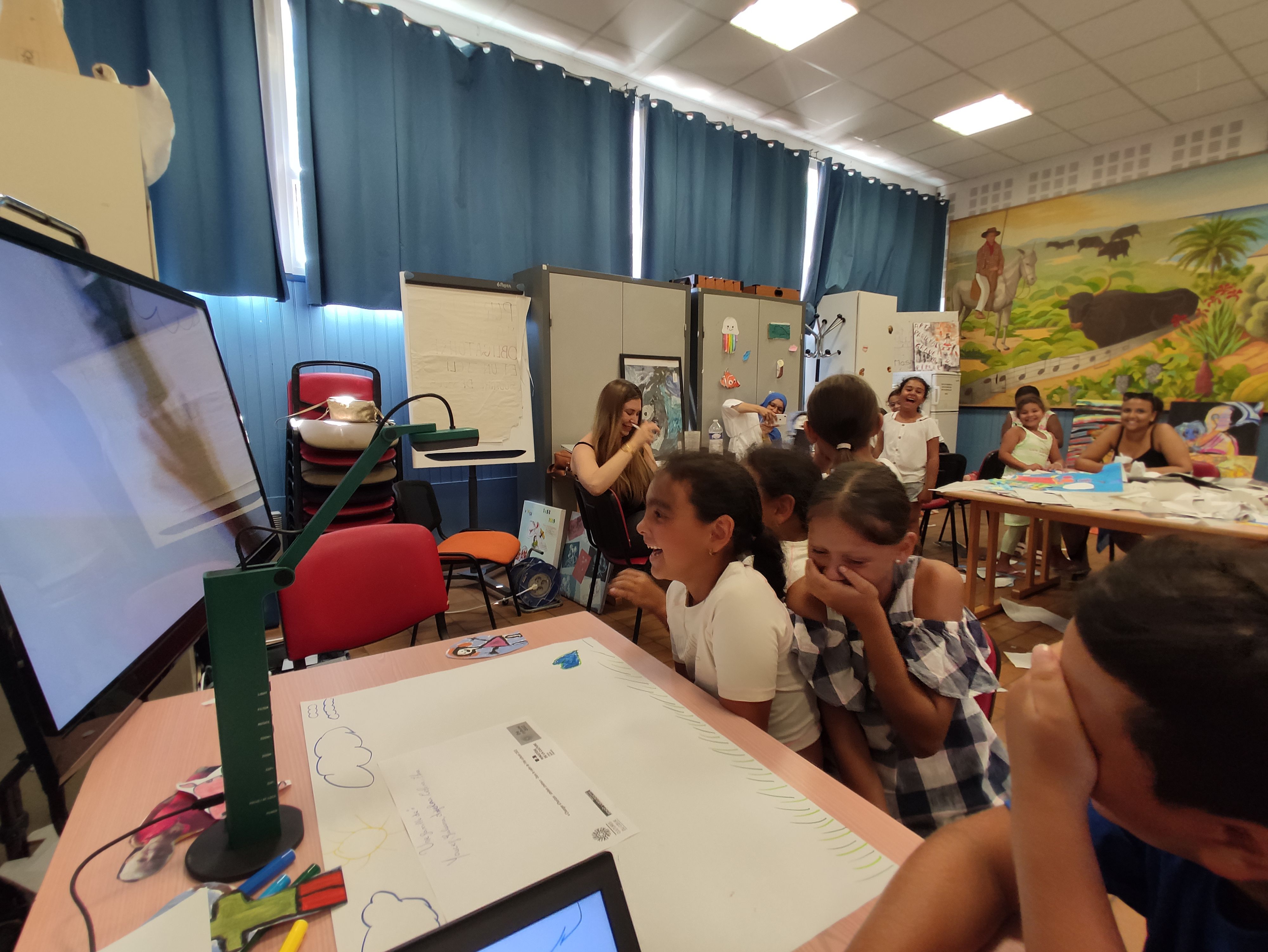
- In 2022: cut-paper animation films offered in various locations. People could cut paper, assemble elements under a camera, tell a story. The narrative was captured through logbooks kept in real time during the workshops, something I learned from working with Alice and Serge Saada.
- In 2023: a more ambitious, multidisciplinary project: music, paper cutting, drawing, podcast, photos, scenography. A website was created for the participants: all the traces of everything that was made are gathered there. It is not a communication tool, it is a tool for the participants. They can find their photos there, share them on their social media. By clicking on a first name, you can see everything that person made that day.
The digital tool was used not to showcase the organisers, but to serve as a record, a narrative, for the participants above all.
Discussion
Alice, Transformation of practices in the cultural sector
Alice reopens the discussion on the transformation of practices in the cultural sector. She shares a striking memory: a training session at the Louvre with Serge Saada, ten years ago, in front of cultural mediators. They had tried to help them understand that the relationship mattered at least as much as the knowledge. It provoked an uproar, a very difficult moment. These are professions that often require a high level of education but are very poorly recognised. She wonders whether things are changing.
Gaëlle, The tension between results and choice in solidarity ticketing
Gaëlle, new to the role but coming from an evaluation background, shares her surprise at the solidarity ticketing system. For the cultural institutions that donate invitations, it is tied to a concern for results. If out of 10,000 invitations, 3,000 are not taken up, it’s a failure for them. Whereas for Gaëlle, having 10,000 invitations of which 7,000 are taken up means that people had a choice.
She also mentions an exchange with the FAS (Fédération des acteurs de la solidarité): professionals working in cultural venues lack knowledge about people experiencing severe precarity. There is no exchange, the experience isn’t there, and things can quickly turn into the kind of “service counter” approach they are trying to avoid.
My response, Object relations and the aesthetics of relationship
I pick up on this: institutions face pressure from their supervisory bodies to fill seats. Beneficiaries become “objects to fill their venue,” what I call, borrowing from psychoanalysis, an object relation. And this, even though the objectives of public funding are to bring something to citizens.
I bring up the aesthetics of relationship and John Dewey: the experience we live together is in itself an artistic practice. There are other things to do than just fill seats, and we can help cultural professionals evaluate their work differently for their supervisory bodies.
Artists themselves feel that “something isn’t right” and they’re stuck. When you really talk to them, they don’t not care about people, but they find themselves in a situation that doesn’t suit them either. We need to open the dialogue in full transparency.
Gaëlle, Valuing the process
Gaëlle says she fully agrees with this idea of valuing the process over the result, even if sometimes a result can make you very proud.
Enguerrand, The clash with the DRAC
Enguerrand describes a concrete problem with the DRAC over a cultural and social call for projects: an artist proposed for a Mediterranean song choir project in a priority neighbourhood was not sufficiently “recognised” by the DRAC. The creative process and exchanges with the public were dismissed in favour of the artist’s institutional legitimacy.
He also mentions several cinema workshop projects with diverse audiences (homeless people, asylum seekers, people with disabilities), using the “cinematic approach” which works well.
My response, The DRAC and cultural rights
I say it’s “appalling”: the DRACs are supposed to uphold cultural rights, but their culture remains one of defending artists legitimised by their own criteria, which are opposed to the criteria of cultural rights.
I give a personal example: a visual arts workshop project with the Meaux museum during the summer, a large open workshop where people come and do what they want. The DRAC said: this is not an artistic project. I had to “invent a fake artistic project” that conformed to expectations in order to get the funding, then I did what was actually planned. Formatted artistic projects, I say, are “formulaic,” you could ask an AI to write them.
I suggest a pragmatic trick: take the DRAC application, the text of their remit, the book, and use an AI (I recommend Claude rather than ChatGPT, for ethical reasons) to generate a project that “speaks” to the DRAC and find arguments to counter theirs. You use normative tools to respond to norms.
I ask Enguerrand where he is based geographically (Alpes-de-Haute-Provence, rural territory, priority neighbourhoods in Manosque, 160,000 inhabitants spread across a very large isolated territory) and I suggest that there may also be work to do on framing language to present the artist’s background in a way that meets the DRAC’s expectations.
Gaëlle, Digital as culture
Gaëlle develops a reflection on digital technology. She observes that young people reputed to be “in digital culture” actually only use their smartphone for two or three things. They have no idea of the richness of the tool they hold in their hands.
What cultural professionals offer is marginal compared to digital flows, but it can become central again if we put social experience back at the centre, with culture as the pretext. What we bring is the possibility of being inspired by someone, of making a choice, of getting it wrong, of being moved or not, of talking about it. Living things for real with people can also help one be more informed, more vigilant, more of a citizen in relation to digital tools, putting them back in their place as tools, setting aside the flows we struggle to manage.
My response, The sideways step and micro-workshops
I agree: there are many digital divides even among users who have a phone. Creative cultural projects offer a sideways step, like when, with a pen, you suggest writing a poem: you take a sideways step with an everyday object. Artistic practice enriches expression, personal development through symbolisation, and also helps people reclaim the digital tool.
Example: the 500 teenagers at the Forum des Images, in groups of 70, young people used to digital technology, but some of them learned things with their own phone that they didn’t know how to do before.
I also mention the importance of micro-workshops: short, focused things that can be done in relatively little time. I share resources on my website, including a “mediation” section that I am currently expanding.
Alice, Supporting appropriation vs. content
Alice raises the question: is the role of Culture du Cœur more about supporting appropriation than producing content? Content is abundant (the Ministry is testing virtual tours, etc.), but it’s often a mimicry between real and virtual. Shouldn’t we rather think in terms of the agility that digital offers? She mentions the plan to launch an online book club in September. She feels that Culture du Cœur has not yet found its place in these practices.
Angélique, The human bond and the Port-de-Bouc intervention
Angélique returns to the human bond that is needed before any project. She talks about accepting to slow down, being there before even making a proposal. When you organise a tour where artists come for a one-day immersion, the bond isn’t always there, it’s an “outreach” that remains frustrating.
She remembers my intervention in Port-de-Bouc: the way I offered the medium, the equipment, the way people were able to tell their own stories in a short and effective timeframe. The films were made in a single take, in one go, we were “in the real.” People told their stories and it was beautiful, in the output, in the listening. The medium made that bond possible.
She notes that we achieved “an economy of the bond with the artist”: when it’s now said that all projects must be co-constructed, that the artist must understand the neighbourhood’s history, sometimes that’s impossible. An artist who is used to giving people a voice and, above all, not judging what will be shared, that’s what makes the difference. What also mattered was the sound quality, the technical efficiency put in place.
My response, The object that mediates
I thank Angélique for “validating the approach.” The question of the object that mediates and of welcome is important: how, when people walk in, they feel welcomed, they understand. Do we really welcome people? Do people have their place? Are they respected, free to say what they want?
Technique matters, but digital can be accessible, not complicated. The equipment I use (microphones, software) is the same as what YouTubers use, young people recognise it, it’s part of their culture. I keep the reference of professional audiovisual practices, but with a different purpose: not to do things the way professionals do, but to enable people to express themselves.
The choice of the single-take film (making the film in one go, without editing) is deliberate: if there’s editing, it’s the facilitator who does it, and you can’t watch the films straight away. Being able to make and watch immediately is very important, it’s like a performance, with an intensity of the moment.
I add that it was intergenerational, everyone could find their place. It needs to be simple, accessible, people need to feel permitted. A table where you can cut paper is accessible to everyone. All of this is designed not in reference to how professionals make films, but to how we can use cinema differently, with approaches adapted to the objectives. And there is often a confusion on this point, particularly within the DRACs.


