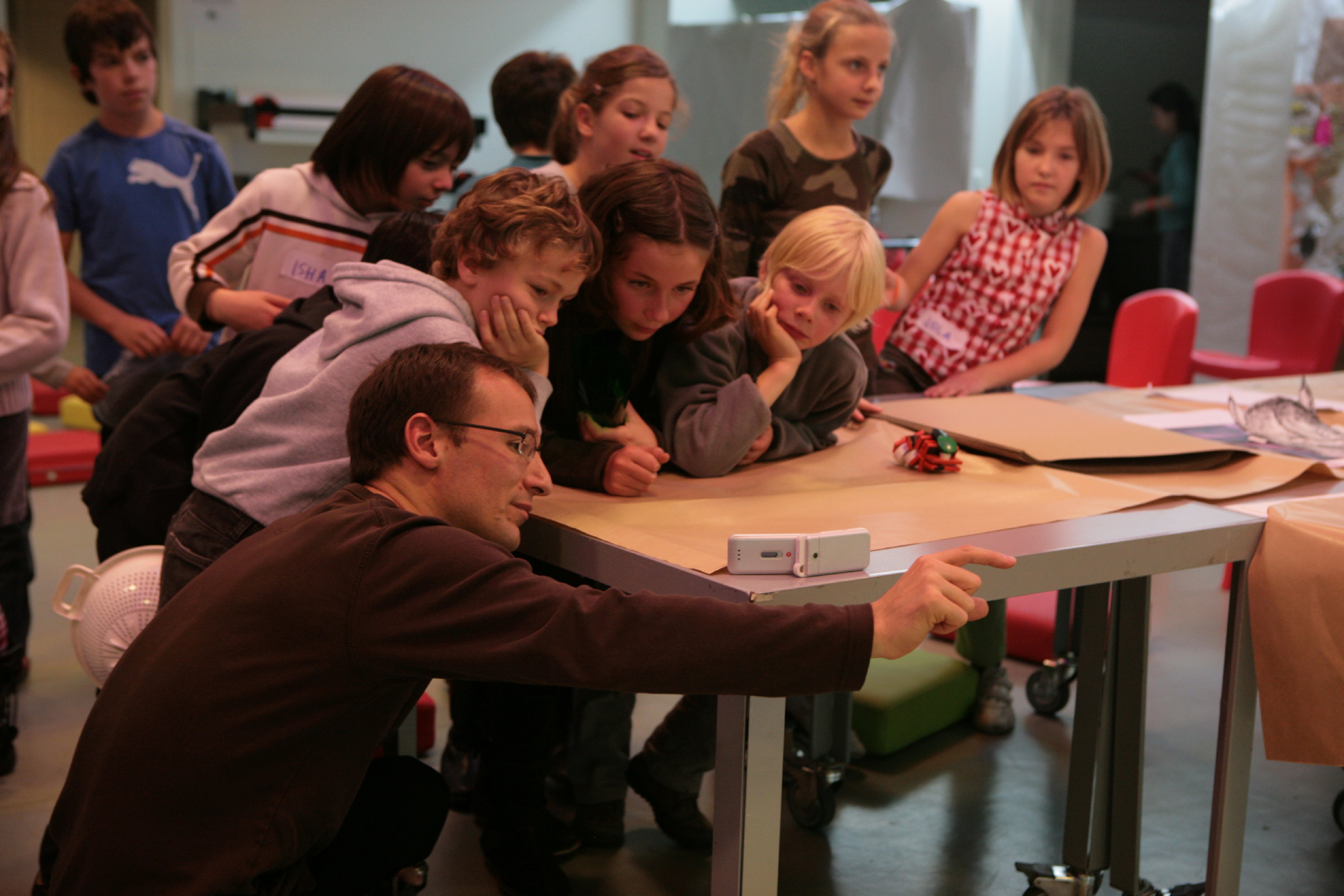
Theatre can produce a de-coincidence, a shift in what had seemed self-evident to us. Other arts do this too, but live performance has this distinctive quality: the disturbance arises at the same time in the spectator and in the performer, and resonates between them. What I want to understand here is this resonance, and how one works to make it possible.
Watching what we thought we knew waver
In Dé-coïncidence (Grasset, 2017), François Jullien offers a way of naming what art does when it truly works. Not creating beauty, not transmitting a message, not stirring an emotion, but opening a breach in what we took to be the real, freeing what had become locked inside us, undoing the representations that had settled into us as natural. He describes the unheard-of becoming possible, not through some naïve beginning, but through the loosening of what had been sealed shut.
This notion is a valuable support for anyone working in live performance, because it helps to name what one is after when accompanying a creation, and to tell it apart from what merely resembles it.
De-coincidence is not surprise. Surprise is an effect, one is caught out by something one did not know. De-coincidence is of another order, one watches things one thought one knew begin to waver. One realises that what seemed natural, obvious, inevitable, is in fact constructed, chosen, and therefore movable. Nor is it the political message. A play can say very true things about social injustice without producing any de-coincidence, because the spectator knows on the way out what they thought on the way in, and the two are identical. They have been reassured, perhaps better armed with arguments, but they have not moved. De-coincidence is when someone leaves the theatre and no longer knows quite where they stand on something that had seemed settled, not in the discomfort of confusion, but in the awareness that their representations are representations, and that the real is more open than they had believed.
A magic that does not reach everyone
There is something that complicates the picture from the outset. De-coincidence is a kind of magic, something that seems to come about without one’s having manufactured it, and that does not reach each person in the same way. Two people in front of the same film, one lives a de-coincidence and the other does not. This is because it is always an interaction, and always what happens to the person living it, not a property of the work that one could deposit there once and for all. One cannot impose it, one cannot even quite aim at it. One builds an energy, a form, and the magic comes about, or does not.
This is why I will never say that a play “produces” a de-coincidence the way one produces an effect. One sets up the conditions, one holds open a space, and what plays out there escapes, in part, the one who held it open.
The nightmare coming true before our eyes
Cinema offers powerful examples of this, and one of them helps to grasp what is at stake. In Mulholland Drive by David Lynch (2001), there is a scene where two men are sitting at a table in a café. One tells the other about a terrible nightmare he had the night before. In the dream, the two of them were in this very café, and he saw his friend paying at the counter and giving him a nod. The account finished, the man looks up, and he sees his friend at the counter, exactly as in the dream, and we, the spectators, see the image he had just recounted.
What shifts in us then has to do with the performativity of the imaginary that this scene sets in motion. The film is an invented story, built like a dream, something we know did not take place in reality. But inside the film, a man recounts a dream, and that dream becomes real before our eyes. The account creates levels within the fiction, nested degrees of reality, and we watch one of these levels pass into another, the imaginary lodging itself in the reality of the film. Because there is, right there, a working of this breach within the narration, it points us toward the possibility of a similar breach in our own reality, and we feel it while we are watching.
This disturbance rests on something worth knowing: our brain does not fully tell the difference between dream and reality, we have all lived this with dreams we wake from shaken. Nor does it quite tell the difference between images and the real. When images are presented to us as information, as having been filmed in the real, they stop being images for us, they enter our reality as if we had seen the thing itself. This is why it is so unsettling to learn afterwards that such images had been fabricated, today for instance with an artificial intelligence, and that we had taken them for the real. This is exactly what happens in front of this film. We were inside a fiction, characters in a café, and all at once we no longer know, because the character himself no longer knows whether he is in reality or in his dream, and we ourselves no longer quite know whether we are watching actors and a staging, or living something that is actually happening.
Not all spectators are seized by this scene, and for some it sets off nothing. It de-coincides nonetheless for many, and the almost uncanny pull of Lynch’s films owes a great deal to this work.
In front of a work that does not move
This cinematic de-coincidence, however strong, takes place in front of a closed work. The film is exactly the same whether I am there or not, whether I am alone or one of a hundred, attentive or distracted. My presence changes nothing of what unfolds. The shift, if it occurs, plays out on my side, in front of an object that does not answer me.
That is already a great deal, and there is no question of ranking the arts. But this is exactly where live performance does something else, and where its distinctiveness lies.
Resonant de-coincidence
In the theatre, de-coincidence does not arise only in the spectator. It can arise at the same time in those who are on the stage. What happens then is that one is taken aback by where one finds oneself, a mental and emotional place one would not have thought one could reach, and where one was not on arriving. The performers can live it, the spectators too, and something a little magical takes place, which one could not explain but which is there, and powerful. Above all, it resonates, the two shifts feed each other. The disturbance that seizes the stage nourishes that of the house, which in turn amplifies that of the stage. This is what makes the de-coincidence of live performance, when it comes about, stronger than the one we feel in front of a fixed work, which will not itself be moved by what it produces in us.
This inner transformation of the performers, real and deep, few actors live regularly. Most take refuge behind their technique, which serves to produce effects on the audience. And an effect can work very well, draw tears, stir fear or disgust. But an emotional effect is not a de-coincidence. This is where the distinction has to be taken up from another side. The effect leaves the spectator where they were, moved but unchanged in their representations. De-coincidence, by contrast, shifts them, and it can only do so if something shifts as well in the one who is performing.
Performers able to welcome their own deep destabilisation, because they have themselves been surprised, overwhelmed by what was happening to them on stage, are few. They are very grounded people, able to welcome an enlargement of their consciousness over the course of the performances, rather than repeating a stabilised execution. This capacity to welcome is rare, and it is worked at, through grounding in oneself and through openness to being transformed at any moment, in life as on stage. It is also prepared through physical training, for to welcome within oneself transformations that are first of all physiological, one needs a sound bodily ground, well tilled, so to speak.
Living a scene rather than receiving it
To understand how two de-coincidences can come into resonance, several traditions of thought offer supports, provided one does not impose them mechanically.
In Le Théâtre et son double (1938), Antonin Artaud was after something of this order, in an extreme form. He refused theatre as psychological imitation and as entertainment, and wanted it to become once more an experience capable of transforming those who attend it, in the manner, he said, of a plague that passes from body to body. His phrase “theatre of cruelty” has nothing to do with represented violence, cruelty there names necessity, the rigour of a jolt that reaches the spectator below the level of discourse, in the body, the sound, the space. His project remained largely unrealised, and his texts are often obscure. One can keep from it, without its excess, the sound intuition: theatre engages the spectator in what is happening rather than presenting it to them, and it aims at a transformation, not merely an emotion.
Psychodrama sheds light on the other side, that of the performers. Jacob Levy Moreno, who invented it in Vienna in the early 1920s out of an improvisation theatre, founds his practice on a few principles: the encounter, spontaneity, creativity. His gesture lies in a reversal of instruction: where a psychoanalyst says “tell me”, the psychodramatist says “show me”. One does not transform a person by transmitting a content to them, one puts them into play in a living scene, and it is having lived that scene, having been spontaneously engaged in it rather than having described it, that shifts them. The theatre I am speaking of places the performers in a neighbouring position, not as patients of a treatment, but as people who really live what is being played, instead of executing it.
Systemic therapies, born around the Palo Alto school, give at last the word that was missing to describe the link between stage and house. They have shown that in a living relational system one cannot not communicate, and that each behaviour of one triggers a response in the other, which in turn modifies the first, along a circular causality they call a feedback loop. Resonant de-coincidence is a loop of this kind. What the house sends back modifies what is being played on stage, which in turn modifies what the house lives, and the shift amplifies as it circulates, instead of remaining on one side only. This loop has nothing to do with improvisation, it can settle into a Molière play performed word for word, because it does not depend on the text but on the way of being present to what is happening across from one.
Family constellations, developed by Bert Hellinger out of systemic approaches, and some of whose positions remain contested, give an image of the force of this mechanism. People who know nothing of another person’s history agree to occupy, in space, the place of a member of that person’s family, and begin to feel something of that place, an emotion, a tension, that they did not have on arriving. The mere fact of being caught in a living relational set-up produces a real shift in them. It is this same spring, at work in the theatre I am describing, that makes stage and house shift each other without anyone having decided it.
Speaking only when the word is awaited
What remains is the most concrete part, the way a company works so that this resonance becomes possible. None of what follows is a matter of participatory devices, and nothing guarantees the result. These are attentions, demanding ones, that one holds when one can and recovers when they slip away.
The clearest example is that of speech. One ordinarily believes that speaking is a given, that the actor says their lines because they are their lines. The proposal is to utter a word only when one senses that it is awaited, and not to say it as long as one does not sense, on the side of the house, an expectation, a connection. This already overturns the logic of the offering, where the spectator receives what one gives them. Here speech comes only on a request, but an unformulated request, one that expresses itself even unbeknownst to the spectators, and it arrives in a breach. This holds for the first line as for each of the following ones, which must all answer an energetic demand, not necessarily from the whole house, but from a few.
This attention does not stand against the repertoire, and each performer carries it in their own way. But it demands considerable physical training, not for performing acrobatics, but to have in the body the energy needed to hold this openness, and to return to it when it closes again. This is what is called stage presence. Nothing shows from the outside, one does not move, and yet a great deal is going on, things one does not quite know the nature of, non-verbal micro-signals, fields, waves, no matter, but which one observes do take place.
This same attention then lodges itself everywhere else, in the costumes, the music, the staging, in the way one shapes what the spectators will feel. It also changes the work of rehearsal. Alongside the properly artistic work, where one tries things out, where one improvises with the performers, where one searches, there is a whole body of work that consists in receiving different people, and in feeling with them the energy that circulates.
Here are a few concrete forms this takes, to be adapted to each creation:
- Work speech as a response to an expectation, and not as an emission. The performer learns to sense when their word is called for, and to hold it back as long as it is not.
- Treat stage presence as a physical fact, and devote to it real training of the body and of energy, independently of the amount of movement on stage.
- Hold the attention to the house at every level of the making, costumes, sound, light, set design, and not at the level of acting alone.
- Bring into rehearsal, regularly, different and numerous people, not to show them excerpts or ask their opinion, but to live with them moments in front of the costumes, the sets, the props, the texts, and to sense what circulates.
- Draw nourishment from what one has sensed in these moments without trying to explain it, letting this perception inflect the way one prepares things, rather than answering an expressed demand.
- Work within oneself on grounding and on openness to being transformed, because resonance presupposes performers able to welcome their own shift, and not only to seek to trigger it in others.
A risk that cannot be proven in an application
De-coincidence is hard to defend in an application or before a panel. It cannot be assessed in advance, it cannot be proven, it is by nature what one did not know one was looking for until one had lived it. What those who seek it recognise in the proposals they receive is a quality of risk, not commercial risk but artistic risk, the fact that a piece attempts something whose outcome is not guaranteed, and that the performers agree to be shifted by it as much as the audience. That risk deserves to be defended, including, and perhaps above all, when it does not fit the usual boxes.


