Our social life is already a staging, but we have forgotten it, and it is that forgetting that freezes it. Theatre does not exist to represent that life a second time; it exists to overturn our representations and to make us see that they are representations. That is where it becomes powerful. Here I try to say how one works on that overturning, in every component of a performance.
Life is already theatre
Antonin Artaud, in The Theatre and Its Double (1938), protests “against the separate idea we form of culture, as if there were culture on one side and life on the other; and as if true culture were not a refined way of understanding and exercising life”. This actor, poet and theorist, who dreamed of a theatre of cruelty able to act physically on the spectator, refused to let art be reduced to entertainment set alongside existence. His protest has lost none of its relevance.
Erving Goffman, in The Presentation of Self in Everyday Life (1956), established, as a sociologist, what Artaud had sensed in his flesh. Our social life is already a permanent staging. We play roles, at work, in the family, in society. We wear costumes, in the literal and the figurative sense. We conform to codified rituals of interaction: the way we pay at the checkout, greet our neighbours, behave at a funeral or a graduation. We have expected lines, assigned places, implicit rules that everyone knows without anyone ever having spelled them out.
The difference between a performance and ordinary life is therefore not a difference of nature, it is a difference of degree, that of the awareness we have of the staging and of its social role. In the theatre, we know we are within a staging, or at least we are supposed to know it. In life, the staging is most often invisible because it seems natural to us, when in fact it has been naturalised.
In the house, we too hold a role
In the theatre, the staging is on the stage, with the actors, the set, the text, and it is to see it that we travel there. But the stage is not its only site. There is another site, at the frontier, and it is the house, where we too play a role. For we ourselves are caught there within a staging. We play precise roles. We go and sit in a seat that has been assigned to us, we follow an imposed path, we fall silent when the lights go down, we applaud at the end, we sometimes dress a certain way to come. We have codes to respect, and we respect them. It is not only the actors who play a role; the audience plays one too.
This places the spectator in a singular situation. In life, everything is already theatre, but without our being aware of it. On entering a theatre, we prepare to watch a staging, a representation, and we prepare for it because we are already, ourselves, consciously on display, held by codes that must be respected. The house is thus at once a frontier and a threshold: the frontier where acknowledged theatre borders our real life, and the threshold by which we pass from one to the other while experiencing, for the space of an evening, that our own life is also a staging. It is that site one can learn to work on, with great care.
This frontier becomes even more perceptible in participatory performances, where one becomes a performer in the show, brought up onto the stage, asked to speak, to take part. But even when nothing of the sort is asked of us explicitly, we have a real role, since without us there would be no performance. The house is part of what takes place.
To overturn is to denaturalise
If life is already theatre, theatre cannot content itself with representing life. That would double something that already exists, less well, because life itself, more brutal and more precise than any representation, always surpasses it.
Theatre, for its part, can carry out an overturning, which ordinary life does not allow. There, before us, is a staging; there, those are actors; there, we pretend; there, we play. The word says it well: we play. And together, tonight, we play at inventing a representation, and not a reality. It is an overturning because, all at once, we no longer naturalise anything. Peter Brook, in The Empty Space (1968), starts from a stage stripped bare, an empty space that someone need only cross while another watches for the theatrical act to begin. It is in that emptiness, and not in the accumulation of objects, that the spectator’s imagination can unfold.
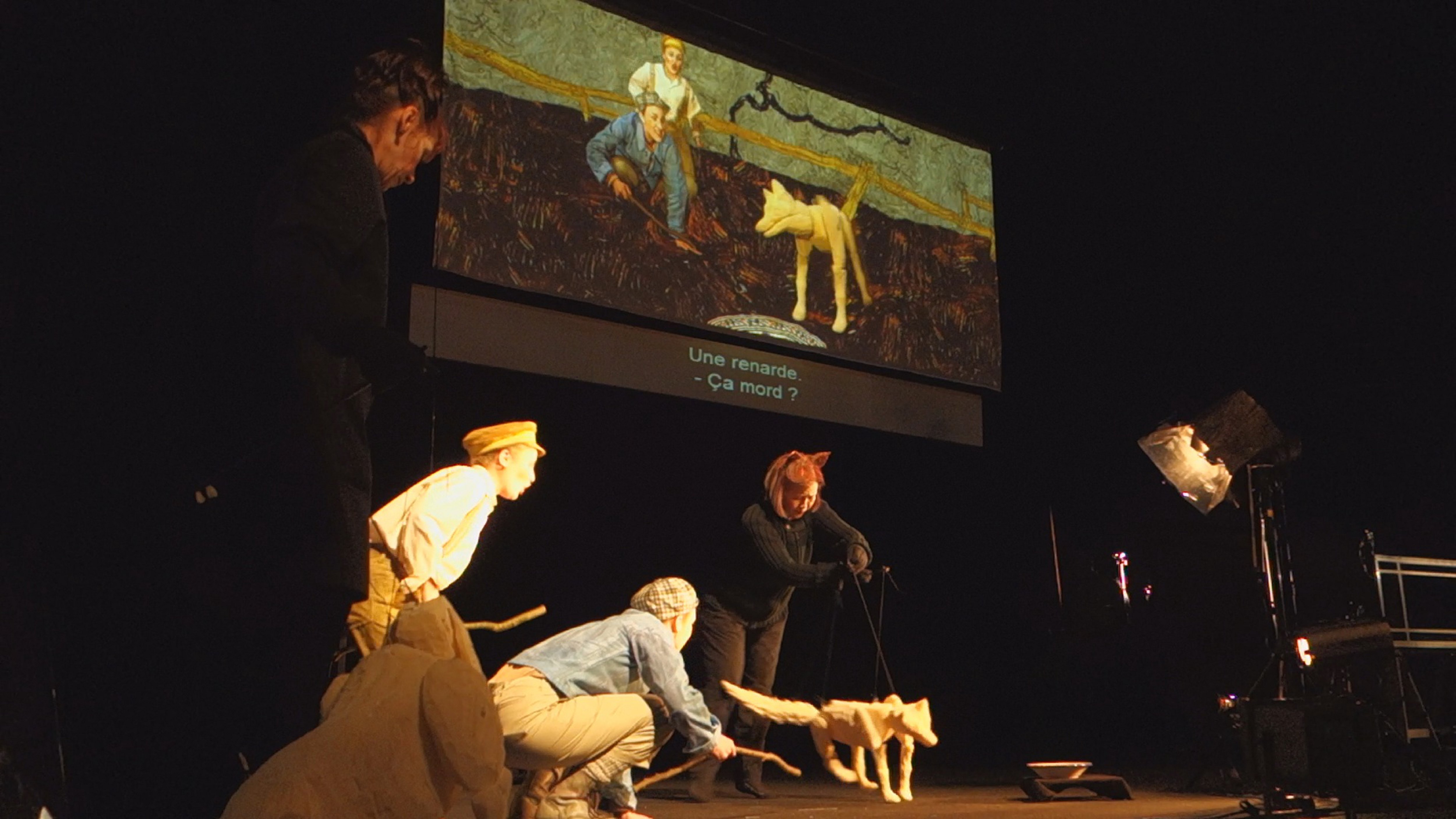
I experienced this very concretely in 2016, designing, with the stage director Louise Moaty, the video device for The Cunning Little Vixen, the opera by Leoš Janáček created in 1924, produced by Arcal. The chosen approach came from silent cinema, contemporary with the work. Several discreet cameras filmed different parts of the stage: puppets animated in small booths in the format of the screen, singers, painted backgrounds laid flat under an overhead camera by a props handler at the side. There were no puppeteers beside the singers: it was the singers themselves who had learned to animate the puppets, or sometimes to perform in person in front of the camera. All of this, against a black background made transparent as in the silent era, with no blue or green screen, was superimposed live by a simple control desk and projected onto a screen set up on the stage. The shadows in the costumes sometimes became semi-transparent, and from that imprecision a kind of poetry arose.
This device raised a question: where did the representation take place? Not on the screen, since the film was not perfect. Not on the stage either, where one could see the performers animating the puppets and moving about. The representation was fabricated, and visibly so, in the spectator’s mind, in the gap between the visible performers and the film being made before their eyes. The technical device was extremely simple, and the show received the prize for best creators of scenic elements from the professional association of theatre, music and dance critics, although there was almost nothing on stage. That is what interests me. One can have elements on the stage, props, machines, but the representation must always overturn itself, one must work on the very subject of representation. It is on that condition that a performance takes on its full force.
And the word, here again, is the right one. We call it a representation. Theatrical representation sets our representations in play, to those images of the world that seem natural to us, whereas a representation, as we know, has nothing natural about it: it is prepared, rehearsed, constructed. Theatre takes on its full meaning if it overturns representations, because it is itself a representation. Otherwise we remain in reproduction, and we do nothing but reproduce the roles of gender, class and age as they already exist, and we legitimise the existing order. For there to be life in theatre, it must on the contrary live by unsettling representations.
The false naturalism of boulevard theatre
One will object with naturalistic sets, those of boulevard theatre in particular, those carefully reconstructed bourgeois interiors. But let us look at them closely. Nothing in them is natural. The characters, instead of speaking to one another, are all turned towards us. This is not naturalism, it is a false naturalism, and that false naturalism is not there for nothing. It reassures: in it we recognise a tradition, an order, familiar domestic codes, and it is that reassuring frame that allows, within, every transgression. Boulevard theatre stages nothing but transgressions, including transgressions of manners that the people in the house would never allow themselves. And it does not shock, because the overturning has already taken place, in that falsely natural set: the codes there are stable enough for us to laugh at them and reflect on them.
These sets are therefore not bad sets. They are classical, repeated from play to play, and yet a real reflection is to be found in them. But that reflection bears not on aesthetics, nor on the divide between realism and abstraction. It bears on representation. The false naturalism of boulevard theatre is a work on our codes, unveiling them and setting them in play through laughter, under cover of reproducing them. It is proof, a contrario, that in theatre there is never a set that is merely illustrative. Even the most traditional of bourgeois drawing rooms also overturns our representations.
Each person comes with their own culture
This overturning sets in play culture in the anthropological sense, the one that cultural rights defend. Each person has their own culture, their ways of seeing, their references, their relation to the world. In a space where one represents openly, what is being played out are confrontations between cultures. Theatre is the place where one can come and overturn what, outside, is taken for natural.
In theatre, then, one must denaturalise: that is its whole meaning. The spectator is not a vessel into which one would pour a correct vision of the world; they arrive with their own, and the performance is the place where these visions meet and transform one another. To confine the audience to a passive role as the receiver of a content, however fine, however just, would reproduce in the house the ordinary hierarchy where some know and speak, while the others listen. It would be to fall back into that culture separated from life against which Artaud protested.
For in the theatre we are alive, but more aware than we are in daily life. That is what theatre is for, and why we speak of representation.
Play, in Winnicott’s sense
It remains to understand why this surplus of awareness does us good. Donald Winnicott, in Playing and Reality (1971), describes a space he calls transitional, a space that is neither quite within us nor quite outside, where the self and the world meet and transform one another. It is the space of the child’s play, where a scrap of cloth is at once a scrap of cloth and something altogether different, and where the child experiences, without risk, things they could not experience otherwise. Winnicott also recalls that this capacity to play develops within a reliable environment, what he calls holding: one only truly plays where one feels sufficiently held to dare.
The theatre house is one of those spaces. We are there together, we feel held by a frame, and we play there, truly. We do not play at inventing a reality, we play at inventing imaginary representations, and at becoming aware, in doing so, that representation is an imaginary. And if representation is an imaginary, our perception of life is one too, our everyday is itself an imaginary theatre that we no longer saw as such. It is that disclosure that makes the force of theatre, and that is why it is cathartic. In that protected in-between, our representations cease to be frozen; we can shift them, turn them over, experience them otherwise, because we know we are within a play and that nothing we risk there has consequences outside the house.
What one works on when preparing a performance
If one accepts this, preparing a performance, thinking it, writing it, rehearsing it, means asking oneself a question without cease: what am I overturning, in our representations, and where? The question holds at every level of the performance, and none escapes it: the subject, the text, the way of speaking it, the way the performers move, the non-human elements, the objects, the sound, the music played live or recorded. Everything is possible, but nothing is neutral, and one must know why one calls on this or that element of all this apparatus. For each thing present on the stage, the question is the same: what representation is being played out there?
This is why I hold that in theatre nothing is ever illustrative. An element that merely illustrated, that contented itself with doubling what the text already says, overturns nothing and stays dead. Once an element is on stage, it enters the play of representations, it unsettles them or it confirms them, and this holds, as we have seen, all the way to the most classical of boulevard sets. To think a performance is not to decide what is beautiful or realistic, it is to decide what one overturns, and to see to it that every element of the performance takes part in that overturning. It is on that condition that there is life in theatre, and that we return to our own a little more aware of what it is.


