How ordinary audiovisual tools — the phone, the camera — become therapeutic mediators: an account and analysis of a pedagogical practice in professional training.
A diploma for thinking about what art does in care
The University Diploma in Arts and Therapeutic Mediations at Université Paris Cité is designed for healthcare professionals — psychologists, physicians, paramedical practitioners — and for artists working in contexts of psychic and psychiatric care. It is a 150-hour programme, grounded in a psychoanalytic perspective, whose ambition is to transmit a theoretical and clinical knowledge of art as relational and therapeutic mediation: how painting, dance, voice, writing, theatre, and music can create, to use the words of academic director Élise Ricadat, “new links between sensoriality and speech” — where speech alone falters, or is not yet possible.
What the diploma offers is not an introduction to art-making, nor technical training, but an intelligence of mediation: the capacity to think through the frame, to understand the psychic processes mobilised by creative devices, to draw on the notions of transference, symbolisation, and subjectivation to read what happens in a group in the process of creating. And to do this, each module of the diploma rests on the same pedagogical principle: above all, participants live the practices from the inside, as creative subjects, before analysing and theorising them.
It is within this framework that I have been working for several years on a module devoted to audiovisual tools — photography, video, sound, animation. My aim is not to train image technicians. It is to explore with healthcare professionals how tools that everyone carries in their pocket can become mediators in a therapeutic relationship, and what this implies in terms of rethinking the frame, the device, and the restitution.
Lived experience as a method of learning
It is worth pausing on this pedagogical principle, because it is constitutive of the entire approach — mine and the diploma’s as a whole. These healthcare professionals are not here to learn techniques they will then apply to their patients. They are here to live through devices, to experience them from the inside, to feel what it is like to be subjected to a creative constraint, to have to expose oneself, to not know in advance what will happen. This lived experience is irreplaceable. You cannot understand what a device does in a therapeutic relationship if you have not gone through it yourself. You cannot invite patients to expose themselves to the collective gaze if you have no idea what it feels like to stay silent and listen to what others find in what you have created.
This is what the diploma calls, in its brochure, “practical simulations”: each workshop is first of all a first-person traversal, which then makes possible an analysis all the more real for being anchored in lived experience. My practice in this module follows the same logic: the methodological commentary I offer after each exercise draws on what participants have just lived through, not on abstract description. What I teach is how to read from experience.
The space before the exercise
The first thing I do when I arrive in a room, before a single person has picked up their phone, is to organise the space. Push the tables back, arrange the chairs in a circle, reposition the projector so that the image is large and visible from everywhere. This is not logistics. It is already meaning — and it is already teaching.
Spatial configuration produces social relations. A room arranged in rows facing a board produces a relationship of domination through knowledge: someone knows, the others listen. A circle produces something else: shared attention, collective responsibility, a horizontality I want to establish before I have said a word, because without it, nothing that follows can truly take place.
Gilbert Simondon, in On the Mode of Existence of Technical Objects (1958), showed that technical objects are never neutral: they dispose people in certain ways, they open up possibilities and close off others. The arrangement of the room is a device in the strong sense — it conditions what can happen within it. To take care of this space is to take care of what is about to unfold.
What I do there, before the first exercise, is both a practitioner’s gesture and a course content. I name it, I explain it to participants, I tell them what I observed on arriving and why I modified the setup. Because one of the central competencies of the diploma — knowing how to “reflect on and build the frame of a therapeutic mediation in an institution”, to quote the title of one of Élise Ricadat’s lectures in the programme — begins there, in this silent care of the space before anyone has yet arrived. I think back, when I explain this, to a video workshop I had run the previous year in a day hospital for autistic children: I would arrive three hours before the start to prepare the room carefully. The way the space was going to offer something different to these children depended entirely on that prior, invisible, silent work.
A photography exercise: living what the constraint liberates
The first workshop I propose is photographic. The instruction is simple: take a single photograph with your phone in which a hand appears — preferably your own. Go out, let yourselves be inspired by what the world offers, come back. Twenty minutes.
The formal constraint — the hand — is not arbitrary. It obliges participants to think their presence in the world through the body, to engage their own flesh in the image rather than simply being a witness to the outside. It also creates a shared thread running through all the images, a formal point of encounter that makes a circulation of gazes possible. But above all, it avoids the paralysing question of the subject. This is not “take a beautiful photograph” or “express something”. It is: go into the world with a light formal constraint, and let what comes, come.
After the exercise, when I discuss it with participants, what I explain — and what they have just lived through — is that the formal constraint is one of the fundamental tools of creative mediation. It shifts the question of expression, always potentially terrifying (“what am I going to say about myself?”), towards a technical question (“how do I get a hand into the frame?”). And while the person is solving the formal problem, something else is happening, unbeknown to them. It is this passage — from technical problem-solving to unconscious expression — that one must learn to recognise, and that participants can now name because they have just gone through it.
Inverted restitution: seeing what the group does to an image
All the photographs are uploaded to a shared digital space via a QR code, then projected large, one by one. And there, I establish a rule whose therapeutic significance is considerable: the person who took the photograph does not speak. The others speak first. The author listens.
This inversion is deliberate, and I explain it to participants by naming it as a decision of the frame. In most educational and cultural contexts, the author is asked to explain what they “wanted to say”. This is, in my view, the poorest question one can ask in front of an image — because it presupposes that an image has a single meaning, that this meaning belongs to the one who made it, and that formulating it is enough for the image to be “understood”. Yet an image is polysemous. It always exceeds what was consciously put into it. Roland Barthes, in Camera Lucida (1980), distinguished the studium — what an image shows intentionally — from the punctum, that detail which touches, which comes from elsewhere. It is often the punctum that others speak of, when the author stays silent. And it is this punctum that says something true.
Invariably, someone who thought “mine is terrible” finds themselves perceiving, through the others’ gaze, that something exists in what they made. Someone who thought they had taken an unremarkable image hears others describe tensions, symbols, stories they had not consciously placed there. This is not valorisation — I am wary of that word, which implies a hierarchy, an evaluation, and to valorise is always also to devalue. It is construction. Serge Tisseron has shown that the images we make construct us in return: the gaze of others on what I have produced helps me to exist within that object, to anchor myself in my own creation, to symbolise myself through it.
What participants learn here — because they have just lived it — is that the practice of collective looking is a practice in its own right, as formative as making. Antonio Damasio showed that seeing an image is not a passive operation of reception but an active reconstruction that mobilises memory, affect, and the body. To look at an image with others is to confront your own reconstructions with theirs, to have the concrete experience of alterity. I may see an open window where someone else sees a threat. Neither reading is false. And in a therapeutic context, this experience of lived polysemy is irreplaceable: it teaches what it means for a group to construct meaning together.
The cut-paper animation film: the sequence shot as ethics
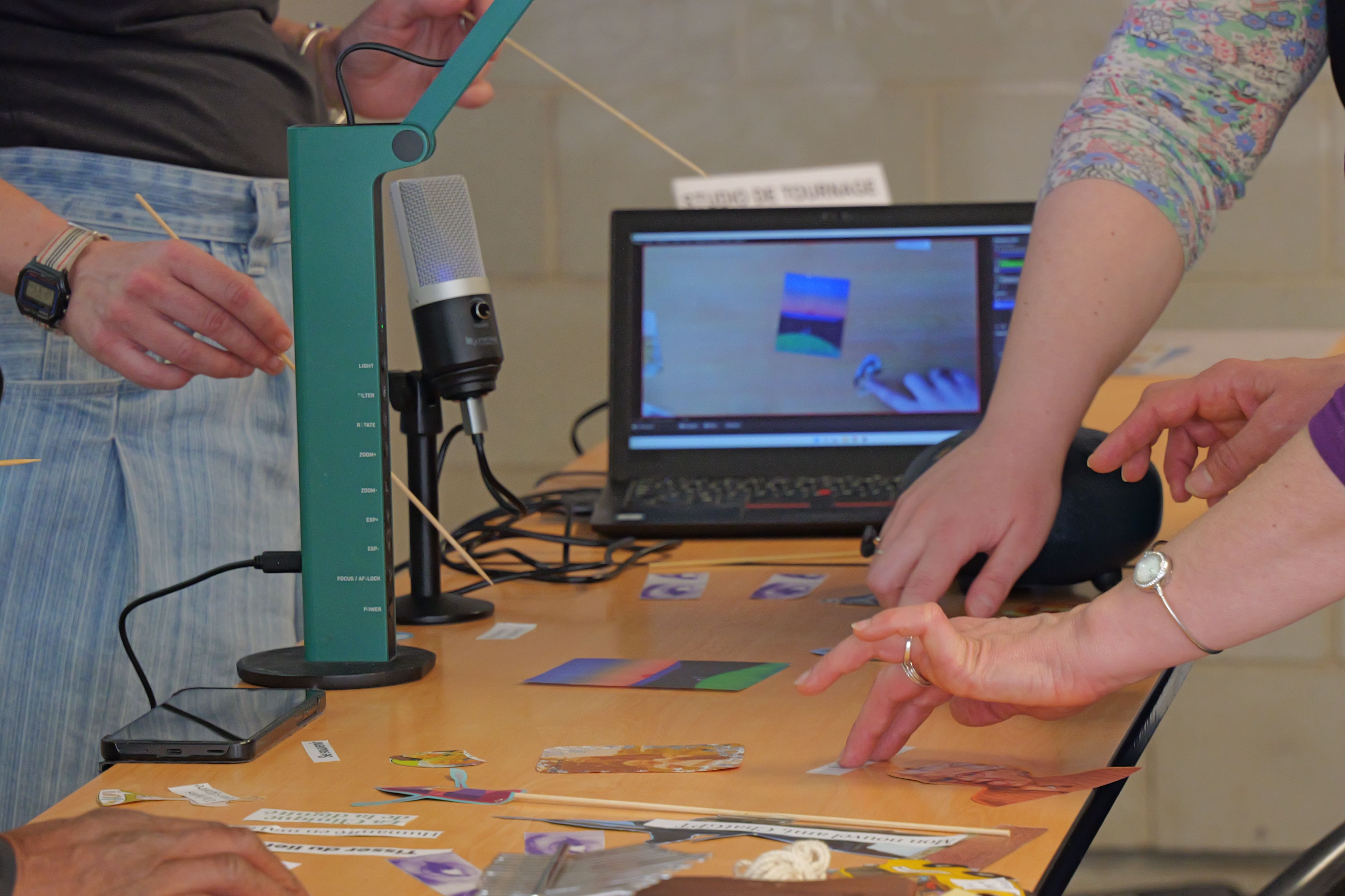
The second workshop engages an entirely different dimension. Participants cut freely from magazines, without prior instruction — characters, objects, shapes, whatever speaks to them. Then, in small groups, they construct a narrative with these materials, which they stage beneath a camera mounted overhead and projecting the image live onto a large screen. The musical instruments present in the room allow them to invent a soundtrack in real time, during the filming.
This device rests on a technical choice I consider an ethical one: the sequence shot. The film is shot in a single take, with no editing possible afterwards. What is done is done. There can be no practitioner who takes the film home afterwards to “make it beautiful”, to correct its imperfections or improve its aesthetics. The film belongs to those who made it, in all its imperfection and all its vitality.
I explain this choice to participants because it points to one of the most common slippages in audiovisual mediations: the moment when the cultural professional, driven by the best intentions, re-edits the film alone so that it “looks good”. In doing so, even without realising it, they sign the film in the participants’ place. They produce something that no longer belongs to those who made it. And the participants, when they see it projected, find themselves facing a form that overwhelms and crushes them rather than carrying them. The mediation has become institutional production. This shift, participants in the diploma have now identified from the inside — they know what it feels like to have made something yourself, and to be recognised as its author.
The sequence-shot constraint is also a practice of presence. You cannot redo it — or rather, you must redo everything from the start. What unfolds beneath the camera unfolds now, with these particular people, in this particular state. This is what Winnicott, in his reflections on transitional space, called play: not the result, but the activity itself, in its dimension of risk and surprise. Cut-paper animation is a transitional space in the Winnicottian sense — between inside and outside, between what one knows and what one discovers, between intention and accident.
The plurality of mediums: what audiovisual brings that the other arts do not
The audiovisual workshop does not stand alone. It takes its full meaning within the context of a training programme that offers, over the same year, dance with Kitsou Dubois, voice with Isabelle Julian and Maria Ruette, painting with Fabien Vée and Magali Berdaguer, writing with Christelle Nguyen-Chailleu and Laetitia Sieffermann, theatre with Fanny Laudicina, and percussion with Ludovic Sautreuil and Dominique Pistilli. Each workshop works a different register of the relationship between sensoriality, body, and symbolisation. Dance engages the axis, the body schema, kinaesthetic memory. Voice unfolds the sonorous object, container and content, the relationship to address. Writing traverses the passage from the intimate to the extimate. Theatre works the minimal triangulation — a place, a being, a gaze — and re-presentation.
Audiovisual occupies a specific place in this ensemble because it introduces something the other arts do not have: the machine that records. When one proposes a mediation through painting, dance, or voice, there is no mechanical intermediary between the person and what they make. The trace, when it exists, is entirely produced by the subject’s gesture. But when you put a phone into someone’s hands, the machine captures more than the person wanted to show. It fixes the background they hadn’t seen, the light they hadn’t chosen, the framing slightly off from the intention. It produces a trace that now exists in the world, independently of the will of whoever made it. I call this phenomenon the machinic third: in image-based mediation, the machine is not a simple tool like a paintbrush. It is a third party in the relationship — between the person and their intention, between the person and the others, between the act of creating and the trace it leaves.
This machinic third renders image-based mediation at once more powerful and more delicate than other devices. More powerful because the trace is there, it attests, it can circulate, it can be looked at collectively. More delicate because this same persistence can weigh, threaten, expose beyond what one had consented to show. Knowing how to navigate between these two dimensions — what the trace permits and what it risks — is one of the competencies that diploma participants acquire by living it themselves first.
What the debriefs reveal
At the end of each exercise, I take time for a debrief. Not an evaluation — “was it good or not” — but a collective elaboration from what we have just gone through. Participants describe their apprehensions before going out to take the photograph, the way the constraint freed or blocked them, what they felt while listening to others speak about their image without being able to respond, the surprises of the cut-paper shoot. These accounts are training materials in their own right.
These debriefs are the moment when lived experience becomes transmissible knowledge. The psychological movements at work in these simple exercises — the resistance to exposure, the discovery of what one expressed without knowing it, the construction through the gaze of others, the solidarity born of collective constraint — are exactly those that participants will encounter, in different forms, in their practices with their patients. Naming them from their own experience makes them available for clinical thinking. This is what the diploma seeks, as a whole, to transmit: not recipes, but a posture. And this posture is learned through the body, not through books.


