Since I began using conversational artificial intelligence in the context of cultural and therapeutic mediation in 2023, I have observed effects I had not anticipated. An absolutely patient, absolutely respectful interlocutor that never judges and always responds with care: this is what people encounter when I place them in front of these machines. Moving beyond binary for-or-against debates, I wish to share here what practice has taught me, and the questions it raises for our mediation professions.
The digital pharmakon
Bernard Stiegler spoke of pharmakon to describe that which can be both poison and remedy. Artificial intelligences are a pharmakon par excellence. We hear many alarmist discourses about the dangers of these technologies, and some of those dangers are real. We also hear enchanted discourses, and some of that enthusiasm is well-founded. But between these two poles lies an immense territory that only practice can explore. It is this territory I wish to discuss.
When academics in Toulouse declare themselves “conscientious objectors” to artificial intelligence and vow never to use it, I am struck by the inconsistency of the stance. Simply using a phone means artificial intelligences are constantly running — in the spell checker, in the GPS, in search suggestions. Artificial intelligence is not an object one can accept or reject wholesale. It has been part of our daily lives for a long time already. The question, then, is not whether we are for or against it. The question is what we do with it, concretely, in our practices, with the people we work alongside.
I forged this critical stance twenty years ago. When I founded the Pocket Film Festival in 2005 with the Forum des images, people told me a phone was for making calls, not films. Today, the vast majority of visual content is produced with smartphones. That experience taught me never to say “this is good” or “this is bad” right away when facing an innovation, but rather to ask what we can do with what comes our way. This is precisely the approach I now apply to artificial intelligence.
What I observed in the field
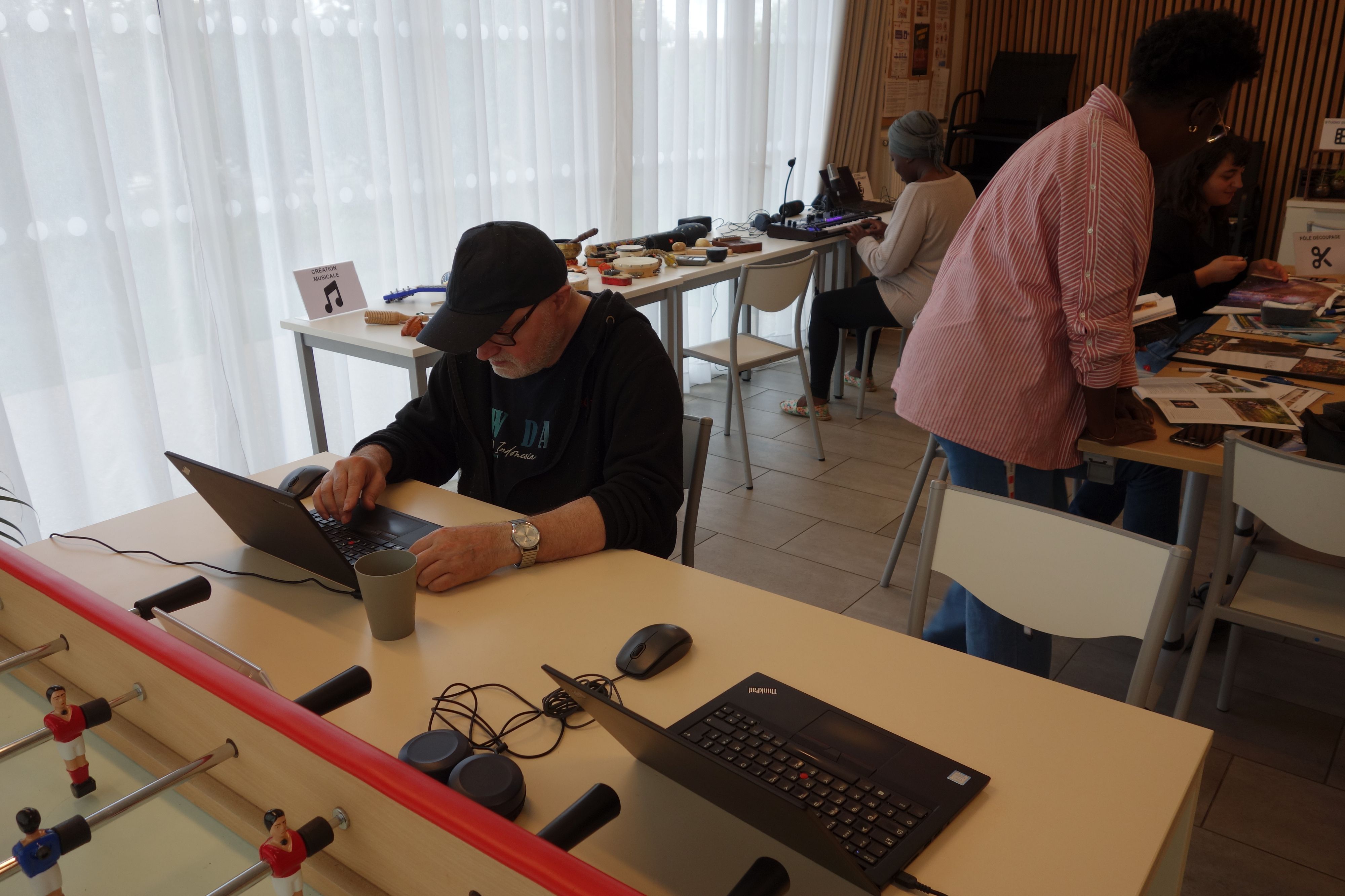
In 2023, as part of the project “La machine à voyager dans le futur” (The Time Machine to the Future), a cultural tour in the social sector designed for Cultures du cœur, I set up, among other things, computers connected to conversational AIs. This was not a rigorous experimental protocol but an open-ended proposition, free of stakes, in the spirit of cultural rights: offering people the possibility of a dialogue, seeing what happens.
What happened left a deep mark on me. In a residential care home, a very shy person struggling with addictions sat down at the computer on their own. After a while, they called me over because the machine wasn’t responding. I noticed they were typing without spaces between words. It was most likely the first time they had ever used a keyboard. I simply showed them the space bar, and what followed was more than two hours of conversation on fundamental subjects. Questions like “What am I doing here?”, “Can one be happy?”, “Am I where I belong?”, “Can one erase one’s mistakes?”. The topics gradually deepened toward essential philosophical questions, guided by the way the artificial intelligence responded. A dialogue of this depth would have been very difficult with a human being, because of the relational dynamics that permeate human interactions.
In another setting, with teenagers in care facing severe difficulties, deeply stigmatised by institutions, I observed very high-level dialogues between the young people and the machine, particularly about video games. Exchanges about expert strategies, precise techniques at very advanced stages of gameplay, using jargon that no adult present was able to understand. The machine had the level of knowledge necessary to establish a genuine exchange. And I saw, very visibly in this teenager’s attitude, something that resembled an anchoring. Someone who, perhaps for the first time, had found an interlocutor who matched their expertise in a domain that was their own.
An interlocutor that does not judge
What struck me in these situations, and in all those I have experienced since, is the very nature of the interlocutor. A conversational artificial intelligence is an absolutely respectful, absolutely patient interlocutor. It always responds with care. It never tires. It does not judge. It projects nothing onto the person. It has no transference, no countertransference.
One might object that this is precisely the problem: it is not a real interlocutor, it is a machine, there is no real empathy. And that is true. There is no human relationship in the full sense. But that may be exactly why it works in certain situations. For people experiencing severe communication difficulties, for people who have lived through relationships of power, judgement and stigmatisation in their dealings with institutions and professionals, finding themselves facing an interlocutor that cannot judge, cannot disappoint, cannot betray, opens an unprecedented space of trust. And within that space, things happen.
Olivier Houdé, in Apprendre à résister (Learning to Resist, 2014), explains that cognitive resistance — the ability to learn something new by resisting one’s reflexive thinking — is biologically possible only when one feels safe. If one fears being judged, one protects oneself and learning becomes impossible. Artificial intelligence, through its very absence of judgement, can create that zone of trust where thought unfolds. It is paradoxical, but it is what I observe.
A democratisation of intelligence
It seems to me that we must name what is happening with conversational artificial intelligences: it is a democratisation of cognition. Intelligence, or rather cognition, is no longer a privilege. It has become what industrialists themselves call a commodity, on a par with water or electricity. Everyone can benefit from it.
The analogy with the invention of the printing press is striking. When Gutenberg made books accessible, the clerics who held a monopoly on knowledge said people would become stupid, that they would no longer need to memorise or learn. These were discourses of power. In reality, the printing press produced the Renaissance. It opened up the world.
On questions of language proficiency, for instance, all the people who, thanks to artificial intelligence, can now write better CVs, comprehensible administrative letters, emails without spelling mistakes: there is a real emancipation at work. This is not a life-support drip. Albert Jacquard recounted a social experiment in which students considered failures, placed in another school where they were presented as excellent, actually became so for half of them. The place we are given, the legitimacy we grant ourselves, self-confidence — these shift how we position ourselves. Artificial intelligence that helps us better formulate our thoughts does not make us dependent: it gives us confidence. It anchors us, it recognises our capacity to think.
This is exactly what I observed with the stigmatised teenager who was conversing about video games. The machine recognised them for their expertise. Nobody else did. And that recognition, even coming from a machine, produced something visible in their attitude, in their anchoring, in their presence.
What changes for our practices
When I started using artificial intelligences in my mediations in 2023, most people either did not know them or knew very little about them. I was the one proposing the encounter. Today, many people already use them on their own, in their daily lives, including for purposes one might call therapeutic. They converse with these machines about their problems, their doubts, their existence. They don’t necessarily say so — it is still somewhat taboo, somewhat secret — but it is a reality.
This profoundly changes our positioning. We are no longer those who bring the tool. We are those who can support a practice that already exists. How do we position ourselves alongside an interlocutor that people may already carry in their pockets, that they may consult outside our sessions, that may extend the work we do with them?
This situation resembles what the cultural sector has been experiencing since the arrival of digital technologies. Cultural professionals long believed they held a monopoly on access to culture. Digital platforms have demonstrated that the majority of cultural practices escape institutions. Theatre directors who think they hold cultural power over people are in reality on the margins — important margins, certainly, as Jean-Luc Godard used to say: it is the margins that hold the page together. But we must recognise that our place is shifting.
Likewise, care and support professionals who might think they hold a monopoly on listening and psychological support must recognise that this monopoly no longer exists. The point is not to be alarmed, but to reposition ourselves. What do we bring that the machine does not? What does the machine bring that we do not? And above all, how do we articulate the two?
The collective as key
What the machine does not do, and cannot do, is create a collective. When I place people in front of artificial intelligences, I do not do so in an isolated individual setting. I do it in groups. And it is there, in the group, in the exchanges between people about what they experience with the machine, that the most important things take place. People share what they asked, what they received, what it did to them. They compare, they debate, they express surprise. And it is in that shared surprise that something distinctly human occurs.
John Dewey argued that art is not an object but a lived experience. Artificial intelligence, within the framework of a mediation, is not a tool one uses: it is an experience one lives together, and it is the togetherness that counts. The dialogue with the machine is a starting point. What is built afterwards, between people, around that dialogue — that is the heart of mediation.
I have worked with groups of five hundred teenagers, doing things with artificial intelligence. I put them in groups so that there is a collective dimension around the practice. And it is within that collective that learning takes place, that awareness emerges, that critical thinking is forged. Not through prohibition, not through moralising discourse, but through shared experience.
The uncanny valley
We are, in relation to artificial intelligences, in what Masahiro Mori called the uncanny valley. This concept, formulated in 1970 in reference to humanoid robots, describes the unease we feel when facing machines that closely resemble us without quite being us. At first, when a machine does not resemble us, it is foreign to us and that is comfortable. Then it begins to resemble us, and that is fascinating. But there comes a point where it resembles us so much, while still being different, that we experience a deep discomfort. That is the uncanny valley. Eventually, we come out the other side, and these machines become a normal part of our lives.
I believe we are right in the middle of that valley. The artificial intelligence that converses with us, that seems to understand us, that formulates responses of sometimes staggering precision, unsettles us. It calls into question what we thought was our defining trait: intelligence, the capacity for reasoning, cognition. If a machine can do that, what remains uniquely ours?
What remains uniquely ours is shared, felt experience. It is attention to the other. It is chance — what we call serendipity — those things that arrive unexpectedly in embodied reality. It is the fact of having planned a class according to a programme and nothing going as planned, and that being precisely what is good about it, because we are together in a unique group and things are being transformed between us. It is no longer intelligence that makes us singular as human beings. It is our capacity to create bonds, to welcome the other, to live together through experiences that transform us.
Moving beyond our fears to accompany reality
I am well aware that what I write here may provoke debate, and that is as it should be. I can be accused of a certain naivety in the face of very real risks carried by these technologies: surveillance, manipulation, uniformisation of thought, concentration of economic power, dependency. These risks exist. But we must look at who is speaking and why. We must, as Pierre Bourdieu would say, ask what purpose alarmist discourses serve, just as we must ask what purpose enchanted discourses serve.
What I know is that people are using these tools. They use them to write, to think, to converse, sometimes to heal. And we, as mediation, care and support professionals, cannot act as though this does not exist. We cannot work with what we are not given, but we can work with what is there, in people’s lives.
On the question of personal data, for instance, it is important to know the different AIs, to know which ones collect data compulsorily, which do so optionally. It is through concrete knowledge of these tools, and not through opinions based on fantasies, that we can support people responsibly. This requires practising oneself, experimenting, engaging with the tool to know what one is talking about.
Fifteen years ago, the mobile phone provoked the same heated debates, the same fears. Today, it has become part of our daily lives, and no one is troubled by it any longer. It is likely that the same will happen with artificial intelligence. The question is not whether we will live with it. We already do. The question is how, in our mediation practices, we will accompany what is happening, by creating the conditions for these tools to serve people’s emancipation rather than their alienation.
Our role is to organise this capacity for diversity, as I have written elsewhere. Our role is to create spaces where it is possible to live together and where each person can flourish. Artificial intelligences, well used, in collective settings, with attention to the individual and ethical concern, can contribute to this. Not as substitutes for human relationships, but as third parties that open spaces which human relationships alone did not always open.
This is an immense undertaking, and we are only at the beginning. But it is a fascinating one, because it compels us to return to the essence of what we do: creating bonds, welcoming the other, inventing together experiences that transform. Precisely what machines, for now, do not know how to do.


