Contrary to popular belief, the most effective way to help people learn is not to pass on knowledge and skills, but to put yourself in a position to learn. Why is this? In this one-minute podcast, we explain why, and suggest a concrete methodological approach.
It is the educator and not the child who needs pedagogy
Podcast on the subject of pedagogical posture.
8 February 2023
Benoît Labourdette
2 min
It is the educator and not the child who needs pedagogy
1m 13s
By Benoît Labourdette (2023).
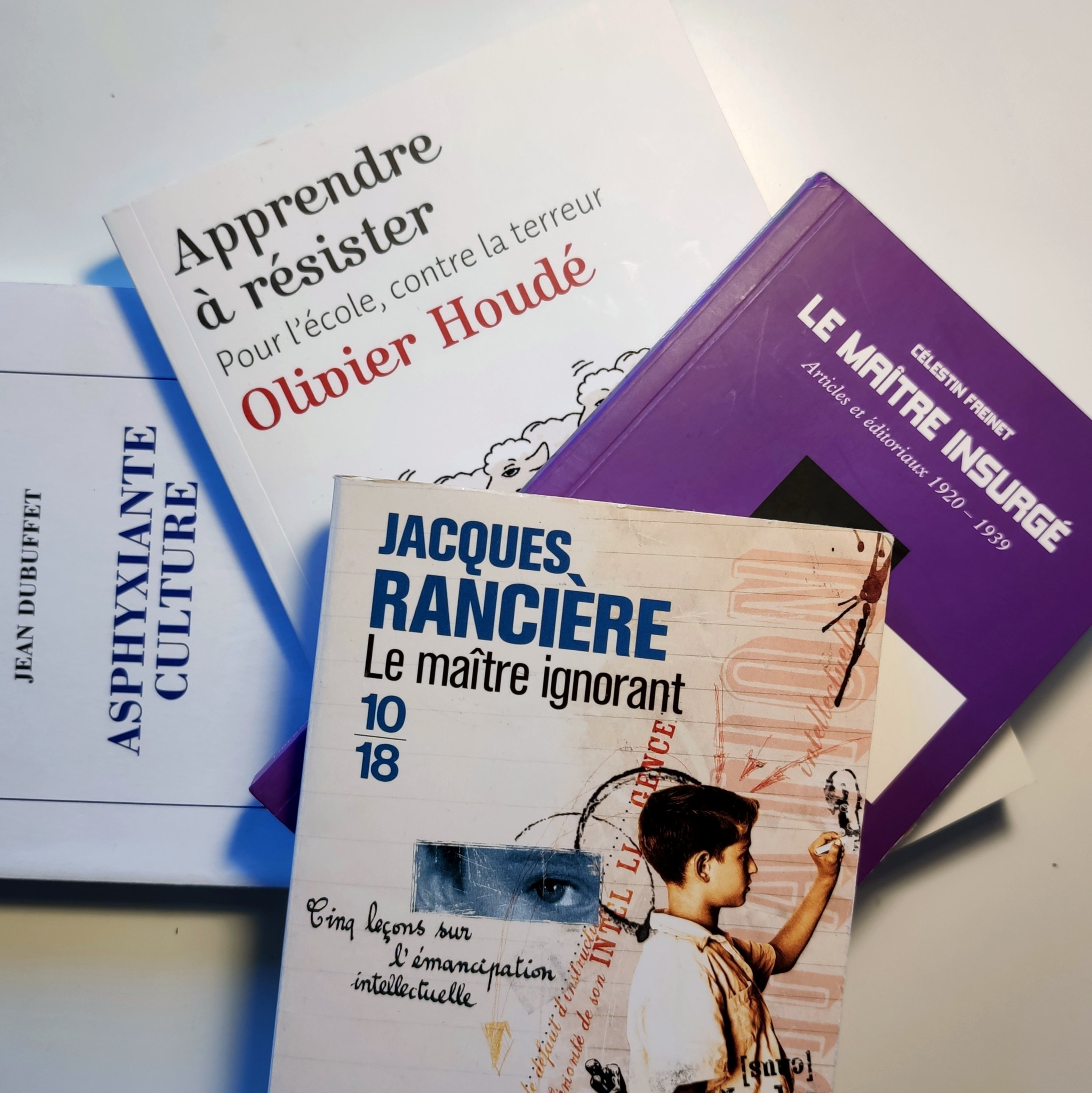
To extend and deepen the subject, I suggest these five books :
- Learning to resist: for schools, against terror by Olivier Houdé. Éditions le Pommier-Humensis, 2019 Neuroscience shows that to learn, we have to resist our reflexive thinking, in order to create new neuronal connections. This is only possible if we are confident and fearless. In fact, fear inhibits the learning process, and activates the protective reflexes of flight.
- Suffocating culture. By Jean Dubuffet. Les Éditions de Minuit, 1986 “Cultural propaganda strives to make people feel the abyss that separates them from those prestigious treasures to which the ruling class holds the keys, and the futility of any attempt to do valid creative work outside the paths marked out by it.”
- Anthropology as education. By Tim Ingold. Presses universitaires de Rennes, 2018. Drawing on John Dewey and his experiences, Tim Ingold argues that education is not the transmission of authorized knowledge from one generation to the next. It’s a way of being present and attentive to things, of opening up paths of growth and discovery.
- The ignorant master: five lessons on intellectual emancipation By Jacques Rancière. Fayard, 1987 In 1818, Joseph Jacotot sowed a wind of revolution in learned Europe. Not content with having taught French to Flemish students without giving them any lessons, he set about teaching what he did not know, proclaiming intellectual emancipation. “Instruction is like freedom: it cannot be given, it must be taken.”
- The insurgent master: writings, 1920-1939. By Célestin Freinet. Libertalia, 2016 We can’t work towards a different kind of school without being concerned about the way the world works, without working, in and out of the classroom, to transform it. We can’t fight against the rise of fascism, the crises generated by capitalism, the development of misery and war, by perpetuating, through our daily practices, a conservative, authoritarian and inegalitarian pedagogy. This is the legacy of the pedagogue and activist Célestin Freinet, whose thinking and development we follow here.
Documents
Working together on this subject
- Training professionals Custom-designed professional training: film and media education, innovative pedagogies, cooperation methods, digital cultures, cultural rights, artificial intelligence.
- Giving talks and lectures Talks and public interventions where the audience contributes: artificial intelligence and creation, cultural policies, youth and digital technology, film and media education, cultural rights.
See also


Themes


How to cite
Benoît Labourdette, “It is the educator and not the child who needs pedagogy”, Benoît Labourdette production, 8 February 2023.
https://www.benoitlabourdette.com/les-ressources/pedagogie/c-est-l-educateur-et-non-l-enfant-qui-a-besoin-de-la-pedagogie?lang=en
This is a long read: you can take it with you.
Download as PDF