Psychoanalysis distinguishes between the subject and the object, and this distinction helps me think about creation as much as about our relationship with technical tools. I defend here an idea that my practice led me to find along the way. One becomes a subject by appropriating a real object, held in one’s hand in one’s own way, within a framework that reassures without dictating the gesture. I build this idea step by step, towards a concept, subject presence, and towards what it entails for democracy.
A distinction I owe to psychoanalysis
I am steeped in psychoanalysis, and one of the distinctions I retain from it, the simplest in appearance, is that between the subject and the object. To be an object is to be acted upon, determined, put in place by something or someone else. To be a subject is to stand at the origin of one’s acts, to exercise a choice, a capacity, a critical mind. Jacques Lacan unfolded this distinction by positing that “man’s desire is the desire of the Other”. We all begin our existence as objects, caught up in our parents’ desire, in a family’s expectations, in places defined before we were even born. Becoming a subject is a labour, never quite completed, through which one frees oneself from these assignments in order to come into one’s own speech. The whole question of emancipation lies in this passage from the position of object to the position of subject, and it is a question at once psychic, social and political, because it concerns the link between a person and the social space in which they find themselves.
Donald Winnicott, in Playing and Reality, published in 1971, gives this passage its concrete ground, which is play. It is in playing, he writes, that the child or the adult becomes capable of being creative, and creativity for him does not designate the production of works but a way of approaching external reality, a colouring of existence as a whole. Winnicott opposes this creative living to compliance, that adaptation to an already given world in which the person experiences themselves as the object of what happens to them. Creation, in this psychoanalytic perspective, overflows the domain of artists to become a possible dimension of any life, and it is this overflow that I want to work on here.
Too much attachment to the object
Our relationship with art suffers, in my view, from an excess of attachment to the object. We readily identify the work with the thing produced, the painting, the film, the installation, as if art resided in that object and nowhere else. John Dewey, in Art as Experience, published in 1934, showed that art does not lie in the object but in the experience lived by human beings, in relation with one another or with objects. When we take this idea seriously, the object ceases to be the centre, and it is the experience, the journey, the relation, that become the locus of art.
This attachment to the object has a direct consequence on the places each person occupies, and this is where creation meets domination. When an artist holds above all to mastering the aesthetics of the final object, because it is from this object that they expect recognition, the next funding, the confirmation of their status, they almost always put themselves in a position of domination over those who work with them. The others become the instruments of their object. Jacques Rancière described an analogous mechanism in The Ignorant Schoolmaster (1987), where the master who explains stultifies the student, since the explanation itself presupposes that the student could not understand on their own, whereas the one who declines to occupy the place of knowledge gives them back their own capacity. The artist who is master of the object stultifies like the explicating master, and for the same reason, because they presuppose that the others would not know how to do.
The problem, then, is not the object in itself, but the way it is held and by whom. The object the artist keeps for themselves subjugates those around them, and the same object, let go, offered to the appropriation of others, becomes the operator of their emancipation.
The instruction manual is an apparatus
The same analysis holds, and this is what matters most to me, for our relationship with technologies. A technical tool always comes to us with a prescribed use, an expected way of handling it, an imaginary that tells us what to do with it. Giorgio Agamben, extending Michel Foucault in What Is an Apparatus? (2006), calls an apparatus anything that has the capacity to orient and determine the gestures, conducts and discourses of living beings. The instruction manual of a technology is in this sense an apparatus. Virtual reality headsets, cameras, software come with it, and it serves first of all the interests of those who manufacture and sell these objects. Agamben also observes that apparatuses have always engaged processes of subjectivation, that they used to fabricate subjects, even if subjected ones, whereas contemporary apparatuses tend in his view to produce desubjectification, users who are no more than traceable numbers, and he takes the mobile phone as his example. Faced with such a tool, one can therefore be its object, that is, do what the manufacturers have planned for us to do, or be its subject, that is, ask oneself what one wants, oneself, to do with it, and accept to divert it, to play, to take a step aside.
The same Agamben, in Profanations (2005), gives a name to this step aside. He calls profanation the gesture that restores to the free use of all what apparatuses have captured and separated, and play is for him the very organ of profanation, which meets what Winnicott says of play as the place where the subject comes into being. This profanation has a history in the field I know best, that of cinema. The Lumière brothers’ Cinématographe was designed for documentary views, and Georges Méliès diverted it, from the very first years, towards trick effects, fantasy, the imaginary. The mobile phone was sold to us for talking, then for consuming content, and when the first devices equipped with cameras arrived, people started filming with them, outside any professional framework. It was to recognise these nascent uses that I created in 2005, with the Forum des images, the Pocket Films festival, whose purpose was to institute a space where uses invented by people themselves, and not prescribed by industry, could be regarded as creation. The very object of desubjectification according to Agamben, the phone, was becoming there a tool of subjectivation.
The object held in hand is no longer oneself
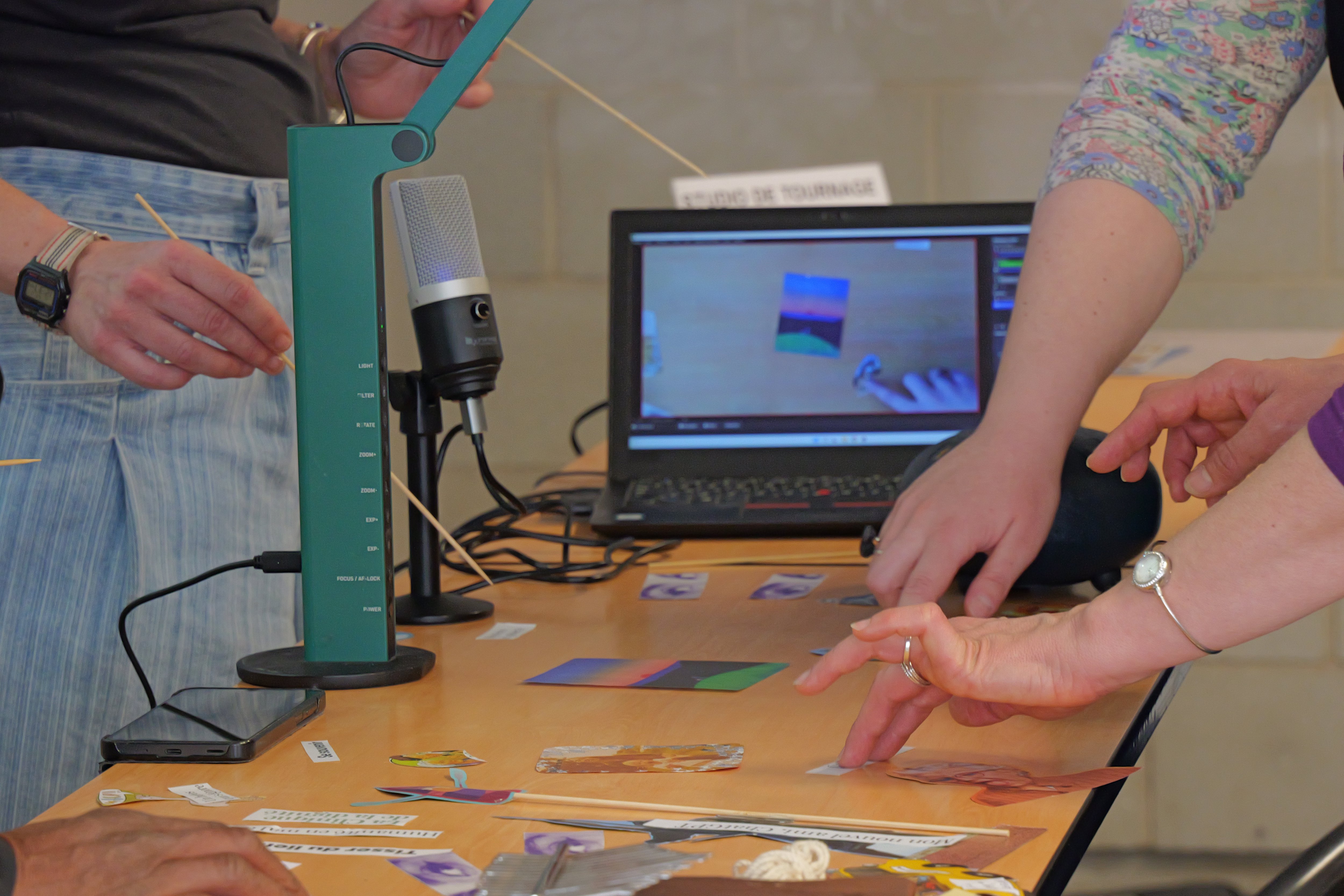
In the workshops I run, objects are laid out in the space, available. A camera placed in the middle of a circle, musical instruments on a table, printed photographs, paper, felt pens. Each person goes towards what attracts them. When a person takes an object in hand, the distribution of places changes. The object is real, it exists, it is external to them. By the very fact that they hold it, and that they hold it as they wish, the object is no longer them. The place of object is occupied, by the object itself, and the person finds themselves moved towards the place of subject. If, on the other hand, I told them exactly how to hold it and what to do with it, the object would remain an object, but they would become another one, the object of my instruction. It is appropriation that makes the difference, not mere possession. The objects laid out in this way play, moreover, what psychoanalysis calls a third, that which stands between subjects and allows them to meet without one dominating the other, and it is through them, not through my authority, that autonomy passes.
Psychoanalysis has thought through this subjectivating power of the appropriated object. Winnicott again, with the transitional object, that piece of cloth or that teddy bear which the child elects, the first possession that is not them without being quite the external world. It is by appropriating this object, by holding it, mistreating it, loving it in their own way, that the child learns to distinguish themselves from the world and begins to become a subject. The area where this is played out, which Winnicott names potential space, is also for him the locus of all cultural experience. What the teddy bear does for the child, a camera can do for a teenager or an adult, provided they are left to hold it in their own way.
Anthropology and the history of technology confirm what psychoanalysis establishes. André Leroi-Gourhan showed, in Gesture and Speech (1964), that human thought developed with the freeing of the hand, and that the tool is not an accessory of intelligence but one of the places where it takes shape. One does not think in the same way when the hand acts on material reality and when the mind handles only words. Henri Focillon, in his In Praise of Hands, writes of the hand that it takes, it creates, and at times one would say it thinks. Tim Ingold, in Making, published in 2013, attacks the hylomorphic model, that old idea according to which creating would consist in imposing a form conceived by the mind onto passive matter, and describes making as a correspondence with materials, which one follows and lets oneself be taught by. The prescribed use is a form that someone wants to impose on our gestures, and appropriating a tool means entering into correspondence with it, discovering through the hand what it makes possible and what nobody had foreseen. I experienced this at a symposium at the ENS Louis Lumière in 2019, where I proposed to the participants that we shoot a collective film in virtual reality together, with, instead of the heavy and intimidating professional rig, a small 360° camera that fits at the end of one’s hand. The images produced, in which the hand of the person filming is present everywhere, aroused jubilation among the participants, and the desire to use these images otherwise than in headsets, as poetic material.
Everything lies, at bottom, in the preposition of my title. To be a subject with technologies is neither to be a subject against them, nor to be a subject without them. The object held in hand is the partner of the becoming subject, not its obstacle.
Technically reassuring instructions
It remains that nobody becomes a subject on command, and that one does not become one in disorder either. When I propose to someone that they take hold of a camera and do what they want with it, this proposal may seem disorderly, written like that, but it never is in fact. The person is within a framework. They have seen films on a screen, they have been attracted by a scenography, they have come towards us, freely when the workshop takes place in a public space where people pass by and take part as they wish, which is the situation I prefer, or within a school obligation, and even then, among the objects laid out, they go towards what attracts them. The place itself says what is done there. If people come here, it is a place where films are made, and this social expectation, shared by all, produces in each person an intention, which does not need to be formulated in words.
My intuition, from the beginning, has been to give instructions, but instructions of a particular nature, a given time, a simple protocol, technically reassuring indications, inside which people are free and do what they want. I am reluctant to explain how to do things, unless I am really asked to, and I do not like showing films as examples, because people would then try to do in the manner of, to imitate, instead of inventing their own way of doing, which is my whole purpose. Winnicott, here again, gives this intuition its foundation. Play, he writes, only becomes possible on the basis of trust, in an environment reliable enough for the child to risk creating. What he calls holding, that carrying which supports without constraining, is what my instructions seek to offer. They reassure enough for the risk of creating to become takeable, and they prescribe little enough for the gesture to remain the person’s own.
Institutional psychotherapy, that of François Tosquelles at Saint-Alban and then of Jean Oury at La Borde, made the framework itself an instrument of care. Its principle is that one cannot care for people without first caring for the institution, its atmosphere, its places, the circulation of speech, and that at La Borde carers and patients share activities, cook, garden, do theatre together, without the distinction of roles assigning anyone to a fixed place. I ask the same thing of the mediators I work with. That they too be engaged in creation, that they make images alongside the participants, that they not be waiting for audiences they would treat as objects of their mediation. What we do then is a creation we share, and if I hold to this, it is so that nobody, neither participant nor mediator, is in the position of object.
Subject presence
Michel de Certeau showed, in The Practice of Everyday Life, published in 1980, that users are never the passive consumers we imagine, that consumption is itself a silent production, made of ruses and poaching, and that ways of walking, of cooking, of dwelling, of reading, are so many creations within an order one has not chosen. I could have stopped there and called the gesture that concerns me a creation of use. But this concept is not enough, and de Certeau himself allows us to understand why. The creation of use is universal and silent. Even the person most obedient to the manufacturers’ prescriptions creates their use with their object, whether they are aware of it or not, and we are also, for one another, the objects of other people’s creations of use. What concerns me is something else. It is not the universal fact of creating uses, it is the becoming subject, that is, the fact of experiencing one’s place as subject, of being present in it.
Michel Foucault, in his late work, named subjectivation the process by which one constitutes oneself as a subject, through practices, exercises, techniques of the self. I propose to call subject presence the sensible side of this subjectivation, not the process seen from the outside, but the state experienced from within. Subject presence is that state of consciousness in which a person feels at the origin of what they do, autonomous, present to themselves in their gesture. This state involves a share of emptiness, in the sense that one is no longer occupied by prescriptions, models, the master’s gaze, and it is this fertile emptiness that I have tried to think elsewhere under the name of “nefaire”, drawing on Romain Graziani, who shows in L’Usage du vide (2019, untranslated, “The Use of Emptiness”) that a will no longer subjected to an external purpose turns into power. Hartmut Rosa describes, for his part, in Resonance (2016), alienation as a relation in which the world remains mute, and the good life as a relation of resonance, in which the world responds and one feels both reached and capable of reaching. Subject presence is the state in which the tool one holds ceases to be mute, in which it responds under the hand. The reverie that Gaston Bachelard describes in The Poetics of Space (1957), that way of inhabiting things instead of merely occupying them, is one of its forms. This state cannot be decreed. It comes about when a real object is held in hand in one’s own way, within a framework that reassures without prescribing.
Concrete democracy begins in our uses
Philippe Roqueplo asserts, in Penser la technique. Pour une démocratie concrète (1983, untranslated, “Thinking Technology: For a Concrete Democracy”), that no technology is neutral, that every technology encloses knowledge and power, and that a democracy which gives up thinking about and discussing its technologies abandons part of collective decision-making to those who design and sell them. We live in a world, ours is capitalist, where we are constantly offered the position of objects of the tools we are sold, invited to enter uses designed for us, and the attachment to the object, be it a work of art or a commodity, perpetuates the domination of those who hold it over those who merely use it.
Subject presence is what each person can set against this, at their own scale, in their gestures, and it is cultivated collectively. In a digital cultural classroom programme I led around virtual reality with secondary school pupils from special-needs classes (SEGPA and ULIS), pupils took the 360° camera and triggered the shot, chose the instrument they would play for the soundtrack, added a scene to the script because they knew a passage was missing. During the last shoots, I almost never triggered the camera myself. These pupils would not have dared if I had held the position of master of the object, and what they take away overflows the moment of the workshop by far, the fact of having felt, once, at the origin of something rather than subjected to what was planned. Likewise, when I propose a photographic creation workshop in which each person works with their own phone, the tool that each person technically masters at their own level, I see intimidations fall away, mutual help organise itself, people who would never have allowed themselves to create make images and show them to others. This technical accessibility is a democratic lever, because it distributes the position of subject instead of reserving it for those who own the equipment and the codes. Democracy is also played out there, in this capacity, distributed or confiscated, to experience one’s place as subject with the objects that surround us. It is not a matter of refusing tools, it is a matter of refusing to be their object.


