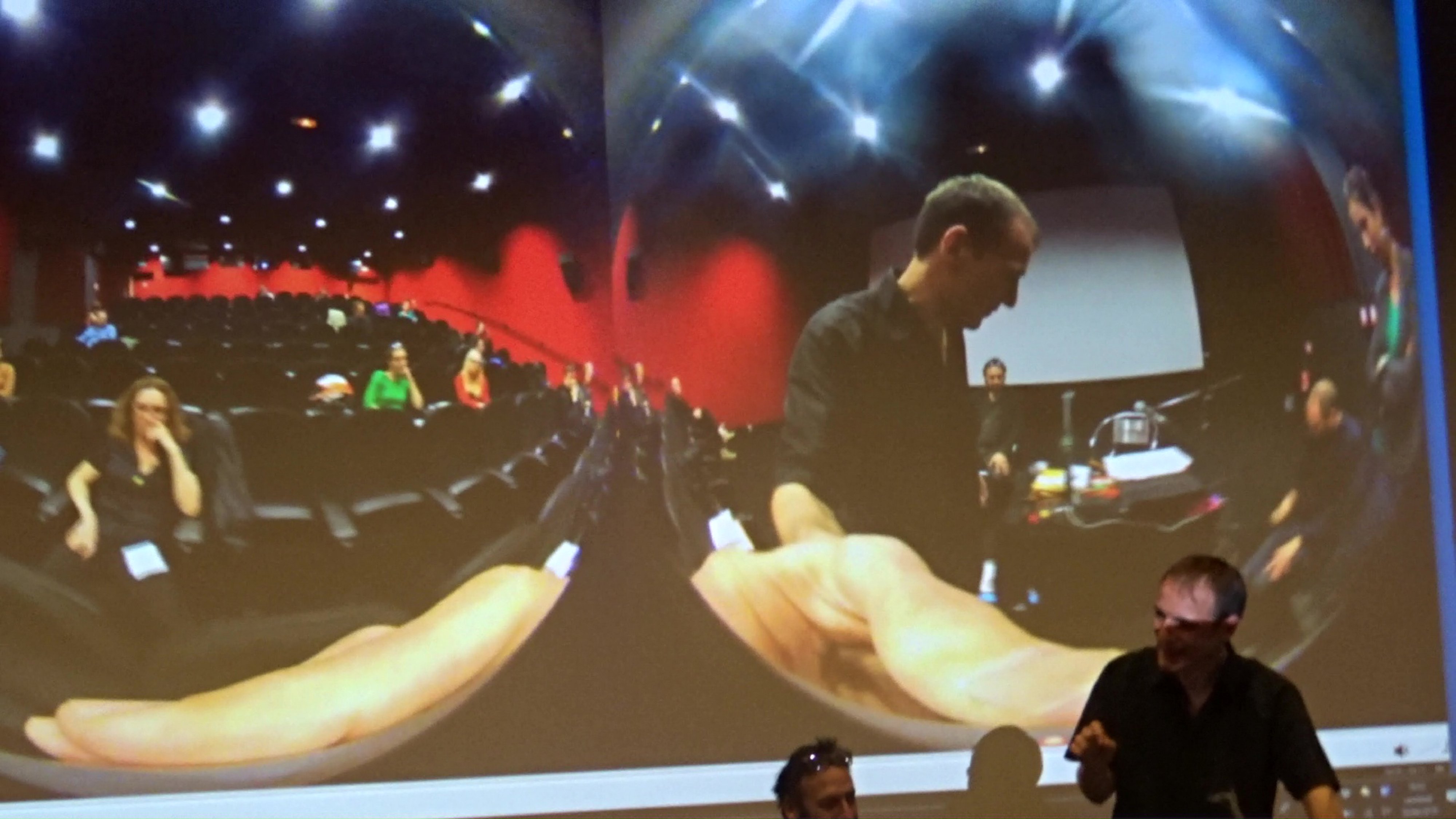
In this article I look for a definition of art as lived experience that transforms through action, drawing on John Dewey. Nicolas Frize’s unrecorded concerts and my own documentation practices, almost opposite in method, then shed light on what the trace becomes when the work of art is the experience itself.
Of the nineteenth-century panoramas, only narratives remain
An immersive work is fragile in a particular way. It depends on a fitted-out venue that will eventually be dismantled, or on a technology that will be obsolete within a few years and impossible to run again. A painting is preserved, a book is reprinted, but an installation that existed only in a given room, at a given time, with given equipment, disappears along with them. We were already discussing this at the international conference on immersive technologies organised in 2019 by the ENS Louis-Lumière and the Paul-Valéry University of Montpellier: we have very few traces of the immersive experiences of the past, even the recent past, and this lack impoverishes our knowledge of the history of these forms.
The nineteenth-century panorama provides the most telling example. Those great circular painted canvases, with the spectators standing on a platform at the centre, produced an immersion said to have been striking. I have not lived it, no one alive today has lived it, and what we know of it comes only from the narratives that have reached us. The experience itself is lost; what remains is what witnesses wrote about it. This holds for yesterday’s panoramas as for today’s virtual reality headsets, and it has made me attentive to a question that goes well beyond the case of immersion: what exactly disappears when a device disappears, and what can a trace retain of it? To answer, we first need to agree on what we call a work, and therefore on what we call art.
What Dewey calls having an experience
My conception of art owes a great deal to John Dewey, whose book “Art as Experience” (1934) has accompanied me for a long time. Dewey starts from a historical observation. Our societies have set art apart from life, in museums, concert halls, consecrated works, and aesthetic theory has fallen into the habit of starting from these already sacralised works to look for what distinguishes them from everything else. Dewey takes the opposite path. He starts from ordinary experience, the crowd gathering around a construction machine at work, the person poking the fire and watching the flames, and there he already finds the very material art is made of, an attention caught up in an unfolding, a pleasure that mingles doing and perceiving.
We are continuously experiencing, in the sense that we are continuously interacting with our environment, but this ordinary experience is scattered, inchoate, interrupted. And then it happens that the lived material runs the full course of its own development, that it forms a whole we will later designate as one single thing, that meal, that storm, that project. Dewey calls this having an experience, and he holds that aesthetic quality is not an ingredient reserved for art, that it is the quality of any experience that reaches fulfilment in this way. Art does not create this quality, it carries it to its highest intensity, by deliberately building experiences made to be consummated.
Dewey finally separates the art product, which is the physical object, the painting, the statue, the book, from the work of art properly speaking, which for him is “what the product does with and in experience”, and it is on this distinction that I will rely. The product can sleep for centuries in a storeroom without any work of art taking place. The work takes place every time an experience is built in the encounter with the product, and the person who perceives is not passive in this encounter; they must accomplish a work comparable in nature to the artist’s, organising what they encounter, building the unity of their own experience. The work is therefore an event rather than an object, and an event that transforms those who live it, for a consummated experience, in Dewey, leaves the person who lived it other than they were.
If we hold to this definition, art requires no durable object, no virtuosity, no professional status. It requires that an experience take place and reach fulfilment, and that people be engaged in it through their action, their gesture, their perception.
Art, craft, and the culture that constitutes us
This definition displaces two boundaries we believe to be natural.
The first separates art from craft, and it is recent. Ancient Greek said technè and Latin said ars to designate without distinction the know-how of sculptors, carpenters and physicians, and for centuries painters were artisans among others, organised in guilds, paid by commission. The modern category of the fine arts, which isolates certain practices to relate them to genius, disinterested contemplation and the museum, takes shape in the eighteenth century, in France with Charles Batteux’s “Les beaux-arts réduits à un même principe” in 1746, and historians, from Paul Oskar Kristeller in the 1950s to Larry Shiner in “The Invention of Art” (2001), have shown how dated and situated this construction is. Dewey, who knew this, refuses to found aesthetics on this separation. For him, artisans make a work of art as soon as they are wholly in what they are doing, as soon as their doing and their perceiving answer each other, and their work moves towards a fulfilment that concerns them. Artistic experience is recognised by its intensity and its unity, not by the nobility of the material or the status of the person acting.
The second boundary separates art from culture. If we understand culture in the anthropological sense, the one Edward Tylor gave it as early as 1871, that complex whole which includes knowledge, beliefs, art, morals, law, customs and all the capabilities acquired by human beings in society, then art is one of the ways culture makes itself, and not a sector set apart from it. This is the meaning of Dewey’s final chapter, “Art and Civilization”, where he holds that the works of a community express its life better than its institutions and doctrines, and that it is through them that one most surely enters the life of another culture. The anthropologist Ellen Dissanayake has extended this intuition by asking what art is as a human behaviour, present in every known society, and she proposes to describe it as the activity of making special, of marking certain moments, certain objects, certain gestures as important, as set apart from the ordinary flow. This description will prove precious to me, because producing a trace is one of the oldest ways of making special what has been lived.
Nicolas Frize, concerts of which no recording exists
Nicolas Frize is a contemporary music composer with whom I have often had long debates on this question of the trace, and it is with him in mind that I wanted to write this article, not to contradict him, but to understand what his position makes possible. Since the 1970s, Frize has been settling his work in places that are not made for music, and first of all in workplaces. He spent two years in residence at the PSA factory in Saint-Ouen, two years at the French National Archives in Pierrefitte-sur-Seine, years at the Sèvres porcelain manufactory, and as early as 1986 he had composed a musical piece from the sounds of the sixteen thousand workstations of the Renault factory in Billancourt, recorded before its closure. In these places, he has the people who work there make music, amateurs and professionals together, and his creations, such as “Silencieusement” at the National Archives in 2015, a score for more than two hundred performers, take the form of itineraries in which the audience moves from place to place inside the building.
Yet his concerts are never recorded, and he never broadcasts his own work. It is a principle with him, and it goes far, since his scores themselves are designed to be performable only in his presence, and he claims the right to let his work disappear with him, rejecting the very idea of posterity. On the other hand, he produces documents around it, writings, interviews, scores of great graphic originality. The trace therefore exists in his work, but displaced, since it never bears on the sound work itself.
I debated this refusal with him for a long time, and I believe I now understand what it protects. Frize gets people who are not music professionals, factory workers, archivists, warehouse staff, to take risks, and he gets them to risk things they would never have dared. If a recording were being made, something in that risk would be inhibited. The camera and the microphone install a future tribunal, an absent audience before which one would have to measure up, and this tribunal weighs first of all on those who do not feel legitimate. The absence of any recording gives the moment back its lived uniqueness, its full and whole life, and it is this uniqueness that authorises the engagement. The performance theorist Peggy Phelan holds that the being of performance lies in its very disappearance, that it gives itself in a present that cannot be reproduced, and that wanting to capture it is to change it into something else. And the anthropologist Paul Connerton, in “How Societies Remember” (1989), distinguishes two ways in which societies preserve their past, inscribing practices, which deposit memory in supports, archives, monuments, images, and incorporating practices, which deposit it in bodies, gestures, ways of holding oneself, and which are transmitted through presence and repetition. What Frize cultivates is an incorporated memory. There is indeed a trace of his concerts, but it lies in the memories and in the bodies of those who were there, an interiorised trace, an inner movement, and he wagers that this trace is the most faithful to what took place.
We must add what the audience of his creations lives through. When you attend “Silencieusement” without having been among the people in residence, you know that those who are playing are not all professionals, you know that what you are listening to was made in a participatory way, and this knowledge changes the nature of what you feel: what makes the artistic value of the moment is their gesture of doing it, their full and serious engagement, amateurs and professionals connected without hierarchy, each contributing in their own place. And since the audience moves through space, from one spot to another in a building not made for artistic presentation, each person becomes, through their own movement, an actor in the transformation of this place into an artistic space. You do not put yourself in the participants’ place, you are with them, your body engaged in the same mutating space. This is art in Dewey’s sense, an experience that reaches fulfilment and transforms through action those who live it, participants and spectators together.
The pico-projector in one’s hands, and the photographs online the same evening
My practice starts from the same ethic and takes the almost opposite methodological path. Since 2011, I have been organising itinerant film projections that I co-construct with local residents: a group prepares a programme of films, heritage excerpts, short films, films people have made themselves, chooses in its neighbourhood the places that will serve as settings for these films, and then, once night has fallen, conducts the projection holding the pico-projector by hand, onto the walls, the doors, the trees of its own town. People transform the walls of their neighbourhood into a space of cinematographic presentation, and the audience that follows lets itself be transformed by living the same experience from a slightly different place. Passers-by join the group along the way, and by the end of the evening we are more numerous than at the start. As with Frize, the value of what takes place lies in people’s engagement and in the mutation of an ordinary place into an artistic space through the very movement of those who pass through it.
But where Frize sets recording aside, I document everything, as it happens. I take photographs during the work, the rushes of what we shoot are put online the same evening, accessible through a QR code, and I commit to keeping these archives alive over time, on dedicated web platforms where the films and creations can be found, such as those of the Fabrique numérique des Lilas, the ateliers numériques of Cultures du Cœur or the project Par ma fenêtre. To this archive of the material is added writing: I strive to narrate the experiences, to write down what happened, what was attempted, what was lived, and I publish these narratives on my website. It is considerable work, technical as much as material, and I hold it to be a full part of the approach.
In my practices, the trace plays the role symmetrical to the one its absence plays with Frize. It authorises. The people I work with find themselves doing things I find extraordinary, but they are not aware that it is extraordinary, because nothing comes to legitimise what they have done. It is not a matter of overvaluing, it is a matter of giving a gesture its rightful place as an artistic act, in the transformative power that is its own, whether its author is an amateur or a professional not being the point. The fact that the photographs are online, that the films are on a lasting platform, that the narrative is published, tells people that what they have done counts, that it deserves to be preserved and shown, and this legitimation allows them to integrate the movement they have made, the path they have travelled. My work as an artist, in the encounter, consists for a large part in legitimising these gestures as artistic acts, and I do this largely through the trace.
A recent experience showed me that this function of the trace is no whim of mine. In a workshop I led over several months in a day hospital for autistic children, I had silently placed three small compact cameras on a piece of furniture, and it was the children themselves who took hold of them and produced the traces of the experience, all the way to the final exhibition in the hospital corridors, which they hung with their own hands. When children who speak little or not at all pick up a camera of their own accord to photograph what they are living, we are touching something that looks very much like an anthropological fact. André Leroi-Gourhan showed in “Gesture and Speech” (1964) that the exteriorisation of memory into supports, from the first engraved tool to writing and then to machines, belongs to the process of hominisation itself. Making traces of what we live so as to be able to return to it, show it, transmit it, is constitutive of our species, and this is why the trace belongs to culture in the anthropological sense, to what constitutes us.
During a recent project with secondary school pupils, the trace even became a visible part of the creation. While some were watching, in virtual reality headsets, the films they had shot themselves, the others were composing, from the printed photographs of the process, panels that each told their own journey through the project, and the exhibition thus born, we visited it together while listening to them talk about it. The trace was no longer a residue, it had become a moment of the artistic experience itself, the place where the participants took hold again of what they had lived and shared it. In Deweyan terms, this moment is that of consummation: the experience closes upon itself, recognises itself, and fully becomes an experience for those who lived it.
Leibniz on the banks of the Seine, September 1675
Leibniz is remembered as the philosopher of the monad, and it is sometimes forgotten that he is also, by perfecting Pascal’s arithmetic machine, the inventor of a calculating machine capable of multiplication, and the designer of binary calculus, which is no small thing when one thinks of what has come of it since. But there is another Leibniz who interests me, the one who, during his Paris stay from 1672 to 1676, developed a passion for the shows, machines, festivities and entertainments of his time, and who kept their memory in writing.
In September 1675, he attended on the Seine the public demonstration of a machine for walking on water, and this presentation inspired in him an astonishing text, which remained in manuscript, known as the “Drôle de pensée touchant une nouvelle sorte de représentations” (Funny thought concerning a new kind of exhibitions). In it he imagines an academy of representations that would mingle technical inventions, scientific experiments, comedies, operas, games and enchantments, a place where knowledge and pleasure would not be separated. The text begins thus (my translation from the 1675 French):
The presentation that was made in Paris, September 1675, on the river Seine, of a Machine for walking on water, gave birth in me to the following thought, which, however funny it may appear, would not fail to be of consequence, were it carried out.
And when Leibniz describes what one would see in his academy, his writing becomes that of a spectator who wants to make us feel what he imagines:
The representations would be, for example, Magic Lanterns (one could begin with these), flights, counterfeit meteors, all sorts of optical marvels [...]. There will presently be marvellous metamorphoses, perilous leaps, flights. Circe the Sorceress who transforms, infernos that appear. After this, all of a sudden, everything would be darkened [...]. This remainder of light, with the help of a Magic Lantern, would cast upon the wall admirably beautiful and moving figures, which would keep the same laws of perspective. This would be accompanied by a song behind the theatre.
Three and a half centuries later, this manuscript gives us access to something nothing else would give us: what it was, in 1675, to be seized by a spectacle of machines on the banks of the Seine, and what a mind of that time could dream of it. The machine for walking on water disappeared leaving no other memory than a few sarcasms in the history of technology; the written trace of the experience it produced in one spectator is still alive, to the point that one recognises in it, projected onto a wall, moving figures accompanied by music that herald our night-time projections on the walls of neighbourhoods. To narrate what one has lived before a presentation is to preserve a sensitive trace of it, the only one that endures when the device itself has disappeared, because it tells what it was like to be there. This is what the nineteenth-century panoramas have left us, and this is what we should be building up, far more systematically than we are doing, for the immersive experiences of today.
Three regimes of the trace
The concept that gives this article its title can now be made more precise. If art were the object, the trace would always be secondary, a more or less faithful document of a thing that exists without it, and the recording of a live performance would be its model, a degraded copy of an event made to be lived by the people present. But if art is the experience, as I hold with Dewey, then the trace changes status, and we must distinguish three regimes ordinarily confused under the same word.
There is the trace-document, which records the object or the event from the outside, for administration, institutional memory, proof. It has its usefulness, and the history of immersive forms suffers from its absence, but it belongs to what Dewey calls recognition: it allows us to identify that a thing took place, without making us perceive what it was like to live it.
There is the incorporated trace, the one Nicolas Frize cultivates, deposited in the memories and in the bodies of those who were there, and transmitted by them alone. By refusing recording, he chooses this regime against the others, because inscription, by installing a future audience before which one would have to measure up, would inhibit the creative risk of the people he engages. This choice has a price, the work will disappear with the living people who carry it, and Frize assumes this price as a fidelity to what the shared moment is, for him.
And there is what I call the trace-gesture, which is made by the very people who live the experience, or with them, while it is taking place or in its immediate extension, and which belongs to the experience as one of its moments. The photograph taken by the child during the workshop, the narrative written and published, the exhibition of the process composed by the participants, the films put online the same evening on a platform one commits to keeping alive. This trace is not a document about the work, it is of the work, in the sense Dewey gives this word: it is part of the actions and effects through which the experience reaches fulfilment, recognises itself and is transmitted. And it has a function the two other regimes do not have, that of legitimising. By making special what has been lived, to take up Dissanayake’s phrase, it tells people that their gesture counts, and this authorisation is itself transformative.
Frize and I therefore follow almost opposite methods, he by setting inscription aside to protect the risk, I by cultivating it to authorise the gesture, and these two methods serve the same ethic, that of an art which transforms not only through reception, but through action, gesture, movement, the creative involvement of people. The question of whether or not a trace should be kept beyond the performance therefore cannot be settled in the absolute; the criterion, to my mind, is what the trace, or its absence, does to the experience of the people engaged. There are situations where the trace would inhibit, and one must then know how to abstain from it; there are situations, and these are those of my practices, where it authorises, deepens and consummates, and one must then hold it for what it is, an artistic act in its own right, to which we give the care, the time and the value we give to the work, since it is part of it.


