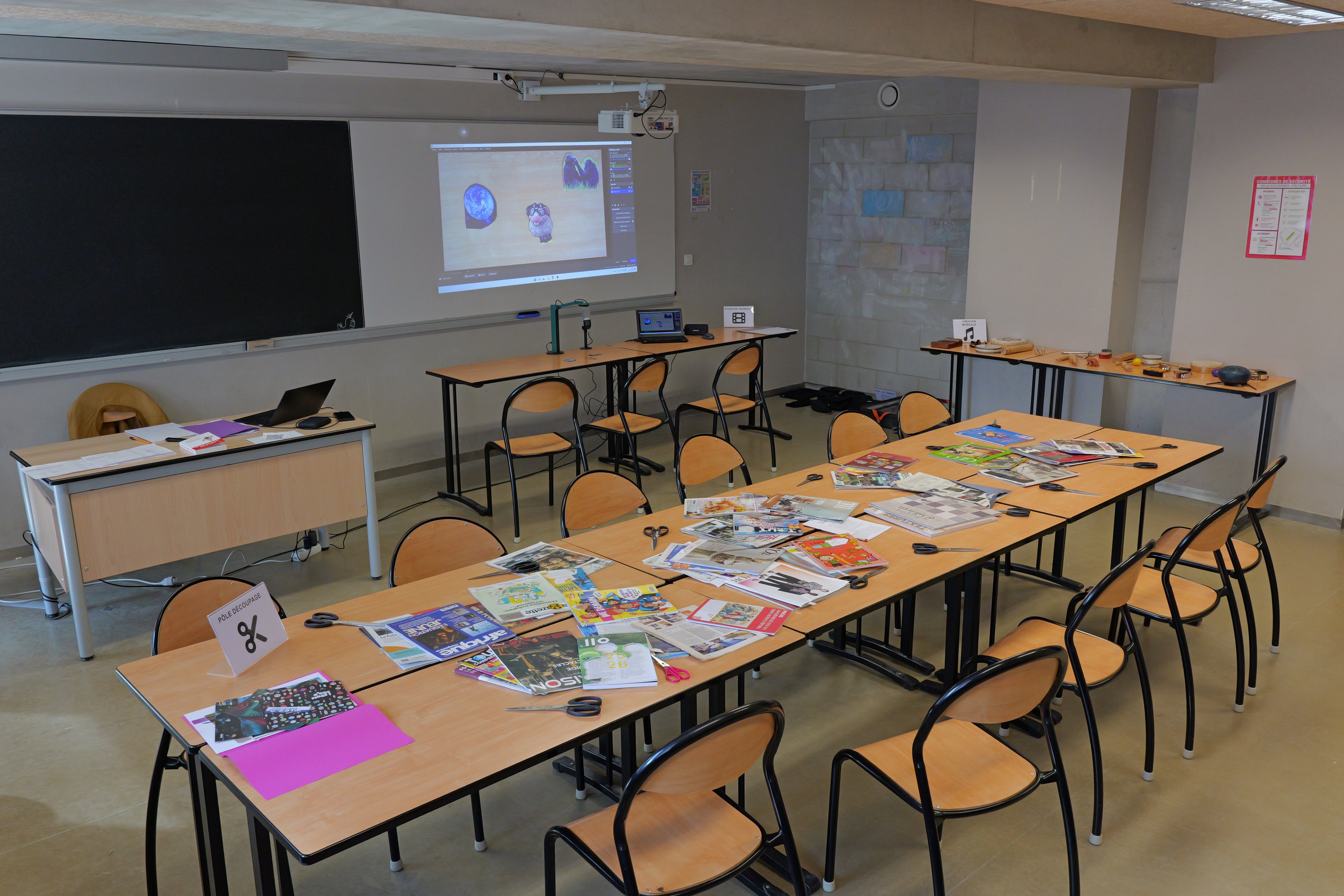
What is creating? Etymology places creation on the side of growth and work on the side of the journey, far from manufacture and mastery. What has just been born cannot yet be judged, since the criteria are missing, and welcoming it requires a sidestep. I defend here this sidestep as a craft, whose concrete condition is independence.
Creare, the verb of Ceres
The verb to create comes from the Latin creare, which belongs to the same family as crescere, to grow, and as the name of Ceres, the goddess of harvests. The Latinist Michiel de Vaan, in his etymological dictionary of Latin (2008), indicates that the original meaning of creare was to make grow, and that it can still be found with this meaning in older texts. The memory of the word thus places creation on the side of growth rather than of manufacture. Manufacture executes a plan and produces an object that conforms to what was planned, whereas growth cannot be ordered about, one can only prepare the ground, sow, then welcome what comes up, which is never quite what was expected. The word culture, from colere, to cultivate, carries the same agricultural metaphor, and this kinship seems to me to say something accurate about what culture and creation have in common.
To this vegetal memory is added a theological history. For centuries, to create was a verb reserved for God. In the sixth century, Cassiodorus notes that things made and things created differ, because we can make, we who cannot create. The historian of ideas Władysław Tatarkiewicz, in A History of Six Ideas (1980), traced this history, in which the artist of Antiquity and of the Middle Ages makes and imitates but does not create, in which one must wait for the Renaissance for human beings to begin to be thought of as capable of creating, then for the nineteenth century for the word to be commonly applied to artists. When we say “artistic creation”, we are therefore using a word that long referred to the emergence of what nothing preceded. Something of that excess remains in the word, and that is what interests me. To create is to claim to bring forth what the existing order did not foresee, and in this sense creation is transgressive by definition, not out of a taste for provocation, but because it overflows the programme.
So that there might be a beginning
In The Human Condition (1958), Hannah Arendt grounds her thinking of action on what she calls natality. Each birth introduces into the world a being who was not there and who carries the capacity to begin something new. To act, for her, is to take an initiative, to begin, and the fact that human beings are capable of action means that the unexpected can be expected of them, that they are able, she writes, to “perform what is infinitely improbable”. She likes to quote a phrase from Augustine, initium ut esset homo creatus est, so that there might be a beginning, the human being was created. This phrase ties creation and beginning together, as etymology tied creation and growth, and what one creates is then worth what it sets going, what it makes grow.
There are several ways of practising the craft of the artist. One can be a performer, one can make commissioned objects, one can look for budgets and for a social inscription that may make it possible to reach a wide audience, and these crafts are legitimate. But that work does not yet describe creation. The craft I defend, the one the word create seems to me to name properly, consists in doing what one was not expected to do, with technology, within a project, right where everything pushed towards doing what was expected. This is what I call the sidestep, which is not an artist’s whim but action itself in Arendt’s sense, creation in the sense of the verb creare, bringing forth, in a given situation, what that situation did not contain.
The new arrives without the criteria to judge it
If creating brings forth what did not exist, then at the moment the thing appears, the criteria to judge it do not exist either, since our criteria were formed in contact with what we already knew. Kant, in the Critique of the Power of Judgment (1790), distinguishes the judgement that already has its rule, and only has to file what presents itself under it, from the judgement that must seek its rule, because what presents itself fits none. Faced with a new work, we are in the second case, without resources, and Kant adds that it is the original work itself which, with time, will give the rule, that is to say, will become the criterion against which later works are measured.
This explains the cycle every innovation goes through. It is first received as incongruous and of no interest, and one should not see in this any stupidity on the part of those who receive it, simply no one yet has anything to judge it with. In 1874 the critic Louis Leroy coined the word “impressionists” to mock a painting by Monet, and in 1913 Stravinsky’s The Rite of Spring was heckled at its premiere, before these same works became references against which others are measured. The cycle thus closes on itself, yesterday’s new having become today’s criterion, until a next novelty overflows it in its turn.
Receiving what has just been born therefore requires an operation that is the reverse of judgement, which consists in suspending one’s criteria, in making oneself available to something one does not yet have the means to evaluate. Simone Weil, in her reflections on attention (1942), describes attention as a suspension of thought, which holds itself available, waiting, without seizing anything. This renunciation is a sidestep in its own right, perhaps the most difficult one. In the creative workshops I lead, what we do often looks simple, but daring to transgress to that extent, welcoming a form that has just been born without flattening it onto what one already knows, is an exceptional moment, and that is where, in my view, creation takes place, as much in those who receive as in the person who made. I have defended elsewhere the spectator’s share in artistic work, and it begins here.
Work transforms, mastery freezes
The French word for work, travail, has its own history too. People always cite the tripalium, the three-staked instrument of torture, to conclude that work is suffering in its essence, but this etymology, the most famous in the French lexicon, is contested by linguists, who lean instead towards trabs, the beam, the one that gave the French word entraver, to shackle. The Romance scholar Marie-France Delport showed, in a 1984 study, that the medieval Spanish trabajo, brother of the French travail, refers to a tension directed towards a goal and meeting a resistance. Language has in any case kept directions of the word that torture does not explain. The English word travel comes from the French travail, French speaks of the travail of childbirth, just as English calls it labour, and in French one says that wood works, travaille, when it changes shape over time. In all these uses, to work names a transformation under way, a crossing.
Mastery belongs to an entirely different register. To master is to control, that is, to prevent a thing from transforming itself otherwise than planned, to bring it back to the plan, to freeze it. Mastery belongs to manufacture, and when it is set up as the horizon of creation, it becomes what I have elsewhere called a fantasy, the illusion that one would arrive, through successive refinements, at an entirely willed form. Creating requires, on the contrary, that other work, the work of the journey, which transforms the one who makes as much as what is made. In the workshops, this is the difference I try to embody, seeking less to impart mastery than to set people to work, in the sense of the labour of birth. Letting go of one’s criteria before what has just been born and renouncing mastery in what one makes are in any case one and the same gesture, performed on one side by the one who receives, on the other by the one who makes.
The breathing space the institution cannot produce alone
I accompany artistic teams, institutions, cities, cultural venues, on questions of innovation. The innovation that interests me does not bear first on techniques, on the latest camera or the latest software, it bears on connection and on meaning, on the way one relates, within a project, to others and to the public. An institution, by nature, tends to reproduce its ways of doing things, to follow its procedures, to stay within what it knows, and that is its very function, since an institution exists to provide stability and continuity. The reverse side of this stability is that the new is hardly born there from within. François Jullien speaks of de-coincidence (dé-coïncidence) to name the slight gap through which art opens up the possible within what seemed closed, and it is a good description of what an outside contributor can bring. What I bring when I intervene is not an additional expertise the institution would not already have in-house, it is that gap, that breathing space, which I can produce because I am not caught in the internal habits and stakes. Bringing in an artist to have them execute what was expected is depriving oneself of the very thing one brought them in for.
A company in my own name
This sidestep has a concrete, almost material condition, which is not to depend entirely on the one who commissions. I chose a structure that belongs to me, a company in my own name, and this choice is not merely administrative. It allows me not to be dependent on a commissioner or a client, or rather to make the effort not to be, because it is a permanent effort. If I depend entirely on whoever pays me, I will do what they expect, I will stay within the frame they have set, and I will lose what I had to bring, dependence bringing the contributor back to the execution of a commission.
In In Praise of Risk (Éloge du risque, 2011), the philosopher and psychoanalyst Anne Dufourmantelle shows that risk is one of the conditions of life, and that the contemporary passion for security, by trying to guarantee everything, shrinks existence instead of protecting it. My independence belongs to that kind of risk, and it has a price. It confines me to projects that are modest in means, it keeps me away from large productions, and I gladly accept this renunciation because it is the source of what I have to offer. Working with public money, within cultural action, a festival, a library, rather than within a market logic, means staying within a dimension of participation and research, where I can play, test, make mistakes.
This independence also reverses the usual order of work. Ordinarily, one first looks for funding, then does what the funding allows. I often proceed otherwise, I first experiment on my own, with inexpensive objects, without always knowing what I will do with them, and it is this experimentation that then allows me to enter into dialogue. If someone tells me they feel like trying an experiment, I take the train and we do it, without having first put together a funding application. If to create is to make grow, then looking for funding first amounts to demanding that the seed describe its fruits before having sprouted, and experimentation is the ground one prepares without knowing what will grow there.
A thinking of what I do
I am an independent researcher, and I am one in all my activities. I left the university long ago, while remaining connected to it, and I kept from it the methodological demand, the way one is oneself engaged in the actions one carries out and reflects from the place where one stands. Every workshop I lead, every technical experiment, every accompaniment gives rise to notes, to documentation of processes, to articles I publish on my website, and these traces in turn feed training courses, accompaniments, writings. It is not a method I apply, it is a thinking that continues from one activity to the next, a question that remains open, and it is because I have a thinking of what I do that I can pass it on.
In What Would Animals Say If We Asked the Right Questions? (Que diraient les animaux, si... on leur posait les bonnes questions ?, 2012), the philosopher Vinciane Despret observes researchers at work with animals and shows that the most fruitful set-ups are those in which observer and observed make each other capable of things neither would have done alone. This description holds for the accompaniment I offer institutions. I come less to apply knowledge onto them than to do something with them, I transform them and am transformed by them, and what grows in this shared work, no one had commissioned or planned it.
This sidestep, I do not demand it of institutions, I offer it to them, and it is to be welcomed rather than imposed. Anne Dufourmantelle, once again, devoted another book, Power of Gentleness (Puissance de la douceur, 2013), to showing that gentleness is a power, the one that transforms without forcing, far from the weakness it is usually filed under. The sidestep happens in that gentleness, and it happens in play, because creating an artistic object means assuming a share of play and even of uselessness, and it is this assumed uselessness that makes it possible to step out of habitual institutional postures and to get moving. Leaving the artist the freedom to do what was not planned, welcoming what has just been born without judging it too quickly, agreeing to be set to work in the sense of the journey, is giving oneself the chance of a growth that the institution, alone, cannot produce.


