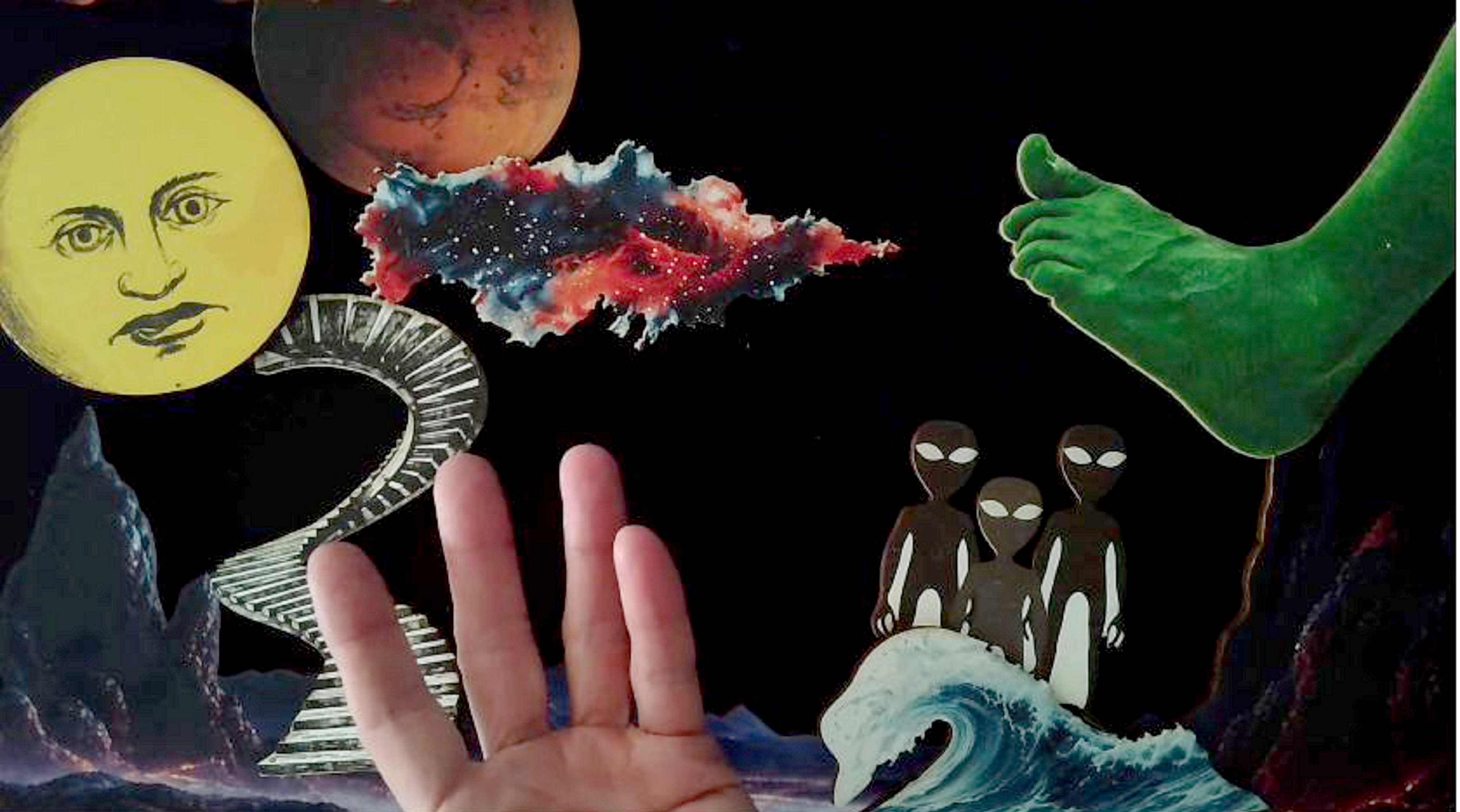
I have filmed live for the stage, at the opera and in concert, and then in workshops: small objects placed under a camera and projected large, backgrounds keyed in behind them, takes in one go. For “Le Voyage de Kristoffer”, I brought these techniques together in a set-up that children take into their own hands, surrounded by the objects and images of the show: they make the image themselves and watch it appear on the screen.
A little vixen filmed on stage
In 2016, for Leoš Janáček’s opera The Cunning Little Vixen, produced by Arcal, a national lyric and music theatre company, I devised with Louise Moaty, who directed it, a way of shooting on stage. The show premiered in January 2016 in Nanterre. The singers shot a film on stage, live, with puppets, using the special effects and image keying of silent cinema (Opera « The little cunning vixen » : video installation). We were working in the tradition of object theatre, where small things are filmed so as to show them large.
From 2018 onwards, I then tried drawing live with a rostrum camera, that is, a camera fixed above a table, whose image is projected onto the walls of a venue (Drawing on architecture). In 2018 I made the video for the recital Songs and dances of death by Karina Desbordes and Sylvie Lechevalier in this way. In October 2022, at the Les Lilas Feminist Film Festival, I set up the same camera at the foot of the stage in a cinema: members of the audience came up one after another to place an object or a text under it while speaking, the film was recorded in one go, then projected straight away (Collective film shot in a movie theater).

Since 2010 I have also had groups shoot collective films in a single sequence shot, more than two hundred so far. The camera passes from hand to hand without stopping, and the film is over when it stops (Going all the way). Since nothing can be fixed in the edit, everyone takes risks they would not take elsewhere, and the group watches its film right away.
Why do I care so much about working live? I think it is because everyone sees the image being made, at the same time as the object being filmed. Émilie-Anna puts it her own way in the project dossier: seeing the images build up while you make them “encourages exchanges, collective adjustments and an understanding of how images are made”.
Two hundred objects under a camera
The immersive trail, Kristoffer au bord de l’univers, includes three experiences: a bedroom in virtual reality, where you become Kristoffer, a cosmogonic labyrinth in augmented reality, and the workshop. Around a table, in groups of six to eight, the children move printed, cut-out wooden pieces with tweezers, sticks or their fingers. A document camera films them from above, and the image appears at once, large, on a screen. Each group shoots, without a break, a sequence of thirty seconds to a minute; each of the four groups in a class takes on one of the four moments of the story, and at the end of the session everyone watches the film from start to finish, then looks for a title.

The company Ex Voto à la Lune presents this set-up in its dossier as “inspired by Benoît Labourdette’s research into real-time audiovisual creation”. Four elements come from my work:
- The collective sequence shot. Each group shoots in a single take. When the recording stops, the objects are left where they are (nobody touches them any more!), and the next group starts from that image. Every group is told so before shooting: “Your ending is the others’ beginning.”
- The image projected live. The children watch their film being made on the big screen while they handle the pieces, as on the stage of the Vixen or in the cinema at Les Lilas.
- Keying on a black background. The objects are laid on a black mat. In OBS Studio (free, open-source software, which records the films), a filter removes the black, and an image of a galaxy, clouds or a landscape is put in its place. The objects then seem to float inside it. The filter also takes away some of the dark parts of the objects, and during the trials a ladder pushed under a black hole sank into the hole, as if it were falling. I found this accident poetic, and we kept it.
- Leading the group, which I describe further on.
The rest comes from other people. Émilie-Anna designed the more than two hundred objects, made with a graphic designer: Kristoffer in several sizes, real and imaginary animals, everyday objects, planets, speech bubbles, philosophical questions, and so on. Some are chosen, others drawn at random, a hand slipped under a cloth. Many of these objects come from the books of the author and illustrator Guillaume Duprat, who also drew from cosmogonies the structure of the four moments shot by the four groups: the origin, the arrival of a transforming agent, the transformation, the resolution. It was Flore, from the mediation team, who found the settings of the keying filter, and we kept them.

Holograms on stage, a black mat on the table
In her dossier, Émilie-Anna describes the image of her show. The actress performs amid holograms and video projections on the floor and on the cyclorama, and Émilie-Anna composes the images by superimposition, bringing together, in her words, “real presence, projected images and optical illusions”, with changes of angle, cuts, ellipses and tracking shots taken from cinema. It seems to me that on the workshop table the children do the same thing by other means: real objects placed by hand, and a background that exists only in the image.
Émilie-Anna and her team give the spectator a different place in each part of the project: they observe at the show, feel in virtual reality, explore in the labyrinth, discover in the digital library, and create in the workshop. The dramaturgical thread of the project comes down to a question: “What if it is because human beings doubt that they became creators?” In the Vixen, in 2016, the singers shot the film and the audience watched it being made. In the Kristoffer workshop, it is the children who hold the objects and decide what happens to the image.
In the evening, the team assembles each class’s film, with a title and credits, and puts it online on the company’s educational website, where the workshop films join the contents of the labyrinth. The plan is to show them on a loop in the theatre foyer during performances, so that the films shot by the children are screened in the very place where the show is performed.

A task for every child
In about ten minutes, six to eight children have to invent a sequence, rehearse it and shoot it. During the trials on 5 October 2026, we saw that, left to themselves, they would produce nothing but chaos, and I shared with the team the principles I use in all my workshops. The children are always told what the objects they pick are for, by announcing from the start that they are going to imagine a film about the origin of the world. Each child has a task, however small: the one who does not feel like handling the pieces goes to the microphone, the one who needs to move handles them, another imitates the wind or passes objects to classmates. With SEGPA classes (special-needs sections in French secondary schools), I have often seen young people in great difficulty pleased as soon as they are given something useful to do, within their reach, and as I told the team that day, “the devil is boredom”.
I also suggest letting the group first play freely with its objects for two or three minutes, because that is where ideas come from. Only then does the person leading help the group to settle its sequence of events. Émilie-Anna suggested structuring it in three stages, a beginning, what happens, an ending, after noticing a “soft middle” in our first trial sequence. During the take, the person leading shows the stages on their fingers, without speaking, and the shoot follows the protocol I use everywhere: you say “Quiet”, you say “Rolling” as you start the recording, and you give the start with a hand signal, otherwise “Action” would be heard in the film.

Mélik, from the mediation team, raised a question about cultural rights: if we stop the children from making their characters fight, are we respecting their creative freedom? We discussed it, and we decided to frame the form of each moment, but not the ending of the story, which the children choose. A group that wants to end its story with all-out war has every right to. I described that working day in Playing the pupil to pass on a workshop.
A tour without me
Le Voyage de Kristoffer lasts fifty-five minutes. After the Théâtre Nouvelle Génération in Lyon on 7 November 2026 and the Théâtre de Rungis on 26 and 27 November, it is presented at Les Gémeaux, the national stage in Sceaux, on Thursday 3 December at 8 pm, Friday 4 December at 10 am and 2.30 pm, and Saturday 5 December at 6 pm, then at the Lieu unique in Nantes on 15 and 16 December. The project received support from France 2030 and from the CNC (the French national centre for cinema and the moving image), under its production aid for adapting immersive works. In each venue, the company’s mediation team runs the workshop without me, with a methodological guide I wrote after the day on 5 October, which we will revise together after the first sessions with classes.
What the agency offers: Creating participatory art projects and events.


