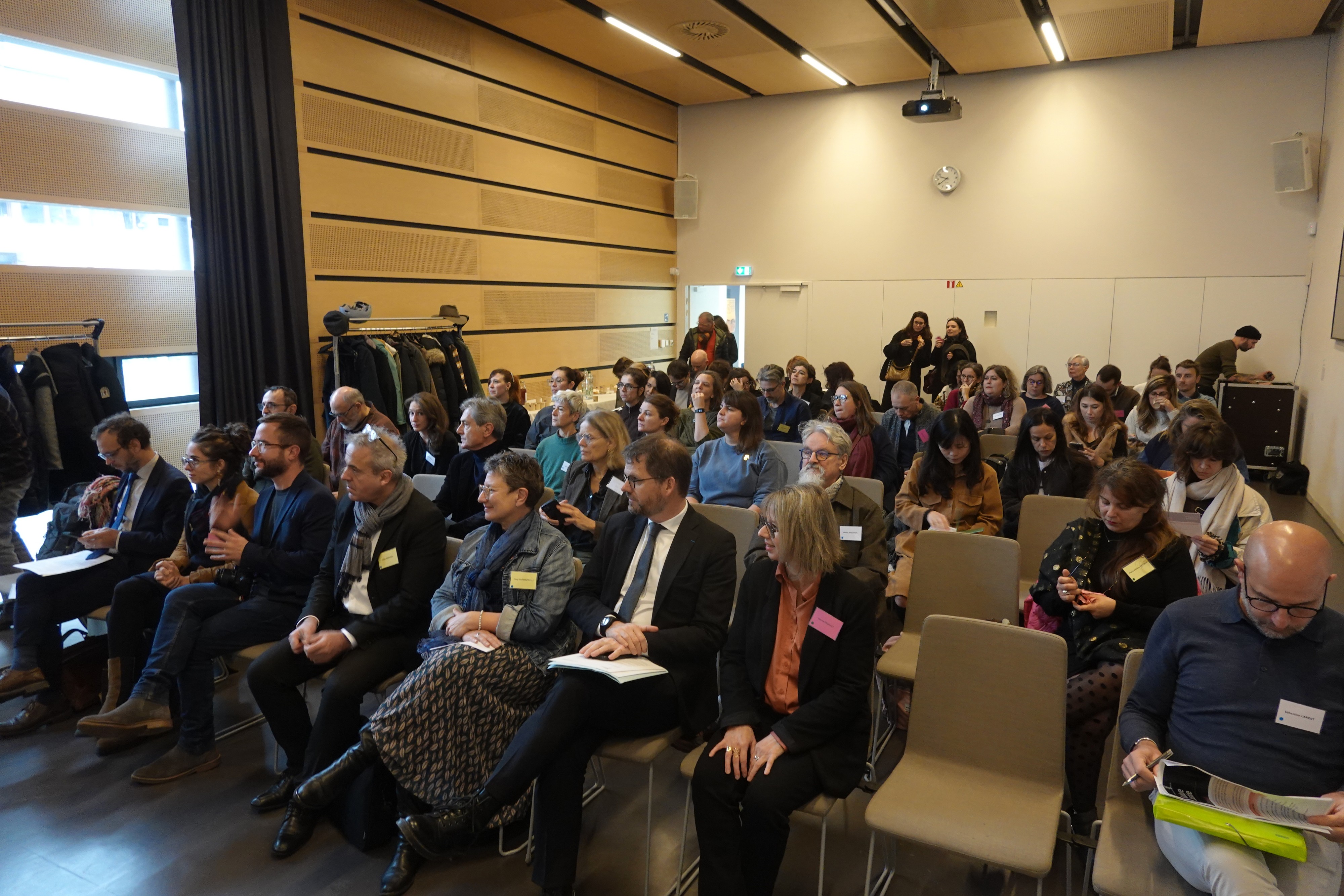
Some sixty professionals from culture, the prison administration and the youth justice service (PJJ) met in Besançon for the fortieth anniversary of the Culture / Justice protocol. What I take away is a talk, a photography workshop, and what everyone came looking for between sessions, a sense of being legitimate in working with others.
Forty years of a protocol, one day to meet
The national Culture / Justice protocol was signed in 1986, on the initiative of Jack Lang and Robert Badinter. In Bourgogne-Franche-Comté it takes the form of a five-year agreement signed in 2022 at La Minoterie in Dijon by the DRAC (the regional office of the Ministry of Culture), the interregional directorate of the youth justice service and the interregional directorate of prison services in Dijon. A first regional day, “Les Mots de l’ombre”, had been held in Dijon in 2024. The one on 24 November 2026 took place at the FRAC Franche-Comté, housed in the Cité des arts in Besançon, in the building designed by Kengo Kuma.
Virginie Lemarchand, deputy director of the FRAC, opened the morning by recalling the preamble to the 1946 Constitution, which guarantees equal access to culture for all. Jonathan Truillet, deputy regional director of the DRAC, announced that the DRAC was keeping a budget of more than 60,000 euros for the 2027 call for projects, published on 17 November, even though the agreement comes to an end in 2027. Mary-José Souvielle, deputy territorial director of the youth justice service in Franche-Comté, and Julien Morel d’Arleux, interregional director of prison services in Dijon, spoke in turn. Julien Morel d’Arleux talked about prison overcrowding and about cultural action that is “sometimes misunderstood by our fellow citizens” and “the subject of controversy”. He gives it educational aims, an added social value and a form of civic engagement, and he added that even art for art’s sake can help a prisoner take a step aside. He made a point of thanking the cultural coordinators, who act as the link between the inside and the outside of the institutions.

Jonathan Truillet, deputy regional director of the DRAC Bourgogne-Franche-Comté, at the opening.
Breakfast and lunch had been prepared by two young people from a training restaurant run by a voluntary-sector service approved by the youth justice service. After my talk, the morning continued with the presentation of six projects run in pairs, each time by a justice body and a cultural organisation. Then a speed meeting brought the participants together, recognisable by the colour of their badge (pink for the prison administration, yellow for youth justice, white for culture), in seven-minute rotations. In the afternoon, after the presentation of the call for projects, two groups alternated between a visit of the FRAC and the photography workshop I was running.
After the call for projects had been presented, the director of the prison probation and integration service of the Nièvre took the floor to point out that we had talked a great deal about detention, whereas more than 80% of the people his service follows are in the community, outside prison. His service already develops cultural actions there, and the 2027 call for projects opens up to work in the community. Projects that bring together the prison administration, youth justice and a cultural organisation remain rare, and you do not set up a project with someone whose name you only know from a form. During the break, a person from the prison administration, who had come from the cultural sector six years earlier, told me she had “the impression of doing the same job”. In a prison, she said, security comes first, and that is precisely why there is “this little piece of humanity that you have to keep holding on to”. Another person, at the end of the morning, was glad that the day was not “empty of meaning”, because sometimes “days are organised just to have days”. That day, people who often carry a project on their own between two institutions were able to put a face to a name, and now know whom to turn to.
The legitimacy of artists
During the speed meeting, everyone had seven minutes to introduce themselves and understand the other person. An advisor from the DRAC, who really appreciates these encounters, remarked to me during the break that the artists talked readily about their work and their approach, and asked fewer questions about the framework in which they might intervene. We talked about it for a while, and I told her that I understood these artists very well. To be recognised and funded, they are asked to present their work and defend it, in applications, in front of juries, in front of programmers, and that is what they do when they arrive. And in seven minutes, facing a youth justice educator or a cultural coordinator from a remand prison, there is barely time to introduce yourself before the next rotation, and little left to talk about the young people, the prisoners and the constraints of an institution.
I also saw in it, and I told her so, a question of authority, legitimation and identity. Many of us artists have learned that being an artist meant belonging to a milieu, and that by opening up too much to people who are not artists, we risked losing something of our legitimacy. We still see the heads of major institutions programming their seasons in a very top-down way, and receiving full recognition from the milieu for it. An artist whose situation is fragile, in terms of identity as well as finances, needs to identify with what seems legitimate to them. It plays out on an emotional level, as if one had to defend oneself, and nobody chooses it. I understand it all the better for having lived it myself. It is difficult for each of us, artists and justice professionals alike, to step out of what is expected of us, and even more so out of what we imagine is expected of us.
After the workshop, an artist who works in secondary schools asked me how this kind of facilitation fed my own work. I told her that for a long time I had kept facilitation and creation apart, and that I now see them as one and the same artistic practice, a collective one, in which I receive a great deal from people. I do not show my own works first, because that blocks people, but I bring my tools. In applications, I reassure partners by describing an artistic project that I am ready to abandon along the way, and the final showing is organised with the participants. She replied that it was “not easy to step out of this well-established tradition”, the one of “having a beautiful showing at the end”.
The texts offer support here. The 2027 call for projects does not fund plain screenings or performances, it requires a practice with people and a co-construction between the cultural organisation and the justice service. Cultural rights, which I talked about in the morning, say the same thing in their own way. These texts give artists a legitimacy other than that of their milieu, the legitimacy to go towards others and to be the guarantor of a process of which they are not the sole author. I have written elsewhere about what artists can learn from amateur practice. Justice professionals need artists to open up an outside, and artists need them to know the people, the framework and its constraints. We need one another, and we need to hold on together to the texts that ground this work.
A talk that begins standing up
I opened the talk with a sit-stand. I ask a question, the people concerned stand up, and the whole room sees who it is made of. The questions ranged from professional affiliation (youth justice, culture, prison administration) to direct contact with young people, via feeling young, having an artistic practice, spending more than three hours a day in front of a screen, having already run a Culture / Justice project, or coming for the first time. About a third of the room stood up to say that social networks were dangerous, and only two people at the question about TikTok. After a few minutes, everyone had stood up at least once, and I knew who I was talking to.
I shared several mediation techniques during the talk by having people practise them. Towards the end, I asked everyone to pair up with their neighbour. For one minute, with a timer on the screen, one of the two told the other about a successful artistic experience in the field of justice, or an idea that had come to them while listening to me, and the other listened without answering. Then they switched. One minute is frustrating, I know, but it is enough for everyone to move from listening to speaking, and speaking is already working out one’s thinking. I have described these exchanges in pairs elsewhere. At the end of the morning, an advisor from the DRAC told me he had found the talk “super clear”, and at lunch another person thanked me for a “really great” contribution. One of the organisers also pointed out to me, rightly, that I had talked a lot about young people when justice also concerns adults, sometimes people in their sixties. I took that into account in the afternoon.
Culture, place, framework, democracy
In a room like this one, the word culture does not mean the same thing to everyone. I suggested distinguishing, roughly, between the culture of the Ministry of Culture, that of works and institutions, and another culture, our own, what makes us who we are, our tastes, the neighbourhood we live in, the way we dress, what we eat, our origins and our family. That is the anthropological sense of the word. The 1959 decree that founded Malraux’s ministry gave it the mission of making the major works of humanity accessible to as many people as possible. The 1982 decree, under Jack Lang, opened that mission to the creativity of all. The painter Jean Dubuffet, who did so much for art brut, was very angry with culture in 1968, when he wrote Asphyxiante culture, and he saw it as a place of power and symbolic domination far more than a place of emancipation. The sociologist Pierre Bourdieu showed in 1979, in Distinction, how cultural tastes classify those who hold them. I apologised at the time for going through this dark side when we had gathered to build, but you need to know these facets to know where you stand. Michel Schneider, who had been in charge of music at the ministry, described the dead ends of cultural policy in 1993 in La Comédie de la culture. More recently, Marjorie Glas traced in Quand l’art chasse le populaire (Agone, 2023) the history of public theatre in France after 1945 and the way it drifted away from working-class audiences. Between democratisation and cultural democracy, the question is whether we bring culture to people who are supposedly deprived of it, or whether we recognise the culture they already have.
Cultural rights answer this question. The Fribourg Declaration of 2007, to which the NOTRe law of 2015 and the 2016 law on freedom of creation, architecture and heritage refer, takes the dignity of each person and of their culture as its starting point. Recognising the value of other people’s culture is a prerequisite for democratic life. The Ministry of Culture created on 1 September 2025 a Directorate-General for Cultural Democracy, Education and Research, putting cultural democracy in the very name of one of its directorates. You can analyse a project using the Fribourg Declaration and ask yourself, very concretely, what place it gives to people’s culture. The philosopher John Dewey asked, in Art as Experience, published in 1934, whether art was an object, and he answered that art is the experience lived by human beings, before an object or together. He says that a beautiful sunset can be an aesthetic experience, even though it has neither author nor artist. I quoted him that morning because he meets cultural rights, which also stand on the side of the person and of what they live. I have written about Dewey and cultural rights, and about how close his thinking is to Célestin Freinet’s.
The question of place follows from there. I told the story, which I have seen several times, of a facilitator who edits on his own the film shot by young people, then screens it in front of them. A script was written, the shooting was done with professionals, and the editing, always complicated, falls to the facilitator. The young people then discover in the cinema a film edited by someone else, and an image of themselves that they did not choose. I have seen young people, at that moment, reject their own image. Projects thus often reproduce the stages of professional filmmaking, writing, preparing the shoot, shooting, editing, screening, and the artist arrives as the official artist, who is asked for their skills. For me, the screening is part of the project, and the young people organise it with us, so that at no point do they feel used. Starting by writing a script immediately excludes those who are not comfortable with writing. You can instead start from filmed improvisations, transcribed by the facilitator, and build the film layer upon layer. When there is no time to edit, the single long take makes it possible to hold a finished form in a single shot. The aim of a Culture / Justice project is the educational journey of the people, and the objects produced are its trace. It is therefore useful to keep a trace of the process itself, for instance by handing cameras to the young people, who become the reporters of the day, and then to tell this process at the time of the final showing. Telling what you have been through is a way of symbolising it. It is legitimate for an artist not to be the dominant artist of the project, and that is what is written in the texts.
That left the framework. It is often confused with a list of prohibitions, something that would contain possible excesses. In artistic and cultural action, I suggested seeing it as what allows us to express ourselves, a framework that authorizes. Expressing oneself is almost dangerous, because you risk being judged and we are all fragile, and it is the security of the framework that makes it possible to try, make mistakes and start again. The psychologist Olivier Houdé described, in Apprendre à résister (Le Pommier, 2014), the share of inhibition that all learning requires, and fear blocks this capacity. A safe space, where people communicate without violence and where nobody judges what is produced, is a condition for learning. The law of 10 July 2019 banned ordinary educational violence in France, and many of our habits of teaching still bear its trace. Within such a framework, artistic practices develop psychosocial skills, as I had discussed at the seminar of the youth justice service in Limousin.
Six projects, six pairs
The six projects presented in the morning, each by a pair bringing together a person from justice and a person from culture, echoed these notions. “Le temps qui pose”, run by the probation service of the Doubs and the Besançon remand prison with the Musée du Temps, was presented by Nathan Muraz-Dulaurier, cultural coordinator, and the photographer Marianne Boiral. “Raconte moi”, by the probation service of the Côte-d’Or and the Dijon remand prison with the Maison Jacques Copeau, by Émilie Michel, cultural coordinator, and Cécile Rivoire, administrator. The “Workshop fresques murales” of the UJPE in Besançon with the Muralistes associés, by Ombeline Rouaz, director of the EPEI in Besançon, and Aurélie Buhler-Compagne, project manager. The “Résidences d’artistes plasticiennes” of the probation service of the Yonne and the Joux-la-Ville detention centre with the Château de Monthelon, by Clémence Michoud, cultural coordinator, and Sébastien Lardet, advisor at the DRAC. “Évoquer le sensible”, by the EPEI in Besançon with the Orchestre Victor Hugo, by Marie-Hélène de Ceris, psychologist at the UJPE, and Laurent Comte, head of cultural action.
“En voix d’expression”, run in the juvenile wing of the Varennes-le-Grand prison with La Péniche, the contemporary music venue in Chalon-sur-Saône, was presented by Bruno Courvoisier, youth justice educator, and Sophie Brandibas, cultural programme officer. The young people wrote and recorded rap lyrics about their own lives. Each young person was, in the team’s words, “his own artistic director for the day” he recorded, and he would tell the musician that he saw it as “rather a sad piece of music”, or that he now wanted it “like that”. One of them only wrote in capitals, with no spaces; he learned to draw a line between the words, and said at the end that he had “learned to put space between words and so between ideas”. Bruno Courvoisier thought he would be able to take a big part in the workshops, and he spent his week acting as stage manager, almost as a guard, taking one young person out to bring another in, because they were not allowed to cross paths. Sophie Brandibas, who usually likes to stay a little in the background so as not to interrupt the exchanges between the musicians and the young people, almost regretted this time not having been more active with them, and she had to rethink her stance as a mediator. I had talked in the morning about everyone’s place, and here I heard it told by two people who had agreed to shift theirs.

Presentation of “En voix d’expression”, run in the juvenile wing of the Varennes-le-Grand prison with La Péniche.

“Carnets de voyage”, a workshop run in 2026 by Maud Coué in the women’s wing of the Joux-la-Ville detention centre, as part of the visual artists’ residencies with the Château de Monthelon.
A hand in every image
In the afternoon, I ran twice, for two groups of about twenty people, the same photography workshop that I run with young people or professionals. The participants split into four or five teams and have a quarter of an hour to make a photograph on the theme “culture and justice”. At least one hand must appear in each image, and the only caption allowed is the list of the team’s first names. I ask them to look for a place first and let it inspire the image, rather than plastering a preconceived idea onto it, so as to receive what the world has to offer. The photographs are then sent via a QR code to a space hosted in Clermont-Ferrand, away from the big platforms, and projected. During the collective reading, the authors do not speak, and it is the others who say what they see.
In the first group, Manon, Pauline, Bruno, Yannick and Géraldine had photographed a woman reading the newspaper on a white bench, under a beam, her face hidden behind the pages. Someone saw in it the scales of justice, with their centre and two pans. Others spoke of protection, or of shame, and one person simply said that she saw in it a way of fighting loneliness with imagination.

Photograph by Manon, Pauline, Bruno, Yannick and Géraldine.
Pauline, Patrick, Pascal and Hsiao-Mei had thrown a book over a brick wall, above the shelves of a library. The room saw freedom and flight in it, then a slightly “cheeky” gesture, like throwing your hat in the air on graduation day. You cannot tell whether the book is leaving or arriving, and I was struck by the library, placed right at the bottom, where the wall’s foundations would be.

Photograph by Pauline, Patrick, Pascal and Hsiao-Mei.
Soraya, Angélia, Jonathan and Aurélie had placed a hand on a wet window, with the Besançon citadel on a diagonal in the reflection. I immediately saw a cave painting in it, a painting made with water, which says that you can paint with whatever comes to hand. Someone with a more prison-minded eye read in it an isolated hand coming up against the wall, and the sky in perspective above the citadel, which, another person recalled, had also been a place of confinement.

Photograph by Soraya, Angélia, Jonathan and Aurélie.
Sylvie, Nadine, Clémence, David and Cédric had photographed two hands reaching out to each other above the Doubs, one wearing rings, the other bracelets, with a bridge in the background. People saw in it the mutual help that lets you cross, and someone read in it the verticality of justice crossing the horizontality of culture. Looking at the four images together, someone noticed that each also contained its opposite, movement and stillness, wood and stone, the river and the bridge.

Photograph by Sylvie, Nadine, Clémence, David and Cédric.
In the second group, Cléofé, Laurent, Sophie and Estelle had photographed from a low angle open hands beneath violins hanging from wires. One person recognised the ceiling of the Sistine Chapel and the gesture of God creating Adam, another a rain of instruments falling on us. The team had drawn on a work of art to make another one, as we do whenever we photograph a landscape or a building, and the image benefits from all the richness of what others have built.

Photograph by Cléofé, Laurent, Sophie and Estelle.
Émilie, Alex, Sébastien, Alex and Nathan had framed very tightly, vertically, an arm passed through a wire fence, the body left off-screen and the word “exposition” written beyond. Someone said that what matters, art, the human, lay outside the space of confinement. The fence, in the foreground, is blurred, and what is sharp lies behind. I saw in it a kind of inverted sfumato, like the blur that sixteenth-century Italian painters reserved for backgrounds.

Photograph by Émilie, Alex, Sébastien, Alex and Nathan.
Marguerite, Jennifer, Lidwine and Julie had photographed a manicured hand, laden with jewellery, passed through bars and holding a printed sheet. One person saw a stolen photo in it, another a conjuror, one hand distracting attention while the other acts. Someone spoke of going to fetch something precious, and that something was perhaps reading.

Photograph by Marguerite, Jennifer, Lidwine and Julie.
The photograph by Olivier, Amel, Leïla and Aurélie, in black and white, was the most dramatic. One hand clings near a lock, another holds out a printed sheet on which you can read the word “beau” (beautiful), and a blurred arrow on the floor points to an exit. Several people saw in it a difficult encounter, generosity too, and the question of how to connect. Then someone noticed the bracelet on the wrist, and the room thought of the electronic tag, with which you can be outside while still under the authority of the courts.

Photograph by Olivier, Amel, Leïla and Aurélie.
The discussion that followed was about method. We spend more time looking at the images than making them, deliberately, because the quality of the time invested matters more than its length. Naming the authors, under a pseudonym if need be, makes the people exist in the image. Other people’s gaze also builds the person who made the photograph. Someone who was ashamed of their image discovers it read richly by the room, and something settles, a small seed that may grow later. That day, the same photograph was read as a pair of scales and as shame, and nobody had to decide between them. I see in this a media and information literacy that happens without tension. While the teams were sending their images, someone had asked me whether it was a competition, and whether there was something to win. I answered that it was a sharing. A competition can be a good pretext in other contexts, but here the point is building, not valorizing, and I refuse any hierarchy between the images because equality of gazes is part of democratic life. None of the photographs showed a face, which means they can be shown without any image-rights difficulty, a question the youth justice service asks to be settled at the very start of any project. Digital tools serve here to connect people and to keep a trace of what they have done together.
Time, the third, the trace
For the closing, I had five minutes, and I came back to time, which we had discussed during the workshop. We readily associate long time with productive time, but the quality of a shared moment also counts, even if it is short. The projects presented in the morning showed it, in prison as in the community the groups are not the same from one session to the next, people arrive along the way and others will not come back. We cannot deplore it, it is the reality of these places. So I try to leave traces, digital ones when possible (in prison, people are not supposed to have a phone, and other kinds have to be invented), so that those who arrive can latch on to what was done before them. I also end each session with a short showing, so that the person who will not come back leaves with something.
The object that remains, outside us, is what psychoanalysis calls the symbolic third. During the workshop, I could have gone from team to team to advise on framing. I have the skills, and it would no doubt have reassured me, but we would have been in a dual relationship, in which I would have exercised a form of domination over the group. I gave an instruction, I held the framework, and each team made its photograph freely. The phones, the online space, the projected images became third objects, which allowed everyone to meet themselves and to meet others.
In the morning, a person working in social and professional integration had talked to me about formalising acquired skills, and she came back to it in the afternoon. When you help young people write their CV, she told me, they often answer that they “haven’t done much”, even after weeks of a project. Listing with them the skills they have acquired and giving them a document they can mention is another way of keeping a trace of the process, and a help for those who find it hard to recognise their own worth. Finally, I showed Infox Trackers, a media literacy game in the form of a cooperative escape game, which we had co-built with the youth justice service in 2020. After the game, people talk about the way each of them played and the qualities that came out. We are currently building version 2, and I showed elements of it that nobody had seen yet.
The 2027 call for projects is open until 1 March, for projects starting from 1 June 2027. When presenting it, a representative of the youth justice service stressed two points of the framework note, the right to image and anonymity of young people, to be settled from the outset, and the integrity check now required of all practitioners who work with minors. She took up the expression “framework that authorizes” that I had used in the morning, recalling that this framework also protects the reintegration of young people when they leave the justice system’s care. Artistic interventions are paid 60 euros an hour, including social charges, and preparation may not exceed 10% of the intervention time.


