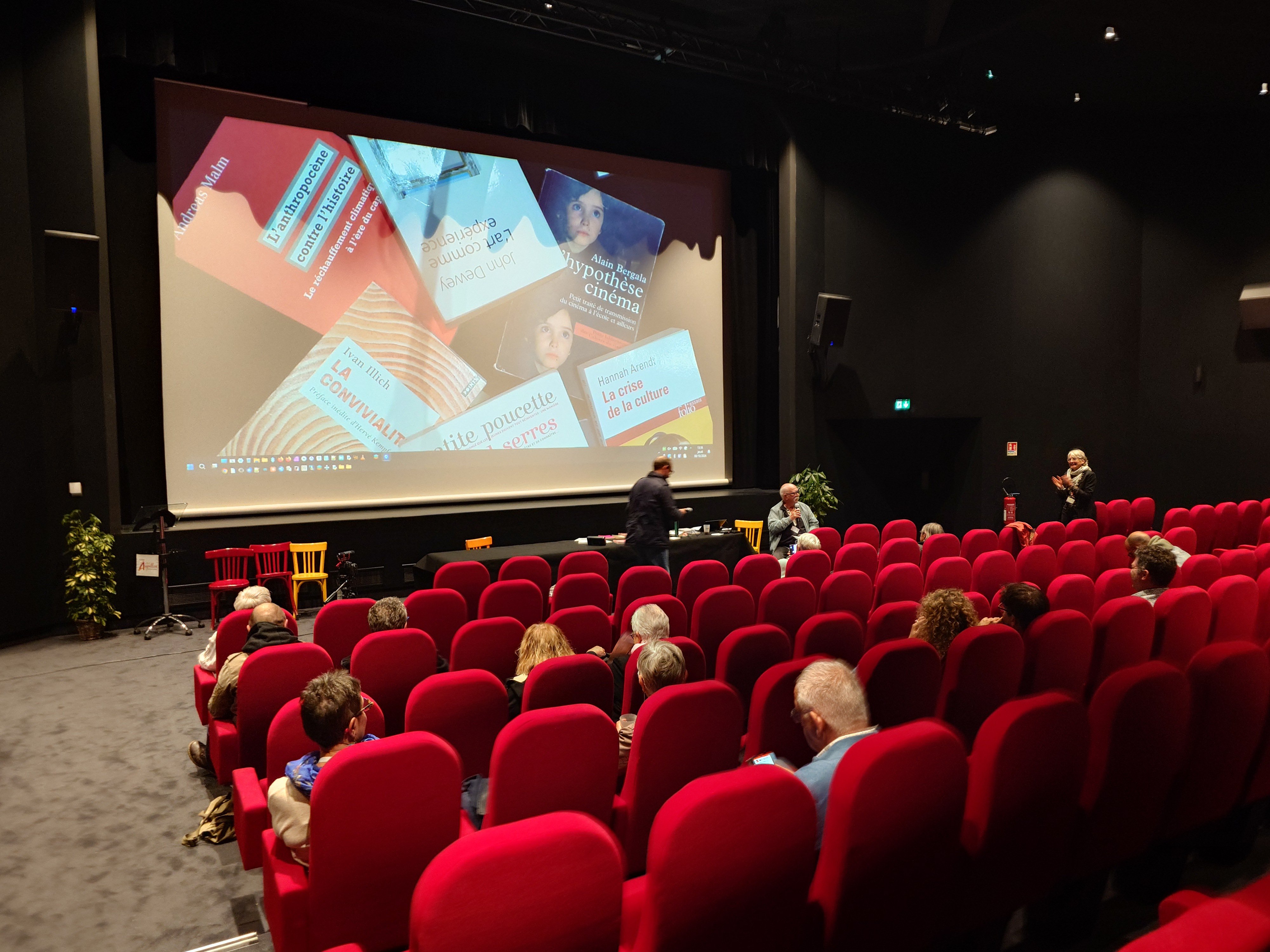
Invited in place of Alain Bergala, twenty-four years after “L’Hypothèse cinéma”, I spoke about the fear that prevents learning, about cultural rights as a support for mediators who doubt their own legitimacy, and about young people who watch, share and film with the same phone. The discussion took up all the time planned for the workshop, so we made the film in five minutes, sitting in the auditorium, with a camera passed from hand to hand along a row of ten people. It is better than what we would have made in the workshop, and I believe this is because it came after an hour and a half of listening.
Twenty-four years after “L’Hypothèse cinéma”
The afternoon had first been designed around Alain Bergala. Les Ouvriers du cinéma, an association of people who love cinema, documentary in particular, and who pass it on to young audiences, had suggested inviting him with a question: twenty-four years after L’Hypothèse cinéma. Petit traité de transmission du cinéma à l’école et ailleurs (Cahiers du cinéma, 2002; published in English as The Cinema Hypothesis), would he still say the same things? He could not come, and it was a mediator, Laura, who put my name forward.
Philippe Quaillet, of Les Ouvriers du cinéma, opened the afternoon by reading three quotations he had taken from the book. One on the “passeur”, a figure Bergala borrows from Serge Daney: the person who gives of himself and takes the same risks as those he helps across, whereas today everyone declares themselves a passeur where there is neither risk nor crossing. Another on the teacher who speaks honestly about the films he loves, instead of serving pupils what he judges good for them but not for himself. And one from Nietzsche, on the work that resists, that repels at first encounter and reveals itself only slowly.
I recognise myself in this lineage. Bergala’s attention to the diversity of viewpoints, his refusal of the idea that there could be a single right reading of a film, the place he gives to sharing sensory experience: none of this has aged. What has changed since 2002 are the objects we work with. Philippe was right to make me say so, because I had planned to unwind my own thread without saying where it came from.
In the room were some twenty mediators from Nouvelle-Aquitaine who had just spent two days in workshops (mash-up table, machinima, a trunk of games) and had not attended the morning round table. There were also staff and volunteers from cinemas, partners, and a few elected officials who had stayed on after lunch. In the morning, people had discussed the economics of the sector, funding from the CNC, what a cinema brings to a rural municipality and what its closure would take away. The afternoon had been announced as devoted to the future and to young people.
A dozen questions, standing up
I began with an exercise: I ask a question, you stand up if the answer is yes, you stay seated if it is no. Who works directly with audiences? Who works in a cinema, as an employee or a volunteer? Who came by bike? Who is wearing a second-hand garment? Who thinks social networks are dangerous? Who spends more than three hours a day in front of a screen? Who went to the cinema last month, outside work? For that one, I was ashamed to stay seated, and I said so. Who has the TikTok app on their phone?
I really needed these answers. They helped me adjust what I was going to propose next, starting with the gap between generations when it comes to judging social networks dangerous. But above all I commented on the exercise as it went along, because it is a tool anyone can take up, and the way to use it is also passed on. It comes from popular education, and I tell how it was passed on to me in Educating about images, organising disagreement.
It needs two things: questions that sting a little, without going as far as controversy (you do not ask who is vaccinated), and a time of preparation before the first one, to announce that people will be standing up and to check that everyone is ready. If you start too fast, people do not move. It may seem like time wasted; yet it is what allows a collective experience to begin. Some call it an icebreaker, and it is much more than that.
We do not learn when we are afraid
Philippe had spoken of taking risks. I took up the word, because it touches on what we do. Daring to say I, daring to expose what you feel in front of a group, is not egocentrism, it is a risk, and it is how you invite others to take one in turn.
In Apprendre à résister [Learning to resist] (Le Pommier, 2014), the psychologist Olivier Houdé calls cognitive resistance the process by which we learn. Creating a new neural connection requires resisting reflex thinking, the groups of neurons that are already pre-activated, and this costs energy. Now, when we feel judged, threatened, in danger of being excluded from the group, our brain goes on the defensive. If I am afraid, I cannot learn, and I cannot enjoy a film either. I have described this in detail in the article Fear, a learning inhibitor. This mechanism has a direct consequence for our professions: for a group to receive anything at all, a film as well as a word, no one in it must fear being mocked; it is a physiological condition.
I then came to condescension. It can start from a generous intention, “I have beautiful things to show you”, and produce the opposite effect, since people hear that what they watch is worthless. I quoted Alice Miller, who shows in For Your Own Good (1980) that a child learns nothing from educational violence except hypocrisy, mistrust and violence itself. France only banned educational violence in July 2019, one of the last countries in Europe to do so. We therefore work in a violent culture, and I said so all the more clearly because the secondary-school students’ movement was in the news in those days, and because the repression it was facing is, in my view, state violence. For culture to serve democracy, that is, for everyone to be able to express themselves in it, we must first give up violence.
“How do you find your legitimacy when you are starting out?”
A young professional took the floor, and it was her question that opened up everything else. She observed that the staff of cultural institutions struggle to have their profession recognised, with falling subsidies and salaries, and asked how to reconcile respect for everyone’s cultural rights with one’s own professional legitimacy, especially when starting out.
I answered with a situation many people know. An artist runs a film-making workshop with young people. At the end comes the presentation, with, in the room, the adviser from the DRAC who funded the project, the mayor, the parents. Everyone expects a result worthy of what was paid for. The artist senses it, and takes back control without always realising it: they frame more, they spend their nights fixing everything in the edit. The project then drifts towards an institutional production, legitimate in everyone’s eyes, in which the young people no longer have a place. It even happens that they discover themselves in close-up on a big screen without having been prepared for it, and this can be violent for them.
My trick lies in a reversal: document the process while it is under way, with photos and logbooks, then make sure that at the presentation it is the participants who tell the story of the process and organise the moment. Even without an edited film, even with only a few rushes, you bring everyone along, including the most reserved interlocutor, because you tell the stages you went through and what you learned. A project of artistic production, perfectly legitimate, is then no longer confused with an arts and cultural education project, which is of a different nature. I developed this point in The process, not the result.
When I run a film-making workshop myself, I never edit anything afterwards. If there is an edit, we do it together on a computer, and I add nothing once the workshop is over. This is one of the reasons why I often have people shoot sequence shots.
A teacher extended the question by recounting what two years of reading had changed for her: the concepts she found in others had allowed her to understand that what resisted in her class was genuinely difficult, and that it was not her fault. These times of reading and of analysing practice among professionals are no longer paid for by institutions, and it is up to us to demand them. The biologist Olivier Hamant gives an argument in their favour, which I take up in Robustness, antifragility, resilience: by pursuing performance, we do just what is needed to reach the result, and a grain of sand in the works then brings everything down. Robustness, on the contrary, requires margins, trials and errors.
From Malraux to Jack Lang, two missions for a ministry
Cultural rights are a tool of legitimation, and it is as such that I presented them. They rest on the Fribourg Declaration (2007), and a group I belong to has for some years been preparing a text that extends it. The Declaration is not legally binding, but cultural rights are written into two French laws, the NOTRe law of 2015 and the LCAP law of 2016: the State and local authorities must conduct their cultural policies with respect for these rights, which commits the organisations they fund.
In the Fribourg Declaration, culture is understood in the anthropological sense, that is, what constitutes me: my language, my parents, my music, my images, what I eat. Respecting the culture of others is therefore the condition for that person to be able to contribute to the life of the community. When I am made to feel, in an institution, that my culture is worthless, I find it hard to respect it myself, and without that respect I do not contribute. I am deeply involved in the subject of cultural rights.
A mediator spoke of her difficulty: the young ambassadors she supervises talk to her only about superhero films or French comedies she has no wish to see, and yet she would need to know them in order to share with these young people instead of looking down on them. I suggested a trick: ask them to tell the whole film. Having a film told to you is a viewing experience in its own right, to which is added the interpretation of the person telling it, and you discover along the way what they like. I argue in See a film or have it told to you ? that these viewers are part of our audience and deserve as much respect as the others, just like those who watch at accelerated speed, a practice in which I see the exercise of a freedom rather than an attention deficit, as I explain in The Accelerated Eye. You can even organise a screening in which young people tell a film they love.
To make the difference between cultural democratisation and cultural democracy tangible, I read two decrees. The decree of 24 July 1959, which set out the missions of the Ministry of Cultural Affairs created a few months earlier for André Malraux: “to make the capital works of humanity, and first of all of France, accessible to the greatest possible number of French people”. And the decree of 10 May 1982, under Jack Lang: “to enable all French people to cultivate their capacity to invent and create, to express their talents freely and to receive the artistic training of their choice” (my translations). It is not the same stance, and I have set out the definitions I give these two expressions in Cultural democratization, cultural democracy : situated definitions. In 1993, the 1959 wording was restored, and it is still the one we read in today’s decrees on the minister’s remit, whereas the law points in another direction. We can therefore invoke the law, in our applications as in our discussions.
Home movies and the phone as pen
In 2005, together with the Forum des images, I founded the Pocket Films Festival, because cameras had just appeared in phones. People told me that a phone is made for phoning. I replied that within ten years everyone would have a camera in their pocket at all times, and that this is what is called a social fact. I told this story in The birth of the Pocket Films Festival (2005).
The semiologist Roger Odin, who worked on what he called private cinema, was already saying at the end of the 1970s that we had to stop ranking professional images above amateur images, because they do not have the same function. With the former, we tell stories, we inform, we make propaganda; with the latter, we build a family identity. Whether a shot is blurred does not matter at all if it shows my child’s first steps. These are two regimes, and the hierarchy we establish between them is a symbolic hierarchy, that is, a form of domination.
With Dailymotion in March 2005 and then YouTube in April, the economics of images tipped over. Until then, professional images had market value and amateur images had none: a father could hold his family hostage on a Sunday afternoon to show them his holiday films, but he could not show them to the whole world. Today, the exchange of amateur content brings in a great deal of money, and professionals find themselves competing with amateurs on the same platforms.
The change that seems most important to me, however, is not economic. On TikTok, I watch, I share, and I press a button to film, with a shooting and editing tool immediately at hand. I am at once viewer, distributor and author, whereas sitting in a cinema I am only a viewer. The experience of the cinema is no less beautiful for that, but it gives me a more limited place, and we would do well to know it. On TikTok again, young people organise, on the fringes of copyright, live film screenings in which everyone comments together on classic films, including those of Louis de Funès; I devoted an article to these screenings, La réinvention de la séance collective de cinéma sur TikTok.
Two people in the room said it better than I did. One mediator recalled how much social networks are demonised in our profession, whereas in her exchanges with young people she sees something quite different: it is through TikTok, and for films through the Letterboxd app, that they discover books and films, and they are often more curious than we are. Then a nineteen-year-old took the microphone to say that the little film culture he had, he had built on these networks, where many filmmakers have accounts, where people popularise cinema, and where young people aged eighteen to twenty-five share their short films.
The phone has become the most ordinary object there is, like a pen. No one writes a poem every day, and if I suggest you write one with an ordinary pen, something powerful can happen. That is where our legitimacy lies: offering, with ordinary tools, practices that are out of the ordinary. Compared with the hours our audiences spend on social networks every day, what we offer is microscopic, and we have become the marginal figures of culture. But “it is the margin that holds the page together”, to quote a phrase attributed to Jean-Luc Godard: our encounters take place in flesh and blood, people are together in them, and they may remember them all their lives. We therefore have to be more demanding than before, precisely because we carry less weight.
Five minutes left to make the film
After the talk, I had planned a shooting workshop in small groups, then a time for collective reflection. At 3.44 pm, we had been talking for an hour and a half and there was almost no time left. I gave up on the workshop, we took a five-minute break, and we did two things.
First, an exercise in pairs: for a minute and a half, each person offers an idea for film mediation to their neighbour, who listens without replying, then they swap. It is not a conversation. What matters is that almost everyone puts into words something they had in their head, what psychoanalysts call symbolisation, and which speaking up in a large meeting does not allow everyone to do. With teenagers, for whom the social risk of speaking in public is considerable, this technique is worth its weight in gold.
Then the film. Ten people sat side by side in a row. I started recording and handed the camera to the first person, who filmed an object she had to hand, lent it her voice and made it speak about its role in film mediation, then passed the camera to her neighbour, and so on to the end of the row. A single shot, no editing, no zoom, with three instructions: speak very distinctly, separating the syllables; give the object a strong emotion; and take care over the way the camera passes from hand to hand, because that passage is part of the film. And if something goes wrong, you carry on.
There was a mediator’s hand reaching out to others, a cinema jealous of not being as modern as this one, another hand indispensable for holding the boom, the rings of a mediator who fiddles with them when he is stressed in front of a large group and which remind him where he comes from, the time that cinema stops when you watch a film, an armrest that is a space of domination or of sharing depending on your neighbour, a pen used to put ideas on paper and to draw a storyboard. We watched the film straight away, with all the lights off, on the cinema screen. It was 4.30 pm, and I was the first to be surprised by the result.
This film joins the series of collective films of talking objects that I have been making for years, such as The Union of Objects or Speech objects. I put it online within the hour, accessible through a QR code that those present could take away as they left. The file is with my hosting provider, in the industrial zone of Clermont-Ferrand, and not on the other side of the world: you can use digital tools without going through the big platforms, and that is what I answer when people confuse digital technology with the GAFAM. I suggested they show it to others without saying anything about how it was made, to hear what those viewers see in it: they will talk about the script, about how the parts complement each other, about things nobody put there.
This film owes nothing to a technical feat; its quality lies in the bond between the people who made it and in their attentiveness to one another. Had I suggested this exercise at 2 pm, we would not have got this. So the afternoon did not go as planned, and I made this methodological remark to them along the way, because it applies to our workshops with young people: when things do not go as planned, it is often because people have made the project their own and transformed it, and that is what we are looking for. We ask the young people we work with to let themselves be transformed by what they had not foreseen. It is up to us to do the same!


