Around a reinforced concrete grain silo built in 1907, inhabitants, artists and heritage professionals worked together, from May to June 2026, to lay the foundations of a museography about ways of inhabiting the world. This is the story of how the collective intelligence method I practise, supported by a simple digital tool, enabled people who all already knew this place to create together more than each of them had been doing there on their own.
The silo, a doorway to the question of inhabiting
The project began with a building. A reinforced concrete silo, built in 1907 at the bottom of a valley in southern Essonne, in the commune of Le Mérévillois, which Agnès Mane, co-founder of the Farine de Froment association that runs it, describes as a lighthouse, oddly out of place in that hollow. Around this building, the association’s team set out to create not an exhibition but a process, a way of giving shareable form to the experience of inhabiting this territory today. I accompanied this process as its facilitator, designing the method and leading the sessions.
Everyone who took part already knew the Silo: the team that runs it, a dancer who performs there, a regular visitor, the director of the local museums, a departmental adviser who has followed its projects for years. We therefore worked on the bond between people who already knew each other, and this may be the most transferable lesson of the whole process. Among people who see each other regularly, the roles are already shared out, everyone does what they are used to doing, and nothing obliges anyone to step outside them. The set-up enabled these same people to contribute differently, and what came out of it is something they would not have produced in their ordinary exchanges.
The first decision was not to freeze the building’s history in a conventional museum. A 1907 silo has a technical history, that of reinforced concrete, of François Hennebique, of the agricultural transformations of the early twentieth century, and this history could have made a fine heritage exhibition, designed by exhibition curators and installed in the place. The choice was instead to make the silo a doorway to a broader question, that of inhabiting, and to build the answer with the people of the territory rather than for them. This shift may seem modest, yet it governs everything else. As soon as you move from “doing for” to “doing with”, the shape of the project, the method, the role of the facilitator, the place given to each person all change in nature.
Five videoconference sessions around “inhabiting the world”
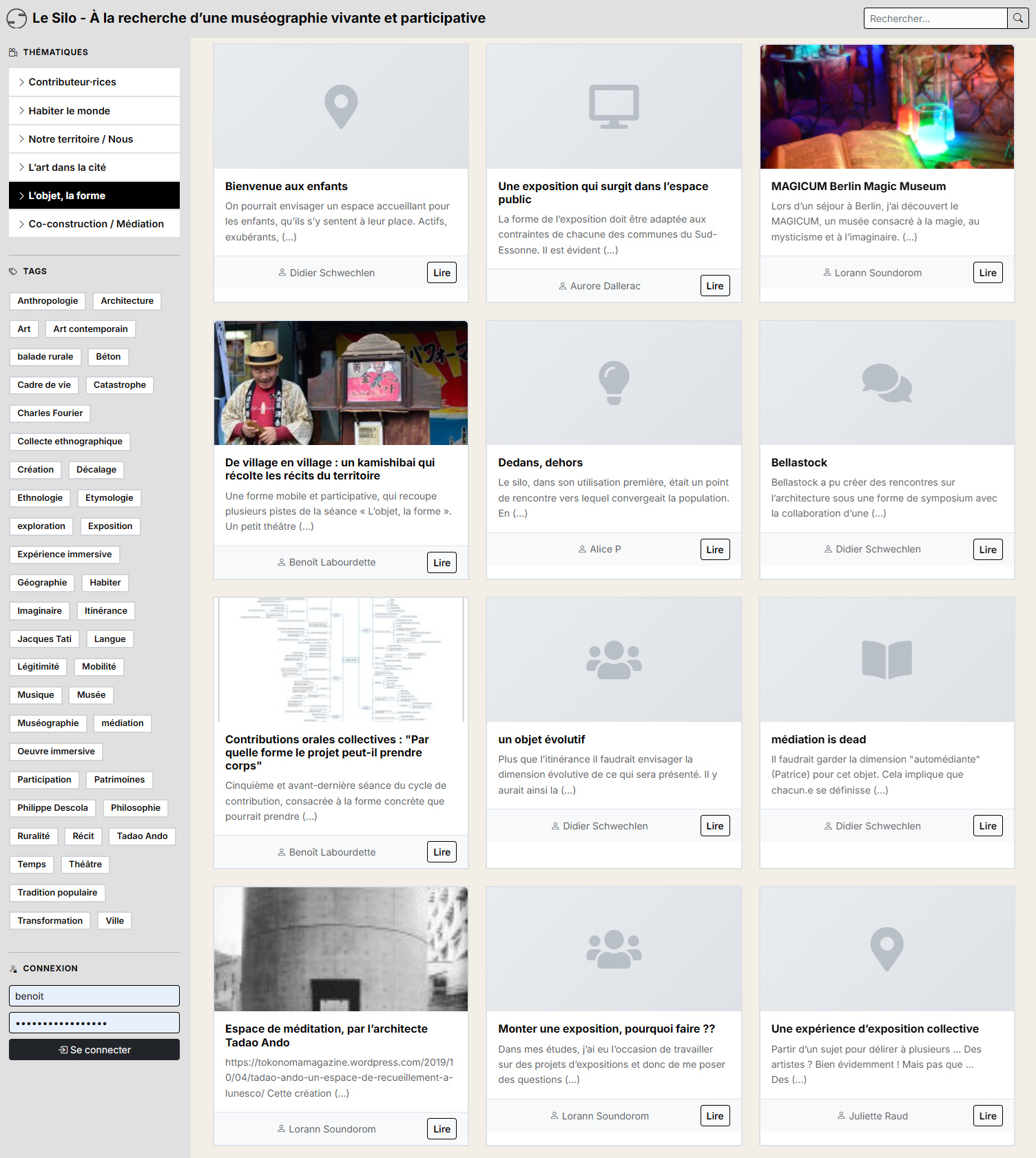
The process took the form of a cycle of videoconference sessions, linked to a digital contribution platform running on free, open-source software hosted in France, where each person writes during and between the meetings. A founding session in May, in which the team defined, by contributing on the platform, what it was going to do together, then five thematic sessions, on subjects that followed on from one another without being sealed off, inhabiting the world, our territory and us, art in public life, the object and its form, co-construction and mediation, the first of these subjects serving as the guiding thread for the whole.
We chose this thread because it lets a great deal in, the intimate and the collective, the home and the landscape, family memory, the political question of the commons, the place of digital technology in a life. The Latin habitare denotes a lasting relationship with a place, and not merely lodging there. The depth of the word allowed very different people to recognise themselves in the same subject, and to engage with it each from their own experience.
A session runs for an hour and a quarter: an informal welcome, a discussion of which I take notes shared on screen, a time of individual, silent writing on the platform, and a collective return to what has just been written. The set-up is simple; whether it produces a great deal or very little depends on the way it is conducted, far more than on the tool.
The session begins before the session
Everything is prepared upstream, starting with the tool itself. Before the cycle of sessions, a meeting served to co-construct the project, with the platform acting as a space for gathering ideas. The team deposited its wishes, its framing texts, its first intuitions there, and this broad preliminary harvest changes everything for what follows. Once the ideas have been put down, they have a right to exist, and it then becomes much easier to work from them, because they are already there, signed, and everyone can read them again. You do not start from a blank page at each meeting, you start from material the group has made its own. And the project itself was defined using the very method that was then going to be used, which gave the team lived experience of what it offers to others.
Each session then begins in the quarter of an hour that precedes it. With Lorann Soundorom, who leads the project for the Silo and facilitates with me, we check the participants’ accounts on the platform, we go over the division of roles again, we run through what will be particular about the day’s session. Having walked through the coming session several times gives a familiarity with the situation which, paradoxically, allows you to be more flexible. You know you will land on your feet if things go differently from what was planned, because you have in mind what is at stake in the session, and no longer just its running order.
Feeling recognised before contributing
What I seek to establish in these sessions, before any production of ideas, is a climate of trust. A person only contributes if they first feel recognised in their identity, in their place, in the roles assigned to them, including those they assign to themselves. This recognition cannot be obtained by a speech that would declare it, it is built in the situation itself, through a welcome that gently names each person’s place without pinning them to it.
The first concrete gesture of this recognition is the introduction. Each person publishes their own introduction on the platform, which is at once a way of getting to grips with the tool and a first contribution. They name themselves, they say where they speak from, and nobody does it in their place. When guests are present because of their position, as were Aurore Dallérac, director of the museums and heritage department of the Étampois Sud-Essonne agglomeration community, and Didier Schwechlen, dance and visual arts adviser at the Essonne departmental council, we invite them to contribute in three capacities at once, in their own name, in their official capacity, and as relays for the words of inhabitants they gather in their daily work. This proposal answers a question that anyone invited to contribute in a professional setting asks themselves, that of whether one has the right to speak for oneself.
Nobody is under any obligation to deliver results, nobody is even obliged to contribute. It is within this obligation-free frame, once you have felt recognised, that contributions come. And when recognition is there, people dare to draw on what they know how to do, because they no longer fear being judged.
Setting the frame through discussion, validating through writing
The discussion that follows the welcome serves to set the frame. I take notes on it as a mind map, on screen, in front of everyone. This visible writing has a precise effect: each person sees their words validated and legitimised, without judgement, as they speak them. Seeing your own words taken up, written down, connected to others, is feeling respected, and this respect is the condition for going further.
There is no power relationship between the people present. I lead the discussion, but nobody’s word carries more weight than anyone else’s, and if someone has not spoken, they are offered the floor so that they can express themselves, without being forced to. It is this attention to each person’s words that settles trust.
At one point in a session, I had the feeling that Didier, who is more reserved, was being left aside by an exchange that was taking place mainly with Aurore, who is more spontaneous. The professional reflex would have been to regulate, to hand him back the floor. I held back. Had I stepped in to restore a balance that I alone perceived, I would have acted as though I were not myself a party to the exchange. I waited, trusting Lorann, who was facilitating with me. What followed showed that this feeling said more about my own frame of reference than about him. During the writing time, Didier, who had spoken little, published three contributions, on concrete, on natural heritage, on the territory’s place in the outer ring of the Paris region. He was not being sidelined, he was listening, and the platform was for him a way of contributing that matched his way of being.
The writing time, where the collective authorises the personal
Then comes the time of individual writing. Since everyone has already taken the platform in hand during the introductions, there is no longer any technical barrier. It is an individual moment of creativity, in silence, each in their own way, and nobody is judged. This moment draws its strength from what came before it. It is because the collective has recognised each person, because their words have been validated without judgement, that a person can withdraw into themselves and write something that belongs to them alone. The collective authorises the personal, and the personal, once published, feeds the collective in return.
Each theme is introduced by a text that sets out what is at stake and by a list of open questions. Questions are put to people, and it is up to them to bring answers. This reverses the usual order, in which only experts would have answers to offer. Here, everyone can answer, and people who would not, at the outset, have been thought legitimate to do so make inventive proposals, because they have been authorised to free their creativity, because they know they will not be judged.
Examples abound. Alice proposes an excursion through the territory by way of the online reviews left on its ordinary places, the McDonald’s in Angerville, the rail-bike line in the Juine valley, the Bricomarché in Méréville, reviews which, placed end to end, draw a portrait of southern Essonne. Mariam Faquir, a dancer, imagines turning concrete into a recipe whose gestures, pouring, turning, mixing, become a performance. Juliette Raud wants to create wildly fanciful silos with people, to spark imaginations. Aurore proposes a walk with no preset route, in which the walkers choose their path and the element that struck them most becomes the totem of an artistic restitution. None of these ideas would have fitted into a questionnaire.
While the others write, I sometimes contribute too, because in this process I am in the same place as everyone else and I can take part in it. But my main work, at that moment, is to take up what has been said, cross-reading the mind map and the oral exchanges, and to turn it into a written synthesis that I put online, in which the words spoken in the first part of the session are taken up and given their due, and which itself becomes a contribution. Then, having read what the others have written as it appeared, I give an overall summing-up, and speech returns for a final discussion in which we build on what we have written.
A tool in the service of the method
This platform is a tool within a process, nothing more. Collective intelligence does not come from the platform, it comes from the method that puts the platform at the service of people. An identical set-up, run without attention to the people and to what they are living through, produces far weaker results, because people do not give themselves permission.
The tool does, however, make possible things that speech alone cannot. Contributions remain, they can be reread, amended, completed at any time, including between sessions and by people who were absent. They are signed, which commits and gives value to those who write them, and each one is an act of creation in itself, and not an answer in a box. The harvest builds up as it goes, and each person can take stock, in their own way, of what has been deposited before. It is through this continuity that the link is made from one meeting to the next. Patrice Barry, who carries the association, remarked at the end of one session on how fluid the conversation had been, everyone having had their time, which, as he put it, does not happen so often, on video calls or anywhere else.
At the last session, two absentees join the process within minutes
It was during the last session of the cycle that this continuity showed its value most clearly. Agnès Mane and Cathy, who runs the community café at the foot of the silo, had taken part in none of the previous meetings, caught up as they were in preparing the Les Traverses festival. They had heard a great deal about them, and they came to the last one to see how it worked. Within a few minutes, at the start of the session, they had taken the platform in hand and published their introduction as a pair, then discovered, as the meeting went on, the writings deposited over the previous weeks. The whole process remained fully accessible to them, because everything that had been written in it had stayed online, readable and signed.
They did more than catch up on what they had missed. Cathy asked, that day, a question nobody had yet asked, that of how to connect what one learns from books and what one makes with one’s hands, without pushing away those who would not feel legitimate on the side of books, and this question, drawn from her experience of welcoming people at the café, became one of the project’s working threads. As for Agnès, she said at the end of the session what the meeting had done for her. She did not know me, she said she was very pleasantly surprised by what had happened, and, in her words, the process had given an energy, an engine to this research. Looking at who was gathered, the team, a regular, a dancer, a museum director, she also found this phrase: “it’s the Silo, already grown larger.”
That is indeed what the method produced among people who already knew each other: these people all frequented the place, each held their own position there, and the set-up allowed them to create together something that goes beyond those positions, a shared project none of them would have carried alone. At the very end, nobody wanted to leave, and this detail, which might seem anecdotal after five sessions by videoconference, gives a fair measure of what had been built.
An A-to-Z and a small book drawn from the harvest
Once the harvest was gathered, artificial intelligence helped us to shape it quickly. The material was rich, because people had given themselves permission for everything, few though they were, and we were able to produce, on the very day the cycle ended, two documents: an A-to-Z of the words that ran through the process, each traced back to those who used it, and a small book that gathers, by broad questions, what circulated from one meeting to the next, without melting the voices into a single synthesis, because their diversity is what makes the material. Both documents are attached to this article.
One may object that using a machine for this consumes resources. That is true, but a videoconference consumes resources too, and so does a computer that is switched on. The time shared during these sessions was productive because we made room in it for the intelligence of each and every person, and the harvest that results from it is dense enough for a great deal to be made of it. Then using a machine to draw syntheses from it stays within the same logic: meaning comes from the human time spent together, and the tool, digital or algorithmic, serves that material instead of replacing it.
These documents are not a final point. They are states of a research in progress, deposited so that they can be taken up again, and the team will use them, or not, for what comes next. The first milestone is set: the European Heritage Days in September 2026, for which the team has set itself the goal of a simple, playful, participatory proposal, the starting point of a journey rather than its completion. What was built during these weeks reaches beyond the coming event. The Silo team now has a way of doing things, and of thinking about the bond between people, which it can take up again on its own, on other subjects, with other people.
The alignment of the person who facilitates
The recognition and the listening that these sessions ask of the participants, the team that runs them must grant to itself. This is what I call alignment, the coherence between what a process asks of people and the way you hold yourself while facilitating it.
A participatory process consists first of all in leaving room for the other’s desire, that of inhabitants, artists, partners, even when that desire escapes us or unsettles us. During the cycle, Lorann saw a desire of her own take shape, that of a consultable object which would give an account of the process and accompany the museographic work to come. Had I set about reining her in, or showing that I knew better than she did, I would have stifled that desire at the very moment it was forming. A team that did not practise this listening within itself would be asking of others what it does not grant itself.
This coherence presupposes accepting to be touched and moved oneself by what happens. The warmth of a collective moment does not fall from the sky, it is built, in a smile, a way of addressing people, a choice of words, and it is up to the person who facilitates to give that impulse. It is work on oneself before being a technique.
Creating occasions to meet, rather than delivering culture
The Silo project is a small project, carried out with few people, in a rural territory poorly served by public transport and little known to its own inhabitants. This modesty is the very condition of the project.
Public consultation schemes have become widespread in public policy over the past fifteen years, almost always in the form of the questionnaire, in which people remain at a distance from one another and each person is taken for a reservoir of ready-made opinions. Another way is possible, one that draws on creativity, on the recognition of people, on the room left for the other’s desire. When a collective intelligence process is carried out with this alignment, when preparation, recognition and attentiveness to desire are practised and not merely proclaimed, it produces more, and faster, than one would imagine, including among people who already know each other and who discover that they can do together something other than what they were doing.
In a territory where withdrawal into oneself has free rein as soon as the places where people used to cross paths disappear, such a project is not about delivering culture as a commodity, it is about creating the occasions to meet, to recognise one another, to make together a trace of what we live. The way the project is built is already part of the project.


