Many pupils leave their music or dance school during adolescence. Each teacher has ideas and things they have tried to keep working with them, which colleagues in other schools never hear about. So that they could learn from one another, I built with the Mixt team a framework in which every person would feel entitled to say what they know. Here I explain why we cared about this, how we prepared it, and what I learned from reading what the participants wrote once they felt confident.
Learning from colleagues
In Loire-Atlantique, about 250 people teach or work in music and dance schools. Their pupils are the same age, a few kilometres apart, and most of these teachers have never met. If someone in Châteaubriant finds a way to keep their fourteen-year-olds, nobody in Couëron knows about it. The Mixt team organised the day of 12 November 2026 for that reason, and asked me to run the afternoon so that these people could teach each other things.
I care about this idea, and to me it is a political one. You can train professionals by sending them someone who knows. You can also consider that they already know a great deal, each in their own corner, and that the job of an institution is to give them the chance to tell each other. I believe people need the second way as much as the first, and that it is rarely offered to them.
These schools are run by towns, groups of towns or associations, in cities or in the countryside, and they do not have the same size, the same means or the same access to training. The team of Mixt, the public institution born in Nantes from the merger of Le Grand T and Musique et Danse en Loire-Atlantique, took over the task of training those who work in them. Opening the day, the director, Catherine Blondeau, said how she understands the role of her house. The institution is funded mainly by the Département, and her team carries out the Département’s cultural policy across the whole territory. She says the word cooperation, she told us, “about fifty thousand times”, and she spelled out what she means by it: gone are the days when the big institution in the main city told the small ones in the surrounding towns what to do. She was speaking of the theatres of the Département, with which her team builds seasons, and she described that network as a network of peers. Of the music schools, she said that her team builds tailor-made training there, based on what teachers need, and that the point is also to create ties between professionals from different schools.
Jenny De Almeida, head of the mediation, engineering and training department, then explained where the day came from. When Mixt was created, in 2025, her team opened a series of exchanges with the teachers and heads of the schools, to rethink the training organisation starting from what they ask for. In February 2026, she launched a survey: fifteen schools visited, 129 answers. Wilfrid Lebrec, who is in charge of the training organisation, gave a few figures. More than half of the teachers who answered have been teaching for over twenty years. Nearly half place pupils’ motivation and commitment among their priorities. And they ask for exchanges of practice, professional days and short training sessions. 12 November was the first of those days. The Mixt team did not choose its theme alone; it chose it with a steering committee of school heads.
The age when pupils leave
The members of that committee chose adolescence for two reasons, which Wilfrid Lebrec had given me when we started preparing the day. It is the age when pupils leave the schools, sometimes for good reasons. And the new plan of the Département asks teams to open their school to its surroundings, which means welcoming teenagers in other ways than the graded curriculum, the one-to-one instrument lesson and music theory. The day was called “Understanding teenagers to welcome and support them better”.
In the morning, the psychosociologist Joëlle Bordet spoke about 11-to-15-year-olds. For her, adolescence is a birth into the world, and young people need adults to offer them “containers” in which to transform what overwhelms them. She calls “educational hospitality” the fact that the adults of an area take this on together, and she made clear that she did not mean a partnership of activities but a shared watchfulness. She quoted Hannah Arendt: a society must be solid enough to pass things on and supple enough to welcome.

A round table followed. The head of an association-run school said she lost her pupils when they started secondary school, then again at sixth form, and that her brand-new building was cold, without a poster or an armchair to sit in. The director of the Saint-Nazaire conservatoire told us about the “salad concerts” of the Lycée Aristide-Briand, which have existed for more than thirty years, and the studios where pupils rehearse with no adult present. He drew from it a question for his own institution: are we able to trust, and to leave places and time? We also watched six minutes of video, in which teenagers from Châteaubriant, Saint-Brévin and Couëron say why they come to music school: friends, clearing their heads, choosing the pieces.

All morning, then, the speakers talked about the room to be left to teenagers. In the afternoon, we were going to ask ourselves the same question about the adults sitting in the tiered seats.
Every person knows something
If the Mixt team thought of me, it was because of Laval. On 2 September 2026, I had run there the start-of-year morning of the city’s culture department, for 220 people, including the conservatoire teachers. I had prepared it with the director of the conservatoire, among others. Every person had spoken at least twice, and we had put 80 written contributions online (A new season with 220 voices). That morning is what inspired the Mixt team. Wilfrid Lebrec asked me to run the afternoon of 12 November, and to make sure that this time would belong to the participants’ contributions. I would like to say why we cared about that.
Most often, a training day is built on the same model: people who know speak, the others listen, and at the end three or four hands go up. I liked Joëlle Bordet’s lecture very much, and I believe we need that kind of distance from our practices. I said so at the start of the afternoon: after that, the question is how we act. While she was speaking, I imagine each teacher was thinking of a pupil, of something they had tried that worked, of an idea for their class. I told the participants before lunch: there is the intelligence of each of you, the experience, the methods of each of you. If we stop after the talks, everyone goes home with what they had in mind, without having heard the others.
In my work with cultural teams, I always come back to the same distinction. With democratisation, you bring works and knowledge to audiences. With cultural democracy, you start from what people already know and do. It is usually discussed for audiences, and on 12 November I used it for professionals in training. Every person knows something. The difficulty, as I said at the start of the afternoon, is knowing what, feeling entitled to say it, and sharing it, because it may be useful to others.
You also need a place to do it. When you teach an instrument, you spend your days in a room with one pupil at a time, and I cannot quite see when you would learn what a colleague has tried in the school next door. The teachers said so in the survey when they asked for exchanges of practice, and someone wrote it in their own way in their booklet that afternoon: “When a teacher is alone and struggling with this age group, what means of cooperation are there?” For an hour and three quarters, we tried to make one of those places.
I am not a specialist in music schools. I am a filmmaker, I work all year round with children and teenagers, and I had just finished a film about children’s right to speak in a progressive school. For years I have also been running sessions in which professionals write together, in person or online (A web platform for collective intelligence). In Nantes, then, I had nothing to teach the teachers about their job. I had to prepare a framework in which they would teach it to each other.
A month of preparation, the two of us
Wilfrid Lebrec and I built this afternoon together, in October and early November, by video call and by email. I describe what we decided, because the participants only saw the result.
I first wrote a list of fifteen themes, based on what the teachers had said in the survey. On 6 November, we went through it together. We removed three themes, including “The body and other people’s gaze”, merged two others, and Wilfrid Lebrec asked me to add “After the curriculum”. Twelve themes were left. He had sent me the pupils’ video, and I checked that everything they say in it could be found in the text or the questions of one of the tables.
For each theme, I wrote four questions. With general questions, the same for every subject, people write little. On the sheet of the group working on those who give up, the third question was: “A teenager tells you this is their last year. What could you offer them, other than stopping or carrying on as before: fewer hours, a different class, a break?”
We discussed the number of people per table. Wilfrid Lebrec was thinking of nine or ten, and I argued for seven at most, so that everyone would have time to speak. We had planned a collective discussion at the end, in front of the contributions shown on screen. We dropped it to give the groups half an hour more. On the day, Wilfrid Lebrec and Magali Mériaud guided people to the fifteen tables, where a sign, a sheet and felt-tip pens were waiting for them.
For registration, I wrote an online application, specially for this day. It was the first time I used it. Before lunch, I showed on the big screen the twelve themes, the table numbers, the places left at each, and a QR code. By scanning it, each person opened the list of themes on their phone. They could read the text of each one, choose one, type their name, and they received their table number straight away. They could change their mind, or register a neighbour who had come without a phone. So people chose their table over lunch, knowing what they were going to talk about, without anyone assigning them. After lunch, we printed the list for each table from the application’s admin page.

The order of things
In Take some felt pens and take a table I described the objects I had prepared: the booklet, the boards for writing on your lap, the pens, the signs, the photo stand set up on stage from the morning. Here I would like to give the reasons for each step.
When I presented registration, before lunch, I gave an instruction. Usually, people choose a workshop to fill a gap. I asked for the opposite: sign up where you think, here I have something to bring to the others. I added that we were not going to look for the right solution, and that what makes a group’s common ground is that its members are different.
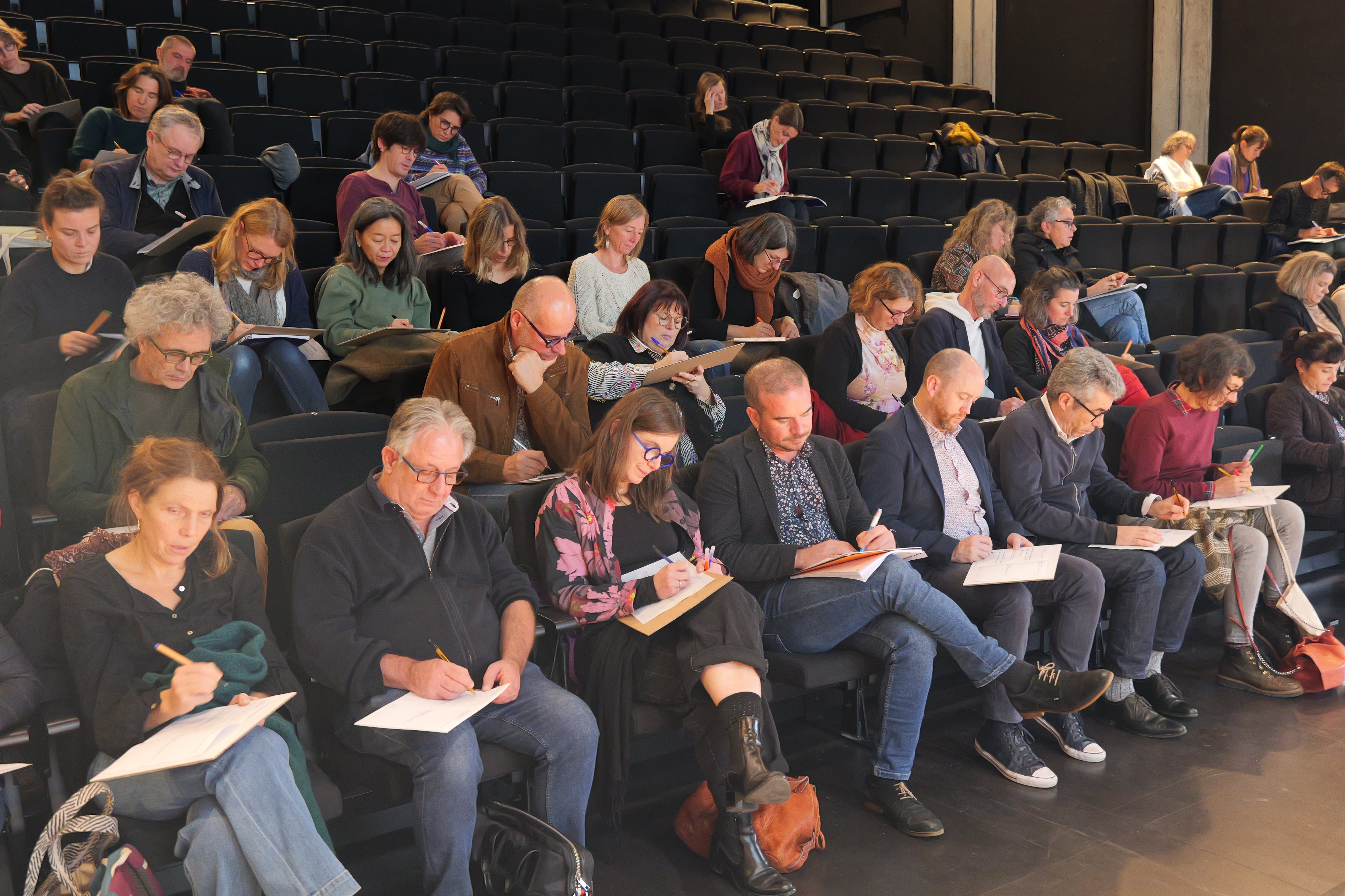
At 2 pm, in the tiered seats, I asked everyone to turn to the person next to them. For a minute and a half, one answered a question and the other listened, then they swapped. In an assembly of a hundred people, not everyone can speak, and speaking in public is very hard. In pairs, everyone speaks. When you put an idea into words for someone, you do not pull out a ready-made idea: you sharpen it, and you find others as you talk. I then told the participants: “I have absolutely no idea what was said.” I have no way of assessing those exchanges, and I wanted it that way, because they belong to them. I also said that people were allowed not to follow the instruction.

Then each person wrote alone, for a little under ten minutes, in a booklet with four boxes: what I take away, what I disagree with, what was not said, what I propose. People write more willingly when they have just spoken and been listened to, and they then arrive at their table with something of their own. I put in the disagreement box because democracy, to me, is the organisation of disagreement. I told the participants that if everyone thinks the same thing, it is no longer democracy. I put in the box “what was not said” because in a day some subjects are always forgotten, and the people present know which ones.

Next the groups went to their tables, in the hall and in the space where we had had lunch. Before they left, I asked two things of them. The first: “I advise you to appoint a timekeeper.” When you are in a discussion you do not watch the clock, and I told them it would be a pity if some of them had no time to speak. The second: leave a written trace. I told them that the discussion would be fascinating, that at that point they would no longer feel like writing, and that they should watch out for it, because what you write is of use to others. Lastly I told them they could set my questions aside and talk about something else. The groups worked for three quarters of an hour without me.

Meanwhile, I photographed the booklets and put them online. On their way back from the tables, each person picked up someone else’s booklet from the stage and took it home. A QR code printed on the cover gives access to everything the participants wrote, because this work belongs to them. At 3.45 pm, while Maxime Leschiera, director of the Bordeaux Conservatoire, was concluding the day, many were reading other people’s booklets on their phones.

Proposals that came from colleagues
In under two hours, the participants filled 64 individual booklets and 12 group sheets, on eleven of the twelve themes. I read all of it, and here is what I take from it.
In the box “What I take away”, I mostly find Joëlle Bordet’s words. Five people copied out “educational hospitality”. Five noted that adolescence is a birth, and one of them adds: “it’s a lot of work”. Another notes “the good ideas of each school”.
38 people wrote in the disagreement box. One person disputes the social categories used in the morning, another the references to psychoanalysis. Someone rejects the idea that the schools are set in their ways. One person asks, in green: “Why want to keep the pupils?” And several teachers write that they had come looking for tools for their lessons and did not find them in the morning: “I wasn’t expecting such a ’politicised’ talk, very interesting of course, but very far from my current practice.”
I find that expectation legitimate, and it is the one we were trying to meet in the afternoon, by another route than that of a trainer bringing his tools. I counted 56 proposals in the box “What I propose”. They were written by colleagues, who have the same pupils, the same timetables and the same rooms. About twenty come down to handing teenagers a share of the project: a free hand, a concert they programme, audition themes chosen by the pupils (“already tried, it works well”). One person would like to bring teenagers and teachers together in June, “forum-style, with workshops”, to decide together on the following year’s project. Others want to leave a room free, open a workshop where the adult only drops in now and then, play with the youth centre or at the secondary school. One teacher suggests saying to those who leave: “You have been and you remain a pupil of ours”, and inviting them back to play.
At the tables, the groups wrote more precise things than in the booklets, and I think it is because my questions were more precise. The timetable group did the sums for a pupil aged fourteen or fifteen: 3 hours 40 at the conservatoire each week, three quarters of an hour of travel, getting home at 9 pm some evenings. It proposes going to play at the secondary school during free periods, which it calls a “musical drop-in”. The group working on those who give up wrote, in red: “Stopping can also be positive! and normal”, and in green: “Leave the door open.” The concerts group imagines a free-hand evening that teenagers would build with their friends, outside the school walls. The after-curriculum group wrote: “What comes after the curriculum happens during the curriculum.”
Some participants also challenged what I had prepared. The group working on teenagers’ voices circled in pink felt-tip the sentence I had printed at the top of its sheet, “Interviewing a teenager is not giving them a voice”, and wrote underneath: “It’s very leading. It presupposes that the teenager would try to answer what is expected. Is that always true?” In a booklet, someone regrets “a fashion for ’sprinkling’ very short exchanges of ideas” and finds that one learns less at these tables than by listening to a long talk. I put both remarks online with the others.
The two tables on digital technology stayed empty. We had doubled them because the subject came up often in the survey. Thinking back, I had asked people to sign up where they have something to bring, and I think that on digital matters many teachers feel they have nothing to bring, because it is not part of their practice. Several people nevertheless list it, in their booklet, among the things that were not said, and one of them notes: “Digital doesn’t hold the room’s attention… a message?” Next time, on this subject, I would rather start from what teenagers do.

Doing it with them
Maxime Leschiera already knew my way of working. In his conclusion, he said there was “a direct connection” between the method I had proposed and the subject of the day. Working as we had just done, he explained, leads you to wonder how you would do it with teenagers: leaving room for everyone, not controlling everything, and telling yourself that your role still exists when you do not know everything that is being said. I found the same thing in the booklets. When a teacher proposes a forum in June with the teenagers, or a workshop where the adult only drops in, they are describing more or less what they had just experienced at their table. One group wrote at the bottom of its sheet: “Being in a group GIVES energy! (for us too)”.

Jenny De Almeida closed the day by saying that her team asks itself the same question with the teenagers it welcomes: how to do things with them, and not always for them. She spoke of what has to be let go, of the methods to be trained in, and of what the Mixt teams and the school teams have to learn from one another. For Wilfrid Lebrec, we were starting a piece of work that day: his team will be able to continue it with more focused days, or by creating times when teachers from several schools go on thinking together. I am preparing for them the summary of the contributions, theme by theme, so that it can serve that purpose.
Before handing back the microphone, I told the participants that making room for others is far more work than taking the decisions yourself. Wilfrid Lebrec and I had spent weeks writing twelve sets of questions, a booklet and a registration application, counting the minutes, imagining how people would move around. But what it produces is beyond comparison. I ended with a sentence I often repeat: the framework is not what constrains, it is what authorises (The framework that authorizes).
Points not to miss
- I start from what people ask for. In Loire-Atlantique, the teachers had answered the February 2026 survey: exchanges of practice.
- I prepare with the person who invites me. With Wilfrid Lebrec, we went from fifteen themes to twelve on 6 November, six days before the event.
- I write a tool when it does not exist. For Nantes, a registration application in which everyone read the content of the tables on their phone before choosing one.
- I ask people to sign up where they have something to bring. As a result, in Nantes, the two digital tables stayed empty, and I learned something I would not otherwise have known.
- I start with pairs. In the tiered seats of the Nova hall, a hundred people each spoke for a minute and a half, and I heard nothing of what they said to each other.
- I have people write alone before the group. People arrived at the tables booklet in hand, with a proposal already written in it.
- I print a box for disagreement. 38 people wrote in it, and one group challenged in pink felt-tip the text I had printed on its sheet.
- I limit tables to seven people. Wilfrid Lebrec wanted nine or ten, I held firm, and I asked each group for a timekeeper.
- I leave. The twelve groups worked for three quarters of an hour while I photographed the booklets.
- I put everything online before the conclusion. While Maxime Leschiera was speaking, people were reading each other’s booklets.


