Some twenty mediators and managers of mobile cinema circuits and cinemas of the Ligue de l’enseignement had gathered in Grenoble to revive their national network. I led the opening morning on mediation, cultural rights, critical thinking and funding, with moments when everyone spoke in pairs and then wrote. I recount it here with their written contributions, and with what Marco Gentili, of Le Méliès, said about my way of working. I try to help each person recognise the value of what they already do, which seems to me the condition for cooperating.
Photos of their venues before coffee
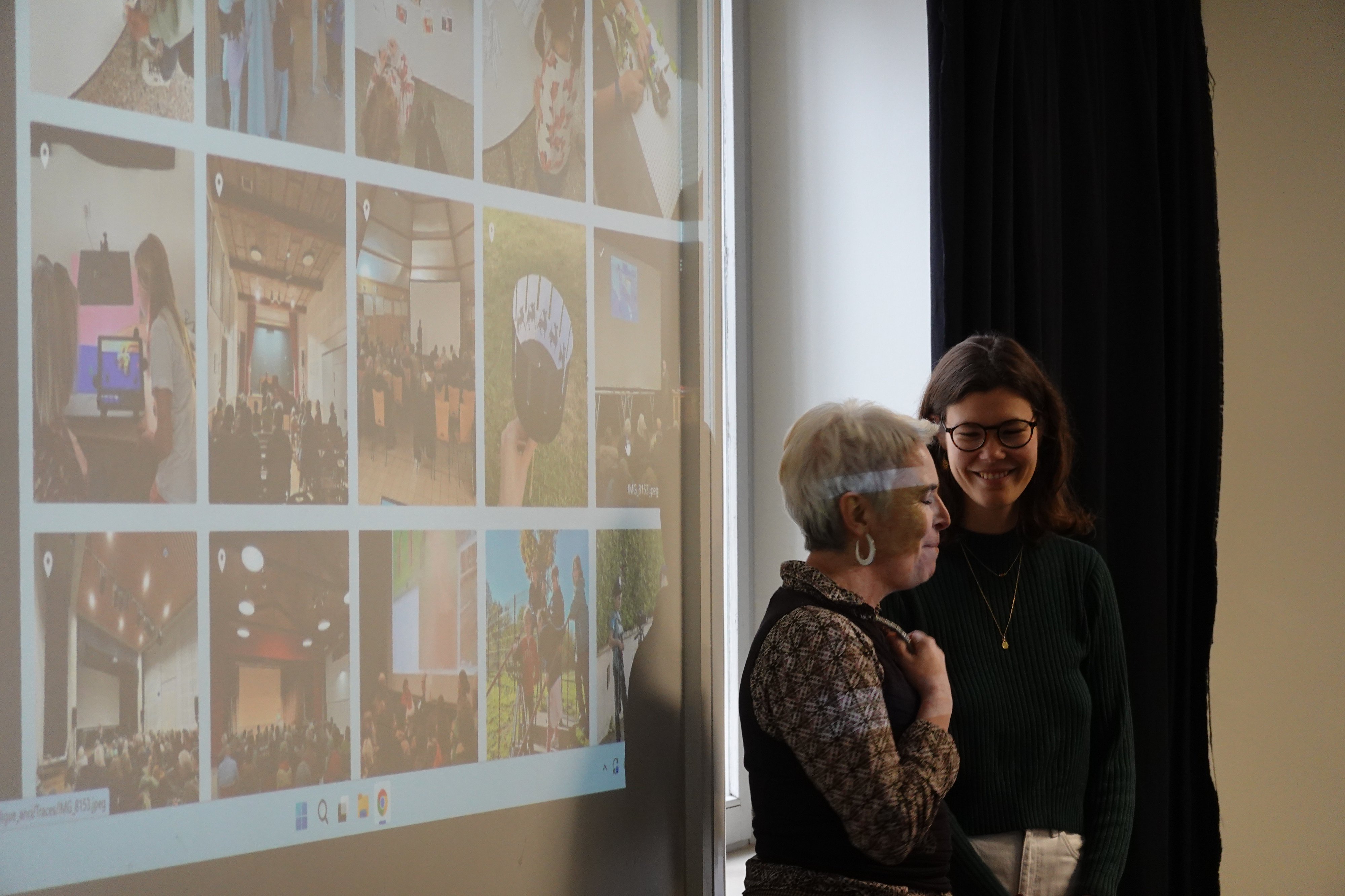
The video projector was not working, it was 9:15, and not everyone had finished their coffee. Before any introductions, I asked who had a photo of their venue, their cinema or a screening on their phone. Hardly anyone raised a hand. One participant ended up saying that her pictures were of no interest: “it’s a person in front of an audience and a screen behind”. I passed around a QR code, created a “Traces” folder in the online sharing space, and everyone dropped their photos into it while we settled in. Within a few minutes there were almost thirty: village halls full of plastic chairs, a screen stretched across a meadow at nightfall, another in a town square, children filming on a staircase with a tripod, an old projector, a cardboard zoetrope.
When the projector worked, that is where I began. An image that seems ordinary to us because it is part of our daily life carries many cultural singularities, ways of setting up, of welcoming people, of turning a village into an audience. It is almost ethnology. We rarely give value to our own images and our own actions, and we need other people’s eyes to recognise it, especially for what we do in our corner, by intuition, without always measuring what it is worth. All morning we came back to this question of the legitimacy of what we do, and to the mutual enrichment that makes it possible to build it.

A century of cinema at the Ligue
We were in the premises of the Isère federation of the Ligue de l’enseignement, which owns Le Méliès. Éric Favey recalled that in 1927 the federation had acquired twenty-two projectors to lend to schools and local clubs, and that it will celebrate its hundredth anniversary next year. He also spoke of the political pressure on cinemas and on popular education today, including threats to withdraw subsidies. Marco Gentili, deputy director of Le Méliès, in charge of image education and young audiences, presented a venue that coordinates the school schemes for the département, from nursery school to secondary school, and whose programme is almost entirely classified art et essai.
Anne Lidove, general delegate of the ANCI, set out the purpose of the two days. Of the 117 mobile cinema circuits that belong to the association, some twenty are linked to the Ligue, and most of them were represented in the room. The project, over two years, is to revive a national cinema group that had existed for a long time, to let people get to know each other and build together, and to lead next year to a public presentation, a publication and a toolkit. “In our mobile cinema movement,” she said, “what matters most isn’t so much cinema, it’s social cinema.”
Before giving me the floor, Marco Gentili asked for a round of introductions. The project officer from the FAL 53 is preparing work on young adult novels, cinema and secularism. The mediation lead from Haute-Savoie coordinates two projectionist-mediators. A project officer from the Drôme summed up her job like this: “I wear a bit of every hat”. The head of the cinema department in the Var, who runs three fixed cinemas and a mobile circuit, said that they did no cultural mediation there, “to my great regret”, and that she hoped to “fill her bag”. When I asked who knew only one person in the room, several hands went up.

I had prepared this session with Paul Oudin, who carries the Ligue’s national cinema mission, and with Fanny Maire, over several video calls with her and Anne Lidove. Their request came down to three angles, which I announced at the start along with the full outline of the morning: where mediation comes from in French cultural history and in the history of popular education, what image education and critical thinking are becoming today, and how to find funding.
Where I speak from
I introduced myself as a filmmaker. My latest film, « Droit à la parole ! », will be screened for the first time on 10 November; it is about children’s speech in a school that has practised a democratic pedagogy since 1946. To be consistent with this subject, I could not just film the pupils, so I gave them cameras; the film contains moments of speech I could never have obtained on my own. I work the same way in my workshops, where the people I hire to lead them with me also create. Together with them, I am looking for ways to make the relationship with the people we supervise more horizontal.
I started in image education in the 1990s, before Passeurs d’images, when the scheme was still called Un été au ciné. In 2005, two things appeared almost at the same time: the camera in the mobile phone, and YouTube. That year, with the Forum des images, we created the Pocket Films festival, devoted to films shot on phones, and some people found the idea absurd: to make films, there were cameras. I used to say that in ten years everyone would have a camera in their pocket, and that a technological fact of this scale would have anthropological effects; with the phone, our relationship to time, to space and to private life had already changed.
Marco Gentili took the floor to describe what the Pocket Films movement had made possible in cinemas like his: remaking one-minute films in a fixed shot with children, like the Lumière brothers, and working with them on point of view and on how characters enter the frame. Before, he used to do it with a clockwork camera. I followed with a story few people know: before the Lumière cinematograph of 1895, Thomas Edison had developed the kinetoscope, in which you watched alone, through an eyepiece, films of about fifty seconds running in a loop, boxing matches, music-hall acts. In the first large-screen projections, people rather saw tableaux vivants, workers leaving a factory, a river in a travelling shot. From the very beginning, depending on the format of distribution, people did not film the same things or watch in the same way, and the small projection came before the large one. That is our situation with the phone: the question is what we do differently, in cinemas, from ordinary image consumption.
Standing or sitting
Next I proposed the sit-stand exercise, which I had already led in Laval with two hundred and twenty people. I ask questions; you stand up if the answer is yes and stay seated if not. Who works in a mobile circuit, who works in a fixed cinema, who leads screenings in direct contact with the audience, who leads workshops. Who came by train, who came by bike: a single person, who lives in Grenoble. Who is wearing second-hand clothes: half the room. Who went to the cinema for pleasure last month, somewhere other than their own cinema: almost everyone, and I hailed a room of cinephiles. Who thinks social networks are dangerous for young people: someone answered that they were dangerous for everyone, and several people half stood up. Who works with volunteers. Who has TikTok on their phone: fewer people than I would have thought.
I commented on the form. Standing up asks for a light involvement, but it is already an expression, and it goes through the body. Before starting, I had taken the time to say that people would have to stand up and sit down, to make room around the laptops; without that preparation, half the people would not have stood up, because they could not. I also slip in a few questions that sting a little, and others that seem unrelated, the bike, second-hand clothes, which bring a theme to light along the way, here ecology. People recognise each other, communities take shape, and I, as the facilitator, learn who is in front of me. With a cinema audience, you can ask questions about the film, about an actor, about the venue.
From Malraux to cultural rights
Then I told a short cultural history, books in hand under the document camera, apologising in advance to those for whom it was familiar. In 1959, the founding decree of André Malraux’s Ministry of Cultural Affairs gave it the mission of “making the capital works of humanity, and first of all of France, accessible to the greatest possible number of French people”. In 1982, the decree on Jack Lang’s ministry gave it the mission of allowing all French people “to cultivate their capacity to invent and to create”. The stance towards citizens is not at all the same, and the second was rarely put into practice, apart from the Fête de la musique, where amateurs and professionals play in the same streets. When the CNC entrusted me in 2011 with creating the Shortest Day, which has since become the Fête du court métrage, that was the model I had in mind: that everyone could organise a screening, including at home, of their own films as well as professional ones.
I recalled that culture in France was first an instrument of power, since Louis XIV funded it for the kingdom’s influence, and that some people criticised the very existence of a state cultural policy without being on the far right: Jean Dubuffet in Asphyxiante culture (1968), and Michel Schneider, former director of music and dance at the ministry, in La Comédie de la culture (1993), where the institution legitimises the artists who legitimise the institution. That did not stop Molière from doing magnificent things in the king’s service; it is our history, and we need to know it.
Cultural rights were formulated in 2007 in the Fribourg Declaration, around the philosopher Patrice Meyer-Bisch, drawing on article 27 of the Universal Declaration of Human Rights; I am part of the group rewriting it for its twentieth anniversary. Culture is understood there in the anthropological sense, what makes me who I am, my language, my neighbourhood, what I eat, my tastes. Respecting a person’s cultural rights means respecting their dignity, and that has a democratic scope. I took my own example: for a long time I thought young people watched worthless things on their phones, and that thanks to me they would see better. I had not even taken an interest in what they watched. A person whose culture is not respected by the institution, or by those who represent it, ends up despising it themselves; they then consider that they have nothing to contribute, and they no longer take part in democratic life. One participant wrote it in her own way on her sheet, at the end of the morning:
“Legitimate culture and the posture of the one who knows instil in people a value judgement on their own culture. This devaluation leads to democratic disengagement.”

This is where the distinction between democratisation and cultural democracy comes from: in cultural democracy, you give up none of your artistic standards, and you recognise that everyone has something to bring to others. I described the workshops I had led the previous week in Tours, in emergency housing, where people made tutorial films about their rights, in several languages, for those who will arrive after them: I know how to make films, and I learned a great deal there, including about how to make films, because I had set up a framework in which I did not hold the power. Some cultural professionals reduce cultural rights to amateur practice and to abandoning all standards; it is rather about taking an interest in the other and accepting to be changed by them, moving from a logic of supply to a logic of cooperation. For anyone who wants to go further, the Réseau Culture 21 has built many tools.
To put it quickly, cultural rights mark the return of popular education into legitimate culture. The ministry was partly built at its expense in 1959, with funds taken from National Education and popular education. Marjorie Glas, in Quand l’art chasse le populaire (Agone), shows how the democratisation offer of public theatre gradually drifted away from people until it reproduced social divisions, hence our eternal question of reaching audiences other than the usual ones. Yet cultural rights entered the law in 2015 and 2016, and the Ministry of Culture now has a directorate-general for cultural democracy, teaching and research, created in September 2025. Many mediators already weave a link with people by intuition, sometimes wondering whether there might be more serious things to do; they can rely on these texts to legitimise this work.
We spend three or four hours a day watching videos on our screens, and those of us who are distribution professionals take up a tiny share of that time. We used to be at the centre of audiovisual practices; we have become marginal. That does not make us less important, and as Jean-Luc Godard used to say, it is the margins that hold the page together; we have different things to do, especially around the collective and the bond between people. I described my own mobile screenings, with a pico-projector held in the hand in the streets. At the War on Screen festival in Châlons-en-Champagne, for six years I have been accompanying high school students who make short films and then take an audience of a hundred and fifty people through the town for an hour to project them on the walls, starting from the cinema and coming back to it. At first it was the festival’s small cultural action; it has become one of its pillars, with the press and photographers, and many spectators leave wanting to see the films and meet the filmmakers. One participant noted on her sheet her interest in these pico-projector screenings, “which can be linked to heritage and even please right-wing mayors”.
Another wrote down a valuable nuance: to legitimise everyone’s culture, start from popular culture and amateur practice, with a sociological approach, and also offer the tools of legitimate culture, aesthetic analysis, narrative analysis. By treating these objects as worthy of being analysed in this way, “you also give value back to the person”.
A minute and a half for the other
First participatory moment, in pairs, with a countdown on the screen. For a minute and a half, one person gives the other an idea for mediation or for meeting the public; the other listens without answering. Then they swap. Nobody is obliged to have an idea; you can stay silent for a minute and a half.
Nobody apart from the two people in each pair knows what was said, and I commented on this point. Speaking in public is difficult; you risk being judged. Speaking to a single person is not dangerous, and everyone has a space for their own thinking. Having to find an idea in a minute and a half, putting it into words outside oneself, is what psychoanalysis calls symbolisation: by formulating words, you do not just translate a thought that is already there, you make it. I regretted not taking part myself, busy as I was preparing what came next; usually I do, and it is better. And I have no power over what was worked out, even though I am the one leading. What makes something common, in this framework, is the diversity of what was said, which nobody knows in full. Democracy is the organisation of disagreement; wanting everyone to think the same thing is totalitarianism. In a cinema, after a film, you can invite the audience to tell their neighbour what they thought, in this way, without dialogue.

The participants took up some of the ideas exchanged in pairs on the sheets they wrote at the end of the morning. Here are a few of them, as they formulated them:
- Create a film club run by pupils, who choose the film, publicise it in their school, introduce the screening and lead the discussion afterwards.
- Use the MashUp table to make short videos about a film, a teaser or trailer, with a voice-over giving two or three strong ideas and personal emotions, to be shown before other screenings and addressed to younger viewers.
- Support young people in organising a screening “while letting them do it completely”, remaining a facilitator, never doing things in their place and granting them the right to make mistakes, right up to the discussion with the filmmakers.
- Have screenings carried by young ambassadors, from communication to programming and facilitation, so that spectators move from passive to active.
- Discuss the film over a drink and a cake: “food draws the public!”
- Approach films for young audiences through a theme, for example a scientific focus in the manner of CinéSciences, with Mary Anning and the Dinosaur Hunters or Le Secret des mésanges.
- Offer activities around image-making, beyond the discussion of the film, and encourage speaking in public.

Thinking for oneself, a social risk
I dealt with funding before the references, without claiming to have a solution. Private foundations, in particular those hosted by the Fondation de France, are places worth looking into, with very good people. They almost always ask for social impact, sometimes impact studies, which can be included in the budget of an application by entrusting them to sociologists. By working with cultural rights, by connecting our proposals to people, we move towards that impact. Your position is nonetheless complex, I said: you show films that already exist, you are in a logic of supply, and the task is to weave links between that offer and more horizontal ways of working.
On digital matters, I described my relationship with TikTok, which I judged harshly eight or nine years ago without having watched it, then installed, explored with teenagers and used in training courses, to the point of writing an article about it for the journal of the Observatoire des politiques culturelles, which is based in Grenoble. It is the only network where the act of creation is immediate: one button starts the camera, and tens of thousands of people can respond to each other within a few days on the same choreography. You are spectator, distributor and creator there; in a cinema, you are only a spectator. The semiologist Roger Odin showed in the 1980s, about what he called private cinema, that amateur and professional images need not be ranked, because they do not have the same function: family images have an identity function. Since 2005, these amateur images have acquired a market value, which the platforms collect, and professionals have lost their monopoly on public distribution.
I put a few books about youth on the table. Sois jeune et tais-toi by Salomé Saqué, on the stigmatisation of youth since Antiquity. For Your Own Good by Alice Miller, on ordinary educational violence and the way the violence children suffer shapes them; France only banned it in 2019. Pour une politique de la jeunesse, in which the sociologist Camille Peugny shows that tastes are very diverse at all ages and that what young people share, across all backgrounds, is anxiety. And Words Are Windows by Marshall Rosenberg, the founder of nonviolent communication, useful when someone in a debate says something that hurts us. I asked whether this had already happened. One participant told of a screening around a film about the Resistance, shot with young people from a local youth employment centre: an elderly person had said that young people today no longer knew how to resist or commit themselves. One of the young people in the film was there; he was the one who answered, and the audience reacted with him. She did not need to step in; the regulation came from the group.
The psychologist Olivier Houdé, in Apprendre à résister, calls cognitive resistance the effort one has to make against one’s own reflexes of thought in order to learn something new. The brain is the organ that consumes the most energy, and our body is made to save it; when a person feels in danger, judged or threatened with punishment, they fall back on reflex thinking and can no longer learn anything. If our job is to open people up to discoveries, we must create conditions where nobody is afraid of being judged. Hence the pairs, and other details: the evening before, I had gone to see each person to introduce myself and ask their first name. A group is an abstraction, there are only individuals, and when each person feels connected with the person leading, they are no longer afraid of stepping out of the group.
Critical thinking, for me, means thinking for oneself; Paul Oudin had suggested another definition to me, choosing to trust a source, and the two meet. Thinking for oneself is a huge social risk, since those who think differently from the group can be excluded from it. Promoting critical thinking therefore means leaving everyone room to think for themselves, and not judging the person who expresses a thought that is foreign to us. I traced a lineage that is dear to me: John Dewey, who writes in Art as Experience (1934) that art is the experience lived in the encounter with an object; Célestin Freinet, who created his schools after reading him; Paulo Freire, who read Freinet and who writes in Pedagogy of the Oppressed (1968) that nobody educates anybody else and nobody educates themselves, since people educate one another through the mediation of the world; bell hooks, who drew on Freire. I also mentioned The Ignorant Schoolmaster by Jacques Rancière (1987), of which you must read at least the first twenty pages: Joseph Jacotot, who did not speak the language of his Flemish students, made them work on their own with a bilingual book, and they learned faster than the others. When you consider that you know better than someone, you reduce their capacity.
Other books stayed on the table, Ivan Illich, Hannah Arendt, Starhawk and her handbook Comment s’organiser ?, Et si on partageait la culture ? by Serge Saada, Faire culture. De pères à pairs, edited by Pierre Brini and Emmanuel Vergès, to which I contributed, and the Histoire culturelle de l’IA edited by Alexandre Gefen. I ended with an example that hurts: Netflix. Its founder, Reed Hastings, described an organisation where employees are very autonomous and constantly change their methods, permanently observing what subscribers do; it was also by finely analysing their audiences that its managers decided to produce House of Cards. It is capitalism at its most brutal, and in a sense they take more interest in people’s practices than we do. What I meant was that if we open ourselves more to people, our working methods, and perhaps our organisation charts, will have to change too.

An idea for funding, even a wild one
Second round of pairs, on another question: an idea for finding funding, a foundation you have heard of, a lead, even a wild one, since only the other person would hear it. Then ten minutes of writing, on paper, with felt-tip pens. I proposed three entry points. One or more ideas received or to share: what seems obvious to us is where our competence lies, and that is precisely why it must be shared, since others have other obvious things. A disagreement with what I had said, since I had monopolised the floor for almost two hours and nobody had had the space to contradict me. A subject that should have been addressed and was not. Everyone was free to sign or not. The sheets were photographed and uploaded to the online space, nineteen in all, and meanwhile I photographed the books on the table to add them.
The participants drew up a map of funding: calls for projects, funding from the départements, foundations such as Engagement Médias pour les jeunes or La France s’engage, mutual insurers and cooperative banks, local businesses, crowdfunding, and the FDVA for training volunteers. One participant wrote “mobilise France’s great fortunes (we believe in it)”. Another: “apart from the classic channels, which are more and more in demand, we need to find something else. Once I’ve said that... I’m open to ideas.” Two people regretted that the question had been dealt with too briefly, and they are right; it would have deserved a whole session.

Disagreements were expressed, as I had asked. One participant wrote that her “cognitive resistance” concerned my choice to end on Netflix, and that we should address the cultural differences between the United States and France, the notion of entertainment, and the history of Netflix, which started by sending DVDs through the post. Another wondered whether it is not reductive to offer subscribers, as Netflix’s algorithm does, the series they already expect. A third regretted that we had talked mostly about image education, social networks and platforms, and not enough about film education, about the relationship to the cinema and to works. A fourth replied to what I had said about TikTok that she recognised its creative possibilities, but that the platform puts people in competition and under judgement, which is harmful for everyone and above all for the youngest. On these last three points I have little to object; these are ways of seeing that I had left aside, and I am glad their authors had a place to write them down.

On other sheets, participants raised broader questions. How to reconcile popular education and popular culture, political conviction and the capitalist culture industry. How to “build society and boost collective intelligence without starting a revolution”; how to believe in the value of artificial intelligence and social networks when these systems “subjugate people”, with this observation: “need proof to the contrary”. How to make a democracy of culture exist within institutional frameworks that follow other logics, as resources become scarcer, by adjusting one’s practices to the framework or by trying to change it. One person suggested a lead, digital democracy: creating one’s own tools to free oneself from the framework imposed by the big platforms. Another noted that it is “always good to shift one’s view of new practices and not to stigmatise them or make them illegitimate”. And another, simply: “It made me want to discover the practices of the other colleagues, to exchange about their different mediation workshops to nourish a shared reflection.”
What Marco Gentili noticed
While the sheets were coming in, Marco Gentili asked me a question I find fair: how do cultural rights, by recognising each person in what they carry, avoid a form of essentialisation, a recognition that would lock people in instead of opening them to the unknown? I answered that being recognised, and even confirmed in the value of what one already has, seems to me the condition for opening up to otherness. If I am not recognised in my roots, opening myself to something that may unsettle me is too dangerous. He added that thinking for oneself is not enough, that one must also look for what connects us, a form of common world. I believe that what makes things common is diversity, and the awareness that others are different; provided one experiences otherness as not dangerous for oneself, one can then work out common rules. Dewey says in The Public and Its Problems that these rules must be constantly rediscussed, otherwise they become fixed; so they must be established democratically, which takes more time, or else some people feel excluded.
He also asked me about what is common in a dematerialised world. Watching a film together in a cinema means hearing the other person cry, breathe, get bored, snore. But digital is not the same thing as data exploitation: the sharing space of the morning is hosted on my agency’s server, in Clermont-Ferrand, outside the big platforms. You can discover a colleague’s sheet there alone in the evening, and go and talk to her the next day. In my collective creations, thanks to these online traces, more people come to the final screenings: they have already seen the films and come to gather and celebrate them. It is keeping the trace in order to meet again, not to replace the encounter.
Then Marco Gentili said what he had noticed in my way of working: I comment on each exercise, I speak from my own place and I speak about the place of others, I respect people, and I exercise critical thinking about the very setup within which we are sharing. “There is no position of superiority,” he said. “You bring knowledge and at the same time you share that knowledge, that practice and that experience, but you bring it to us in a very horizontal way, open to participation.” He added that we adhere all the more to what I say because we are living it, and we can see its effects.

That is what I try to do, to be consistent between what I say and my practice, as with the cameras entrusted to the pupils in “Droit à la parole!”. Commenting on the method aloud serves several purposes. People can take up the exercises in their own sessions, since they know the reasons for them. They can also criticise them, since I have made them visible. And when I say that I monopolised the floor, that I did not take part in the pairs, or which server their photos are stored on, I give a hold to disagreement instead of forestalling it. One participant put it in other words. Usually, when the floor is opened to the room, it is always the same people who speak; that morning, she, who readily speaks up, held back, and others took her place. “You come and initiate something, and then afterwards, for us, it sets things off.”
The people on the ground
Before I left, one participant said what these two days meant to her: “It reminds us where each of us stands in our organisation”, and the meaning we have to share. In national gatherings, she added, managers meet regularly, the people on the ground almost never. Another had written that it was “enriching for my part to address the why of mediation, of the legitimacy of all cultures”, and that it was a good basis for future projects.
I had to leave at noon for my train, which I regretted. The participants carried on without me for two days, in workshops. The online space remains open during these days and beyond, with the photos of the venues, the contributions and the bibliography. Thanks to Paul Oudin and Fanny Maire for their trust and the preparation, to Anne Lidove for the ANCI, to Éric Favey for the welcome of the Isère federation, and to Marco Gentili and the team at Le Méliès.

To go further:


