A travelling exhibition about nine women who built, named or defended Villetaneuse, five cut-paper filmmaking workshops in four places across the town, a public screening on 7 March 2026, and an online space where everyone can find the films. I recount this project in detail here, because that is where, in my view, cultural democracy is concretely built.
Pierrette Petitot, mayor at twenty-seven, and eight others
In Villetaneuse, a small town in Seine-Saint-Denis, the memory of women is inscribed in stone and on nameplates. The town hall was designed by the architect Nina Schuch, born Janina Podolecka in Wilno in 1932, who long remained in the shadow of her partner Jean Renaudie before signing alone this glass and aluminium building, inaugurated in 1993. The first buildings of the university, today Sorbonne Paris Nord, were designed in the early 1970s by the Icelandic architect Högna Sigurðardóttir with Adrien Fainsilber. Renée Gailhoustet built housing in the town. A nursery school bears the name of Jacqueline Quatremaire, a resistance fighter and trade unionist who died in deportation at Auschwitz in 1943; a playground that of Rosa Parks; the socio-cultural centre that of Clara Zetkin, who initiated International Women’s Rights Day; the media library that of Annie Ernaux, and its auditorium that of Zaïma Hamnache-Gaessler, a library curator who devoted her life to giving very young children access to books. And the town itself was run for thirty-two years, from 1945 to 1977, by Pierrette Petitot, who came out of the liberation committee, one of the first women mayors in France, elected at twenty-seven, who had housing built and created infant health clinics and holiday camps, in a municipality which at the time had neither sewers nor public facilities.
This density comes from the political history of the working-class suburbs, where women reached municipal responsibilities early (in 1971, Seine-Saint-Denis had proportionally four times more women mayors than the French average), and where social housing was a field of invention for women architects who long remained invisible. This is what is now called the “matrimoine”, a word of medieval origin that the researcher and stage director Aurore Evain brought back into circulation to name the cultural heritage that comes to us from women, erased in favour of “patrimoine” alone, and which the HF Movement has been highlighting since 2015 with the Journées du Matrimoine. The town of Villetaneuse itself points it out in its communications: only about 6% of French streets bear a woman’s name.
It is within this framework that Gishly Didon, the town’s director of cultural action, who carried this project and made it possible, asked me to design and lead a series of animation film workshops, following on from the Filme Tout Court : Account of a First Collective Experience in Villetaneuse competition, in which I had taken part as a jury member in December 2025. The action was part of the municipal event organised around International Women’s Rights Day, and ended on Saturday 7 March 2026, the 8th falling on a Sunday. Alannah Santos de Almeida, a cultural mediation intern hosted by the town for six months, began by creating a travelling exhibition: nine panels, one per woman, with biographies, photographs and quotations. This exhibition was the starting point for everything else. Noélia Perez-Rodrigo, Town-Media library coordinator, provided the link with the Annie Ernaux media library and took part in every workshop.
Nine trays, a camera, a microphone and scissors
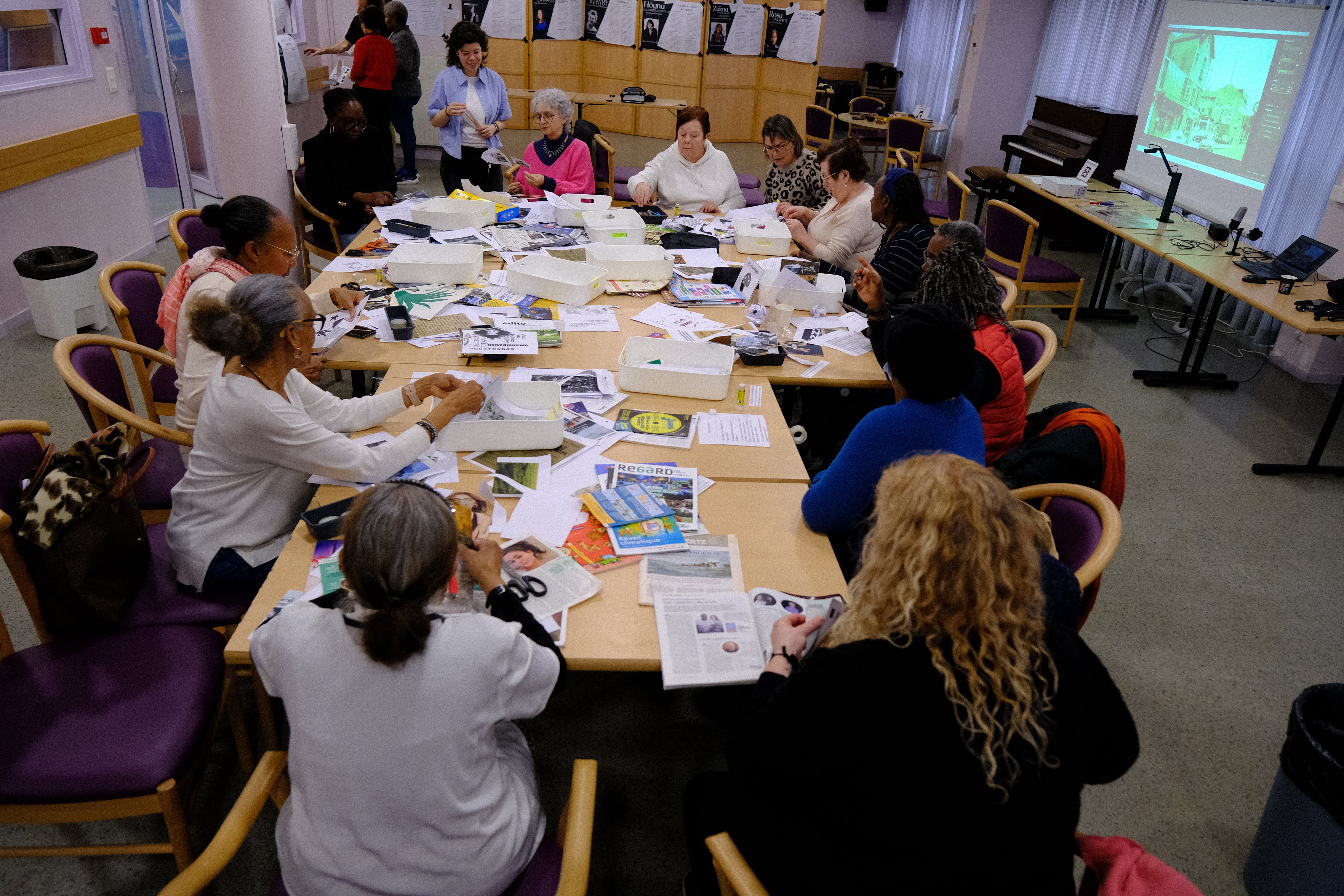
Five workshops took place between February and early March: two at the Annie Ernaux media library, including one I offered to add the day before the screening, one at the Lucie Aubrac secondary school, one at the town’s seniors’ centre, one in a community centre. Each time, we spent considerable time setting up and transforming the space, so that the place itself would do the mediating: the large cutting table in the centre, the camera connected to the video projector, the microphone, the musical instruments, small islands where you can withdraw to prepare your film, and the exhibition, present at every workshop.
The people who arrive do not know what they are going to do. They do not know these women, they discover them; I myself discovered several whose existence I had been unaware of. Making a film, let alone an animated film, does not seem within their reach. But they can see that they can sit down, pick up a pair of scissors, try a small percussion instrument. That leaves the camera, the most mysterious object. So the first thing I do is take two or three people, give them elements already cut out, and ask them to place their hands under the camera: the image appears immediately on the screen, and everyone understands that the camera films what is on the table. I ask them to improvise anything at all, a character saying hello, another one arriving. It takes thirty seconds. The shooting is done in a single take, without editing, and we watch the resulting film together, with amplified sound of excellent quality and a beautiful image; there is a beginning, a middle and an end. A film exists. The moment of hesitation when the person was searching for their words, embarrassing during the shoot, becomes very funny at the screening. This shift, from the lived experience of making to the space of reception, is what matters most to me. Once created, the object takes on its own autonomy and produces effects on viewers that no one had perceived while making it. Some people have become authors, others watch their creation. That is what a device is: different places to occupy, and a capability being born.
The rest is a matter of material. There were nine trays, one per woman, containing everything printed on the panels and more: texts, photographs, quotations, in several copies, to be read or cut out and put on screen. Those trays, I searched for them. At the first workshop, the ones I had were too small, the sheets stuck out; at the second, it was better; at the third, the right object had been found, with each woman’s name on each tray. From one workshop to the next, the mediation tool becomes more precise, and this flexibility of buying, testing and improving as you go is part of the work itself. Noélia had also found 50 x 70 prints on aluminium of old photographs of the town, slightly larger than my camera’s field of view. They served as backgrounds, and the films thus found themselves anchored, de facto, in Villetaneuse’s visual history, since everyone chose their setting from among these old images.
This apparent simplicity comes from long technical work. It took me thirty years to find this camera, fifteen years to find this microphone; the musical instruments, the scenography, the transport cases, the double computer (one for filming, one for screening), all of this has been tested in the field for years. Simple tools for people require more technical work, not less, because the tool must constantly be reworked so that it becomes simpler and more accessible, exactly like phone interfaces, whose growing simplicity has required ever more engineering work. It is this technical fluidity that produces, for the participants, the feeling that things are accessible.
Three registrations announced, some twenty filmmakers
At the first session, at the media library, there were teenagers who were initially unmotivated, mothers who had come with their children after receiving a text message, a drama teacher who had not brought her students in the end but who stayed. Through improvisation, in cutting as in music, things gradually wove themselves together, and everyone took part.
At the seniors’ centre, we had been told there were three registrations. A good fifteen elderly people finally came, if not twenty, who took a little time to understand, then formed small groups and made films that were fragile, beautiful, important. I would never have believed this moment would be so invested. Alannah, who found it hard to dare approach people, ended up at the piano making the music for several films. One lady wanted a jazz atmosphere: I found a trumpet sound on the Kaossilator, a small electronic instrument that makes it possible to create music without musical technique, and Noélia, who says she is not a musician at all, played jazz. For two women who were completely lost, I read aloud the whole panel devoted to Clara Zetkin, and the texts already printed, ready to be cut out, gave them something to hold on to.
This experience confirms something I have been defending for a long time: we must stop believing that creation is what comes from the depths of the self, and that it has no value otherwise. Creation is the encounter with a material. Our job is to offer rich materials, suited to the theme we are defending, and not to be timid about it; people seize them and make something personal out of them. The mission we entrusted to them was in fact explicit: to make films to honour these women, for the other residents. Some films were made individually, others collectively; families dropped in at the media library for an hour or for the whole afternoon; the device is very flexible. Communication, on the other hand, could have been better; group leaders who came to the media library with their groups regretted not having known, and would have organised their visit around the workshop. It always pays to circulate information better, and to know how to talk about the substance of what we do, because it is the substance that interests people.
A QR code on every panel of the exhibition
The films were put online right after each workshop, in an online sharing space organised in folders, one per woman, containing the exhibition panels and, little by little, the films made about each of them. I gave the QR code to the participants, who accessed their film straight away. Elderly people have smartphones like everyone else, and the question of connection through digital tools concerns them just as much. Everyone can download their film, keep it, share it; the films belong to those who made them, and that is a principle I hold to. We had considered a more elaborate editorial website, which the budget did not allow; that is not a problem, the essential is there. After the screening, a QR code was added to each panel of the exhibition, which continues to travel around the town: in front of the Rosa Parks panel, you can now watch the films that residents have made about Rosa Parks. The participants really did make films for the other residents, and other residents really do watch them.
7 March, in the Zaïma Hamnache-Gaessler auditorium
The public presentation took place on Saturday 7 March 2026 at the Annie Ernaux media library: opening of the exhibition, then screening in the auditorium. I had built a programme of about three quarters of an hour, from the more than thirty films made, organised woman by woman. It opened with Clara Zetkin, the mother of 8 March, and closed with Pierrette Petitot, the town’s former mayor. During the last workshop, the day before, we had made with Alannah and Noélia “De l’ombre à la lumière” (“From shadow to light”), a three-voice film about Nina Schuch, the architect of the town hall; it was part of the programme. The filmmakers present came on stage after the screening.
Flore, who had made a film about Rosa Parks with Olivia and Cécile, explained their choice: “to show that with courage and determination, you can manage to do things”. Olivia added: “it was her determination to say, stop, I have had enough of all this racism, all this injustice”, then, about today’s situation: “there is still work to do. I think she opened a path, we have to rush into it and carry on the fight”. Another participant, who had made a film about Renée Gailhoustet, did not know this architect before the workshop, even though she lives in a town Gailhoustet helped to build. One of the elders described very well the complementarity of the generations in the programme: with the young people’s films, “more spontaneous”, you drift into the imaginary; with theirs, more documented, you learn the history. The secondary school students could not come, it is always complicated, but their films were there.
There was also a surprise film, which Noélia and Alannah had made with a phone, and which I discovered in the auditorium along with everyone else; it moved me deeply. That screening moment was very powerful. Even elderly people who have lived in Villetaneuse for a long time learned things about women some of them had actually known, and young people discovered that these women had existed.
The submerged part of the iceberg
The goal of this project was not the films. The films exist, they are the object around which everything is articulated, but what counts is the process that brought them into existence, and the process that continues afterwards, through which people come to see themselves as bearers of this culture and as inhabitants of this territory, in depth. I often say that the process matters more than the result, and I developed this idea in the article The process, not the result; this project confirms it for me, in the manner of an iceberg: a visible part, the result, is needed, but the submerged part, everything that happens before, during and after, is always larger, and neither exists without the other.
In such a project, direct human connection and empathy are built, and so is a relationship to one’s own territory: all of a sudden, you are connected to a history, to these women. You have learned things, but this is not a school subject. Even if you no longer remember exactly what you learned, you become an actor of the territory yourself again, and you bring that to the people around you, who can watch the films.
The philosopher Joëlle Zask, in Participer. Essai sur les formes démocratiques de la participation (Le Bord de l’eau, 2011), defines authentic participation as the articulation of three dimensions: taking part, bringing a part (contributing), and receiving a part (benefiting). She shows that, in many so-called participatory approaches, things stop at the first dimension, and that the imbalance between the three leads to resentment or dispossession. In these workshops, we sought exactly this articulation: you take part (you come in, you cut, you try), you contribute (you make a film, which is added to the town’s common corpus), and you benefit (you leave with your film, you discover yourself capable, you feel connected).
This is why cultural democracy is enormous work. It does not consist in saying that everyone is equal and that everything will work by itself if you open the floodgates. Our base culture is a culture of domination, and cultural democratisation, which proceeds from the top down, is part of it; it must be deconstructed in order to build something else, and this deconstruction needs people to drive it and devices designed for it. I developed the distinction between these two logics in the article Democratisation or cultural democracy : what these two words do to theatre. What I have described here, in its material detail, with its trays, its QR codes and its transport cases, is a device for cultural democracy. It is designed to be transmissible: the staff of the town’s cultural and social services took part in the workshops and can reproduce the approach. That is also why I have just told this story: so that other towns, other teams, can take hold of it and invent their own projects.


