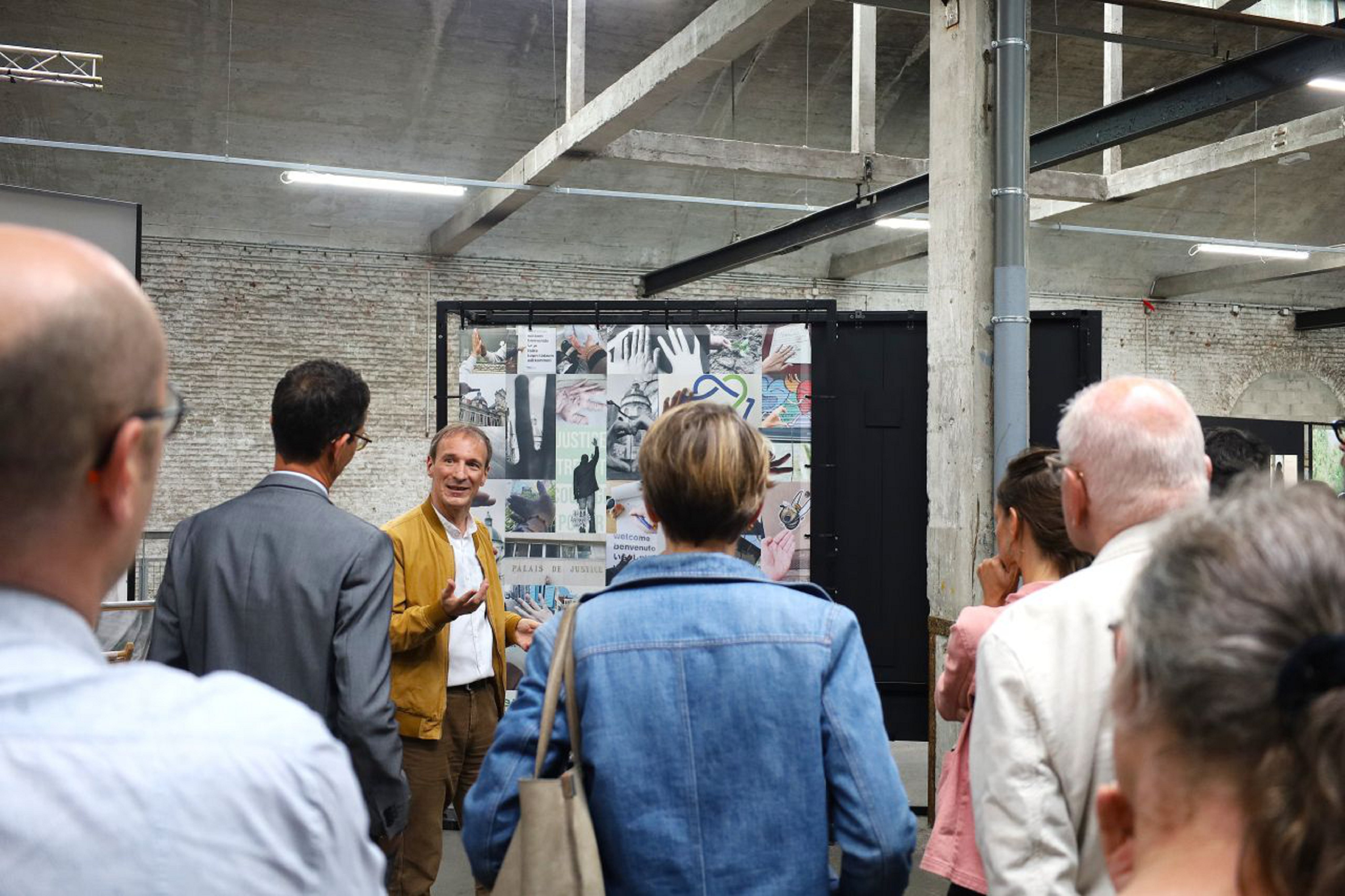
The youth justice service (Protection judiciaire de la jeunesse, PJJ) invited some sixty young people in its care, and the youth workers who accompany them, to photograph laïcité, French secularism. Rather than explaining it, we had them go through situations in which everyone creates freely within a shared framework, and in which opposite readings of the same image coexist without any one of them prevailing over the others. To my mind this is a very concrete way of learning secularism, provided the adults experience it themselves, and the young people find in it something to rebuild themselves with.
An intelligent secularism
The Grand Nord interregional directorate of the youth justice service holds a regional contest every year, “Photographing secularism”. In 2025, it paired it with an artistic support mission entitled “Faire convivialité en laïcité” (“Making conviviality within secularism”), a scheme it co-funded with the DRAC Hauts-de-France, the regional office of the Ministry of Culture, and whose implementation was coordinated by the association Hors Cadre. The Institut pour la photographie in Lille led its artistic side. Alice Rougeulle, who is in charge of artistic and cultural transmission, inclusion and accessibility there, invited four photographers with very different practices, Sidonie Hadoux, Cédric Gerbehaye, Charles Thiéfaine and myself, to run the five two-day workshop modules spread across the region. Sixty-two young people took part, followed by thirty-six PJJ educational units, and young people from the Institut des jeunes aveugles de Lille, a school for blind and visually impaired young people, also joined in. For my part, I ran the two training days offered to youth workers, on 14 March and 5 June 2025, and the first module with young people, in April.
When secularism is given as a theme, one expects images that illustrate it: a flag, a motto, a poster. I did not want the young people, or the adults, to produce such illustrations, because by illustrating a principle one repeats a discourse held by others, and it seems to me that one does not make a principle one’s own by repeating it. I found this conviction again, in another form, in the words of Frédéric Phaure, interregional director of the PJJ Grand Nord, at the presentation of the exhibition in Lille in September 2026. He recalled that his administration’s mission is to bring the young people entrusted to it to embrace the values of the Republic, and that such adherence cannot be decreed: “it is embodied, it is lived, it is shared”, including through photography. He added that “secularism is not the negation of religions, it is the recognition of the plurality of religions and of the freedom to believe or not to believe”.
Hilaire Multon, regional director of cultural affairs for Hauts-de-France, had spoken just before him. He said that with the eye of the artists and the work of the youth workers, one arrived at an “intelligent secularism”. The expression comes from Régis Debray. In the report on the teaching of religious facts that he handed to the Minister of National Education in February 2002, he judged that the time had come for the “passage from a secularism of incompetence (the religious, by construction, is none of our business) to a secularism of intelligence (it is our duty to understand it)”. In a workshop, understanding goes through experience. One understands that different convictions can coexist once one has felt for oneself that an image one has made is read by others in ways one never imagined, sometimes opposite ones, and that these readings do not cancel each other out.
The word conviviality, in the title of the mission, points in the same direction. In 2013, sixty-four intellectuals signed, at the initiative of the sociologist Alain Caillé, the Convivialist Manifesto (Le Bord de l’eau). Alain Caillé and Philippe Chanial summed up its proposal in the Revue du MAUSS in 2014: “an art of living together (con-vivere) that values relationship and cooperation”, and that allows people “to oppose one another without massacring one another”, a phrase the convivialists borrow from Marcel Mauss’s The Gift. I defend the idea that democracy is the organisation of disagreement, which I have developed with regard to images in the article Educating about images, organising disagreement. In a creative workshop, one can experience this on a small scale, over two days, with people who do not know one another.
In two days of workshops, one does not change the course of a life, and I do not claim to act on anyone’s convictions. Artists are not youth workers, and we could not resolve in a few sessions questions that the youth justice teams work on every day. What we could do, on the other hand, was offer a creative experience out of the ordinary, and sow a seed that the educational teams might later bring to germinate.
Two sockets, one source
From the outset, the Institut and its partners had wanted the youth workers not only to receive information, but to experience the making of images in their turn, setting aside their professional role for a day. At the two days I ran at the Institut, on 14 March and 5 June, there were twenty to thirty of us each time: youth workers from all over the region, and in June also teachers from “classes relais” (classes for pupils at risk of dropping out), staff from the EPIDE (a public establishment for the integration of young adults) and a specialised teacher from the Institut des jeunes aveugles. Each workshop with young people would be different: the aim was therefore not to pass on a model, but to make the adults feel, from the inside, the emotions, sometimes very strong ones, that one experiences when creating in front of others.
In the morning, I proposed the method I describe in detail in the article Participatory reverse photography workshop. Everyone had a quarter of an hour to take a single photograph with their phone, inside the Institut or in the street, on the theme of secularism, with one formal constraint: a hand had to appear in the image. Thanks to this hand, the photographs share a common feature that later allows them to be exhibited together, and each person’s body is present in their image without their face being seen. I made clear that the point was not to illustrate secularism, but to wander, to look, and to photograph whatever, without quite knowing why, had something to do with it. In giving the instruction, I was receiving it too, and I told the group that I myself had no idea what photo I was going to take. Each person then uploaded their photograph through a QR code to a private space on my website, under their first name only and with no title, because a title steers the reading of an image before it has even been looked at.
We then looked at the photographs one by one, projected large, and the author of the projected image was not allowed to speak while the others said what they saw in it and what it made them feel. Just before we began, someone said they felt they were about to “strip naked in front of everyone”. In March, one photograph showed two electrical sockets of different colours; several people saw in it two different objects that serve the same purpose and draw from the same source, and another added that if you connected one to the other, you would cause a short circuit. Before a black-skinned hand laid on the image of a smooth building bearing the word “accueil” (“welcome”), some saw colonial history and the fortunes built on colonisation, others a fiction brought back to reality by a living hand, others still a hand that protects. In June, a hand covered the cross on a religious poster, and some read it as a secular statement, but one participant pointed out that the hand hid only half of the quotation from the Gospel, which for her made it a sign of tolerance. Before another image, in which a large adult hand held a reproduction of an artwork, the group had seen a protective gesture; Marc Le Piouf, who coordinated the project for Hors Cadre, turned this reading around: this hand, he said, might just as well be about to crumple it.
At the end of the June morning, I told the group that the polysemy of images is absolute, and that there is no single interpretation of an image that would be the right one. The participants had just lived among themselves a situation very close to the one secularism makes possible in a society: no one imposed their reading, the author could not impose their intention, and contradictory interpretations could be voiced in front of everyone without anything having to be settled. The secularism and citizenship officer of one of the PJJ’s territorial directorates had put it this way on the very morning of 14 March, about the freedom left to the photographers and the young people to stray from the theme: it was, in her view, “out of respect for the principle of secularism”, as long as young people are offered a real space for expression. On the afternoon of 14 March, a team of youth workers even ended their short animated film, shot in a single take, with this line: “Anyway, secularism, it wasn’t that complicated after all.”
Everyone is also touched in their relationship with themselves. Almost everyone finds their own photograph less good than the others’, and yet discovers, in what the group sees in it, things they had not consciously put there and which are nonetheless really there. The gaze of others is then no longer a judgement: thanks to it, a creation to which one attached no value acquires some, which I analysed in What the gaze of others does to our images.
The framework of the workshop only holds if everyone takes the same risk, including the person leading it: if I stayed outside the exercise, in the position of the boss who watches, I would weaken it. I developed this idea in The framework that authorizes and in Putting Yourself on the Line. I had proof of it by contrast on the afternoon of 5 June. During the animated film workshop in small teams, one person told me she would not take part and would observe; with another person, she stayed on the sidelines, joking, and the group they were in lost its momentum, while the other teams, absorbed in their project, moved forward. I followed this group closely, and its film did get made, but I saw that day how a single person standing aloof is enough to undermine a group’s confidence.
We haven’t necessarily chosen to be here
The first module took place on 24 and 25 April 2025 at the La Source media library in Harnes, with Alice Rougeulle and her colleague Camélia, from the Institut pour la photographie. Some fifteen young people were there, with their youth workers. For them, we had chosen a theme broader than secularism, the encounter (with someone, with a place, with oneself), and indeed the word “secularism” was not uttered once all morning. We voted by show of hands on whether to use the familiar “tu” with one another, on condition that it be mutual, and “tu” won the day. Then, before handing out the cameras, I wanted to say something that usually goes unsaid. We were gathered in an institutional setting, each in our own personal or professional path, and none of us had necessarily chosen to be there. I said that I was happy to be there, but that some might not feel like it, that this was entirely respectable, and that we were not there to force anyone. Naming the constraint, instead of pretending it does not exist, is to my mind a way of respecting people.
None of the young people knew the media library, and neither did we. With small compact cameras, since the young people were not using their phones in this project, everyone set off to photograph the place with a single rule, to show no faces (people appear from behind or through a part of their body); the hand in the image was this time only a suggestion. At the end of the morning, we looked together, projected large, at one hundred and seventy-two photographs. One of them showed a face by mistake; I asked the person who had taken it whether they agreed to my deleting it, we looked at it once, then I erased it in front of everyone, and, as I said at the time, it now existed only in our memory. One young person thought the blurred photographs were failures, because you could not see anything in them; we talked about blur as a style that some photographers embrace. The director of the media library then showed us round the building, and the young people asked her the questions that had come to them while photographing, about opening hours, about the architecture, about the right to sign up when you do not live in the town.
At noon, the cook from a food truck that the PJJ had brought in served everyone the same meal, a vegetarian one, so that everyone could share it, whatever their habits or convictions. The conviviality in the title of the mission began there, very concretely.
In the afternoon, all the printed photographs were laid out on the floor, and everyone could take their own or other people’s, with their agreement, to compose collages on black paper or foam board. We had added magazines, photographs by artists, and texts: declarations of rights, legal and political texts, extracts about cultural rights. Young people and adults cut pieces out of these texts, and one can see, from the titles each person gave their collage, how different their paths were: “Le partage” (“Sharing”), “La vie” (“Life”), “Reborn”, “L’identité” (“Identity”), “Diversité” (“Diversity”), “Joie” (“Joy”), “L’Afrique change” (“Africa is changing”), “Traité sur la tolérance” (“Treatise on Tolerance”). In the morning, when we had announced the collages, a young man had asked whether he would be able to take his work back. Alice Rougeulle had answered that the originals would belong to their authors and would be returned to them, and I had explained that we would photograph each collage in very good quality, so that everyone could download its reproduction on their phone, through a QR code. What is made in a workshop belongs to the people who made it, and young people sense very quickly when someone appropriates what they have made.
Each drawing in its place
The next morning, I set up lighting and rephotographed all the collages, then we compared on a big screen the images from the day before, taken without lighting, with those from the morning, before cropping the photographs and reworking their brightness and contrast together. This exercise called for a care for precision that not everyone had, but it showed that one can be demanding in the way one keeps the trace of a work, and that this is how one shows the value one sets on it. I put everything online in a private space, accessible only to the participants, as I do in all my workshops and as I explain in Keeping the Trace.
We had planned to write a text together for each image, starting from a mind map. After a while, I sensed that it would not take, and we changed the programme: everyone made one or more drawings in black felt-tip pen, then cut them out, to project them large. During a break, two members of the facilitation team stacked all the drawings in a pile, to make room. I asked them to put them back on the table, each in its place: this was not a set of drawings, it was each person’s drawing, and everyone had to be able to take their own back. This detail is a matter of respecting people’s cultural rights, just like the consent one asks for before exhibiting a work. In a room plunged into half-darkness, each person then placed their drawing under a camera connected to a video projector, and the image was projected in negative, from floor to ceiling. Some young people lay down on the floor to watch the images move above them, and this moment of shared relaxation lasted about twenty minutes.
In the afternoon, three small film studios were set up in the main hall, each with a camera, a microphone and a few musical instruments. In each team, some moved characters and sets cut out of the photographs and magazines under the camera, live, while others played music or did the voices, and each scene was shot in a single take. One group made “Mode d’emploi d’une rencontre” (“Instructions for an encounter”), in which a voice wonders what it takes to meet: a table and chairs are not enough, a coffee machine already draws people in, food even more so, and music or sport bring everyone together, right up to the cry of “Allez les Bleus!”. In another film, “Notre histoire” (“Our story”), a couple meet on a beach in Marseille, and the last line, “we lived happily, but we didn’t have children”, echoes the title a collage had been given the day before. Images thus travelled from one form to another, from photograph to collage, from collage to film. We watched all the films projected large, then I put them online with the collages, accessible through the same QR code.
In two days, the young people entered in turn some ten different worlds: photography, large-scale projection, the printed and cut-out image, exhibition, careful reproduction, drawing, the image projected onto architecture, animated film and music. Each of these worlds required tools that were ready and suited to the task: on the first day the scissors were too small, and I brought bigger ones the next day; for drawing, black felt-tip pens and paper in quantity were needed. I wrote it down that very evening: the objects themselves must be welcoming, so that everyone can enter them as one enters a landscape, and discover themselves there. I described this material preparation in Setting the table.
Youth workers who create too
During these two days, the youth workers took part in the activities on the same footing as the young people, and, in the film workshop, with just as much enthusiasm. At first, I thought their role was to leave all the room to the young people, especially since adults sometimes take up too much of it, because they feel like it, or do things in the young people’s place. I see it differently today. A space for expression like this one is rare for adults too, and when a youth worker sincerely commits to it, through their desire to create, the young people discover the humanity of the person who accompanies them. People then meet on the ground of involvement and desire, and not on that of consuming occupational, cultural, sporting or tourist activities, which often fills the time of outings. The experience also gives adults the desire to carry out more ambitious cultural projects with young people, while leaving them their autonomy. This is the whole point of the preliminary training sessions: adults cannot offer young people an experience whose force they have not felt themselves.
Cédric Gerbehaye made a similar observation in the workshop he led, where he had asked the youth workers to make images on the same footing as the young people. At the presentation of the exhibition in Lille, he recounted that these young people, who came from different centres and did not know one another, had worked for two days in an excellent atmosphere, and that “there was no authority on the part of the educators, it was absolutely not necessary”. He added that before tackling the notions of secularism, the participants had built bonds.
Rebuilding oneself without being flattered
To my mind, young people come to a project like this one to rebuild themselves. By placing something of themselves in an outside object, a photograph, a collage, a drawing, they renew a bond with themselves, and by showing this object to others, they take back their place among others. I think it important to be clear about this aim, because everything else depends on it: the artistic set-up and the mediation serve this rebuilding. Kindness is one of its conditions, and respect for people’s cultural rights is another. One must also take into account the fragility of identity, often extreme, of these young people. Overpraising them, going into raptures over what they do, would be experienced as a lie, and as a seduction that mainly reassures the adults about their own role. What one can offer them is an extraordinary creative experience, in contact with an artistic world.
At the presentation in Lille, Frédéric Phaure said that art makes it possible to get around “articulated language alone, which sometimes holds the emotions in too much”, and to give young people the chance to produce something visible and “rewarding for them” (“valorisant”). When my turn came to present my work, in front of the walls of the exhibition, I took up this last word with caution, because whoever says enhancing someone’s value also says lowering it: I prefer to speak of building and of a path, as I explain in Building, Not Valorizing. In the course of a workshop, each person also builds what are called psychosocial skills: the ability to express what one feels, to receive the gaze of others, to cooperate. They are what allow one to hold one’s place in a democracy, and I give a definition of them in What are psychosocial skills ?. They are not acquired in one go, it is a path. My role, as I said that evening, is to walk alongside these young people, who are our equals, including in creation, even if we do not have the same function at that moment, and I am always learning with them.
With the regional contest, in which a jury awarded prizes at the end of the process to photographs by young people and adults, a question arose that I raised from the very first training day. To rank creations is to rank people, and social ranking is, to my mind, a form of social violence. It is the subject of A good pretext, which I wrote partly on the basis of this project, and I will not go back over it here. I presented this contest to the teams as a pretext, in the noble sense of the word: an opportunity to go on taking photographs with the young people after the workshops, without winning being the point.
From Roubaix to the gare Saint-Sauveur
The Institut pour la photographie designed the exhibition bringing together the work from the five modules. It was first shown at the École nationale de protection judiciaire de la jeunesse, the national youth justice school, in Roubaix, from 9 December 2025, the hundred and twentieth anniversary of the law separating the Churches and the State, to 2 February 2026, under the title “Laïcité, une histoire partagée” (“Secularism, a shared story”). It was then shown in Lille, at the gare Saint-Sauveur, from 11 to 27 September 2026, under the title “Une histoire de partage” (“A story of sharing”), on the occasion of the opening weekend of the Bicentenary of Photography. Over the five modules, according to Alice Rougeulle, the young people had tried their hand at analogue and digital photography, staging and spontaneous shooting, writing, collage, drawing or embroidery, and she recalled at the presentation that what mattered was “the possibility they were given here to express themselves and to tell their story differently”. QR codes in the exhibition gave access to audio descriptions of the images, for visually impaired visitors, and to young people’s voices recorded during the shoots.
In an exhibition of this kind, what one mostly sees are results, and the process that gave rise to them remains largely invisible, which I analysed in The process, not the result. That is why I insisted, during the training day on 5 June, that the teams should not stop at the two days of workshops. I invited them to have the young people take photographs in their own facilities, to exhibit them on site rather than aiming for a prize, and to involve the young people in organising this showing and in guiding visitors. Doing a project means carrying it through to the moment when one shows one’s work to others, and it is by going that far that one finds one’s place among others. The youth workers had experienced this in their turn, and it is through them, it seems to me, that a mission on secularism can carry on long after the photographers have left.


