When you arrive at a shelter, you are given a stack of documents that many people never read, because they cannot read French or because they have other things on their mind. Fabienne Forveille, who runs the Housing division of Entraide et Solidarités, wanted to explain them on video. I suggested that the residents make the films themselves. In three days, with volunteers and staff, they made twenty-seven of them, in four languages, shot without editing and put online the same evening. It is the first stage of a larger project.

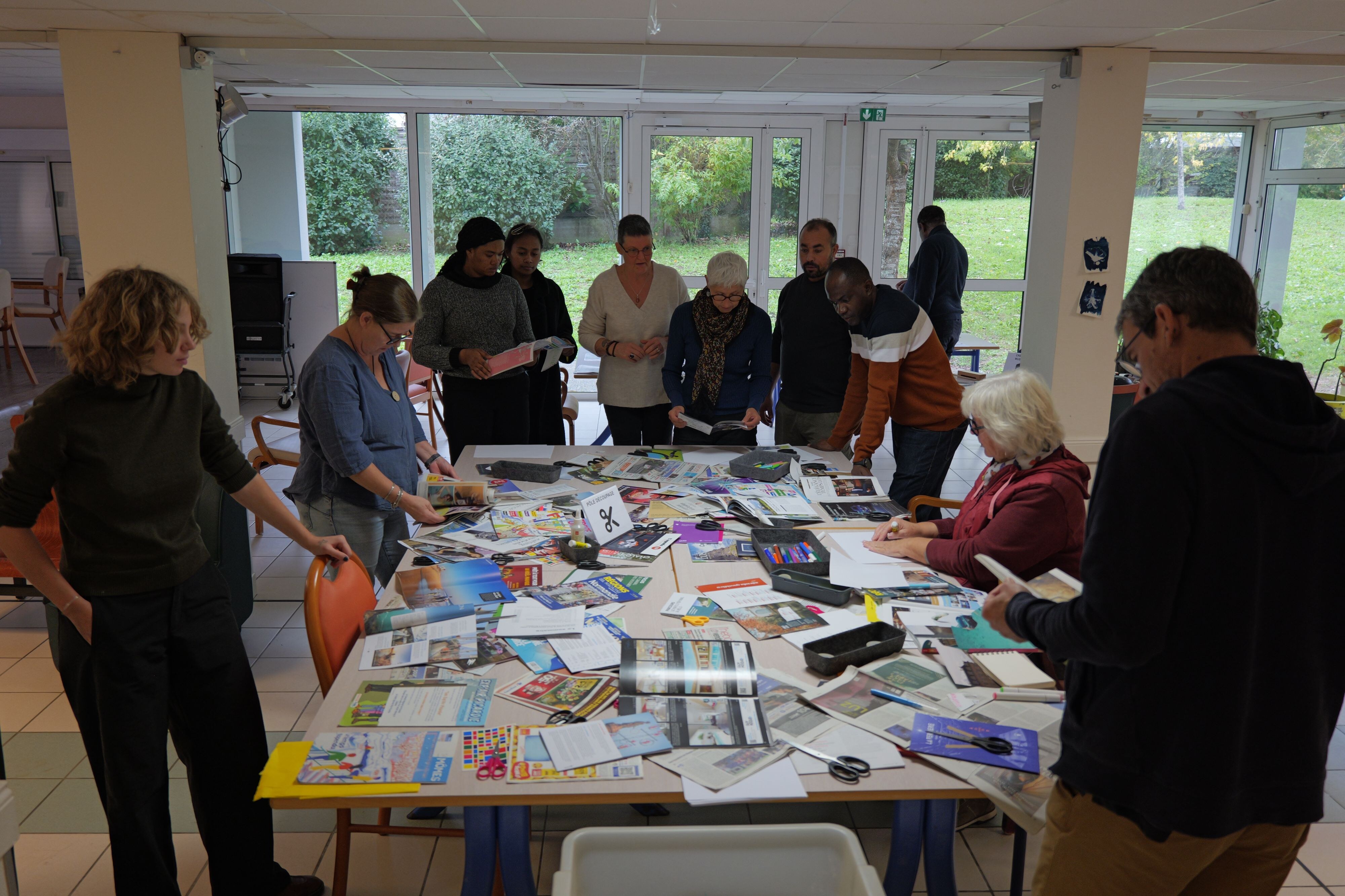
The first morning at the CHRS Albert Camus, around the cutting table (photo Benoît Labourdette).
One page, then the drawer
The French law of 2 January 2002, which reformed social and medico-social action, requires institutions to provide seven tools: the charter of rights and freedoms of the person received, the welcome booklet, the residence contract, the list of qualified persons, the operating rules, the social life council and the institution’s project. At Entraide et Solidarités, in Tours, these documents exist for each facility, they are kept up to date, and they are handed out on paper to people when they arrive. Fabienne Forveille knew the limits of this: some people cannot read, others do not speak French, and almost all of them arrive at a time when there is, in her words, “a lot of stress, a lot of fear”. Marianna, one of the residents who took part in the workshops, put it differently: “some people take the contracts, the explanations, they see a page, then they say it’s too much, they put it in the drawer.”
In her filmed testimony, Fabienne talks about two dreams. The first was to explain on video “all the tools of the 2002-2 law that we hand out to residents on paper”. Her project already planned for residents to take part in the videos. When we met, at the beginning of the year, I suggested going further: the films should not be interviews of residents, they should make the films themselves, from the writing to the end credits. The second dream, as she puts it, is “that it’s the residents themselves who explain these different documents to the people who come after them”.
The proposal I wrote in January 2026 covered all the tools. It planned four films shared by all the facilities of the division (the charter, the social life council, the list of qualified persons, the residence contract), then one film per facility on its welcome booklet and operating rules, for six facilities in Tours, from the Cherpa to the Dolbeau residence. Each film was to exist in several languages, each version made by the participants themselves, and to be reachable through a QR code printed on the paper document. The three days in October are the first stage, the one the first funding made possible: the social life council, which Fabienne had just set up for the whole division, the charter of rights and freedoms, and the remedies available when you dispute a decision or when a right is not respected. They were supported by the Fédération des acteurs de la solidarité, through its local initiatives fund against exclusion, by Cultures du Cœur, with whom I have worked for several years (I told the story of the 2023 cultural summer, for example), by the Respiration programme and by La Choiseulerie, a newsagent and tobacconist in Tours.
Objects you are allowed to pick up
The first two days took place at the CHRS Albert Camus, in the north of Tours, and the third at the Cherpa, a shelter in the city centre. I ran the workshops with Rosalie Lescure, a young artist, and with Fabienne, who was there all three days. Every morning, before people arrived, we set up the room. At the Camus, four tables pushed together made the cutting area, with magazines, scissors, glue, tape and the association’s documents printed out, so that people could cut out the words and information they needed. Another table held the musical instruments. Two rows of chairs made a small cinema facing the screen. On the stage there were two filming studios: a table with a camera above it and a microphone, for the animated films, and a corner where you could be interviewed facing a camera.
Why spend so much time setting up? Because it is the first thing people see when they come in, before any explanation, and that is where they feel welcome, or not. I described this work in Setting the table. At the Cherpa, on the last morning, while we were setting up, I said as much to Fabienne: the more things there are on the table, the more inviting it is, “and that way everyone finds their own path through it”. The instruments are chosen with care, so that anyone can get music out of them that works, from the very first minute (kalimbas, a tongue drum, a Tibetan singing bowl, small synthesisers, etc.). Cutting works the same way: with well-chosen magazines and a pair of scissors, you can make beautiful images very quickly. These objects, the felt-tip pens, the paper, the cameras, the still cameras, are laid out so that everyone can go and take them without asking, and it is through them that people meet.

The table of musical instruments (photo Benoît Labourdette).
When people arrive, I go up to them, introduce myself and ask their first name. I write it down on a small piece of paper, because I find it hard to remember names. I choose the technical equipment so that it is both of excellent quality and very simple to use. At the animation studio, you only have to press one button on the computer to record. I want this equipment to enable people rather than dominate them, and to serve what each of them wants to say. On the first morning, before the participants arrived, I said so to the team: “Everyone has the right to take part and they are entitled to, because they have their experience, which we don’t have”, and a very modest contribution, a single cut-out character for example, “has value”.

The animation studio: the camera above the table, the lights, the microphone and the computer (photo Benoît Labourdette).
A title held by hand, one take, and we watch together
The animated film is made under the camera, live. One or two people move the cut-out characters, often on the end of a skewer, another reads the text, others play the music, and the computer records it all. There is no editing. On the first day, I gave the group the rule: “even if it doesn’t go as planned, we don’t say damn, you messed up, we keep going, we go all the way”. If the take isn’t right, we do a whole new one. I explained in Going all the way why people dare more under this constraint.
The title and the end credits are written by hand on sheets of paper, which people show to the camera themselves, at the beginning and at the end of the film. Everyone writes their first name in their own handwriting. The same goes for the testimonies: the person being interviewed holds up their title card, then their credits card. Nothing is added afterwards, and you can see that these people are the authors of their film. We had pre-printed the credits sheets with the logos of the association and the partners, so the films are also official, signed by the institution. I explained in Writing « The End » what these few seconds change in the value of a workshop film.

A handwritten title, projected on the screen during filming (photo Étienne Rémy).
After each take, everyone sits down in the small cinema and we watch the film. We validate it together, or we redo it, and we often did. Requests for improvement did not only come from the team, they also came from the participants, who saw what was missing and suggested something else. We make the films, we show them straight away to the others, and everyone knows why they are making them. On the first afternoon, I reminded the group: “these films start from us, really, but they’re there so that the people who watch them come away richer”. I developed this idea in It’s not a private joke.

The small cinema, watching a film that has just been shot (photo Benoît Labourdette).
The same evening, I put the films online, on a page of the association’s website, which can be reached through a QR code printed on a small cardboard character that everyone could take away. The films are useful straight away, and the people who made them are the ones who can show them. I care about putting them online immediately, for the reasons I gave in Keeping the Trace. On the first evening, I said to Fabienne: “We don’t know what people do with them, but they should have access […] there’s an energy, an emulation, that we mustn’t lose”.
The social life council in four languages
I had imagined that people would split up into small groups straight away. On the first morning there were about ten of us, residents, volunteers and staff, and we made the film on the social life council together. Fabienne suggested an outline in chapters (what the council is, who sits on it, what it is for, etc.), and someone suggested the form: an innocent asks the questions, Fabienne answers them. After about twenty minutes, I suggested we start shooting. I whispered to someone on the team at that moment: “They’ll feel it’s too early, but at some point you have to go for it.”
The first take lasted five minutes. While watching it, I talked mainly about two things. The music first, which has to be there all the time: “it’s what links things, it’s what brings us together”. Then the characters, which are only bits of paper: “It comes alive if we make it move.” The second take, three and a half minutes long, became the French version.
Someone then suggested keeping these images and only replacing the voice for the other languages. It would have been quicker, and I preferred that we redo the whole film each time. In this kind of workshop, the meaning lies in the collective: we do everything together, each person contributes from where they are, and the set-up is designed to put them in a position to do so. A person who speaks Arabic or Lingala does not lend their voice to a film made by others, they remake the film with the group, in their language and in their own way, and that is how their culture is respected. I see this as a concrete practice of cultural rights, in the sense in which I defined them in The presumption of competence. And since what you improvise changes from one take to the next, each version is different: “It’s the same film, but different.”
Omar, a volunteer, made the Arabic version by reading the translated text, with Fabienne asking him the questions in French. In the afternoon, Cyprian made the English version, which he opened with “Ladies and gentlemen, you are welcome to the CVS meeting”. Another resident did both the questions and the answers of the Lingala version on his own. After the English version, I said it was “a lot messier than the ones before, but at the same time, it’s a joyful mess”. Someone answered that the French one “is very serious!”.
At the interview studio, the camera was placed just behind Fabienne, who asked the questions, so that looking at her meant looking at the camera. Cyprian talked about the last meeting of the council, on 22 October, where the members had voted to accept animals in the facilities, with rules (vaccination, respect for shared spaces, walks outside). For him, this decision will “encourage other people […] to leave the street”. Étienne Rémy, a delegate at the Cherpa, explained his role: “to carry the word and the voice of people who […] won’t know how to put it, who won’t dare go and see […] the staff”. Fabienne noted afterwards that in the other videos nobody had talked about being elected, “we were missing that”.

A testimony filmed at the interview studio, projected live on the screen (photo Étienne Rémy).
Marianna did not want to be filmed. She had written a text by hand, in her own language, and we filmed her sheet of paper while she read it in French: “Some people don’t dare ask a question a second time when they haven’t understood an explanation or a document. […] It is essential that everyone can understand their rights, their duties and the information they are given without being afraid to ask questions or to bother the professionals.” After watching it, she said to me: “Yes, but you are professionals, you know very well whether it’s good or not.” I told her she had a very pleasant voice, and that in a few words she was saying something essential.
By the evening, seven films had been made, four versions of the collective film and three testimonies. While packing up, I said to Fabienne: “I’d imagined small groups straight away. But actually, they need the collective. It’s really precious to be all together.” Our roles also complemented each other. Fabienne knows the substance, she gives structure, and I told her at lunchtime that this reassures everyone, “and so they can express themselves”; Rosalie and I took care of the form.
Chips and the Defender of Rights
The second day was about remedies. Before we started, Fabienne told a story that happened at the Cherpa: residents complained that they never had chips, the request was not heard internally, and it went all the way up to the social life council. She used it to explain the difference between the two procedures: “I complain that the toilets… I claim chips.”
We then went into the hall to photograph the notices that have to be displayed (the claim form, the poster of the Défenseur des droits, the French Defender of Rights, and the list of qualified persons), to print them out and cut them up. Fabienne said the old list dated from 2008 and that it had taken her about three years to get an updated one. Rosalie asked the question many people must ask themselves in front of that list: “qualified in what, exactly? From which office?” Fabienne replied that it was “the legal term”. In front of these notices, I told the group that these documents are full of tools for respecting people’s dignity, and that you can nevertheless stand in front of them without feeling respected in your dignity or your culture. I was thinking of the thought that is often missing upstream of these notices, when they are designed without starting from the person who will read them. With these films, it is people who have been through arriving who explain it to those who are about to.
Three groups formed, one per film. For complaints and claims, Véronique and Franck acted out a short scene (“I don’t agree, I don’t agree at all.” “Calm down, calm down Véronique.”), with the real form and the seven-day response time. For the qualified person, Fabienne read the text while Rosalie drew live under the camera. She had written “solution” with two Ls, and worried afterwards that she had used the wrong word. Fabienne reassured her: “people will understand”. I think so too, and I talked about it at lunchtime with Rosalie: the fact that things are not perfect is part of their quality, “it doesn’t pretend to be something other than what it is”. The film on the Defender of Rights was made by Laurence, a volunteer, and by several women, including Whitney and Alice. At the end, Laurence’s arm comes into the frame, tattooed with a figure of justice. At the screening, I told her it was perfect, since justice was “inscribed on the body”.

At the animation studio, on the second day (photo Étienne Rémy).
Omar could not come back in the afternoon. I had planned to record only his voice in Arabic, but the group told me they were ready to shoot the films, and we shot the three Arabic versions before lunch. In the afternoon, Michel, vice-president of the association, handled the papers for the first time, for the Lingala version. At first he struggled to follow the text: “You don’t signal when to change, so I can’t keep up.” We redid the take, and he concluded: “Now we understand Lingala, all of it.” At that pace, I said to the group: “It’s a production line here… it’s Hollywood-on-Tours”. By the evening we had made fifteen films, three subjects in four languages and three testimonies.
At lunch, Michel, who had watched the previous day’s films, made a remark: he did not know who was answering the questions. I explained that it is everyone’s film, made by people “on an equal footing, but each with their own expertise”, and that each person brings what they want to and are able to bring. Hence the idea of also showing how the films were made, with photographs and texts, so that they are not received “as a film that comes from above”. The viewer cannot guess, for example, that the music is played by people sitting next to the table. During that same lunch, Étienne called us to order, because we were still talking shop. Fabienne told the story a little later: “Étienne says to me, Fabienne, that’s enough, it’s the break… And he’s right.”
In the afternoon, we filmed testimonies from every position. Fabienne and Travis, a social worker at the Cherpa, spoke for the professionals. Michel interviewed Laurence. Their first take stayed general, and I asked them: “it was great being together, OK, but what did you actually do together?” The next one was more concrete. In it, Laurence says that “behind the camera […] there are at least 5 or 6 people around who are filming”, and that “you don’t come out of it the same way you came in”. Franck, who is housed by one of the association’s services, spoke alone, in one take, about “cultural barriers, language barriers” and “the fear of the unknown the first time”. He added that using several languages “comforts the person, puts the person at ease”, and that since the films are online you can, “quietly at home”, “watch them again” and “understand them again”.
Twelve rights and some Playmobil
On the third day, at the Cherpa, there were fewer of us, and the subject was the charter of rights and freedoms of the person received, which lists twelve rights. I did not show the films from the first two days, because with films that are already made, “they become models and examples and it’s inhibiting”. The initial idea was for each person to take on one or two rights, but that was too complicated. We photocopied the twelve cards of the charter. Everyone illustrated part of them with collage, and Whitney read the whole text. In the evening, Fabienne told me that some women had come on the first day “very cautiously”, that they had needed a day, and that this morning one of them had asked to go in front of the camera. Some participants first made fun of the cutting out: “Are you sending me back to nursery school or what?” I answered that I was a big kid myself.
That day, I changed the set-up, and I stepped in a little more. There were three cameras, one for the interview, one above the table for the animation, and one for the title and credits sheets, and I switched from one to the other live while everyone took part. I set one rule: “either you see the person because they have chosen to show themselves, or you see their hands with the stuff”. The films were still shot in a single take, and we still watched them right afterwards, to validate them together or redo them, but their forms were more varied, and still without waiting for any editing.

At the Cherpa, the camera above the table, the microphone and the Playmobil (photo Benoît Labourdette).
During the preparation, Bruno had settled alone under the camera with two Playmobil figures brought by Alice. I felt it was the moment, and I suggested he move them around while explaining what justice and rights are. He began with “As long as I play with justice and rights, there’s usually a fight”, then he talked about the rights that matter to him: “Equality between people, as well as freedom of expression. It’s important to be able to say what you think.” He called his film “Le fil de la vie” (The Thread of Life). There are no written credits, because we did not have time to make them, and I explained it afterwards: “It was Bruno or never.” In the evening, I put the film on his phone.
The French version of the charter was shot around midday. On the first take, the voice was too low because of a setting, and we redid the take at once, while people were crossing the room to go to lunch: “I’d rather we do it even with people walking past”. The film, five and a half minutes long, was online before the meal. In the afternoon, Cyprian read the English version over visuals he had prepared on his own on his computer. The person who was supposed to read in Arabic did not come back, so we made a version without a voice, with music and the Arabic text to read on screen, the longest of all to leave time for reading. During the take, the cards entered the frame from the left, whereas Arabic is read from right to left. Bilal found this awkward, and I suggested redoing it. Michel pointed out that this way the beginning of the text appeared first, which was rather practical for reading, and we kept the take.

The cards of the charter, illustrated with collage (photo Benoît Labourdette).
Véronique, a volunteer, gave the last testimony. She did not know the charter before these days. She said what touched her in the way the films were made: “it’s the first time I’ve seen that there’s no difference at all between in front of and behind the camera”. She also talked about the translations, made by people “who are not translators at all but who do it to help those who speak the same language as them”, and she saw in them “something of a universal understanding”.
Étienne’s photographs
Throughout the three days, Étienne Rémy, who lives at the Cherpa, photographed the workshops. Half of the photographs you see here are his, the others are mine, and we are waiting for Rosalie’s. He showed them to me on the last afternoon, some of them in black and white. He tries to “capture a gaze”, and he told me that it is when “your heart is already going there” that he takes good photos. I told him they were magnificent and that he had an eye. Travis, a social worker at the Cherpa, filmed the three days for a short film about the process. I care about these traces of the process as much as about the films, because they show the trust that was built between people, and the films would not exist without it.
“It’s better to show a video than to read the whole thing”
The twenty-seven films are online on the “Un clic pour tout comprendre” page of the association’s website. For each subject, there is a film explaining it, in French, English, Arabic and, for two subjects, Lingala, followed by testimonies from residents, volunteers and professionals. On the first evening, a social worker from the Cherpa was already imagining how to use them: “we’ll be able, when people arrive, to show them the videos straight away […] it’s better to show a video than to read the whole thing”. Fabienne plans to use the testimonies to convince other funders. I advised her to count in her report the people who made the films and those who helped, and to say that most of them had watched them again in the evening or the next morning. There were between ten and fifteen of us each day, which allowed us to work well, and I put it to her this way: “we have few people, but it’s because we have few people that we make something really good”.
In the car, on the last evening, the three of us took stock, Fabienne, Rosalie and I. I told them that Fabienne had put the collective at the centre from the first morning, and that we had been “really in mutual facilitation, all three of us”. Rosalie said what she had liked, the alternation between making and watching, being “both the spectators and the creators”. On the last afternoon, Fabienne had summed up the three days in her own way: “I knew what I wanted”, and it is “partly achieved. I keep dreaming.” Since then, she has obtained new funding to continue soon, and she is looking for more. The residence contract still has to be made into films, as well as the welcome booklet and operating rules of each facility, and I have suggested that she also train some of the association’s staff, so that the method stays with them.


