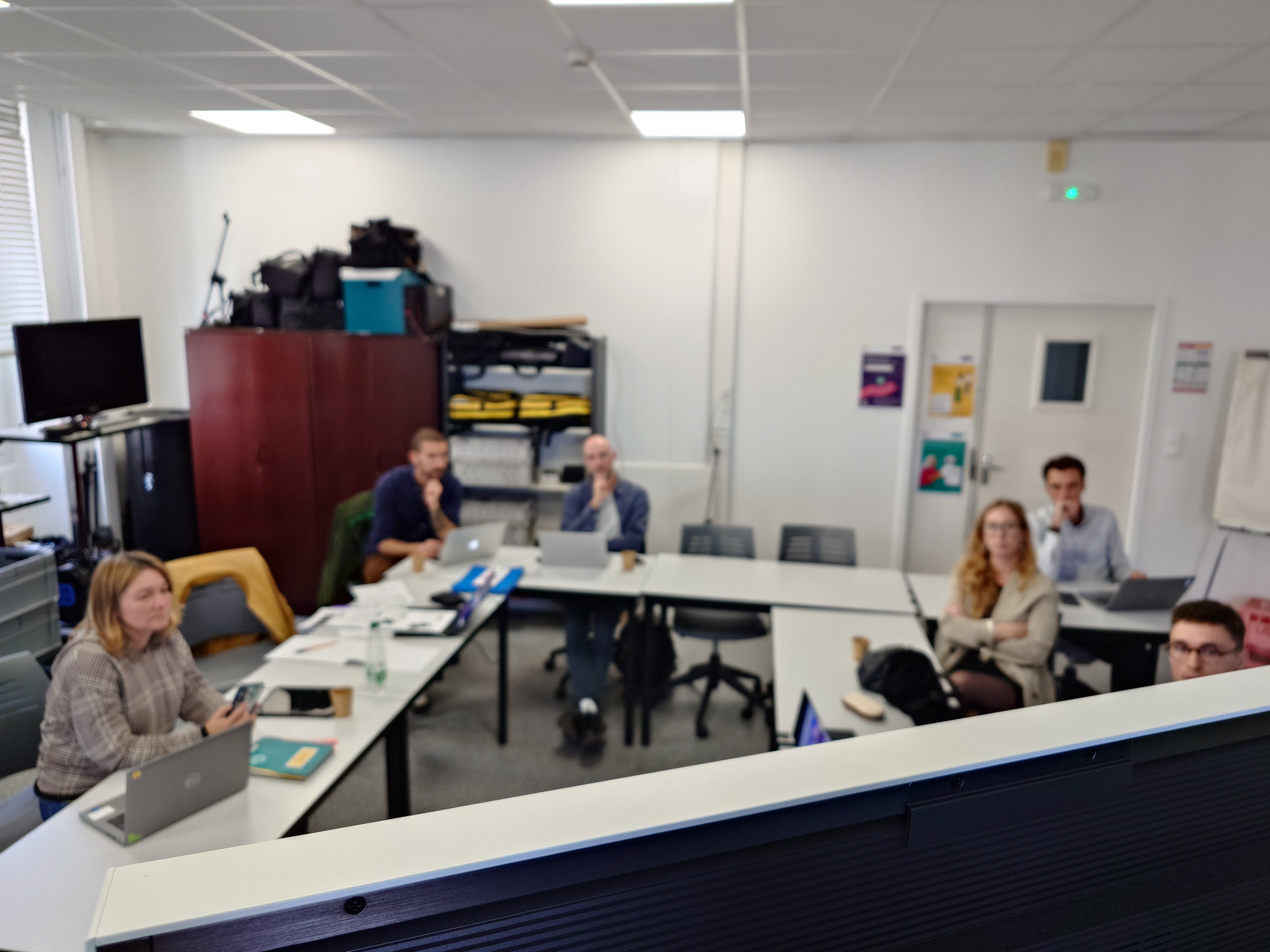
This year, four lower secondary school classes in the Lyon metropolitan area will make virtual reality films that stage debates they will have invented themselves. On the day of the launch, the plan I had designed for six classes and a joint shoot in an assembly chamber was rethought with the teachers. The shoots will take place in each school, and the joint closing event may in turn become a debate, with the films as its subject.
The twenty-fifth launch of the digital cultural classes
On Wednesday 14 October, early in the afternoon, Christophe Monnet opened the launch day of the digital cultural classes (classes culturelles numériques, or CCN) at Erasme, the open innovation laboratory of the Métropole de Lyon, based at the Pôle Pixel in Villeurbanne. Christophe has run the programme since its beginnings, and he reminded us that this was his twenty-fifth launch. In the CCN, as everyone calls them, classes spend a school year working with artists and scientists who are, in his words, “in residence on the internet”. The artists and scientists post instructions on the laclasse.com platform, the classes respond and see what the others are doing, and the year ends with a closing event where everyone meets.
He gave the figures for the season: 58 classes, more than 1,300 pupils and around a hundred teachers, spread across eight projects. The pupils range from the last years of primary school to the final year of collège, medical and educational institutes (IME) take part, and this year classes in Yerevan, Armenia, will work with classes in Lyon. The subjects are very varied. Among them are writing a novel from archives, the city and its building sites, protecting data and passwords, heat in schools, electronic music with GRAME, coding to make music, and our virtual reality class.
Christophe spoke of the place the internet held “in our hearts” in the early 2000s, when everyone thought it could become a tool for teaching and creation. The internet has become something else since then, and he presented the CCN as “a pocket of resistance”. He took up an expression that is going around at the moment, rewilding the web, and made it more precise: “rewilding the web just means giving ourselves back the possibility of using the internet as a creative tool to make things”. I recognise myself in this idea, having had people make films with phones since the Pocket Films Festival, which I founded with the Forum des images in 2005.
To introduce our CCN, Christophe showed an interview in which the filmmaker Alejandro González Iñárritu, director of Carne y Arena, explains why he came to virtual reality. He wanted, as Christophe summed it up, to project himself into “this childhood of cinematic language that 360 immersion is today”. The pupils, he added, will be able to enter “this rather pioneering phase we are living through for 360 cinema”. It is the same idea as his comparison with the Lumière brothers, which I reported in Making virtual reality a ground for student autonomy, that of a new medium going through a period when its uses are not yet fixed, and when secondary school pupils can invent something with it.
The platform was rebuilt over the summer. Instructions are now called missions, each class is represented by a small animal, and each CCN has its own calendar and staff room. The rhythm is the one we knew: a mission is posted, there is about a month to respond, then a period of exchanges between classes. Réseau Canopé supports the teachers throughout the year, and its team presented a booklet on assessment. They have observed that the CCN is often one of the arts and cultural education projects in which pupils work the hardest, yet it sometimes remains outside their school record. They suggest, for example, opening a project assessment for the whole period and validating a skill each time it is observed, without ever penalising, so that pupils do not experience the project as one more grade.
A year after the forgotten women of history
Last year, for the first CCN devoted to virtual reality, three classes made six short films about women whom history has left in the shadows, from Valentina Tereshkova to Aretha Franklin. I wrote about the launch, in October 2025, and then the whole year, up to the closing event on 21 May 2026. So I knew the programme from the inside when I arrived this year, and we were able to spend less time on organisation and more on content.
This season’s subject is democratic debate. Christophe and I chose it in the spring, with the 2027 elections in mind. I also see a link with the very form of our films. A debate has something of an agora, a place where speech circulates between people who face one another. A 360° image works in the same way, since in the headset you turn towards the person speaking, then towards the person answering, and each viewer chooses their own point of view. With pupils, a whole game of questions and answers can be invented in this space.
I told the teachers what I mean by democratic debate. Our institutions were designed to organise disagreement and to be enriched by different points of view. Democracy is often described as a search for compromise. I believe it rests first of all on welcoming a diversity of points of view, and French secularism, laïcité, for example, is built on this principle. Yet many pupils today feel that thinking differently from what they are told to think puts them in the wrong, almost in confrontation. I would like them to have the opposite experience, as I put it that day: “it’s not a problem not to agree”.
For this experience to be possible, we need to be wary of overly divisive subjects, those on which pupils already know what they are or are not allowed to say. I suggested going through the imagination. You can debate pets, the right to use the colour red, or whether we should leave the Earth. You can imagine a town where some inhabitants want to remove all the benches and others want them everywhere, right into the middle of the street, so that cars can no longer get through. We are in an artistic creation project, and what matters to me is that pupils enjoy sharing their ideas without being afraid to speak. The films Festivals Connexion will show them also have a large share of imagination.
I added something that is close to my heart. This project is an artistic one, but what interests me is each person’s journey, including my own, since I too will discover things along the way. The films and the shoots matter a great deal, provided they are real moments of encounter in which every pupil can express themselves.
From six classes to four
Until that day, six classes from five schools had signed up, around a hundred pupils, and I had designed the year for them. With six classes, I could not spend a day of shooting in each school as I had the year before. So I had proposed a single day in the council chamber of the Métropole, where each class would have filmed its piece in front of the other five, who would have formed the audience in the semicircle.
In the small training room where the Immersion VR group gathered for the afternoon, with Antoine Quévreux, who supports our CCN for Réseau Canopé, we reviewed the registrations, and two schools will not be taking part after all. We will be four classes in three schools, around sixty pupils. At the André Lassagne school in Caluire-et-Cuire, Thibault and Vincent are coming with two SEGPA classes (adapted general and vocational education), one in the third year and one in the fourth and final year of collège. Thibault had already taken part in other CCN, and Sylvain, who had led the project last year with his SEGPA class, had told him it was good. At the Katia Krafft school in Vénissieux, Cyril is coming with a class on a digital arts timetable. At Notre-Dame des Minimes, in Lyon’s fifth arrondissement, Isabelle, who was already with us last year, is coming with a first-year digital class.
This changed the way of working, and I reconsidered the question in front of everyone, out loud. Filming in the council chamber carried strong meaning for films about democracy. The logistics, however, were fragile, since all the classes had to be free on the same day, and the chamber, which belongs first of all to the elected members, must not be taken back at the last minute for a committee meeting. Christophe was in discussion with the chamber’s manager and was about to take the request as high as possible. And from a teaching point of view, I prefer to spend a day with a single class, because there are fewer people and we can work more attentively. The teachers added that in their own school, pupils know the place, and it is easy to rehearse and book a room there.
Proposals came from several sides. Cyril thought of asking the Vénissieux town hall for its council chamber, which his pupils know better than the Hôtel de la Métropole. Christophe suggested circulating shared props from one shoot to the next, for example a cardboard lectern that Erasme owns, made during a workshop and used for speaking in public, so that the four films have something in common and feel like part of the same project. The Réseau Canopé team suggested that the closing event could become a kind of democratic mise en abyme, in which this time the films themselves would be debated.
I suggested bringing these ideas together. The shoots will take place in each school, or at the town hall if a class wishes, each class on its own ground, with props passing from one film to the next. And we will still use a council chamber, for the closing event rather than for the shoot: the Métropole’s if it is free, or otherwise the Erasme lab, which Christophe suggests dressing up as a “CCN council chamber”. When I resumed speaking, I said that between an hour earlier and that moment, everything had changed, and that this was very good. At the end of the afternoon, Christophe told me he liked it being “co-constructed also at the moment of the meeting”.
Four missions, from “what is debating?” to the day of the shoot
I built the year around four missions. I send them to the classes as short videos, so that I can speak directly to the pupils with my face and my voice, and the teachers work on them in class in their own way.
In the first mission, posted on 3 November, I first ask the pupils to think about what debating is. Is it arguing, convincing, trying to agree? Why should we listen to the other person? These questions seem obvious, but they are not as obvious as all that, and everyone needs their own idea of what a debate is for before staging one. I will offer the teachers short session plans, for example around the moving debate, in which you defend, by moving around the room, a position that is not necessarily your own. I then ask each class what it wants to debate: school life, the town, the world, or completely imaginary subjects. And I invite everyone to introduce themselves, pupils and class alike, by saying what we like and what we want to do, perhaps by associating ourselves with an animal, since that is how the platform represents each class.
The second mission consists of choosing, from everything that has been suggested, the subject of the film, and writing a first version of it, which may already take the form of recorded debates, like a podcast. A film tells a story. It starts from an initial situation, here a disagreement, for example between those who no longer want benches in the town and those who want them everywhere. Then something happens between the characters. A democratic debate does not mean hitting each other; it requires bodies in which points of view are shared and rules for making decisions, and this is the question of governance, who decides what and how, even in a small group. Pupils can invent a neighbourhood council, or have the inhabitants played by small animated characters. At the end, the situation is no longer the same as at the beginning, and that is what makes a film work. It is classic storytelling, but it helps a great deal in picturing what you are going to do.
With the third mission, the classes prepare the shoot through improvisations and rehearsals, imagining the camera in the centre and the actors moving around it. The fourth is the most concrete. You need costumes and props, you need to know who does what, and each pupil projects themselves into what they will do on the day of the shoot. It will be posted on 26 March, before the spring holidays, and the classes will respond on 3 May, just before the shoots. If you prepare your props before the holidays, you have forgotten everything when school starts again; if you prepare them in the week of the shoot, everything stays concrete.
Between the first and second missions, I will hold a one-hour video call with each class, between 7 and 14 December. We placed it after the first submission, so that pupils come to the meeting already nourished by their work. Isabelle remembered last year’s call. Each pupil had introduced themselves by talking about their passions, Isabelle and I had introduced ourselves too, and I noted down what they said on screen in mind-mapping, a technique I use a lot because speech is converted into writing live, which legitimises it and gives it a place. She said that this first meeting had made the project concrete for her pupils: “They had gone off in 360 to find ideas, so we had to hold them back because they were always waiting for the next instructions.”
Three films in the headsets before making one
Before the pupils make their films, Gala Frecon and Jérémy, from Festivals Connexion, will come and show them some. Festivals Connexion is originally a network of film festivals in the Auvergne-Rhône-Alpes region, founded in 2015. For five years it has been screening virtual reality films, because these films could be seen at Cannes or Clermont-Ferrand but not at small and medium-sized events, and even less in schools. The network has 150 headsets and distributes a catalogue of 57 works, and its set-up makes it possible to show films to thirty pupils at a time in an hour and a half. The sessions will take place in January, in the schools or at the Pôle Pixel depending on the case. Gala and Jérémy begin by telling the history of the medium, from Edison’s kinetoscope to the present day, to place this optical toy on a timeline, and then the pupils put on a headset, something few of them have done before.
Gala presented the three works chosen for this year. Accused #2: Walter Sisulu, by Nicolas Champeaux and Gilles Porte (2018), is built from the sound recordings of the Rivonia trial in 1963 and 1964; from inside the courtroom, you experience the cross-examination of Walter Sisulu, Nelson Mandela’s companion, by an apartheid prosecutor. In The Dollhouse, by Charlotte Bruneau and Dominique Desjardins (2024), we follow a child who discovers, on the night her family’s domestic worker tries to run away, how her parents treat her. For Draw for Change: Existimos, Resistimos (2024), Mariana Cadenas Sangronis combines 360° images and animation to follow Maremoto, a Mexican illustrator who campaigns for women’s rights through her art. Gala chose them because all three raise questions of power, justice and self-expression, with very different aesthetics and ways of telling a story, and two of them are interactive.
Gala and I came up with this partnership together, asking ourselves what we could do together from our different positions. Festivals Connexion comes before me, so that the pupils know what it is about when I come to film, and we meet again at the closing event, where their own films are shown in the network’s headsets.
A camera without a frame
In virtual reality, there is no framing. The frame is made by the staging, by where each person stands around the camera, and nobody can hide behind it; you have to hide in the set. If the camera moves too much, the film becomes unreadable and gives you a headache. It is a very different way of thinking about images from the videos pupils shoot every day with their phones, and that is why I find it so rich for image education.
The camera I use has two lenses. On the day of the shoot, we watch the rushes as we go, and they appear as two images side by side, which is very strange. To be watched in a headset, these two images are then joined by an operation called stitching, and they become a kind of world map. Flat, the image is distorted, and it is precisely because it is distorted when flat that it recovers its proportions when it becomes a sphere again in the headset. At the closing event, pupils see their film both ways, on a big screen and then in the headset, and they then ask themselves curious questions about what reality is. I had experienced this with other audiences, for example in 2023 during a workshop at the QIFF festival in Quimper, where we explored binocular video and the world-map projection.
Sound matters a great deal to me. The microphones of the camera, which I bought last year, are of very good quality, and we had worked with the pupils on the distance between voices and the camera, listening to each take. People often think that immersion comes from the image. For me, it comes even more from sound, since even in a cinema we are already immersed in sound.
The films are made up of several sequences, each shot as a single take, often with the camera placed in a different spot. Last year, most of the films had around five sequences. Editing consists of joining the takes we choose together on the day; I then send the film to the class, which can ask me to replace one take with another. During a single take, everyone always has something to do. If there are sixteen pupils and only four lead actors, the other twelve look after the props or play small instruments to create the sound atmosphere live, what I call the ambient sound chorus, and they change roles over the course of the day.
The trace on the platform, and the calendar
Everything the classes do is posted as it happens on laclasse.com. I discover their work there, the pupils see what the other classes have done, and it is the trace of the process. Christophe said it to the group: “what interests us is that everything happens on this platform”. I think it is important for pupils to go and look at what the others are doing in order to work on complementarity, without getting lost in it, since each class is building its own film.
We set the dates for the year on the day itself, school by school, and they were noted down as we went in the presentation used that day.
- Tuesday 3 November, mission 1 posted, due Friday 4 December.
- Monday 7 to Monday 14 December, a video call with each class.
- In January, film discovery sessions with Festivals Connexion.
- Monday 11 January, mission 2, due Friday 12 February, the day before the winter holidays.
- Monday 1 March, mission 3, due Friday 19 March.
- Friday 26 March, mission 4, due Monday 3 May.
- Tuesday 4 to Tuesday 11 May, the shoots in the schools.
- Wednesday 12 May, 1.30 to 4.30 pm, an afternoon with the teachers, Réseau Canopé and Erasme to prepare the closing event.
- Thursday 27 May, the closing event, with Thursday 20 May as a fallback.
The 12 May afternoon was originally planned for 28 April. We moved it so that it falls after the shoots, two weeks before the closing event, when the films will exist and we can decide together what the pupils will do there. Last year, they made an exhibition of panels from photographs of the shoots while the others watched the films in the headsets. This year, we may make use of the sets, perhaps hand out roles, and Christophe had the idea of a small exhibition as a cabinet of curiosities from the shoots, with the props and the photographs.


