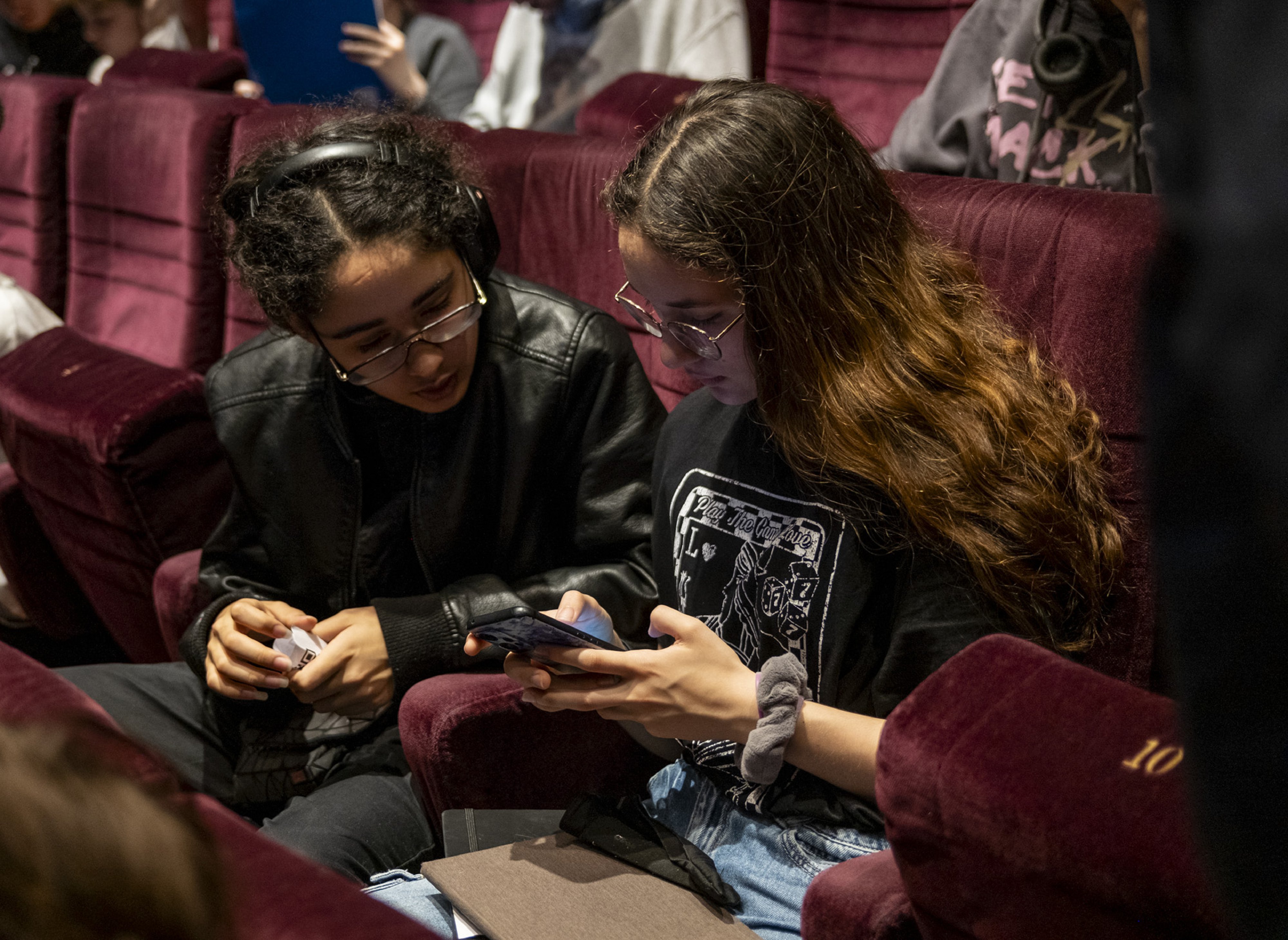
The festival organisers gathered that morning were wondering whether to accept films made with artificial intelligence, whether to use it to write their funding applications, or whether to keep their distance for ecological reasons. Here I share the substance of our discussions: it seems to me that one can take a position for or against, provided one knows why and can argue for it; that the ecological impact lies first in the materials of the machines and in political decisions; and that the quality of the results depends above all on the context one gives the tools. Festivals, which have become marginal in everyday audiovisual practices, are all the more necessary as places for dialogue.
The new marginals of audiovisual culture
Today we watch videos for several hours a day, on our phones, our computers, our consoles, and what cinemas and festivals offer has become marginal in that screen time. The people who keep festivals alive have become, in a way, the marginals of audiovisual culture.
In 2005, together with the Forum des images, I founded the Pocket Films festival, devoted to films shot on mobile phones, at a time when cameras were becoming standard in phones. Many people found the idea absurd. My answer was that almost everyone already had a phone in their pocket, that this object had already changed our relationship to time, to private space, to writing, and that within ten years everyone would carry a camera at all times. It was worth thinking about this through creation, by lending phones to artists and to people who were not artists. We are, I think, at the same moment with artificial intelligence.
The same year, YouTube appeared, and amateurs were able to make their videos public. On TikTok today, the same person watches videos (as a spectator), shares them (as a distributor) and makes them with the camera button (as an author). Tools that generate video from a simple written request, already built into these apps, now allow that person to produce images that imitate the codes of professional productions, starting with those of blockbusters, which are the easiest to reproduce because they are the most codified. We are in fact living in a cultural democracy, where we no longer always know where images come from.
This is why I find it useful to return to cultural rights, set out in 2007 in the Fribourg Declaration, and to the difference between cultural democratisation, which brings to people works chosen for them, and cultural democracy, which starts from what people do and know. The French Ministry of Culture created in 2025 a directorate-general for cultural democracy, education and research. Marjorie Glas’s book Quand l’art chasse le populaire traces the gradual drifting apart of public theatre and the working classes since the post-war years, and this question of the link between what we offer and the people we offer it to concerns us just as much.
According to a phrase attributed to Jean-Luc Godard, it is the margins that hold the page, and what people experience at a festival, they do not experience in front of a stream of videos. Still, this has to be explained, with arguments, to elected officials who are not necessarily specialists in culture and to politicians who ask what the CNC is for. Several of the festivals present had done so this autumn by showing, before screenings, a short visual explaining that cinema is funded by the price of the ticket and not by taxes; most audience members did not know this.
Taking a position, including against
Tensions around artificial intelligence are very strong (ecology, our relationship with the big tech companies, copyright), and they are understandable. But they often lead to positions of principle based on preconceptions, whereas we speak better about what we have experienced.
I think of Le Canard enchaîné, the French satirical weekly that refuses advertising, long kept the internet at arm’s length, and remains one of the few truly independent newspapers. Taking a position against something is also a way of asserting an identity, and that is precious in a cultural landscape that lives from its diversity. But one still has to know what one is refusing. A festival announcing that it only programmes films made without artificial intelligence would be telling itself a story: a simple online search while writing a script already goes through it. It can, on the other hand, decide to show only images of filmed reality, or to refuse entirely generated films, and explain why. Understanding why one takes a given position, and being able to argue for it, before one’s audience as well as before the regional cultural affairs office or the CNC, seems to me essential today.
One of the festivals present had in fact started this year to ask submitted films whether they had used artificial intelligence: five out of two hundred and fifty had. Entirely generated films are ruled out from the start; for the others, the team will decide case by case. Over lunch, I suggested also asking which AI was used: a film made with ChatGPT and a film made with an open model running on the director’s own computer do not have the same impact, either on the environment or on the independence of the person making it. Several people also noted that funding applications now include a box asking “have you used AI, and to what extent?”, while some European funders, on the contrary, encourage resolutely digital projects.
I saw something else this year, sitting on the committee of the CNC’s new fund for innovative film and image education schemes. Artificial intelligence was barely addressed, and often in a basic way. Several people around the table explained that they had not applied for lack of time: a few weeks to build a project meant to be innovative and co-designed with audiences, for a modest national budget. In my view, innovation is not supported by waiting for a miracle solution within a short deadline; it is supported by funding research and development.
A history much older than ChatGPT
History is somewhat reassuring: what troubles us today was wanted and built over centuries, and does not begin with the bosses of Silicon Valley. In the eighteenth century, the Mechanical Turk, a chess-playing automaton, toured the courts of Europe; its doors were opened to show the gears, but a player was hidden inside. The myth of the golem, the clay creature that comes to life when a word is written on its forehead, already says something about these machines fed on words.
In 1642, Blaise Pascal, aged nineteen, presented a machine that calculates for us, the Pascaline. In 1703, Leibniz published his explanation of binary arithmetic, with 0s and 1s, which is the arithmetic of our processors. In the nineteenth century, Charles Babbage designed his Analytical Engine, which borrowed punched cards from Jacquard looms. Ada Lovelace translated into English an article describing it and added notes much longer than the text, in which she imagined that the machine might one day handle symbols, and even compose music. She was the daughter of Lord Byron, at whose house Mary Shelley imagined Frankenstein. Mark Alizart, in Informatique céleste (2017), sees in these cards, which can be punched again, a machine able to modify its own results, which he considers the first step towards a form of intelligence.
The term itself comes from marketing. In 1955, a group of researchers working on what might be called electronic cognition were looking for funding; they came up with the expression “artificial intelligence”, which sounded good, and obtained funding for a summer seminar at Dartmouth. Filmmakers have accompanied this history, from 2001: A Space Odyssey to Spike Jonze’s Her (2013). Chris Marker himself programmed a chatbot, Dialector, on his Apple II in 1988, which artists recovered from his floppy disks after his death; you can still talk to it online, in English. I had met Chris Marker in 2005, when he took part in Pocket Films; he was over eighty and had the curiosity of a teenager. A participant asked whether the perception we have of AI today had not been created by these myths, and I absolutely believe so. A festival can programme these films and discuss them with its audience.
Ecology is decided in the mines and at the ballot box
Ecology was what worried people most around the table, and I share that concern. What exactly are we talking about? First, the manufacture of the machines: with what materials, and at the cost of which mines, are processors made? In my view, this is where the main impact lies, far more than in the water that is so often discussed. A CNRS laboratory in Nantes is working on other materials for processors; this is research that needs political support.
Then come data centres, which are filled with these processors. Why are they built near us, in the Paris area for example, rather than in the Far North, where it is cold and they would not need cooling? For two reasons. The first is response time, which would be slightly longer. The second is economic: a data centre is a new industry that territories compete for, and since the industrial revolution industries have been set up without much concern for their impact. Since these centres run hospitals, administrations and transport, they are the ones that will be given water first in times of drought, before residents; I explained this in Ecology and Artificial Intelligence. We tend to ask ourselves how to be as virtuous as possible as individuals, whereas the subject is first and foremost highly political, and is also decided at the ballot box and through citizen mobilisation. Do you know, incidentally, who funded the first individual carbon footprint calculators in the mid-2000s? The oil company BP, which had every interest in making each of us feel personally responsible.
Does this mean we have a choice? Partly, yes. Someone asked whether the heat from data centres could not heat towns: that is what the Swiss host Infomaniak does, whose Geneva data centre heats around six thousand homes, and which offers open artificial intelligence models. An association can host its website with Infomaniak rather than with another host: for the same website, the impact is not the same. You can also run a model on your own computer. You install free software, LM Studio, download one of the many open models, and you have, offline, the equivalent of ChatGPT from a year and a half ago. There was the energy consumed to train the model in the first place, but after that there is only your computer’s electricity consumption. It is somewhat experimental today, and still quite surprising, and the new generation of laptops has much more powerful chips.
I also suggest an order of magnitude, which I detailed in The last straw: an industrial beef steak represents about ten thousand litres of water, or some four thousand queries to a language model. Someone who makes fifty queries a day for a year, which is already heavy use, therefore comes to three or four steaks. I am a vegetarian, so obviously biased on this, and the argument is a little easy intellectually. But do I ask myself questions when I eat a steak? I do when I write my little prompts. We feel guilty in one place, and there may be other places we have not yet looked.
The quality of the results depends on the context you give
Many people judge artificial intelligence on a few lines typed into a free account, and the result is indeed disappointing: a summary of what one would have found oneself on the internet. A few notions change the results completely; everyone can do with them what they like.
- Context is the main key. In a “project”, you upload documents (your past applications, the call for projects, the transcript of a conversation with committee members) and the tool relies on them rather than on generalities. This also means organising your documents with your colleagues. I developed this point in Context : The Key to Artificial Intelligence in Cultural Organizations.
- The application installed on your computer can work in a folder you open to it. The context is then one or more folders on my computer. When open models have evolved enough, I will be able to unplug Claude and use another model running on my own computer with the same context, and I will be independent of any single company. These are questions of sovereignty, where my data are and how I back them up, and an association can decide on them. Someone asked whether one could really trust what one installs in this way. It is a question of trust: today I trust Anthropic and not OpenAI, tomorrow I may think the opposite, and for all the ministries that run on Microsoft, American judges have the power to shut down accounts or delete documents.
- You can teach the tool skills. A skill is a kind of text file, with attached documents, that describes not a profession but a task or a series of tasks: doing my invoices from my templates, for example, rather than by hand. When you ask it something, the tool fetches the stored skill, and you can improve it as you go, so that recurring tasks become more and more precise and more and more economical. There are also a huge number of them online, for marketing, for layout; a very well-known one, Humanizer, is meant to make a text sound less like AI. I explained in The skill as a work of art how I made one of my way of writing.
- Agents and connectors automate. An agent can carry out a news watch every morning and send it by email; a connector links the tool to a mailbox, a calendar, an editing program. Tools can now even drive a browser and fill in an online form they have been shown once.
The latest models, reserved for paid accounts, are clearly better than the previous ones, and often more economical. In audiovisual production, we see the arrival of short AI-generated fictions watched by many teenagers, vertical micro-series mass-produced by Chinese studios, and automatic editing, where you drop your rushes into a folder and describe the film you want. I am going to try it, by the way, for the trailer of my latest film, an exercise I do not enjoy. Someone replied that no tool will live the editing for us, and I fully agree: I edited that film, shot at the École La Source, for six months with a group, and it was during that time that the film came into being. For practical and institutional needs, automation makes sense; in an artistic approach, it no longer does. An industry that replaces its actors with generated images remains an industry; what I stand for lies elsewhere, on the side of craft, which has always existed alongside industry and has not disappeared with it.
Translators without work and a film editor
I am not reporting here who said what, but I would like to convey the variety of what was exchanged, because the participants’ questions were as valuable as my answers.
One person asked whether artificial intelligence was not, after all, just one more tool, as the internet had been: their festival existed before the internet and could no longer function without it. Another pointed out that on Google, the first thing displayed today, before the links, is a generated answer. A third thought that everything comes from the word “intelligence”: it makes us believe the program is thinking in our place, which nobody believed of a dictionary or of Wikipedia.
We talked a lot about translators. A participant had just been speaking with a Basque-French translator: he still has work, but his colleagues who translate from English or Spanish have almost no commissions left. A festival that used to have its films subtitled by volunteers will, on the contrary, pay professional translators, because someone is needed to check the exact meaning of the original version. We also talked about funding bodies that screen applications with AI tools, and about publishers who check that their authors have not used any.
A participant, a film editor by profession, went through the move from 35mm to editing software. Producers said: with digital, things will go much faster. The opposite happened: much more footage was shot and editing took longer. For her, the question remains the same, whether you are editing a film, writing an application or using an AI: which tool you choose, why, and from what point of view. AI can help to formalise, but it will not provide the angle.
One person uses AI to correct her emails and noticed that by the end of the day she writes faster and less well, since the correction will come afterwards. Another refuses to use it for writing: she wants to keep searching for her own words. One participant said he was “struck by [his] own conservatism”: when he was at secondary school, he was reproached for using Wikipedia in exactly the same words used against AI today, and Plato already complained about writing. He also spoke about the financial bubble, with the tens of billions invested in data centres, in Texas and elsewhere, on profits nobody can guarantee, and recommended reading Frédéric Lordon’s analyses on his Monde diplomatique blog. I answered with the internet bubble of 2000-2001: companies and investors had bet too early on uses that came later, many lost a lot of money, but the uses did come. A bubble bursting does not mean things will not happen. And if online access one day becomes more expensive, some of these uses will move to our own machines.
We talked about authors’ rights, which composers of film music feel are threatened, and how they differ from American copyright: French authors’ rights, inalienable in their moral component, start from a humanist conception of the work, whereas copyright follows a commercial logic. We talked about memory, which we entrust to our phones. Around 1450, the same thing was said of Gutenberg’s printing press: if everything is in books, there will be no need to learn. Who said so? Above all those who held knowledge, the monks who copied manuscripts for example. What bothered them was that knowledge would spread, and yet it is thanks to printing that the Renaissance happened. Language-learning apps based on artificial intelligence meet each person where they are, far better than a method that is the same for everyone. A participant objected that one day we would no longer need to learn languages; I thought of the washerwomen who defended their trade when washing machines arrived, and who then did something else with their lives.
One question came back at the end: if all funding applications are written with artificial intelligence, they will all comply perfectly with expectations, and selection may also be done by machines. I believe that what is singular will end up standing out. From its beginnings, Google has tried to distinguish original content from content made to please its algorithm. I was asked how I spot a text written by artificial intelligence: abstractions stacked one on another, superlatives, reasoning that always closes on an impressive conclusion.
When cognition becomes a commodity
Electricity and running water have become commodities: we flick the switch, turn on the tap, and no longer think of the power station or the well. Cognition (making a summary, connecting things, producing a coherent argument) is becoming one too, and this is unsettling, because we thought intelligence was what defined us. Yet this conviction served to justify human domination over animals, and that of some human groups over others, with pseudo-scientific theories about the supposed abilities of “races”. If we are not the most intelligent beings, entitled to dominate everything else, what are we? I have no answer, but I believe the question opens onto what we do together: connection, intuition, creativity, the complementarities of a group that would be quite different with one person more or one person less.
Serge Tisseron, with whom I often work, suggests that we should not ourselves behave like machines. I think of calls for projects, through which organisations whose strengths would rather complement each other are put in competition, and on which many people spend considerable energy for applications that are eventually rejected. I also think of art schools, which struggle to lead their graduates into employment, while the ability to imagine and to think outside the box may be worth more tomorrow than the ability to make things, which machines increasingly take over.
After the session, one participant spoke to me about emotion, which she would have liked to address: we go to the cinema to feel emotions, and no one can do that for us. Another was worried about lonely people who make a chatbot their companion, as in Her. I told them about the summer of 2023, when I offered, with Cultures du cœur, computers connected to a conversational artificial intelligence in care and shelter settings. A man in his sixties who did not know how to type spent two hours asking it questions about his life, once someone had shown him the space bar; a teenager in care, often stigmatised, talked for two hours about video games with an interlocutor who knew his culture, and came out visibly reassured. I told these two encounters in ChatGPT as an empathetic social interlocutor. A participant replied that this could also prevent connection with others; we agreed that it was complex, since humans are not always kind to each other either. I believe it is the role of cultural workers to open spaces for dialogue on these questions, spaces that are not spaces of judgement, since such spaces are lacking in everyday life.
Some leads for festivals
Here are some concrete leads for festivals, as they emerged from the morning:
- Say why you accept or refuse films made with artificial intelligence. The position matters less than the ability to explain it to the audience and to funders. In submission forms, ask which tools were used, not only whether they were.
- Choose where your data are hosted. The festival’s website, archives and working documents can be entrusted to a host that heats homes rather than another, or to a server kept on your own premises. I offered other leads in Data Centers : We Fill Them Ourselves.
- Try before judging, with your audiences. The workshop I run with teenagers (a short film made in pairs in two and a half hours, from a discussion on the dangers and benefits of artificial intelligence through to the screening, via the script, the images, the editing and the voices recorded by the young people themselves) is described step by step in the Tutorial for making films in collaboration with artificial intelligence. The debates after the screening are often lively, and some people change their minds in one direction or the other.
- Tell the democratic meaning of your work. Explain to the audience how cinema is funded, and to elected officials what a festival brings that time spent in front of screens does not.
And some readings and resources mentioned during the morning:
- Une histoire culturelle de l’intelligence artificielle, a collective book edited by Alexandre Gefen (CNRS Éditions), with contributions from historians of science, philosophers, computer scientists and arts specialists; of the many books I have read on the subject, it is the one I most recommend to non-specialists.
- Mark Alizart, Informatique céleste (PUF, 2017).
- Marjorie Glas, Quand l’art chasse le populaire (Agone, 2023).
- Dialector, Chris Marker’s chatbot.
- The Dead End of Digital Conscientious Objection and Not judging people’s digital practices, on posture.
A programme we did not follow
With Pierre-Henri Arnstam, I had prepared a timed programme in four parts, with an online contribution tool accessible by QR code, a mind map to build together, a list of films and series made with artificial intelligence to watch, and a one-hour accelerated version of the workshop I ran with the teenagers of TUMO Paris. The group gathered that day was small, and everyone could speak directly to the others. So I built the morning from what they had to say.
I suggested treating it as a working session rather than a lecture: I had things to bring, and so did everyone else. After setting out the framework, I asked each person where they stood, what they needed and what worried them, making clear that we were allowed to disagree, and even to hold opposing positions. I took notes. After the break, I took the questions one by one, somewhat out of order, bringing historical landmarks, technical information, orders of magnitude and readings: “marbles”, as I call them, that everyone can then do with as they wish. One person let me understand that she did not want to go into the details of the tools; I told her that I respected this choice, and carried on for those who wanted to know.
Careful preparation does not prevent you from letting go of your plan; it is even what makes it possible. I wrote about the TUMO workshops: “Careful rehearsal and minute-by-minute precision are key to creating a proposal that works, and to having the flexibility to adapt to unforeseen circumstances.” At the end of the morning, I said that we had done nothing of what was planned, and that this was very good. Someone who runs through their PowerPoint whatever happens behaves a little like a machine. I believe the answer to artificial intelligence is collective intelligence: each person arrives with an experience the others do not have, and it is by pooling them that we manage to follow a subject that changes from month to month.


