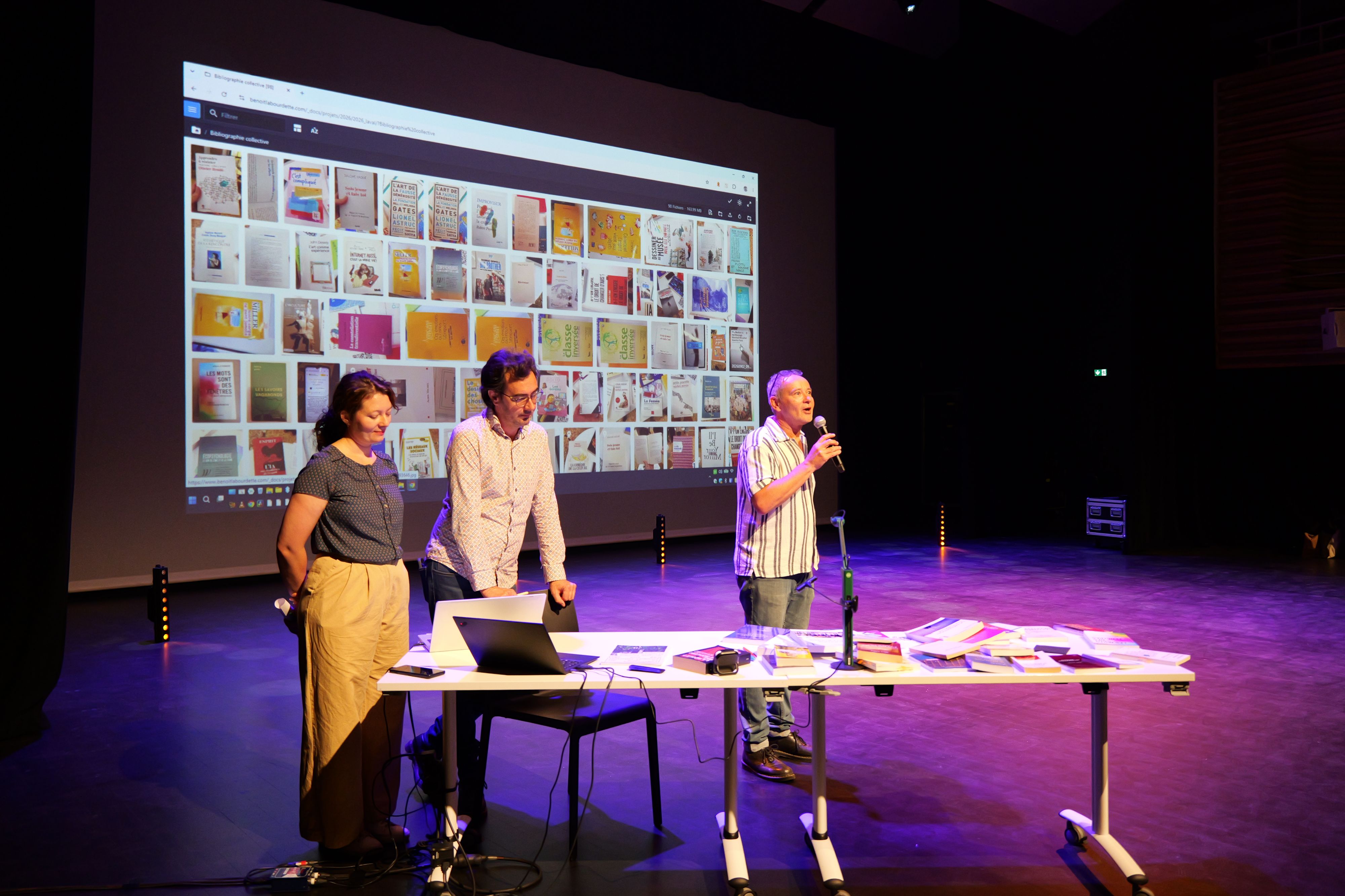
The “Cultures pour tous” department of Laval and Laval Agglomération entrusted me with facilitating its back-to-work gathering, a full morning devoted to the cultural practices of 15-25 year olds. 150 people were expected, 220 came, from the conservatoire’s teachers to the teams of public libraries, heritage, museums, archives and front-desk services. Each of them spoke at least twice, and 80 written contributions were shared online. I recount this morning here as it unfolded, with what I proposed, what I said, and why I go about it this way.
A region that puts its energy into its culture
Laval is a town of about 50,000 inhabitants, in an urban area of 110,000. Its conservatoire is one of the largest in France relative to its population, with 4,000 students and about a hundred full-time equivalents of arts teaching. The town now counts six thousand higher-education students, up from three to four thousand not long ago, and has set itself a target of ten thousand; a design school has moved in. Arts and cultural education is very solidly built there up to the end of middle school. Recently, a single place has brought together a large part of these forces, Le Quarante, which houses the conservatoire, an indoor “village square”, an auditorium, and workspaces the students have already made their own. That is where the morning took place.
I built this project with Emmanuel Têtedoie, director of the Cultures pour tous department, François-Marie Foucault, director of Le Quarante and of the conservatoire, and Clarisse Dire, director of public libraries and heritage. The department’s staff work on different sites, in different professions; this back-to-work morning is the only moment of the year when they all cross paths. It could have been nothing more than a functional meeting, timetables, announcements service by service. The choice was different, and I hold it to be a political choice: to devote this rare moment to a substantive question, common to all professions, and to live it together from beginning to end. For Emmanuel Têtedoie, refusing to give in to catastrophism was a matter that involved his teams, cooperation with young people and the very meaning of their work; and he wanted each person to leave enriched by something, if only by having spoken.
Preparing at length in order to improvise well
We prepared this morning throughout the summer, in several video calls, with a running order document that I updated after each exchange. Everything went into it: the timing to within five minutes, the exact questions for the paired conversations, the choice of felt pens that would not stain the auditorium seats, the size of the screen, the microphone. My interlocutors told me about their region and their teams; I learned a great deal from them, about the conservatoire’s educational project, which accompanies students towards their own autonomous practices, or about la Magma, that artistic protest march carried in June by a collective of young people from Laval with the institution’s support. One prepares the way one rehearses, precisely in order to be able to improvise when the moment comes. The day before, I arrived in Laval at the end of the afternoon; at eight in the morning, we were setting up the spaces all together: Emmanuel Têtedoie, François-Marie Foucault, Clarisse Dire, the venue’s teams and me. Where to put the tables, how to spread out the books: that welcome, too, was prepared collectively.
Books in everyone’s path
From 9:15 am, the welcome on the village square, over breakfast. I had brought from my own library some three hundred books (sociology of youth, digital culture, mediation, education, psychoanalysis), which we had laid out on tables placed right in everyone’s path. On the tables, QR codes: anyone could photograph the covers that drew them and drop the pictures into a shared folder, to build a collective bibliography online.
I did not know whether this would work on a back-to-work day, among colleagues who had not seen each other all summer. It worked beyond what I had hoped. People read, showed each other covers, took pictures, talked; some arrived well before the hour. The reason is methodological. An object placed between people makes it possible to meet without being the other’s object. We gather around the books, each does with them as they please, leafs through them or not, photographs them or not. Nobody tells anybody what to do. I had planned to make this comment during the morning and I forgot; here it is.
On the screen, their photos
At 10 am, on entering the auditorium, people discovered on a huge screen their collective bibliography, the photos they had just taken, all mixed together. No first slide with the title of the morning; on the screen, what the people present had already created.
Emmanuel Têtedoie opened the morning, flanked by Clarisse Dire and François-Marie Foucault, explaining the choice of this format and this theme, then playing a recent radio piece from France Culture on the decline of cultural practices, alarmist in tone, laid there as material to work on. Agnès Camarena, deputy mayor of Laval for culture and cultural rights, who had recently taken office, then spoke of her refusal of catastrophism and her confidence in the practices of the inhabitants.
Then I took the microphone, and I began by giving the complete programme of the morning, down to the writing instructions at the end. When you are sitting in a room without knowing what is coming, your time is confiscated, even by someone benevolent. When you know where you are going, you can project yourself, choose your own way of being there. On my table, a camera is connected to the screen: whatever I place under it appears in large format. I put my watch there, in plain sight, commenting on the gesture: I will keep an eye on the time, the announced frame will be kept, I am taking no one hostage. These are details, and these details tell people that they are respected.
Another visible choice: no slideshow. Under that same camera, piles of books; I show the covers full size, I leaf through them, I choose on the spot according to what is happening and what is being said. The material is there, larger than what will be used, and everyone can see that nothing is scripted.
Before introducing myself, I proposed a first exercise: ten questions, you stand up if the answer is yes, you stay seated otherwise. Who is under 30, who is the parent of teenagers, who still feels young inside, who came by bicycle, who wears second-hand clothes, who watched a video on their phone yesterday, who thinks social media are dangerous, who meets 15-25 year olds in their work, who spends more than three hours a day in front of a screen, who has TikTok on their phone. Two minutes, laughter, and the group’s real communities coming into view. Two contrasts interested me in particular: everyone on their feet for the three daily hours of screen time, almost nobody for TikTok, the app most used by young people, whose users are on average 29 years old. And I immediately made the methodological comment: this exercise can be reused as it stands, with young people, with an audience, with a team; it is funny, requires little self-exposure, and it gives the group an image of itself.
Part one: youth only exists in the plural
I opened my first input session with the category itself: youth is first of all a dividing line. Adolescence is a twentieth-century invention, a social construction more than a biological reality; Pierre Bourdieu summed it up in 1978: “youth is just a word”, a division of the ages that organizes positions and power relations. From there, a few points of reference, books in hand under the camera:
- The stigmatization of youth is nothing new. Salomé Saqué, in Sois jeune et tais-toi (Payot, 2023), quotes Hesiod, around 700 BCE, already deploring a youth that was “unbearable, without restraint”. Clarisse Dire had passed on to me a reference I discovered with delight: the sumptuary laws of medieval Italy, studied by the historian Ilaria Taddei, which taxed the clothes of young people deemed too short. Laughing together at this permanence helps us spot our own judgements.
- The figures contradict the narrative of decline. The 16-29 age group goes out the most: 76% had at least one cultural outing in the year, against 56% of 50-64 year olds and 38% of those 65 and over (Insee, 2022 data). 27% of under-25s went to a festival in the year, against 19% of the French population on average. 84% of 15-24 year olds go to the cinema. And they spend an average of 3 hours 34 minutes a day on their phone, where most of what they do belongs to cultural practices.
- An age group is not a taste group. The sociologist Camille Peugny (Pour une politique de la jeunesse, Seuil, 2022) shows the total cultural and political heterogeneity of youth; the tastes formed around the age of 15 persist throughout life. “Young people will like this” therefore means nothing. What young people truly share, across all backgrounds, is anxiety about the future.
- Surveys give figures, not instructions. In our professions, we are alongside real people; asking them what they do and what they think is not demagogy, it is the first bond. And it is up to us, the professionals in charge, to go towards them.
I took the opportunity for a detour through critical thinking, going back to the radio piece heard at the opening. A message is always produced by someone, from somewhere, for someone, with a purpose; Marshall McLuhan and Bourdieu each established this in their own way, and it holds for journalists as it does for me. Before announcing the decline of cultural practices, one would first have to define what one calls a cultural practice.
Then I proposed the first paired conversation, each with the person sitting next to them. A minute and a half to speak while the other only listens, then we switch, stopwatch on the screen. The question: what have I already changed in my way of doing, or of thinking, following an exchange with a young person? The trios organized themselves differently, and I adapted the instruction for them. And afterwards I said why I hold on to this exercise: everyone speaks and is listened to, with no public judgement; and I, the facilitator, do not know what was said. It is frustrating, and it is precious. It invites me to let go of the fantasy of mastery over other people’s elaborations, a well-meaning fantasy, but a fantasy of power.
Part two: the digital as a milieu of existence
Second input session, the digital. My definition, which everyone was free to discuss: the digital is not one tool among others, it is a milieu of existence, like air, water or electricity. Without the digital, no more hospitals, no more schools, no more security. One cannot be for or against a milieu; one can look at what one does in it.
Michel Serres, in Petite Poucette (2012, published in English as Thumbelina), said it of the thumb generation: these tools do not make people less intelligent, they shape brains differently, with different skills. Text-message language, so mocked in its day, was the invention of a language by a generation, made precisely so that adults could not enter it. Creating a language is the opposite of not mastering the language. And I recalled 1450: the printing press was received as a catastrophe that would cheapen knowledge and dispense with learning. What was really at stake were positions of power. It produced the Renaissance and the Enlightenment. Our judgements on the internet yesterday, on artificial intelligence today, deserve to be looked at with this memory in mind.
On screens and health, I described the actual state of research: deep disagreements among scientists. A recent Finnish study, which followed 260 adolescents for eight years, records better cognitive abilities among those who use screens the most, and its very authors warn against any direct causal reading. Screen time, in itself, tells us nothing; everything depends on what one does with it. We never judge our own, for that matter, since we know what we do with it.
So, what do young people do? I described TikTok from the inside, I who had judged it without looking at it ten years ago; I told it plainly, as I had in fact written in the journal of the Observatoire des politiques culturelles. What sets this space apart:
- organic reach: every published video is shown to about a hundred people, then to more if it strikes a chord; a first video can be seen millions of times, which exists on no other network;
- sharing and commenting, which make every person active in the circulation of content;
- a creation button: you watch, you tap, you film, you publish. The “trends” bring tens of thousands of people answering one another in choreographies on the same piece of music, a kind of high-speed artistic palimpsest.
80% of young people have already created or contributed on social media. The place such a space offers is not only that of a spectator: everyone there recommends, circulates, and can create. That is why I ask that we take a close look before judging, and why I advise cultural institutions against wearing themselves out on YouTube channels with twelve views.
I also shared my workshop practice, in day hospitals, in youth employment centres, with asylum seekers: every session ends with something made (a podcast, a drawing, a video), put online the same day, with the names of the people. Naming is what makes symbolization possible, what helps each person recognize themselves and build themselves. And the young person who missed a session is not left behind, they find the trace again. The digital, used this way, is a tool for connection. This morning’s online space, QR codes included, is in fact hosted on my agency’s server, in an industrial estate in Clermont-Ferrand, outside the big platforms.
One person spoke up to qualify what I had said about social media; she was right to do so, I said so, and that is exactly why we need one another. Then I launched the second paired conversation, everyone changing partners: an idea for action with young people, your own or one you have carried out and that worked, to share with your neighbour. At the end, I was once again frustrated not to know, and once again, that was the principle.
Part three: cultural democracy, concretely
Last input session, cultural rights. The term appears in the deputy mayor’s remit, and it can seem conceptual, almost obligatory; I wanted to give a definition of it that would be understandable, concise and workable. Cultural rights are rooted in the 1948 Universal Declaration of Human Rights and were formalized in 2007 by the Fribourg Declaration, around the philosopher Patrice Meyer-Bisch; a working group, of which I am a member, is currently rewriting it in the light of ecological, digital and gender issues. Culture is taken there in the anthropological sense: the language I speak, my tastes, my neighbourhood, my ancestors. To respect a person’s cultural rights is to respect their culture, and therefore their dignity. And a person whose culture is respected can then, in their own eyes, give value to that culture, a condition for contributing to the life of the city. Many young people, when asked about their tastes, answer “I like it, but it’s rubbish”: they have learned to despise their own culture.
From there, the distinction between cultural democratization (making the great works accessible to the greatest number, Malraux’s project in 1959) and cultural democracy (fostering everyone’s creativity and mutual enrichment, the 1982 roadmap). The two complement each other, but the second requires giving up condescension. The sociologist Tomas Legon has shown this with regard to school cinema programmes: designed to broaden horizons, they mainly reach the young people already culturally endowed, and confirm the others in their rejection. There is no relativism in this: recognizing the diversity of cultures forbids neither high standards nor long journeys, it forbids the hierarchy that stigmatizes.
I grounded this part in two references that are essential to me:
- John Dewey, Art as Experience (1934). Art is not the object, it is the experience human beings live through in the encounter with the object. In our workshop projects, this shifts everything: what counts is not the beauty of the result, it is the process lived by each person; and telling that process at the moment of sharing gives the most fragile works their value. Digital platforms have understood this in their own way, with experience design; it is up to us to understand it for purposes other than commerce.
- Olivier Houdé, on cognitive resistance. Learning means creating new neural connections, which is costly in energy; under stress or under threat of judgement, the brain falls back into reflex thinking and learning becomes, in the literal sense, biologically impossible. Each person’s place in a group is therefore not a nicety: it is the material condition for anyone to learn anything there.
Hence my definition of the frame, which I have long been working on with the psychiatrist and psychoanalyst Serge Tisseron: the frame is not what forbids, it is what authorizes. The teacher who stays “to police the room” during the workshop destroys the very frame they believe they are holding. And one does not learn information, one learns lived experiences: a prevention workshop where young people do what is expected of them mainly teaches how to meet adults’ expectations.
Eighty sheets of paper on the screen
There remained the moment I had announced from the start as the most important of the morning. Ten minutes of individual writing, felt pen and paper, four possible entries:
- a synthesis: what I take away, in a word or a sentence;
- a disagreement: you are allowed, and it matters that it be written;
- a contribution: a point that would have been missing;
- an idea for action with young people, to be shared.
Each person photographed their sheets via the QR code. 80 handwritten contributions appeared on the big screen, no two alike, and disagreements had their full place among them. The discussion drew on this wall until noon sharp, as announced. In the afternoon, the teams went on working in groups, some again the next day.
The online space remains open. A written synthesis is in preparation, which will incorporate the contributions, for those who were there as well as for absent colleagues. What these 220 people said to each other in pairs, nobody will ever know, and that is just as it should be: what they created belongs to them. If this morning built something in common, it is not because everyone there thought alike; it is because each person could think differently from their neighbour, and say so. My thanks to Emmanuel Têtedoie, François-Marie Foucault and Clarisse Dire for their trust and the finesse of the preparation, and to Agnès Camarena for her openness.
To go further:
Culture, youth and digital (resources section)
Cultural mediation methods (resources section)
Rethinking youth culture. From democratization to cultural democracy
Towards renewed cultural mediation for young people. Cultural rights and the digital age


