The imaginary is commonly seen as a decorative extra set beside serious life. I argue here for the opposite view: our institutions, our interactions and our stories are made of imaginary significations, and this weave can be worked on. Drawing on Castoriadis, Goffman, Goody, Guattari and Illich, I propose the concept of the imaginary as survival equipment, that is, an imaginary that is produced rather than consumed, known as imaginary, worked on in the mode of play and retold together, which allows people and groups to get through ordeals and come out of them stronger.
The letter after the fire of Lyon
In the first century of our era, a fire destroyed Lyon in a single night. Seneca then wrote to his friend Lucilius a letter, the ninety-first, to console their mutual friend Liberalis, a native of the city, whom the disaster had left devastated. His argument rests on a psychological observation: misfortune weighs more heavily when it has not been foreseen. Hence the advice that runs through the whole of Stoic philosophy under the name of premeditation of evils: to go over in one’s mind, regularly, everything that can happen, ruin, exile, bereavement, fire. The point is not to wallow in the worst but to strip the worst of its power to stun. A person who has already imagined loss is not paralysed when loss occurs; in a sense, they have already begun to act. Seneca did not recommend looking at images of the worst, he recommended forming them oneself, and his advice presupposes something he does not say: that we have a hold on our representations. This hold cannot be taken for granted, and it is what I want to understand here.
Believing that we live in reality
Cornelius Castoriadis thought about this hold at the scale of entire societies, in The Imaginary Institution of Society (1975). A society holds together through its social imaginary significations: God, the nation, capital, progress are neither things nor true or false ideas, they are creations through which a human group institutes its common world and decides what exists and what matters for it. Castoriadis distinguishes the instituted imaginary, those significations inherited and sedimented in institutions, from the instituting imaginary, the capacity to create new significations, whose concrete workings I described in the article The framework that authorizes. And he calls heteronomous a society that hides from itself the fact that it creates its own institutions, attributing them to the gods, to the ancestors, to nature or to the laws of the economy; autonomous, a society that knows itself to be the author of its significations, and is thereby able to take them up again.
Heteronomy does not only concern societies, it plays out again at the scale of individuals. Many people do not see themselves as woven of imaginaries; they think of themselves as living directly in reality. I sometimes hear, at a shop counter or on the sidelines of a training session, someone declare that sessions with a psychologist are useless, that they have no need of them. In this I hear, perhaps wrongly, less a judgement about psychology than a worry: to look at one’s own workings is to risk discovering a weave there, and a discovered weave calls for work. As long as we believe we live in reality, there is nothing to rework, the world is as it is and so am I. This is Castoriadis’s heteronomy at the scale of a life: whoever does not know themselves to be woven cannot imagine reworking the weave, and endures their imaginaries the way one endures the weather.
The fire alarm and the evacuation drill
Our most ordinary interactions also depend on this weave. Erving Goffman showed in Frame Analysis (1974) that we are constantly answering the question “what is going on here?” by means of frames that organize experience, a notion I presented in the article The Eye in the Hand. Goffman calls keying the process by which an activity that is meaningful within a primary framework is transformed into another activity patterned on the first: a fight becomes play-fighting, a fire becomes an evacuation drill. A siren goes off in a building: real fire or drill? The sound is identical, and the whole experience of the people present depends on the answer.
Fiction is a keying, in which we take the catastrophe as a model and can approach it without being overwhelmed. Within the frame of play, we can look at the flood we dread, stage it, discuss it, whereas in the primary framework the same flood stuns those it catches unawares. And because frames are shared conventions, held in interaction, this work is done with others: it is together that we establish that here we are playing, and this agreement is already a bond.
The Bagre is never recited the same way twice
The anthropologist Jack Goody spent decades among the LoDagaa of Ghana recording the Bagre, their great initiation narrative of several thousand verses. Myths were believed to be immutable, passed on identically from generation to generation. His recordings, made with S.W.D.K. Gandah (The Myth of the Bagre, 1972; Une Récitation du Bagré, 1980), show the opposite: from one ceremony to another, from one reciter to another, the versions diverge considerably, the audience breaks into the flow of speech, and yet the LoDagaa hold all these versions to be one and the same Bagre. Goody drew a general lesson from this (Myth, Ritual and the Oral, 2010): societies without writing do not preserve their stories, they recreate them at each recitation. A collective imaginary lives only by being retold.
This is the meaning I give to the work of the IHMéC, the Institute for the History and Memory of Catastrophes chaired by Serge Tisseron: keeping the memory of past disasters alive requires retelling them again and again, and this narrative work feeds the collective capacity to picture possible disasters. I situated this activity within the concept of co-resilience in the article Fabriquer la corésilience.
The mass manufacturing of imaginaries
The image industry has interrupted this regime of re-creation. Félix Guattari made it a concern of his mental ecology, the third register of The Three Ecologies (1989) alongside the environment and social relations: he called for apparatuses of subjectivity production moving towards an individual and collective re-singularisation, rather than towards what he named “a mass-media manufacturing synonymous with distress and despair”. I reread these three registers in the light of co-resilience in the article Les trois écologies de la corésilience.
In Tools for Conviviality (1973), Ivan Illich calls radical monopoly the dominance of a technique not over its competitors but over the human capacities it replaces: the car makes cities unwalkable, the medical institution deskills the care people knew how to give themselves. The entertainment industry exercises a radical monopoly over the picturing of crises. It supplies ready-made images of panic, looting and every-man-for-himself, so available and so powerful that we no longer make our own, whereas the researchers who study real disasters observe on the ground the prevalence of mutual aid, a gap I documented in the article Fabriquer la corésilience. Consuming this imaginary trains us to fear other people, the least useful disposition in a real crisis.
Producing one’s own story involves something else entirely. The person who makes a disaster story chooses their subject from among their real worries, negotiates with the material, with time, with others; it is a convivial tool in Illich’s sense, a tool the person handles instead of being seized by it. The imagined threat ceases to be a spectacle endured and becomes a material worked on, and this is, at workshop scale, the re-singularisation Guattari was calling for.
Bruno Latour rereads lockdown as an opportunity
No one stands above this weave, not even those who have thought about it best. Bruno Latour offers an example that touches me, because his work otherwise feeds my thinking on co-resilience, as can be read in the article Atterrir ensemble. In January 2021, after the first lockdown, he published Où suis-je ? (After Lockdown: A Metamorphosis). In it he rereads the ordeal through Kafka’s Metamorphosis and presents lockdown, if we can learn its lessons, as “an opportunity to be seized”, that of finally experiencing our terrestrial condition, our belonging to the thin layer of the Earth where life is possible. He does not deal there with the political dimension of the ordeal, even though a power was then governing through fear, concentrating decisions in the name of urgency and confining everyone to their homes, and this way of governing was in no way a natural necessity. Sweden, which never locked down its population, recorded, over the first two years of the pandemic, one of the lowest levels of total excess mortality in Europe, and the Corona Commission, the independent evaluation body appointed by its own government, judged the choice to avoid lockdown fundamentally reasonable. Lockdown was a political decision, not a fact of nature, and the thinker who had taught generations of researchers to follow actors and their assemblages did not see, in the assemblage of 2020, the despotic agent.
I am not inside his head, we all do what we can with our fear, and I keep away from retrospective judgement, whose deceptive ease I examined in the article Placing ourselves after the fact, or during. My hypothesis is that fear wove him as it wove everyone, and that rereading obedience as an experience of the terrestrial condition allowed him to reduce the dissonance between what he had accepted and what he thought, a mechanism I described in the article The social cost of coherence. Noam Chomsky, who had nevertheless theorized the manufacture of consent, consented in the same way to the narratives of the period, and I devoted to this reversal the article Noam Chomsky’s consent. None of this invalidates their works, both of which equip me. Knowledge about imaginaries does not protect from imaginaries; what protects is a practice, maintained before the ordeal.
An imaginary becomes equipment under four conditions
The political scientist Yannick Rumpala speaks, with regard to science fiction, of a collective intellectual equipment to be adapted for inhabiting the worlds now in preparation (Hors des décombres du monde. Écologie, science-fiction et éthique du futur, 2018): stories of futures predict nothing, they train thought to move through situations that do not yet exist. I take up this word, equipment, and propose to make it a fully fledged concept. Survival equipment is prepared before the ordeal, carried with you, checked regularly; you do not make it while drowning. I call an imaginary survival equipment an imaginary that meets four conditions:
- it is known as imaginary: the person or the group knows themselves to be woven, and therefore able to take up the weave again, which Castoriadis calls autonomy;
- it is produced, and not merely consumed: made by those it equips, out of their real worries and their own territory, outside the radical monopoly of industrial images;
- it is worked on in a played mode: Goffman’s keying makes it possible to approach threats, to look at them and handle them without being stunned;
- it is retold: like the Bagre, it is not preserved, it is reactivated through ever-new recitations, which keep it adjusted to the present.
With such an imaginary, ordeals change status. We fear that they damage us, and they do indeed damage those they catch without equipment. Nassim Nicholas Taleb calls antifragile the systems that shocks strengthen (Antifragile, 2012), a concept I situated among its neighbours in the article Robustesse, résilience, antifragilité. The person and the group who have already gone through loss in their minds, who have played it, told it and shared it, can come out of the ordeal stronger, because they have the means to metabolize it.
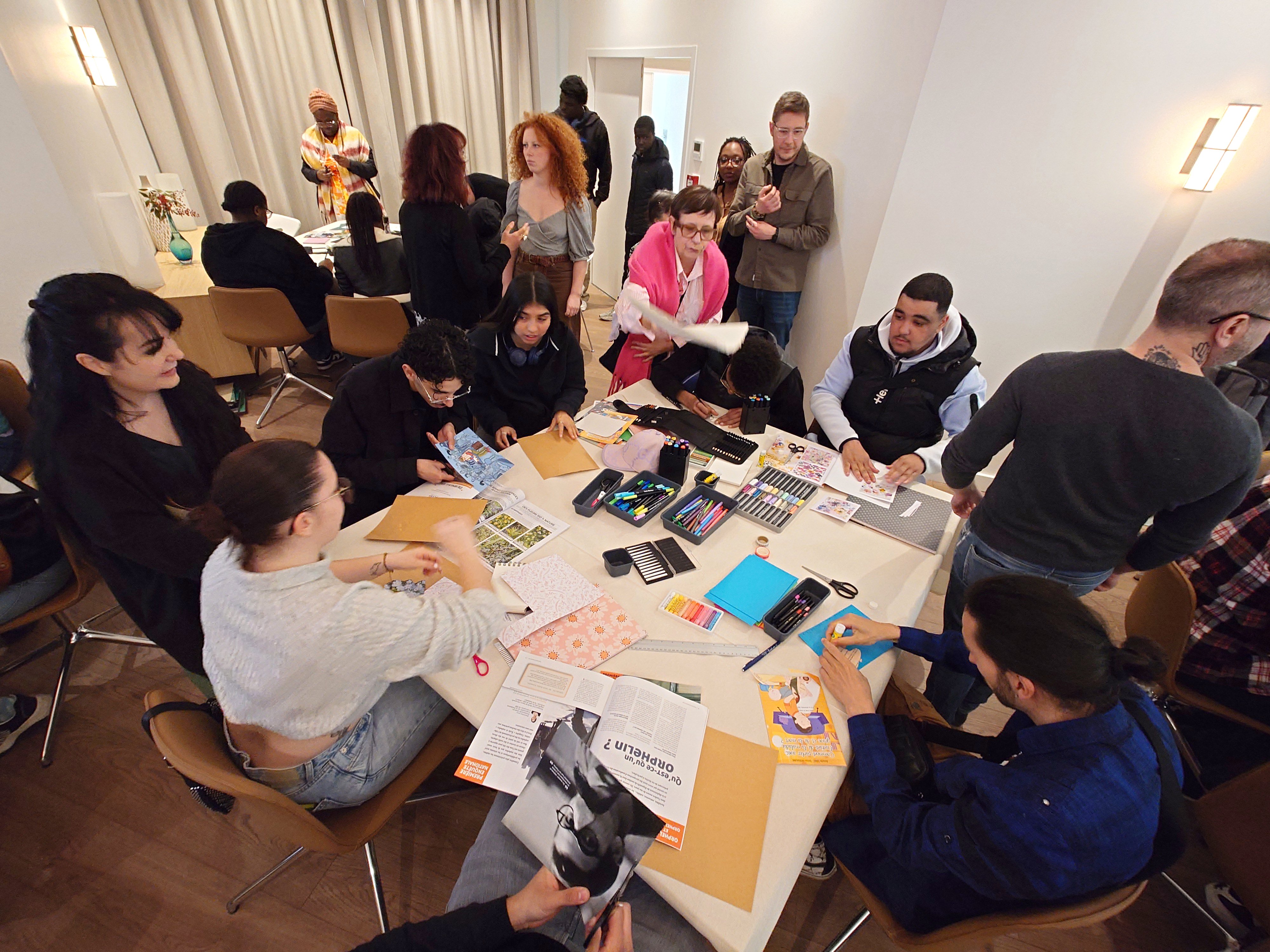
Putting this into practice comes down to three gestures. The first is to externalize the worry, to give it a body outside oneself, a written list (I propose its simplest form in What do you fear ?), a photograph or a film; the object made renders the weave visible and open to discussion, following the logic of Goody’s graphic reason, which I developed in the article The cage of representations. The second is to play, that is, to explicitly set up the frame that authorizes us to approach what frightens us. The third is to retell: to screen, to publish, to circulate, so that the story produced becomes a common good again and sets off in new variations. In the creative workshops on the future and on disasters that I have led, we put these three gestures to work, and I recounted them in the articles Cultural summer 2023 with Cultures du cœur : « The machine that travels into the future », Create your own film about imaginary disasters and its 2nd edition. As for the moment to carry out this work, calm times rather than crises, and the way to bring in those who have no desire to think about disasters, I address it in the article Atterrir ensemble with the concept of the dual-focus activity.
Risk prevention policies already have one keying at their disposal, the evacuation drill, which prepares bodies and organizations. It seems to me they would gain from giving themselves a second one, the creative workshop, where imaginaries are equipped and where people bond before they need one another.


