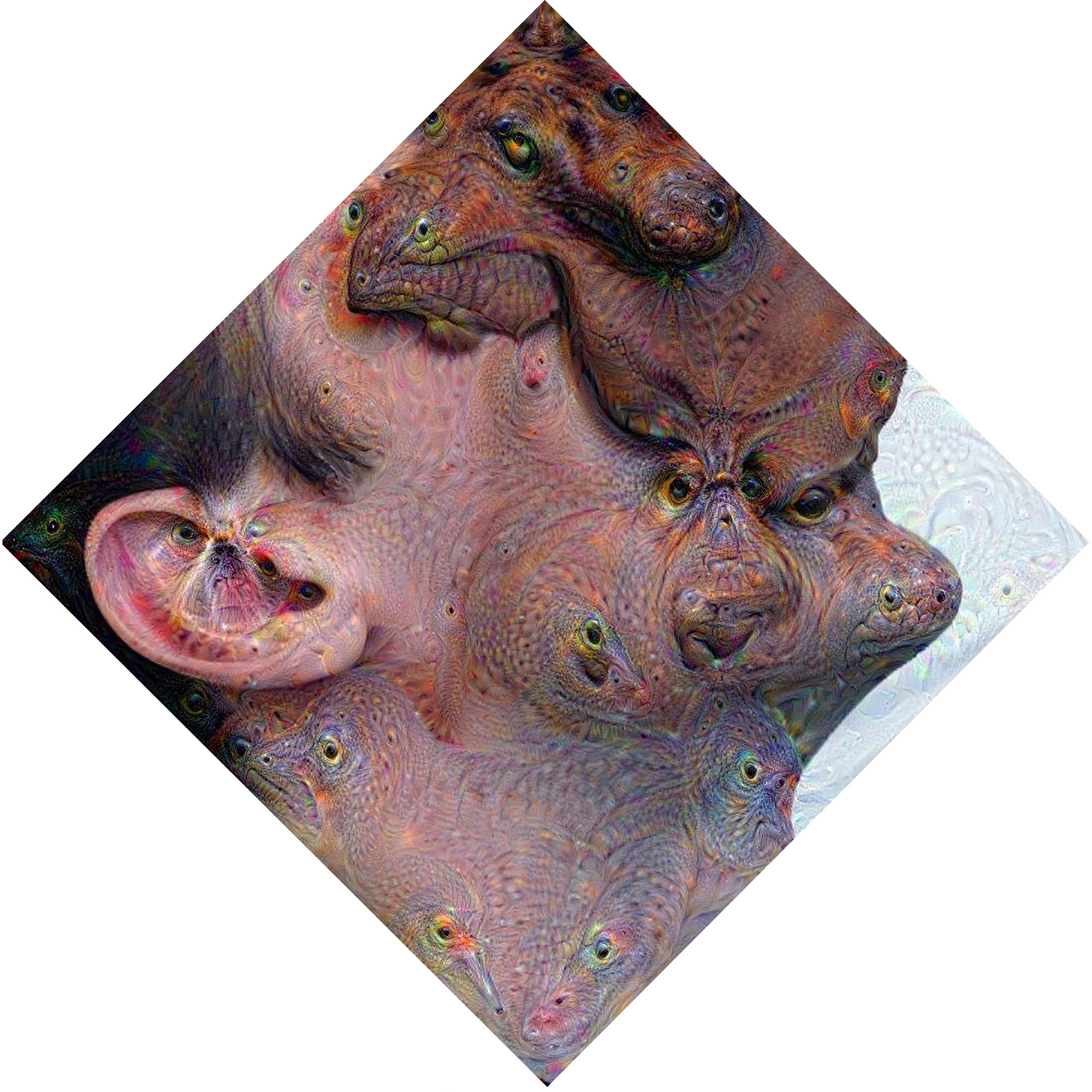
The artificial intelligence industry promises ever more perfect images, indistinguishable from reality. I defend the opposite path. Old, open, frugal models produce glitched, strange forms that are an artistic material in their own right, and artists have always made work out of the resistances of their tools. This long history sheds light on what we can do, today, with imperfect machines.
The phone images deemed unworthy of cinema
My intuition on this subject is an old one, and it long predates artificial intelligence. From 2005 onwards, I conceived with the Forum des images and directed the Pocket Films festival, devoted to films shot with mobile phones. The festival was born at the very moment when cameras were appearing in phones. The images these devices produced were, by the professional standards of the time, indefensible. Compressed, pixellated, unable to hold low light, shaken by tiny sensors. They were seen as an obstacle to the making of “real” films. And yet these images carried something that the polished images of the industry did not have. A closeness of bodies, a freedom of gesture, a truth of presence, which came from the fact that the device was always there, in the pocket, as close as possible to life. Technical poverty was not an obstacle to expression, it was one of its conditions. Filmmakers seized upon it, forms were born, and much of what makes up today’s ordinary visual culture was invented in those margins that were said to be unworthy.
When I look at what old or frugal generative models produce, these approximate, drifting images with their improbable textures, I recognise something of that period. And I see the same misunderstanding playing out again, which consists in measuring nascent images against a criterion, technical perfection, that has never been an artistic criterion.
Super 8, reclaimed by those who despised it
What I experienced with phones, I had already experienced in the days of amateur Super 8 cinema. That cinema was thoroughly stigmatised, held to be poor and weak, the real things being reserved for professionals and their formats. Then Super 8 film stock disappeared, replaced by video, by digital, by phones. And once it had disappeared, professionals seized upon it. In films, the sequences that represent the past are readily shot with old Super 8 cameras, because that grain now carries a value of authenticity. The image that a system of hierarchy had despised found itself reclaimed by professional representations, in what I believe to be the anthropological function of the image. Images have roles, and poor images make it possible to touch other places of the real than rich images do. It has never occurred to anyone to say that hyperrealist painting, the kind you would almost take for a photograph, is of better quality than impressionist painting on the grounds that the latter is blurry. That would make absolutely no sense. Yet this is the reasoning we apply, without thinking, to technical images.
35 mm films and slide shows on the same screen
In the article On systems of domination in the film industry, I recounted how this hierarchy of formats was built, and how the price of each format, from 35 mm to Super 8, decided who could make films and how much legitimacy those films were granted. From the age of 18, at university, I organised monthly public screenings of short films, and I was absolutely intent on showing on the same screen, one after another, films in 35 mm, in 16 mm, in Super 8, videos, and even slide shows whose slides followed one another over a synchronised soundtrack. I wanted no work to be devalued because of its relation to money, since the choice of a format was first of all a financial choice. In the same way I mixed genres, experimental films, fiction, documentaries, music videos, autobiographical films, so that no aesthetic would dominate the others. I felt it even then: these forms that were called poor are other forms of expression, they are not of lesser value.
“Appunti per una guerriglia”, notes for a guerrilla
In 1967, the Italian critic Germano Celant published in the magazine Flash Art a text with a warlike title, “Appunti per una guerriglia”, which became the manifesto of a movement he named arte povera, poor art. The artists he brought together, Mario Merz, Jannis Kounellis, Giuseppe Penone, Michelangelo Pistoletto, worked with earth, felt, coal, branches, rags, the humblest materials, against the grain of industrial sophistication and of the triumphant American painting of those years. The poverty of the material was not, for them, a lack of means. It was a position, both poetic and political, asserting that the value of a work is not to be confused with the richness of what composes it, and that working with almost nothing is a way of resisting a society that measures everything by accumulation.
I transpose. In the field of artificial intelligence, choosing to work with poor models, that is to say open, old, small ones, installed on modest local machines, is also a position. The industry sells sophistication, the latest generation, the extra billion parameters, and organises the obsolescence of everything else. Turning towards the models that this race declasses means refusing to let creation be indexed to the commercial calendar of the big platforms, and discovering that these declassed tools have qualities the dominant tools do not have.
The lumpen proletariat of the society of images
The artist and theorist Hito Steyerl wrote in 2009 a text that has become a classic, “In Defense of the Poor Image”, published in e-flux journal. The poor image, for Steyerl, is the moving copy, the compressed, shared, resampled video that degrades as it circulates. She describes it as “a lumpen proletarian in the class society of appearances”, where images are ranked and valued according to their resolution. And she reverses the judgement. The poor image trades its quality for its accessibility; in losing its visual substance, it gains a power of circulation and a political charge that rich images, locked in their commercial circuits, cannot have.
This analysis applies almost word for word to the present situation. There now exists a class society of generated images, where the hierarchy of definition overlaps with an economic hierarchy. Producing photorealistic images in high definition requires costly subscriptions, proprietary models, outsized data centres. Producing poor images with open models on a personal machine is within the reach of far more people. Defending the generated poor image therefore also means refusing to let the value of an image be measured by the computing power that produced it, and keeping open a space of creation that does not belong to the wealthiest.
2K on the big screens of movie theatres
The hierarchy of definition is also manufactured on the professional side, and it belongs in good part to commerce. We were sold high definition, then 4K, then 6K, then 8K, ever more Ks. Yet most of the films we see on the big screens of movie theatres are delivered to those theatres in 2K. An enlargement system, the upscaler, brings that image up to 4K with such quality that, unless you have the two images side by side, the sharpness is almost equivalent to that of a 4K shoot. And the resolving power of the human eye does the rest. At the distance where we sit, even in the front row, these differences cannot be seen. The race for Ks belongs to the commerce of equipment far more than to any demand of the eye or of art, an agenda of merchants, and it confirms, on the side of the professional world itself, the hierarchy of resolutions that Steyerl describes.
Walter Benjamin had opened this path as early as 1935 in The Work of Art in the Age of Mechanical Reproduction. The aura, that power of the original work which places people in a position of being dominated, disappears with technical reproduction, and Benjamin does not mourn this disappearance, he rejoices in it, because it allows people to appropriate works for themselves. I proposed an update of these concepts in the article The work of art in the age of digital mediation. The poor image continues this movement of appropriation, while the perfect image restores, through its very perfection, a distance that partakes of the aura.
The skipping disc in Oval, the six-fingered hand in ours
Electronic musicians formulated all of this twenty years in advance. In a landmark article published in 2000 in the Computer Music Journal, “The Aesthetics of Failure”, the composer Kim Cascone describes a generation of musicians who make work out of the failures of their digital tools, the background noise, the quantisation errors, the compression artifacts, everything audio engineering strove to eliminate. The German group Oval composed from deliberately damaged compact discs, whose skips in playback became the rhythmic material of the tracks. Cascone names this sensibility post-digital, because it stops celebrating the cleanliness of the digital in order to listen to its seams.
The theorist Rosa Menkman extended this thinking to images, with her Glitch Studies Manifesto (2010) and then The Glitch Moment(um) (Institute of Network Cultures, 2011). The glitch, for her, is the moment when the technological flow, designed to be transparent and perfect, breaks and makes the machine visible. That moment is a moment of knowledge, because it reveals the norms, formats and conventions that ordinary functioning conceals, and it is a moment of creation, because what appears in the breach belongs to no existing repertoire. In France, Jacques Perconte has been working since the late 1990s on video compression against the grain of the industry; he pushes codecs to their limits and makes their artifacts into a pictorial material, his filmed landscapes dissolving into shifting fields of colour, somewhere between video and painting.
The hallucinations of generative models are our glitches. The image that accompanies this article, I made in 2016 with DeepDream, a program that three Google engineers, Alexander Mordvintsev, Christopher Olah and Mike Tyka, had released the previous year. In those days, when you asked these neural networks for images, dogs’ heads would surge up everywhere. The network had been trained on the ImageNet database, which counts around one hundred and twenty categories of dog breeds among its thousand categories, and so it saw dogs in everything it was given to look at. Faced with this generalised hallucination, you learned what the machine was made of, better than through any discourse. The six-fingered hand, the text drifting into an invented language, the impossible architecture, the face melting into matter, everything the industry corrects at forced march, shows statistics at work, the very fabric of the model, and artists can choose to listen to these accidents rather than correct them. A true archaeology of models, one that would return to the low resolutions and pronounced hallucinations of the first generations, opens up images we rarely see, surrealist without meaning to be, strange without effort, images that document in passing what these machines really are, far better than their polished versions.
An archaeology of models
The media theorist Siegfried Zielinski proposed, in Deep Time of the Media (2006), a method he calls anarchaeology, which consists in digging through the deep layers of the history of technology to recover the possibilities that the narrative of progress has buried. The history of media, he shows, is not a line rising towards the better; it is a field of bifurcations, of abandoned inventions, of paths that could have been taken. Looking at these old layers is not nostalgia, it is a way of defusing the self-evidence of the present and of reopening the range of futures.
Artificial intelligence models succeed one another at such a pace that a generation becomes old in less than a year. This pace manufactures archaeology at high speed, and it gives us, if we preserve them, dated instruments such as cinema has always had. Today people return to Super 8 for its grain, to the analogue synthesiser for its warmth, to VHS for its texture. Nothing prevents us from returning in the same way to the first image models, provided we keep them accessible, which the open source world allows and which proprietary services, switching off their old versions overnight, forbid. Grégory Chatonsky, to write his novel Internes (2022), had chosen to work with a model that was already outdated at the time he was using it, because that model was open and modifiable where its successor no longer was. Preserving old models, running them on sober local machines, regarding them as instruments and not as expired versions, is a practice that is at once artistic, patrimonial and, through the modesty of the means it engages, ecological.
Photorealism is an engineering objective
The industry measures its progress by indistinguishability. Each new generation of models is evaluated on its capacity to produce images that can no longer be told apart from photographs, voices that can no longer be told apart from human voices, texts that can no longer be told apart from writers’ texts. This is an engineering objective, perfectly legitimate in its own order, and it has nothing to do with art. Cinema never sought to be indistinguishable from reality; the grain of 16 millimetre, the saturation of Technicolor, black and white at a time when colour already existed, have always been choices of material, not defects awaiting correction. Painting did not die out when photography achieved resemblance, it freed itself.
The crowning irony of this history is playing out today before our eyes. The images produced by cameras and by models alike have never been so smooth, and filters are added on top of them to imitate the grain of Super 8, the texture of VHS, the very defects that took decades to eliminate. It shows, the imitation sits on the image like a varnish. There is here an attempt to reclaim the need for different images, but without leaving the imaginary of technical excellence, and this mixture seems to me rather perverse, because it acknowledges the need while neutralising it.
The biologist Olivier Hamant, whose work I often draw on, shows that the living world does not favour performance but robustness, which rests on heterogeneity, redundancy, sub-optimality. An ecology of creation seems to me to follow the same logic. It keeps alive the diversity of tools, the powerful and the poor, the recent and the old, because this diversity is the condition for forms that do not resemble one another. In the training and residency programmes I design, I make a point of placing cutting-edge models and primitive models side by side, and of letting each person measure for themselves what each one opens and what each one closes. What we discover then, almost always, is that perfection impresses and imperfection inspires.


