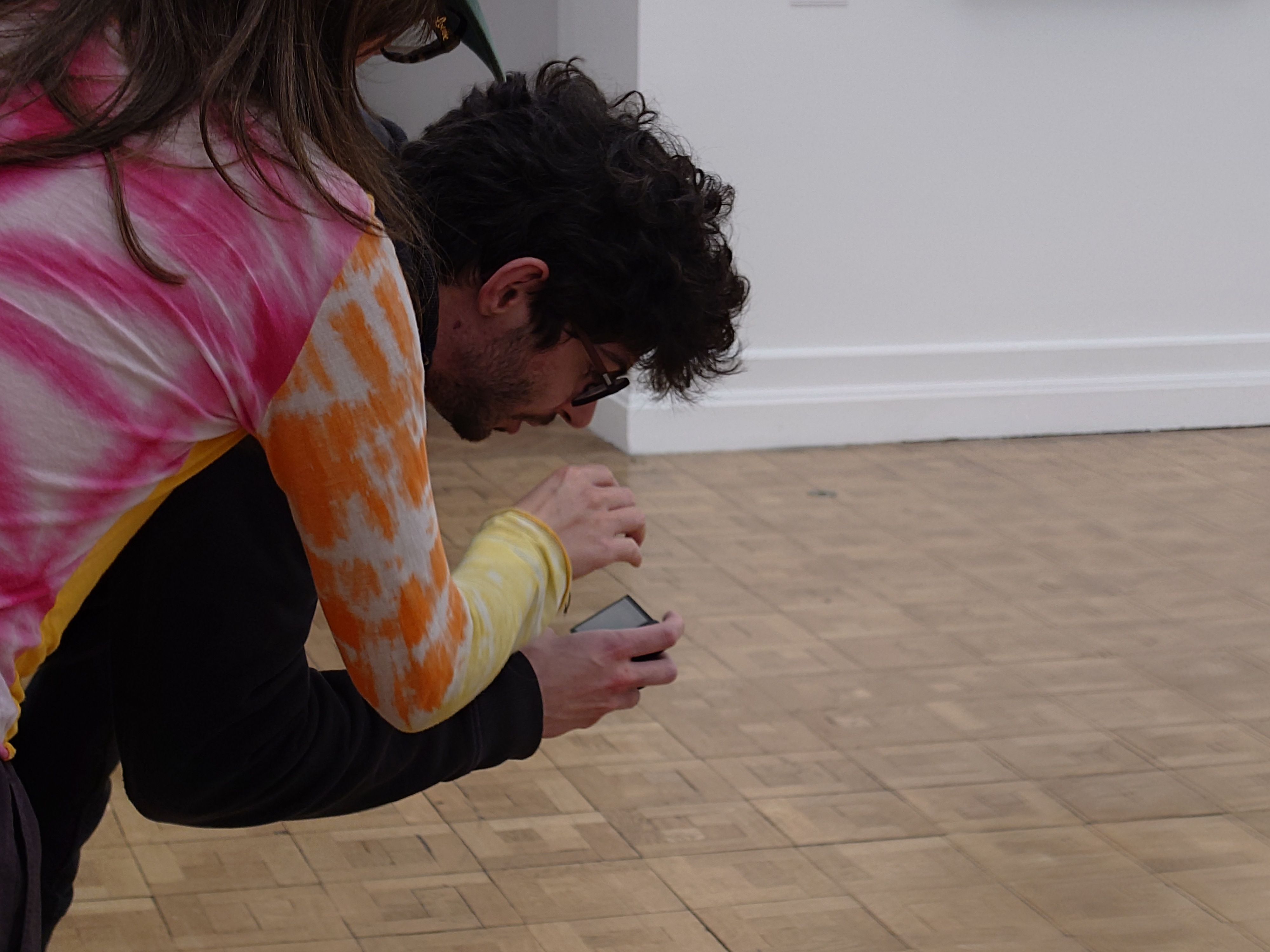
For more than fifteen years, I have been getting groups to shoot collective films in a single take: a camera passes from hand to hand, each person films their part without knowing what the others will do, and the film is finished when the camera stops, with no editing. Since nothing can be cut, people take risks they would not take on a shoot where editing protects them. Watching the film right after shooting it is part of the creative work, and showing it to people who were not there brings out a storyline that nobody decided on, provided the group is close-knit.
A way of working that comes down to three instructions
I have offered this approach to nursery school children, teenagers, adults in public libraries, film students at La Fémis, audiovisual professionals and teachers. It has stayed the same from the start, with a group of ten as with a group of seventy. We choose a theme or a principle, for example lending a voice to an object, or saying what one thinks while looking at something. One person films a title written in felt-tip pen, then their own part, then hands the camera to the person next to them without stopping it; that person films theirs, passes it on, and so on until the end credits. I give three instructions, and almost nothing else:
- Do not listen to the others too much, because if the first person is sad, everyone risks becoming sad after them, and it is the diversity of the parts that makes the film rich.
- Pay attention to the person who has just filmed and to the one who will film after you, because the film holds together or falls apart at the moment the camera changes hands: take the camera without a jolt, hold your shot until the next person is ready, hand it over at a moment when they can take it.
- Go all the way, whatever happens.
There is nothing technical about this, and that is what I find most interesting in this way of working. What makes a collective film hold together is attention to what comes before and what comes after, something within anyone’s reach, a five-year-old child as much as a professional film editor. I have had such a film shot in a public library with some fifty people who did not know each other, and another in a large hall with seventy teachers of French as a foreign language; in both cases the camera went all the way round, the film existed at the end, and it held together, because each person had paid attention to two others. More than seventy of these films, shot between 2012 and 2022, can be seen in the Collective films section of this site, out of more than two hundred made since 2010.
A camera that cannot be switched off
At the end of September 2026, at the MUba Eugène Leroy in Tourcoing, I led, as I do every year, the opening workshop of the Master’s programme in Eco-responsible Exhibition Design and Museography at the Université d’Artois. For the collective film, I chose a small compact camera rather than a phone. The reason is practical: a phone has a touch screen, and when eleven people pass it from hand to hand without stopping it, the risk of switching it off by accident is high, whereas the buttons on the camera are recessed, and you have to mean to switch it off to do so. Everything in this approach is designed so that no one can stop. If the camera switches off anyway, we start again from the beginning; if something goes differently than planned, we go all the way, we do our best, and we decide afterwards whether a second take is needed.
The students shot the film twice. Between the two takes, I only asked them not to put less emotion into it than in the first, because on a second take people often think they have understood, and they do less. The second was better paced, the camera handovers smoother, the movements learned, but the first had discoveries that the second no longer had. We kept both. A third would have been different again. A single take does not guarantee that the film will be good; it gives whole takes, lived through from beginning to end, that can be compared.
The failed shot that cannot be cut
When you shoot shot by shot, intending to edit afterwards, you protect yourself. You know that a failed shot can be cut, that a hesitation will disappear, that you will choose the best of what you did afterwards. This protection is valuable for a professional film. In a workshop, it has an effect I find harmful: it allows people not to commit fully, since nothing is final. With a single take, that possibility disappears. What happens happens, there is no choice, and people venture into things they would not have attempted with more time and more resources. In the urgency of the shot that keeps running, ideas come that would not have come to someone sitting in front of an editing screen. That is why I regard this way of working as a method of creation as much as a teaching exercise. In Tourcoing, the student who filmed the museum ceiling felt that her movement went on too long and regretted it as soon as the take was over, whereas the others, watching the film, saw in it a breathing space that gave its strength to the counterpoint that followed. She would never have shot it that way if she had known she could cut it.
In this experience I find ideas that filmmakers and critics put forward long ago about the single take. Alfred Hitchcock shot Rope (1948) in about ten shots lasting up to ten minutes each, the length of a film magazine, several of them joined on a character’s back to give the illusion of a continuous film; in his conversations with François Truffaut, he called it a “stunt”, which went against his own ideas about editing, and which had forced him to rethink the whole staging around the movements of the camera and the mobile sets. André Bazin, in “Montage interdit” (1956, translated as “The Virtues and Limitations of Montage”), defended a related idea from the spectator’s side: when the essence of a scene depends on the simultaneous presence of two elements in the same space (the child and the lioness in Harry Watt’s Where No Vultures Fly, the hunter and the seal in Robert Flaherty’s Nanook of the North), editing is a lie, because it makes it possible never to have brought them together, and only the continuity of the shot attests that the thing took place. In a workshop, it is the person filming who needs this attestation. The single take guarantees that what we see was lived through from beginning to end by those who made it, with no possible cheating, and this guarantee matters to them as much as to the spectators.
Watching straight away
A film is made to be seen, and that is what distinguishes a creation from an exercise. In many workshops, people create, and looking at what they have created comes later, somewhere else, or not at all; that is why, in the article What the gaze of others does to our images, I proposed giving more time to looking than to making. The collective single take has the particular feature that the film exists the second the camera stops, and that it can be watched together ten minutes after it is shot, which is what we did in Tourcoing, with all the lights off, in the very room where it was shot. This moment is as important as the shoot, and I would even say it is part of it. The people who have just shot without a safety net discover what came of it, they see their part among the others, they hear the group react to what they did, and they exercise their eye on what they created and on what the others created, without anything having to be organised.
It is often said that constraint is liberating, and the phrase has been used so much that it no longer says much. I would like to be more precise about what this constraint frees us from. The single take frees us from the concern for perfection. Since the film cannot be corrected, there is no point in aiming for a perfect image, and everyone can concentrate on what is essential: being present, speaking clearly, passing the camera at the right moment, not laughing off camera. It also frees us from anticipated judgement: you cannot tell yourself, while shooting, that this shot will be cut or kept, because everything will be kept, and so you stop watching yourself act. And it frees up time, which is no small thing in mediation work. The films the students then shot in small teams, also in single takes, could be watched the next morning without anyone having had to spend an evening in front of editing software.
In the article The process, not the result, I showed how the process disappears as soon as the artist takes back control of the result, in the edit for instance. In a workshop where the editing is still to be done, the collective time stops at the shoot, and what follows happens elsewhere, later, often in the hands of a single person. In a single-take workshop, the collective time includes the screening, that is, the moment when the group receives what it has made, and this is the moment where mediation happens.
Showing the film to those who were not there
In my view, the film also has to be shown to people who did not take part in the shoot and know nothing of its context. In a film shot without a script, by people who do not know what the others are going to film, each person’s unconscious and the collective unconscious of the group give the film a real storyline, which nobody decided on. The parts answer one another and make up a story, which spectators who do not know the context perceive clearly. In the article The creative unconscious, a method for collective creation, I recounted how this coherence emerged last year, with students from the same Master’s programme, at the Palais des Beaux-Arts in Lille.
There is a second reason to show the film outside the group, which has to do with symbolisation, in the sense in which psychoanalysts use the word and in which I took it up in the article The writing being: what we represent outside ourselves, in an image or a story, in turn helps to build us. We symbolise all the more when we intend our images for the outside. If the film were to be seen only by those who shot it, it would remain the memory of a moment spent together, and each person would symbolise less through it. Because it is made for spectators who are not part of the group, each person addresses what they film to people they do not know, and it is this address, beyond the closed circle, that makes symbolisation happen.
A morning of photographs before the film
I do not consider the single take superior to editing. It has its limits, and I talked about them with the students on the second day, when it came to preparing the films they would shoot without me. Editing is fascinating, it opens up possibilities that the continuous shot does not allow, and those who love editing should be able to do it. What I ask is that people anticipate the time it takes, and know what they lose by putting it off.
The single take also has a less visible limit, which concerns the quality of the group. A collective single take holds together through the bond between the people passing the camera, and attention to the person before and the person after, which I said was within everyone’s reach, presupposes that one wants to give it. If I had proposed this film on the first morning, to people who had known each other for three days and whom I had known for an hour, we would have made something, but not this film. It took a morning of photographs looked at together (the exercise I present in What the gaze of others does to our images), a meal and some laughter for eleven people to agree to lend a ridiculous voice to an air vent in front of the others. The cohesion of the group also allows the collective unconscious to come fully into play, and it is thanks to it that the storyline nobody decided on emerges; I therefore regard it as the key to a good collective film, far more than technique. The constraint of going all the way only works if no one is left alone along the way, and that is where the work of the person leading the workshop lies.


