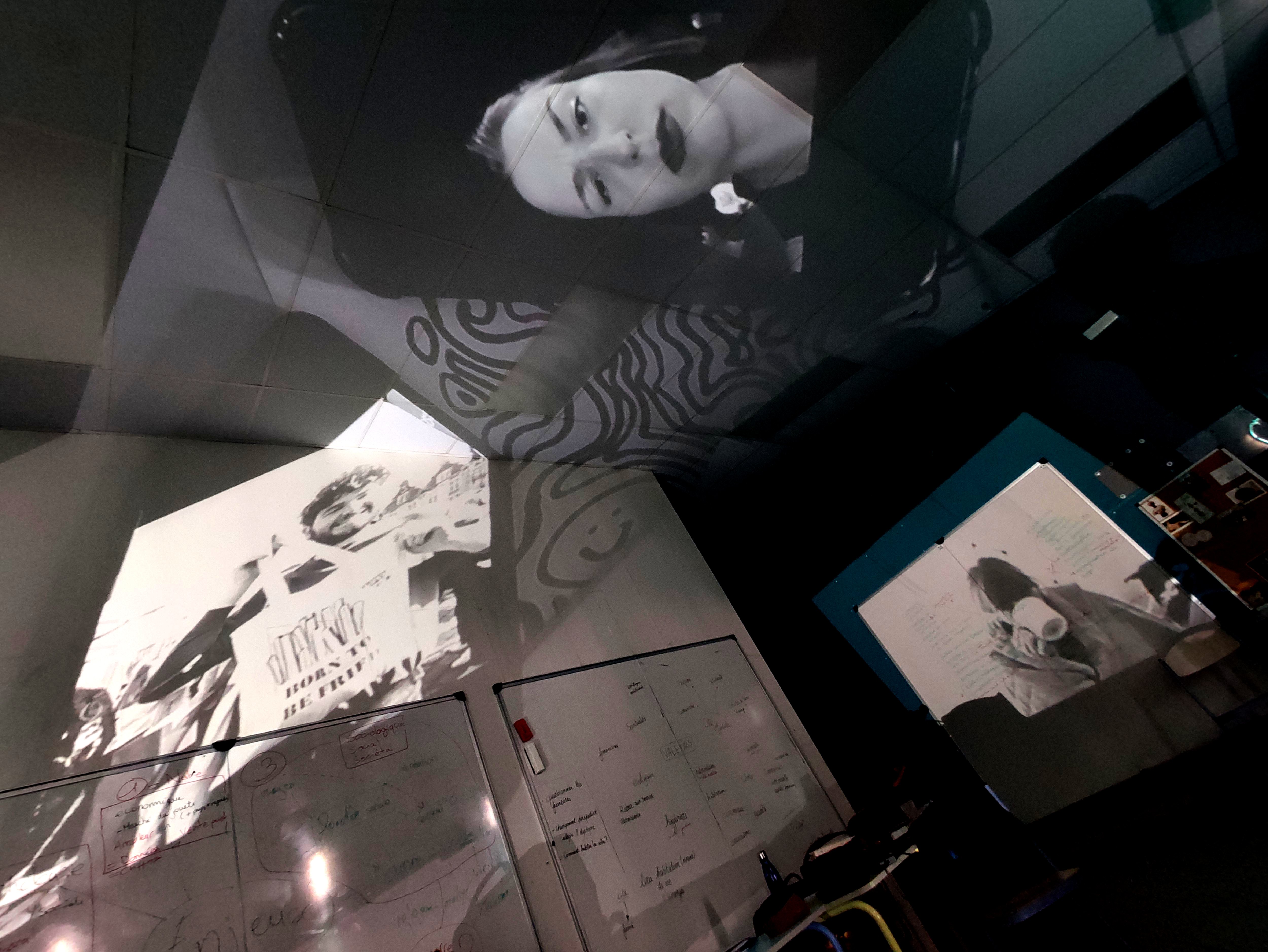
In an audiovisual workshop in cultural outreach, we make films that will be seen by people who are not in the room, and it is by making them for those people that participants commit most fully and that the films turn out best. From many years of workshops with children, teenagers, adults, students and professionals, I draw five methodological proposals: make public things, script for someone, don’t laugh off camera, show the film to someone who has seen nothing, put everything online the same evening.
Why make films with people who may never make another one
If we have people make films who may never make another, it is neither for the result, as I often say, nor to teach them a trade. We do it because the experience of creating something and seeing it exist outside oneself builds people, and because this building is stronger when it happens in a group, under the gaze of others. In the article The writing being, I proposed a definition of what psychoanalysts call symbolization: what we represent outside ourselves, through writing or through images, helps in return to build us. In the article What the gaze of others does to our images, I studied the role the collective gaze plays in it. I would like to add here a condition I had developed in neither of them: symbolization works all the better when what we have represented is addressed to someone. We symbolize little with a film made for the small group we belong to, which only that group will understand, because it stays among ourselves and we have not had to detach it from us. A film made for people we do not know has to stand on its own, and it is in working to make it stand without us that something is built within us.
For anyone who leads workshops, it follows that the methods that enrich people’s experience are the same ones that improve the films. There is no need to choose between a caring pedagogy and a watchable result. When a group makes something for viewers who are not there, everyone invests more, and the film is better, in one and the same movement. In an educational setting, we aim first at people’s engagement, whereas in a production setting we aim at cinematic quality, and the instructions I propose below hold in both cases.
Making public things
From the very first instruction, I tell participants that what they are about to make may be seen by people who are not there. I say it early, before the first image is made, and I say it as information rather than as a threat: we are making public things. They may be shown to colleagues, to families, to strangers, out of their context. People who know neither the town, nor the place, nor the group will see these images, and these images have to give them something. We can make things deeply rooted in a place, but we then have to keep in mind that they will be seen by someone who has never been there.
Last year, in the article Taking narrative capillarity into account, I called narrative capillarity the way an image seen on a social network is received in continuity with the ones seen before it and the ones that will be seen after. The image that comes out of a workshop loses its original neighbours, those of the day, and finds itself among others that have nothing to do with it. It reaches someone without the laughter that went with it, without the instruction that gave rise to it. In Lector in fabula (1979), Umberto Eco called model reader the reader an author constructs through his very choices and whom he expects to cooperate in the interpretation, and without that cooperation the text remains a dead letter. Making public things means thinking about this reader from the first minute of the workshop.
The bomb under the table
When a group has to invent a story, I almost always explain an idea Alfred Hitchcock develops in his conversations with François Truffaut, Le Cinéma selon Hitchcock (1966, published in English as Hitchcock/Truffaut), which I detailed in the article Mastering suspense. To explain it, I start from the situation we are in. Let us imagine that the last ten minutes of our exchange had been recorded, that a script were drawn from it word for word, and that it were entrusted to a great filmmaker, with real actors, lighting, careful staging. The film lasts ten minutes, it is very well acted, and it is of no interest at all: people in a room, someone coming in, we are bored. Then, at the end, a bomb goes off under the table. We have been bored for ten minutes, and for a few seconds something finally happens. This is what Hitchcock calls surprise. Now let us imagine the same shoot, the same actors, the same text, with a single difference: at the start, the camera shows the inside of a bag lying under the table, and in the bag a box with wires and a countdown. The characters know nothing. The viewer, however, knows, and from then on every trivial line keeps them on the edge of their seat; they would like to warn these people, they find their conversation unbearably slow, they find them well acted, because these people have become important to them. This is suspense, and the only difference between the two films is a gap in information between what the viewer knows and what the characters know.
I draw two lessons from this for the workshop. First, emotion comes from the structure of the story before it comes from the acting, since the same actors bore us in one film and grip us in the other. We can therefore make very powerful films with people who cannot act, provided we think about what the viewer knows and what they do not. Robert Bresson, who had his takes redone until his performers, whom he called his models, no longer acted at all, and whose films are nonetheless full of emotion, is the most radical example. Second, and more broadly, I sum up Hitchcock’s thinking by saying that the main character of a film, the one who lives the emotions, is the viewer, which may explain why his heroes are so often so neutral: we project onto them whatever we like (I drew the consequences for writing in the article Scenario and psychology). In other words, a script is always written for someone: we do not build a story for ourselves, but for a person who does not know what we know, or who knows what the characters do not, and it is by thinking of that person that we find what needs to be shown, in what order, and what needs to be left out. This holds for a fiction shot in an hour with thoughts in voice-over, where the viewer hears what the other characters do not, and it holds just as much for a short outreach video in a museum: how we enter the subject, what question we ask, what people will discover that we already know, what we do not know and they are going to teach us.
Don’t laugh off camera
Thinking about the absent viewer comes down to instructions that seem like details. While shooting a collective single-take film, I ask the people off camera not to laugh and not to comment, even when it is very funny, and it often is very funny. As soon as giggling can be heard beside the camera, the scene stops addressing the viewer: whoever watches later will hear people having fun without them, and will feel left out of the joke. I ask people to speak more distinctly than usual, separating the syllables a little, because a viewer who does not understand a line leaves the film to concentrate on what was said, and does not come back. I ask that the title and each card of the credits stay on screen for three or four seconds, which seems endless to those who are filming and already know the title, and is barely enough for someone discovering it. Each of these instructions amounts to making room, in the film, for a person who is not there, and that is why I give them in the same terms to children and to professionals.
Showing it to someone who has seen nothing
It is not enough to think about the absent viewer; when possible, we have to bring them in. If someone comes into the room just after we have watched a film, a colleague, a parent, someone from the venue passing by, I suggest that the group show it to them, and tell them nothing. Not how the film was made, not that it was improvised, not that it is an hour old. We are both judge and party, and this person is not. What they see, they see without the keys that make us lenient, and they almost always notice something no one in the group could see, an object whose origin we knew and which, for them, clashed with the rest, a slow passage we had stopped feeling.
Showing the film to someone who has seen nothing is also, to my mind, part of cultural mediation. When an outside person comes to see what we have made, the group has to present it to them, tell them in a few words what it is about, welcome them into the film. The participants then cross over to the other side: they are no longer the ones being shown something, but the ones who show. It is very good when other people come to watch, and we should invite them rather than close the door to stay among ourselves.
Putting everything online the same evening
That same evening, I put online everything the group has made during the day, the photographs, the films, the takes we kept, in a shared folder open to all the participants, where everyone can watch, download, and do whatever they like with what is there. Show it to their family, send it to friends, publish it, keep it to themselves. I create the folder before the first image, give access to it through a QR code, and add the images as we go, so that the group sees it fill up, and everything is there by the evening.
This folder is part of the method just as much as the shooting instructions, because it is what keeps the promise made with the very first instruction. Telling people that what they make is public commits you to nothing if no image ever leaves the room. Giving them, the same evening, the files and the freedom to share them means letting them decide whom the film is for, and participants do so all the more willingly because they have spent the whole day making something that stands on its own. It is also a way of giving back to each person what belongs to them, the film, their share of it, and the right to show it, rather than leaving all that on my computer.
The absent third party
Making this absent third party present is, to my mind, the hardest thing in an audiovisual workshop. If no one thinks about them, the workshop goes round in circles, because people make things for the person who gave the instruction, or to please themselves among themselves, and come away with a good memory and an object that concerns no one, whereas when the group has them in mind, everyone measures their choices against a concrete question: what does this bring to someone who was not there? That question serves as a criterion without the facilitator having to impose their own. In the article Building, Not Valorizing, I showed how a group builds itself by looking together at what it has made. The person who was not there, faced with the film, tells us something else: whether the film stands without us, and that is a question we cannot answer ourselves.


