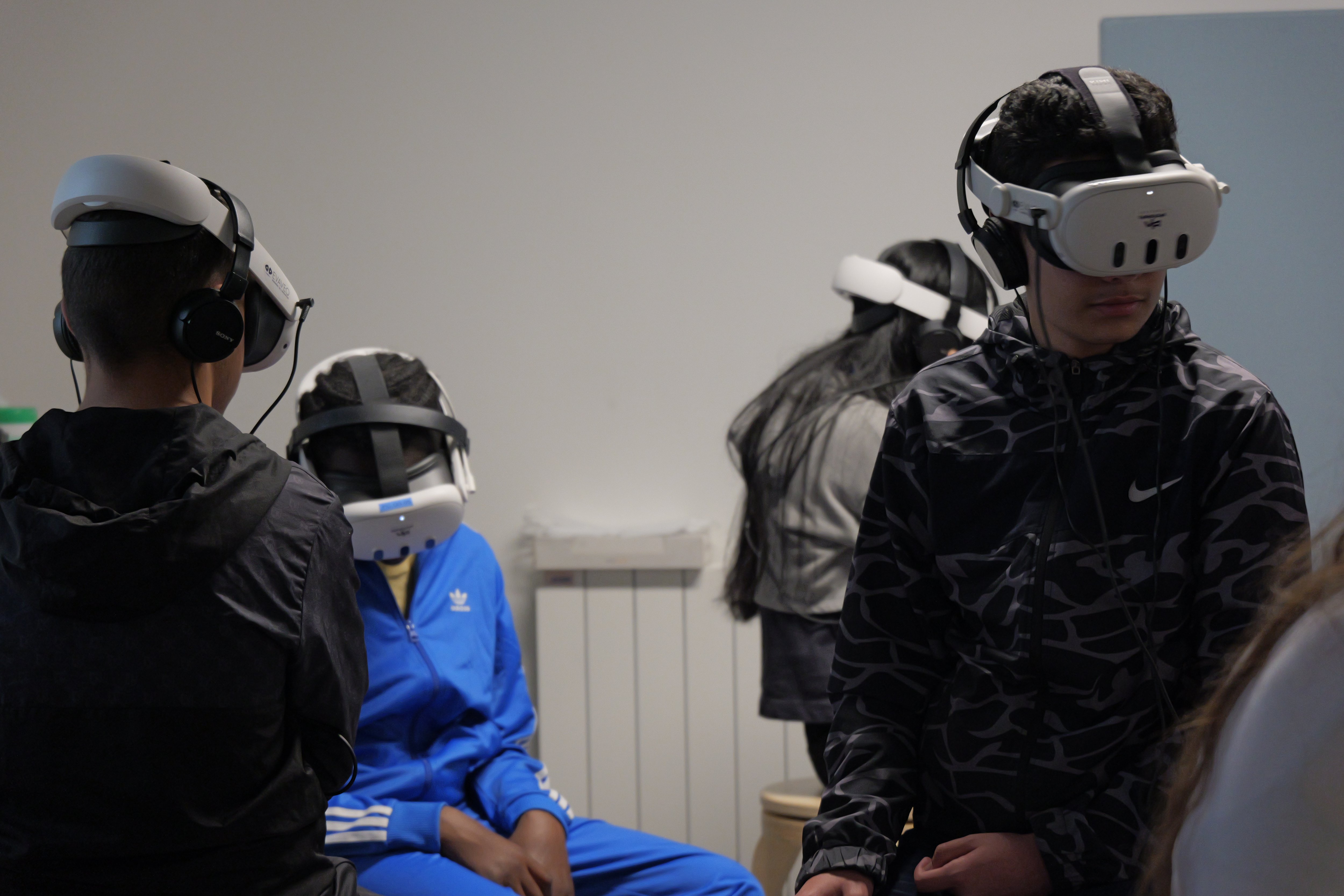
We declare the metaverse dead, judging it by Meta’s headsets. But the metaverse is not a world you enter, it is the space in which our social functions become present without the co-presence of bodies. I propose to think it through the decoupling of function and body, and I argue that this decoupling is an opportunity for our humanity.
Inhabiting a space where the body is not
There is an experience that has become so ordinary we no longer notice it. For several hours a day, millions of people hold meetings, make decisions, build projects, inside a space where their body is not. They are not in the same room. They are not in the same country. And yet they are together, in one place, to do something. That place has no physical location. It exists through something other than the co-presence of bodies.
This is the experience I would like to think about, because it is poorly named. We call it “video conferencing”, “remote work”, “online meeting”, and these words reduce it to a communication technique, as if it were no more than an improved telephone. I believe something deeper is at play, something that touches the way human beings make themselves present to one another, and that the word “metaverse” names better than we think, provided we strip it of what it has been made to mean.
Before the digital age, occupying a social function almost always meant bringing one’s body somewhere. To be the teacher, you had to be in the classroom. To be the shopkeeper, you had to be at the shop. To decide together, you had to gather, that is, to bring bodies together in a single place. Function and body were tied together by the necessity of place. You could not occupy your place in the social fabric without carrying your physical presence there.
This tie is coming undone. Our social functions can now be exercised without bodies being in the same place, and even without the body being shown at all. This is the movement I want to name, because everything else follows from it. I will call it the decoupling of function and body. And what this decoupling brings into view is a presence of a particular kind, one that does not rest on shared flesh but on the function occupied. I will call it functional presence.
What Zuckerberg saw and what he missed
The word “metaverse” has a recent history that sheds light on what I am describing, above all through its failure. When Facebook became Meta in October 2021, Mark Zuckerberg presented the metaverse as the successor to the mobile internet, a set of interconnected three-dimensional spaces. He named its primary quality with an apt word, “social presence”, the feeling of really being there, with another person, wherever you happen to be. He was right about the word, since presence is indeed what is at stake, but he was wrong about the path to reach it.
For Zuckerberg, presence was to come from immersion. You would put on a headset, enter a world reconstructed in three dimensions, and the more enveloping that world was, the more present you would feel in it. Presence was conceived as an effect of sensory richness. The more there was to see and to touch, the stronger the illusion of being there would be.
This idea came at a very high cost. The Reality Labs division, which develops the Quest headsets and the Horizon Worlds platform, has since swallowed more than eighty billion dollars in cumulative losses. Horizon Worlds never became the digital public square that had been announced, and its legless avatars were ridiculed for years. In early 2026, Meta shut down Horizon Worlds in virtual reality, laid off more than a thousand people from Reality Labs, and redirected its resources toward artificial intelligence and connected glasses. The press concluded that the metaverse was dead.
What is dead is a certain idea of presence, the one that makes it depend on sensory immersion. Zuckerberg’s mistake was not believing in presence at a distance, it was believing that you produce it by reconstructing a world around the body. Presence is not produced by enveloping the senses. It rests on something else entirely, something that was already there while the headsets were being built, and that no one looked at because it was too ordinary.
The virtual office that exists nowhere
Look at a professional video conference today. A growing proportion of people no longer show the room they are in. They have placed a background behind them. That background is often always the same, and often it is an office, but an office that is neither the one in their home nor the one at their employer’s. It is a virtual office, and this office constitutes their professional identity within the space of the meeting.
Technically, this may seem basic, a still image behind a person automatically cut out from their surroundings. But that cutout demands a great deal, because the person is in front of neither a blue screen nor a green screen. It is an artificial intelligence that isolates their silhouette from the real background, frame by frame, and reconstitutes a setting. Microsoft says as much explicitly in its documentation, Teams uses AI and the camera to isolate the silhouette and create a new frame. The quality of this cutout improves year by year. Today it is more or less good, with edges that blur a little around the hair, and tomorrow it will be excellent, while the background, which for now is a flat image, will become a three-dimensional space.
What stops me is not the technical feat, it is that this tiny device achieves what the eighty-billion-dollar headsets missed. The person against the virtual background is present in the meeting. They occupy their place, they are recognisable, they build things with others. And the place from which they appear, that office which exists nowhere, has no sensory thickness. It is only an image. Yet it is enough to install them in the space of the function. Presence did not need immersion, it needed a place where the function could stand.
When the camera goes off, the avatar takes its place
The next step has already been taken. Some people do not turn on their camera, sometimes because they find it hard to show themselves. There is something almost immodest in having to expose one’s face and one’s home to a whole meeting. For these moments, some applications offer an avatar in place of the camera. Microsoft has integrated its 3D avatars into Teams, developed by its Mesh branch, which animate according to speech and intonation, take on the expressions of the emoji dropped into the conversation, wave, register surprise or thought.
For now these avatars are simplistic, a kind of cartoon that is rather unpleasant to look at. But they are already enough to maintain the person’s presence in the meeting, for the precise activity that brings them there. And a video meeting is not a substitute for social interaction, it is a place where important decisions are made, where fundamental human stakes play out between people, where essential things can happen.
These avatars will gain in quality, to a point where the avatar will be perfectly dressed, with facial expressions aligned with what the person says, and even a voice whose intonations are slightly improved. At that point, we will have every interest in appearing through our avatar rather than through our raw image, because the avatar carries the function better. It gives a better presence to the other, a more composed representation of oneself, and through this a greater quality of interaction and mutual understanding, by a sharper concentration on what we are doing together. The image the camera captures of me, tired, badly lit, in a cluttered room, says much about my body and little about my function. The avatar does the opposite, and that is why it serves the functional space.
What the king’s effigy teaches us about the avatar
This presence through the image is nothing new in human history. I have already worked on it in connection with the selfie and the filter, proposing to say that each of us today has at least two bodies. An incarnate body, the one others see in front of them, which has a size, a weight, a face, a voice. And an imaged body, the one that exists in the images we produce and that circulate in our place in social spaces. These two bodies do not coincide, and they never have, since the painted portrait did not look exactly like the model and the photograph did not return to the photographed person the image they had of themselves.
The historian Ernst Kantorowicz, in The King’s Two Bodies published in 1957, showed that in medieval political theology the king possessed two bodies, a natural and mortal body, and a political and immortal body that passed to his successor. At royal funerals, an effigy of the king was placed on the coffin, a statue clad in the insignia, which kept the political body present during the transition. The effigy did not represent the king, it maintained his presence. And it was often more perfect, more solemn than the mortal body it replaced, because that is how it could fulfil its function.
The king’s political body is a function, and the effigy is what makes it present when the natural body no longer can. This is the work the meeting avatar does. When I put an avatar in my place, I do not represent my body, I make my function present where my biological body is not. And if that avatar is more composed, better held, more legible than I would be as the camera caught me at that instant, it does not betray me, it makes my function present in its own mode, that of the image held better than the body. The decoupling of function and body, which we live out in our video conferences, extends a very old operation that human societies have always known how to perform with their images. The digital age does not invent it, it brings it within everyone’s reach and installs it in the ordinary course of work.
Why there will not be one metaverse but many
If the metaverse is the space of functional presence, then its structure follows from the structure of our functions, and our functions are multiple.
When we interact with others in a professional setting, we do so out of who we are, but first of all out of our functions. Take an architecture project, in which the architect, the artist, the client, the city, the contractor each play their role. The contractor of this project is perhaps, in another, an elected official commissioning a public facility, and the architect who here designs someone’s house is perhaps elsewhere the client of another architect for their own house. Our social functions are variable, they are not us, and yet they are necessary to common construction, since it is in our singularities of function, each in their place, that we can make things together.
These functions intersect with who we are without merging with our identity. In one facet of my life I am an architect, in another a client, in another a member of an association, in another in a romantic relationship, in another in a family relationship, and each time I occupy a different function in relation to others while remaining myself. To each of these functions corresponds a distinct space of presence, with its partners, its stakes, its rules. This is why there will not be a single metaverse but several, as many as there are functions to occupy. The metaverse is not a single world one would enter, it is the plurality of spaces where our functions become present.
I have, for instance, partners in a foreign country I may never visit. The virtual office from which they speak to me, the avatar that speaks to me, will be the only reality I can picture of that space, and it will indeed be my reality, because I will really have interacted with these people, co-built products, services, films, music, training programmes, architectures that will change people’s lives. I will not have watched a film as a spectator, I will have been an actor. Functional presence is not a diminished presence, it is a full presence in the order of the function, which simply does without the co-presence of bodies.
Delegating one’s function to an agent
The decoupling can go further still, by crossing all of this with artificial intelligence and autonomous agents. One can imagine that it is no longer even I, in a meeting, who is behind the screen speaking, but an autonomous agent, my double, which interacts out of a precise knowledge of my context, my ethics, my history, my intuitions, my way of working. This agent answers a large part of the requests, and at certain moments, during the meeting it is itself running, it calls on me because it cannot find the answer alone. A question arrives on my phone, what would you prefer, what would you choose. I answer. The agent would not have answered off the cuff, it would have said it needed a little reflection before coming back on it, the conversation would have moved on to something else, and once it has my answer it reports it.
What is freed in this way is me. Since everyone present at this meeting is there for their function, and some have placed their avatar or their agent there, the interaction takes place without anyone having to be physically present, and each is free to be there or not, without obligation. One can occupy one’s function, truly meet the needs, build very well what one has to build, without having been there in body or even in continuous attention.
One can then imagine several meetings held at the same time, where different avatars carry different functions in different groups, while I do something else. I am free to learn, to educate myself, and from time to time a question reaches me on my phone, which I answer, while my avatars, in parallel, have built many things with many people, and have done so well. The decoupling redoubles, because the function detaches itself not only from the body but from attentive presence itself, while remaining moored to me by the decisions I continue to make.
I know this may seem like science fiction, but what I am describing here is feasible today. It is possible, it is accessible, not yet to the ordinary person, since on this kind of subject we are still in experimental phases, but when one experiments one can already do many concrete and constructive things.
The metaverse does not dehumanise, it undoes a confusion
All this can seem dehumanizing, because it’s no longer even us—it’s avatars who “live” life in our place. So we believe we are drifting away from the real to live in an abstraction, in an artificial and ultimately inhuman world. This is the imaginary of dehumanization that we readily project onto the use of technologies. Yet I think it’s the opposite—but to see this, one has to understand that the idea of a preserved humanism is in fact a confusion between identity and function. Let me explain.
If my avatar is well crafted, if its expressions align with what I’m saying, if it carries my words in a voice with perfect intonations, then I let it do its work, and I, behind it, can have all my freedom. Yes, I’m in a double reality: on one side I play my function, and on the other I remain myself, in my identity. One might object to this duality, arguing that the ideal would be to be coherent with oneself, in a single world. But we have always had many facets; we are the same person and we play different roles, and we are not our social functions. To recognize this duality is to stop mistaking one’s function for one’s identity.
This is where I see an anthropological shift. We’re inclined to judge the changing world in a backward-looking way: “things were better before, we’re being dehumanized, we’re no longer in real relationships with others.” But in reality, the co-presence of bodies has never guaranteed the authenticity of relationships. When we used to gather in person, we could very well be prisoners of our function, reduced to it by the gaze of others, and therefore not in an authentic relationship, in our identity. Physical presence could confine us within a function just as much as it could reveal us. Romanticizing a world where function and identity were merged, and where this confusion served relations of domination, is therefore not the progress we imagine it to be.
Decoupling undoes this constraint. By separating function from the body, it also separates function from identity, and it makes possible what was difficult in co-presence: fully occupying a function without being reduced to it. This confusion between identity and function produces an enormous amount of suffering—violence against oneself, violence against others, situations of exclusion, relations of power. Undoing it can truly help each person better understand themselves and find their place in the world.
A presence more delicate than that of the headsets
Ten years ago, I argued that we had already entered the technological singularity, at a time when most people still awaited it as a future event. It is the same with the metaverse. We await it, or declare it dead, as if it had to take the form of a 3D world one would enter by putting on a headset. Meanwhile it settles in, through virtual backgrounds, through meeting avatars, soon through the agents that will carry our functions. It does not make us leave the real, it decouples our functions from our bodies, and thereby from our identities.
The presence Zuckerberg sought in immersion, he sought on the side of sensory envelopment, where it was not. Functional presence is of another order. It does not ask that we leave the world for another, it asks only for a place where the function can stand, and a virtual background is enough. It is a more delicate presence, in the sense that it rests on little and settles in without our noticing. And that little works deep down, because by placing our functions at a more just and exact place within our humanity, beside us and not in our stead, it gives us back the possibility of not being only what we do.


