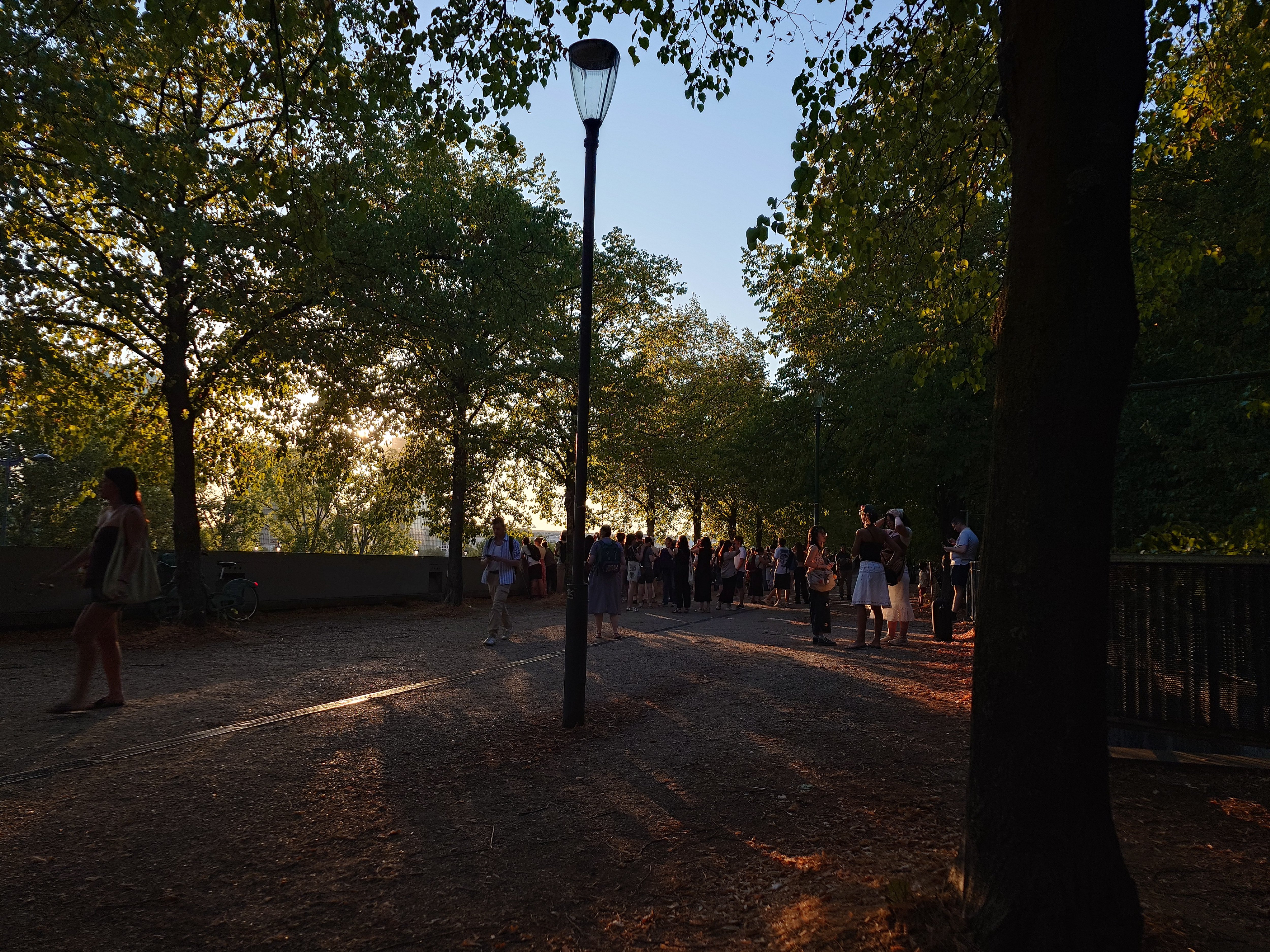
We talk about occupations as if they were places that exist before us: we pick one from a list, then we go and fill it. That is not how I found mine, and around me I see many people who invented their work by doing it, and who only found a name for it afterwards, sometimes years later. I would like to call this the trodden craft, in French le métier frayé. The French verb frayer comes from the Latin fricare, to rub. It means to open a path by passing along it again and again, but also to keep company with someone, and, for fish, to spawn! That is pretty much it, in fact: you bump into things, you are never alone, and you discover the path by looking back. Only, I see it clearly in my work with young people, you have to pay the rent while you tread your path, and when your family does not follow, you give up fast. Those who praise the “entrepreneur of the self” act as if everyone had all that, and in their mouths, precarity passes for freedom. Here I try to keep both in mind.
Ministerium and mysterium
The French word métier comes from the Latin ministerium, service, the function of the one who serves. The Dictionnaire historique de la langue française recalls that in popular Latin this word crossed paths with mysterium, mystery, giving a form misterium, from which come Old French mestier and then our métier. In English, for centuries, a mystery was a trade, and the guild that practised it: the mystery plays of the Middle Ages were performed by the town guilds. And then there is the métier as a loom, the machine, the one Boileau uses in his Art poétique in 1674:
« Hâtez-vous lentement, et, sans perdre courage,
Vingt fois sur le métier remettez votre ouvrage :
Polissez-le sans cesse et le repolissez ;
Ajoutez quelquefois, et souvent effacez. »"Make haste slowly, and, without losing heart,
Put your work back on the loom twenty times:
Polish it ceaselessly and polish it again;
Add sometimes, and often erase.“Nicolas Boileau,”L’Art poétique", canto I, 1674 (my translation).
When I run a workshop, I am providing a service, someone has commissioned me. But what I know how to do there, I could not write it down in full: it is what Michael Polanyi called tacit knowledge, what you only learn by doing. And I keep coming back to my workshops, as if to a loom, to undo and start again. The French word holds all of this together, whereas we have grown used to separating it. In all three senses, the métier is an activity, which takes place between one person, other people and a material.
And yet today we think of occupations as a catalogue. France Travail, the French employment agency, has its operational directory of trades and jobs, the ROME, one sheet per occupation, and at school young people are asked to choose from these lists, earlier and earlier, when nobody knows the world they will live in, nor the occupations that will exist in twenty years. How does an occupation take shape when it is on no sheet? And how does each of us shape our own, even when that occupation has a name? To answer that, I am proposing a concept.
Frayer, from the Latin fricare
The dictionary of the Académie française derives frayer from the Latin fricare, to rub, to polish. The stag rubs its head against trees to strip the velvet from its antlers, and you tread a path through a thicket by passing and passing again until it becomes passable. The verb took on two other meanings. Frayer avec quelqu’un is to keep company with someone, to have regular dealings with them. And fish fraient when they reproduce, which gave le frai, spawn.
I keep all three meanings:
- A trodden craft is traced by rubbing. You pass a hundred times against whatever resists: the material, institutions, other people’s habits, and your own shortcomings, of course.
- It only exists because others keep company with it. Clients, colleagues, audiences recognise it by taking it in their turn.
- And it is fertile. It brings things into being that nobody had foreseen.
The verb to create, creare, is moreover related to crescere, to grow: spawning and growing belong to the same world, that of things that are not made according to a plan.
And work? It too is on the side of the path. People often say the French word travail comes etymologically from tripalium, an instrument of torture made of three stakes, but linguists doubt it. What is certain is that the English travel and the French travail share the same ancestor, the Old French travaillier. To travel is to journey, and you never come back from a journey quite the same. In French we speak of le travail de la naissance, the labour of birth, of le travail sur soi, work on oneself, and of wood that travaille, that warps and moves. Working means transforming oneself on the way: Marie-France Delport, a specialist in Romance languages, describes the trabajo of medieval Spanish, a cousin of the French travail, as an effort straining towards an end, which runs up against an obstacle. Travelling, rubbing up against the world, coming out of it transformed: the trodden craft is work in the strong sense.
The word frayer also has a history in psychoanalysis. In 1895, in a manuscript published long after his death as the Project for a Scientific Psychology, Sigmund Freud borrowed from the physiologist Sigmund Exner the term Bahnung, which French translators rendered as frayage and English ones as facilitation. Freud was trying to understand memory. He imagined that the excitation passing from one neuron to another meets a resistance, and that each passage lowers that resistance, so that the path becomes easier the next time. Memory would be made of the differences between these facilitations, between paths often travelled and those almost never travelled at all. Freud later abandoned this neurology, and the word frayage remained in the vocabulary of psychoanalysis.
I find that this image describes accurately what we call a skill. What we know how to do, we know because we have done it, each time against a slightly lesser resistance, until our way of doing it looks natural to those who watch us. A trodden craft is the memory of these resistances overcome. The sociologist Richard Sennett wrote a whole book about it, The Craftsman (2008): the craftsman learns by working with what resists him, and that is even how he gets good.
Caminante, no hay camino
In 1912, in Campos de Castilla, the Spanish poet Antonio Machado wrote a few lines that are often quoted without being read to the end:
« Caminante, son tus huellas
el camino, y nada más;
caminante, no hay camino,
se hace camino al andar.
Al andar se hace camino,
y al volver la vista atrás
se ve la senda que nunca
se ha de volver a pisar. »"Traveller, your footprints
are the path, and nothing more;
traveller, there is no path,
the path is made by walking.
By walking the path is made,
and when you turn to look back
you see the trail that you
will never tread again.“Antonio Machado,”Proverbios y cantares“XXIX,”Campos de Castilla", 1912 (my translation).
Machado says that the path only appears when you look back, and that is what happens to the trodden craft. While doing it, we do not know that we are inventing an occupation. We answer requests, we try things out, we turn down what does not suit us, and it is by turning round, years later, that we see a line where we had lived a series of steps. The name comes at that moment, often given by others.
On one point, the trodden craft departs from Machado. For the poet, the trail will never be trodden again. An occupation is walked again and again, by the person who practises it, who puts their work back on the loom twenty times, and by those who follow them. French also says frayer la voie à quelqu’un, to clear the way for someone, when you give them the example or the means to reach a goal. All the occupations that appear in directories today were trodden one day by people who did not know they were inventing them. In 1896, Alice Guy was Léon Gaumont’s secretary when she shot La Fée aux choux (The Cabbage Fairy), at a time when the occupation of film director, whether woman or man, did not yet exist.
Tim Ingold’s wayfaring
In Lines: A Brief History (2007), the anthropologist Tim Ingold distinguishes two ways of moving. Transport connects a point of departure to a point of arrival, and the journey between the two is only time to be reduced. What he calls wayfaring has no final destination. The wayfarer is one with their movement, finds their bearings while moving forward, feeds on what they encounter, and there is always somewhere further they can go.
We usually think of career guidance on the model of transport. You choose an occupation, which is the point of arrival, you follow the training that leads to it, which is the journey, and you arrive. The trodden craft belongs to wayfaring. It takes shape during the journey, through the journey, and it has no point of arrival, since you keep treading it as long as you practise it. Occupations that have a name are trodden too. In The Reflective Practitioner (1983), Donald Schön showed that the most established professionals, architects, doctors, town planners, constantly meet unique situations their training did not foresee, and that they respond to them through a conversation with the situation. Even an occupation that has a name, each of us treads it in our own way, and two people practising the same occupation never do quite the same thing.
There is a detail in Ingold that we readily forget when we praise walking. On the way, the wayfarer must “sustain himself, both perceptually and materially”, he writes: through the senses, yes, but also through matter. You eat along the way, you sleep somewhere. And there, the trodden craft stops being a pretty image.
I call œuvrant·e the person who creates meaning and connections, where the employee carries out tasks. The trodden craft is its temporal dimension. The œuvrant·e traces their occupation through their works, and it is this trace that we end up calling an occupation.
A base to set out from
You have to be really sure of yourself to set off on the adventure of life, because in life there is also the financial side. The rent falls due every month. Sometimes there are children. We need to feel reassured, and you cannot tread a path for long on an empty stomach. What reassures, in social space, and what causes anxiety? Diplomas count enormously in France. So does the name of the occupation: “I’m a nurse”, “I’m a plumber”, everybody understands, whereas “I run phone filmmaking workshops and I support institutions” takes an hour to explain, and even then. And who, among the people around you, has ever stepped aside from the beaten track? Your answer to that question weighs heavily, I believe, on what you allow yourself.
In the 1960s and 1970s, the psychologist Mary Ainsworth, who worked with John Bowlby, observed one-year-old children with their mothers. The mother is there, in the room, and the child moves away, goes to touch the toys, comes back to her, sets off again: Ainsworth called this a “secure base”. If the child is not sure of being able to come back, it stays glued to her. Of course, this research on attachment concerns one-year-olds. I think it is the same for us adults, all our lives: we need to know where we can come back to. This anchoring that we find in ourselves was built with others, first.
Robert Castel looked at the same question from the side of society. In his conversations with Claudine Haroche, Propriété privée, propriété sociale, propriété de soi (2001), he explains that one does not become an individual alone: one needs “supports”. For a long time, private property was the only solid support, reserved for a few, and it was the rights attached to work, social security and labour law, that gave non-owners what he calls social property. Castel speaks of individuals “by excess”, who have more resources than they need, and individuals “by default”, who lack the minimum to lead their lives with a little independence. “When you have no other resources, you have to pay with your own person,” he says. Treading your own craft is obviously easier for the former. And for many, the wage system whose history Castel wrote remains the support that makes it possible to risk something elsewhere, on the side.
The entrepreneur of the self
Beware of naivety here. Praise for those who invent their own lives has a history, and not the most innocent one. In the nineteenth century, the industrial revolution was built on the exploitation of working men and women, and of children too, and it took a century of struggles to build the protections Castel speaks of. The philosopher Simone Weil went to work in factories, notably at Alsthom and at Renault, in 1934 and 1935. A few years later, in Marseille, she wrote:
« Au cours des dernières années on a bien senti qu’en fait les ouvriers d’usine sont en quelque sorte déracinés, exilés sur la terre de leur propre pays. Mais on ne sait pas pourquoi. »
“In recent years people have clearly felt that factory workers are in fact, in a way, uprooted, exiles in the land of their own country. But we do not know why.”
Simone Weil, “Expérience de la vie d’usine”, 1941-1942, in “La Condition ouvrière” (my translation).
Across the Atlantic, the figure of the self-made man was cultivated, the man who owes nothing to anyone, along with the imagery of the conquest of the West. On 12 July 1893, in Chicago, the historian Frederick Jackson Turner read to his colleagues a paper that made the frontier the source of the American character, and of its individualism:
“The frontier is the line of most rapid and effective Americanization. The wilderness masters the colonist.”
Frederick Jackson Turner, “The Significance of the Frontier in American History”, 1893.
What Turner calls wilderness was inhabited land, taken from the peoples who lived there.
Frederick Douglass, who had escaped slavery, devoted a lecture to this figure, “Self-Made Men”, which he delivered more than fifty times from 1859 onwards. And he begins by taking apart his own title: “Properly speaking, there are in the world no such men as self-made men”. Of course, these men “have made the road on which they have travelled”. But straight away:
“I believe in individuality, but individuals are, to the mass, like waves to the ocean. The highest order of genius is as dependent as is the lowest. It, like the loftiest waves of the sea, derives its power and greatness from the grandeur and vastness of the ocean of which it forms a part. We differ as the waves, but are one as the sea.”
Frederick Douglass, “Self-Made Men”, 1859.
This is a man who had known slavery, and then the support of the abolitionists, speaking.
A hundred and twenty years later, neoliberal thinkers kept the wave and forgot the sea. On 14 March 1979, at the Collège de France, Michel Foucault explained how these economists redefined homo œconomicus as an “entrepreneur of himself”, who would be his own capital. Twenty years later, Luc Boltanski and Ève Chiapello, in The New Spirit of Capitalism, described company managements that had taken over the demands for autonomy and creativity of 1968 and turned them into flexibility. And in France, in 2008, the auto-entrepreneur scheme was created: more than a million registrations. The sociologist Sarah Abdelnour investigated. In Moi, petite entreprise (2017), she shows that 90% of these auto-entrepreneurs earn less than the minimum wage, and that they lose the protections of salaried employment along the way. She speaks of an injunction to autonomy, addressed first and foremost to the working classes.
Then came the platforms. The delivery rider, the driver, are declared independent, and it is an app that assigns them jobs, sets the rates, rates them. People are made to believe they are free, when in fact they are bound hand and foot: they invent nothing, they fit into boxes, even narrower than those of salaried employment. They follow the path the algorithm draws for them, without the safety net that would allow them to step off it, which is the opposite of a trodden craft. I insist on this, because it is often with the vocabulary of freedom that people are stripped of their supports.
Those who don’t dare, and those who tread elsewhere
To tread your own path, you have to feel entitled to, and that is not simple. I think of the young people whom school has excluded, or who have felt excluded. They sense that something is wrong with what is being offered to them, but they lack the social anchoring to invent something else in the open, and because they feel excluded, they don’t dare. In 1974, Pierre Bourdieu spoke of the “causality of the probable”: our hopes adjust to what people like us have, statistically, had the chance to obtain. In the mid-1970s, in a working-class school in the English Midlands, the sociologist Paul Willis followed a gang of boys who called themselves “the lads”. Messing about, refusal, contempt for the good pupils: in Learning to Labour (1977), Willis shows how, through this counter-culture, these boys come to choose for themselves, as a freedom, the factory jobs they were destined for.
And then there are those who tread a path anyway, but elsewhere, where other rules legitimise what official society refuses. The anthropologist Philippe Bourgois went to live with his family in East Harlem, New York, in the second half of the 1980s. He spent hundreds of nights there with crack dealers. In In Search of Respect (1995), he tells of men who had worked in Manhattan offices, who had felt humiliated there, and who found in dealing an income, a recognised skill, and above all respect. Legitimation in reverse, then! There too a craft is trodden, with its knowledge, its careers, its elders who pass things on, except that at the end there is prison, or death. Howard Becker played piano in Chicago bars before writing Outsiders in 1963, where he follows jazz musicians and marijuana users. He shows that deviance too has its careers: you enter it in stages, and it is from others that you learn it. So I take good care not to make treading a path into a virtue. Each of us treads with what we have to hand, our supports, our recognitions, and the path keeps their shape.
An occupation that had no name
I know this movement from the inside. My own occupation, I could not say it in one word, and no ROME sheet describes it: I make films, I run workshops, I train professionals, I support institutions, I write. In 2005, the Forum des images asked me to find a cultural and artistic meaning for the phones that were starting to film. That didn’t exist, as an occupation! The institution had come to find me because I had been defending the poor forms of audiovisual media for more than fifteen years, and that is how the Pocket Films Festival was born. During those fifteen years, I was not preparing for any occupation. It was only afterwards that they became the path leading to the festival, and then to the creative workshops with phones that are now run in many schools.
That is often how I work, by stepping aside. There is a cheap device, a phone, a drone, a pico projector, and I don’t yet know what I’m going to do with it. I play with it, I tinker, and one day I have something to offer to a media library, a festival, a town. The funding, the commission, the name of the service come afterwards, always. And if I set up a company in my own name, it was to keep the freedom not to do only what is expected of me, without which I could not tread much of anything (when you depend entirely on whoever pays, you follow their path). I could not have made that choice without support, and I know that not everyone has it.
Five ways to tread your craft
Here is what I take from it, for someone starting out as much as for someone who has practised for thirty years an occupation everyone knows:
- Start before you have the name. What you already do, what you try out in the evenings or at weekends, even without knowing why it attracts you, may already be the beginning of a path. No need to know where it leads to take the next step. If I had waited, in 2005, for a name to exist for “making films with phones”, I would never have started.
- Take resistance as material. A refusal, a technique that escapes you, an institution that understands nothing of what you are proposing: that is exactly where the path gets dug. In 2005, some people found the idea of Pocket Films absurd, since there were cameras for making films! I replied that within ten years, everyone would have a camera in their pocket, and that it would change our relationship to time, to space and to private life.
- Keep company, in the sense of frayer avec. For an occupation to exist, others have to walk it with you, recognise it, and one day come and ask you for it. For years, the Pocket Films Festival showed on the big screen of the Forum des images films that people were shooting on their own, with their phones. Many people wait to be “ready” before showing what they do, and they wait a long time.
- Keep a trace of your passages. After every workshop, I take notes, and many of them end up as articles on my website; there are thousands of them today. I sometimes reread these writings, and that is where I see, looking back, the path I have followed. They are also what allows me to clear the way for others.
- Give yourself supports, or give them to others. An income that does not depend on a single client, a collective, an association, friends trying out similar things, social rights that you know about and assert: that is where you set out from and where you come back to. Those who have these supports can share them, and the others would do well to look for them together.
All this also applies to adults who support young people in their career choices. Asking a sixteen-year-old what job they want to do is asking them to choose a point of arrival on a map that nobody has drawn yet. I prefer to ask them what they already do, what keeps them busy, with whom, and to help them recognise in it the first passages of a path. And then, as far as possible, to be for them a piece of that base from which one dares to set out. We learn better within a framework we have invented ourselves, and the trodden craft is, at bottom, the same idea, stretched over a whole working life.


