In the wake of the wildfires and heatwaves of the summer of 2026, psychiatrist Serge Tisseron argues in Le Monde that the capacity of a person, a group or a territory to overcome a disaster depends on that of all the others, which he calls co-resilience. I agree with him, and I propose to look into the how: the methods of shared creation and collective intelligence offer concrete training grounds for this co-resilience.
The fifth wave of resilience
In his opinion piece “Incendies et canicules obligent à penser la résilience autrement” (“Wildfires and heatwaves force us to think resilience differently”, Le Monde, August 2026), Serge Tisseron traces the history of the word. Resilience was first theorised, he recalls, as an individual quality enabling children traumatised by war to rebuild themselves, then it became a skill anyone could acquire, which the personal development market seized upon. In the 2000s, a fourth phase conceived it as a social phenomenon involving multiple dimensions. And since 2020, in his view, a fifth wave has been opening: “there is no resilience, only co-resiliences”. The resilience of no system, he writes, can be envisaged independently of that of the others. A company cannot be resilient in a city that is not, nor a city in an abandoned region, and so on, step by step, up to the global level. Climate change forces this shift, because it makes prevention based on past events impossible, because it brings chronic stresses and no longer only exceptional shocks, and because “by revealing and aggravating inequalities, it becomes a major factor of social disruption”. His conclusion is political: building a resilient society means reducing inequalities and giving people a better life in the moments without crisis. Serge Tisseron has been working on this subject for a long time, notably in La Résilience (PUF, 2007).
From programme to method
This piece seems important to me because Serge Tisseron shifts resilience there from psychological vocabulary to political vocabulary, without abandoning the former. But it remains, and this is the role of an opinion piece, at the level of the programme. Reducing inequalities, organising solidarities, strengthening social ties in everyday life, assessing collective vulnerabilities and detecting weak signals: the text does not say who will do these things, where, or with what tools. This is where my practice can, in my view, bring something. Co-resilience is a capacity that is exercised, and a capacity that is exercised needs training grounds. Collective creation settings are such grounds. They are certainly not the only ones, but they are the ones I know from the inside, through more than twenty years of practice in the cultural, social, educational and care fields.
In a collective creation workshop, people who do not know each other receive a common object to make, simple means to make it and a limited time. Within this framework, the gestures Serge Tisseron calls for actually happen. Participants cooperate with strangers, and social ties grow stronger. The subjects they choose to address express their worries, and an assessment of collective vulnerabilities takes shape. And the stories they make carry their fine perception of the territory, the very perception that makes it possible to detect weak signals.
The imaginary of disasters in cut-out paper
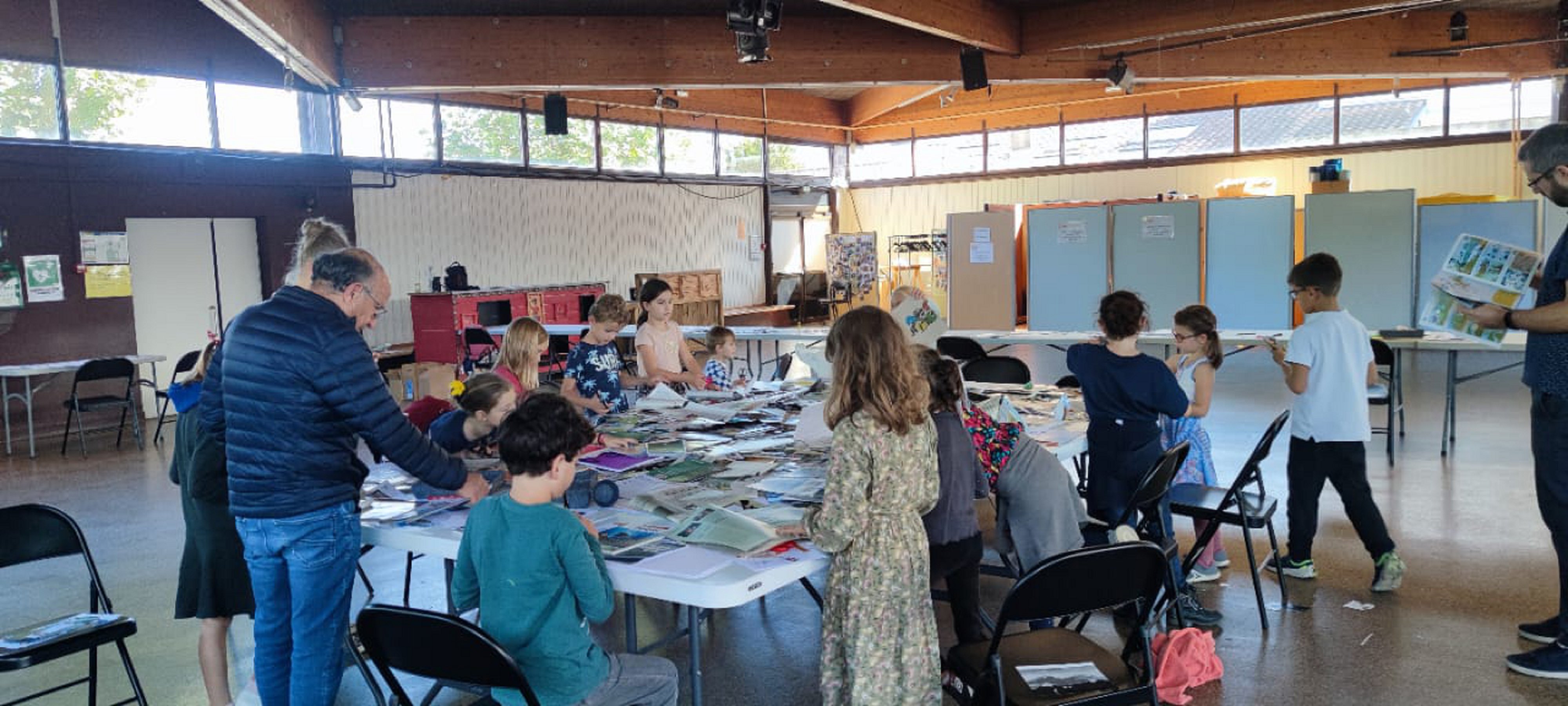
The idea of working upstream on the imaginary of disasters comes from Serge Tisseron, who chairs the IHMéC, the Institute for the History and Memory of Disasters. During the summer of 2023, with the association Cultures du Cœur, I had led “The machine that travels into the future”, a cycle of creative workshops in eight social-field organisations in France, where the people they support created collective and individual stories on the theme of the future. At the public presentation of this project at the French Ministry of Culture, which I recounted in the article Digital technology, a tool for mediation and cultural democracy, Serge Tisseron, the morning’s guest of honour, underlined how much this work of imagining the future prepares each of us to build our resilience. From there came the idea of a workshop bearing directly on the imaginary of disasters. I designed the setting: in one day, with cut-out paper, each person makes short animated films about the disasters that worry the inhabitants of a territory, flood, industrial accident, forest fire or chemical pollution. In Bègles and then in Bordeaux, families, adults, children and young people doing civic service created more than twenty-five films in this way, then screened in public. I recounted these two days in the articles Create your own film about imaginary disasters and Create your film about imaginary disasters - 2nd edition. Reading the August 2026 opinion piece, I found in it, formulated in concepts, an experience these days had already given me.
One detail had struck me during the second edition. In several films, solidarity between neighbours appeared although no instruction asked for it. A participant had included in her film about forest fires gestures of mutual aid that appear in no official prevention document. When people receive the means to imagine a disaster together, what they first tell is how we help each other.
Real disasters do not look like disaster movies
The American essayist Rebecca Solnit studied five major disasters, from the San Francisco earthquake of 1906 to Hurricane Katrina in 2005, by way of the Halifax explosion, the Mexico City earthquake and September 11, 2001 (A Paradise Built in Hell: The Extraordinary Communities That Arise in Disaster, 2009). She observes, with archives and testimonies in support, that in real disasters mutual aid predominates. Survivors improvise canteens and shelters, organise first aid, with an inventiveness and sometimes a disconcerting joy. The behaviours of panic and looting, omnipresent in disaster movies, are extremely rare on the ground. Solnit even shows that danger often comes from the authorities’ fear of the crowd, this “elite panic” which, in New Orleans, led to disaster victims being treated as looters.
I find in this book a light on our workshops. The dominant imaginary of disaster, that of blockbusters, is false on this precise point, and it is not harmless, since it prepares institutions to distrust populations at the very moment when they are helping each other. Working on the imaginary collectively is therefore a corrective act, and not a decorative activity on the margins of “real” prevention. The solidarity that the participants of our workshops put into their films, without anyone asking them to, corresponds precisely to the real behaviour of disaster-struck populations that Solnit documents. The imaginary that takes shape in a workshop, nourished by people’s lived experience and territory, is, on this point at least, closer to reality than the industrial imaginary of Hollywood cinema.
Skills that can be trained
Serge Tisseron writes that a resilient society adds together individual qualities and collective processes internal to groups. Psychosocial skills give this formula a precise content. Defined by the World Health Organization in 1993, they bring together the cognitive, emotional and social capacities that make it possible to meet the demands of everyday life. I developed in the articles Art and Culture in the Service of Psychosocial Skills and When thirty-five professionals discover their psychosocial skills through creative experience the way artistic practices put them to work. In a cut-out paper film workshop, the three registers are mobilised at once: the emotional register when staging fears, the social register when making things together with the constraints of others, the cognitive register when solving the thousand concrete problems of a shoot. Passing these skills on, particularly to the younger generations, seems to me to belong to a politics of co-resilience.
Three ecologies for three levels
Serge Tisseron distinguishes three levels of organisation of co-resilience: micro (the individual), meso (the family, associations, municipalities), macro (states and, step by step, the planet). I recognise in this architecture the one Félix Guattari proposed as early as 1989 in The Three Ecologies: mental ecology, social ecology, environmental ecology, three registers to be worked on together because none holds without the others. I presented this ecosophy in the article Presence and adaptation. The correspondence between the two lines of thought seems enlightening to me, because it indicates the task of a co-resilience setting: to act on the three registers at the same time. In a creative workshop about disasters, we work on mental ecology (representations and fears), social ecology (the group making together) and environmental ecology (the very subject of the films, the territory and its risks). This simultaneity distinguishes a co-resilience setting from a mere awareness-raising action, which only touches representations.
Describing what we depend on
Bruno Latour proposed in Down to Earth (Où atterrir ?, La Découverte, 2017) a political exercise of modest appearance: describing one’s terrain of life, that is, taking stock of what we depend on to subsist, and of who depends on us. He saw in it the condition of any political reorientation in the era of the new climatic regime, and suggested reviving the procedure of the “cahiers de doléances”, the grievance books of the French Revolution. This exercise of description is, in my view, the first gesture of co-resilience. We cannot take care of interdependencies we do not know. And the description of dependencies gains from being done collectively, because no one sees alone the whole of their own network: my neighbours know fragilities of my territory that I do not. Shared inquiry and collective mapping, among other collective intelligence methods, make this work possible. The vigilance of all and the attention to weak signals that Serge Tisseron calls for presuppose this distributed attention, which cannot be delegated to experts.
A culture of resilience
The word culture fits here in both its senses. Co-resilience is cultivated, like a soil, through patient and repeated work, and not through one-off communication campaigns. And the cultural field, that of cinemas, libraries, community centres and popular education venues, already constitutes the infrastructure available for this work: a mesh of places where people gather and where imaginaries take shape. I proposed in the article Pour une robustesse coopérative des projets culturels some paths for these organisations themselves to hold in uncertainty. It would now be a matter of recognising their role in the holding of everything else.
The necessary means are modest. Paper, scissors, a camera, a municipal hall, a few hours. This simplicity is a condition of reproducibility, for methods that would require rare means would reproduce the very inequalities Serge Tisseron calls on us to reduce. Anyone who leads groups can take up these ways of doing, and that is precisely why I document them and pass them on.


