“Droit à la parole!” (The Right to Speak)
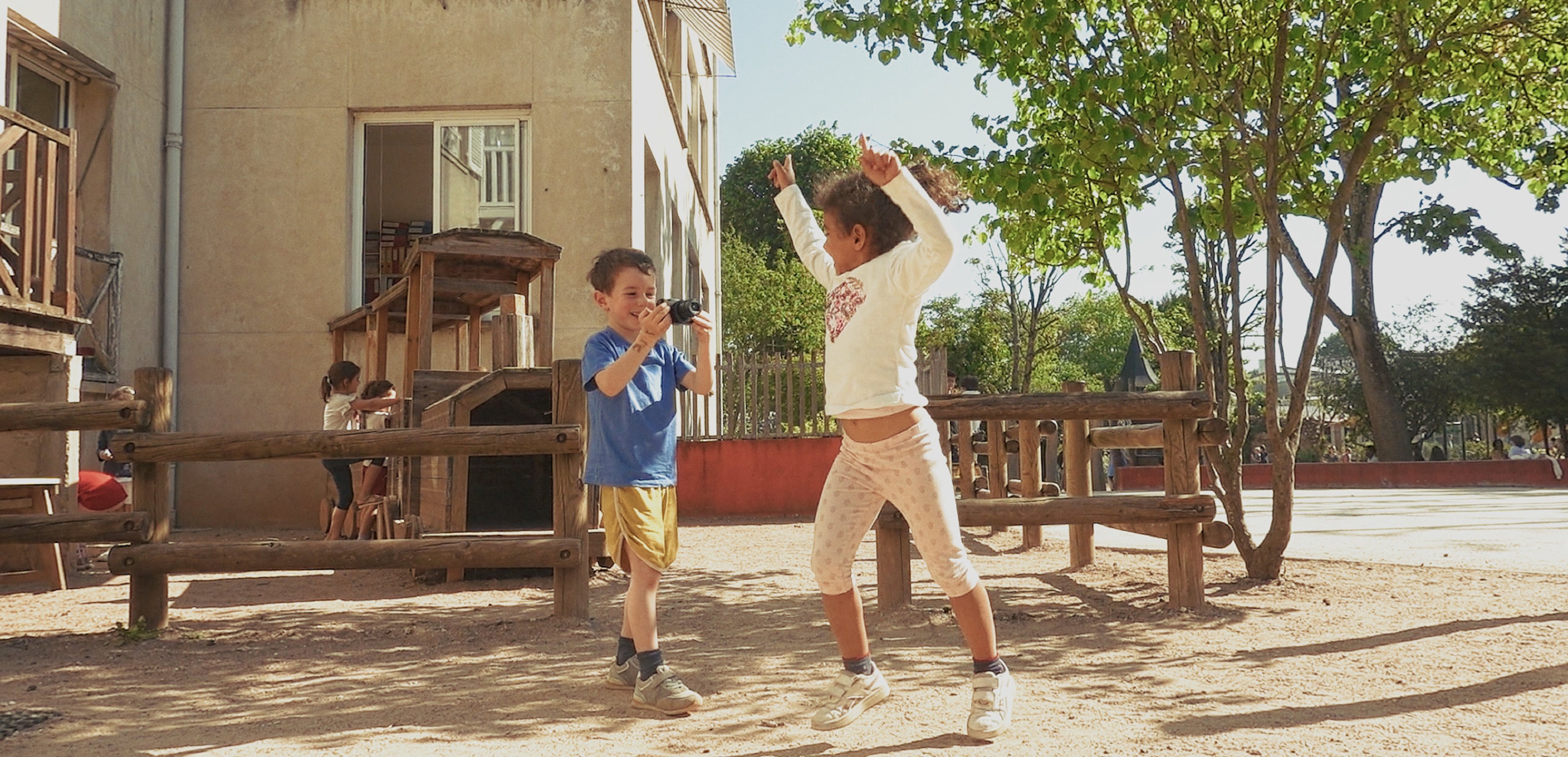
Speaking up, listening, debating, deciding together: at La Source, children learn this from nursery school onwards, just as they learn to read and count. I made “Droit à la parole!” in the school where I went to primary school, handing cameras over to the pupils. I start from a way of teaching practised there since 1946 to share methods that anyone can take up, in a classroom, an association or a family.
A sandpit outside the reception class
I arrived at the École Nouvelle La Source at the age of six, in the 1970s, to go to primary school there. I clearly remember the sandpit outside the reception class: children welcomed me there, talked to me, explained how things worked. I was afraid of adults, and it was other children who first gave me confidence. I left the school more than forty years ago. Today my work consists in giving people a voice, as a filmmaker and as an educator, and I keep working on the same question: how can every voice be heard?
La Source was founded in 1946 by Roger Cousinet and François Chatelain, two educators from the New Education movement, and the first pupils moved into its buildings in Meudon in 1948. Sources Vives, the school’s endowment fund, aims to promote New Education. It commissioned this film, produced it, and it is its first project.
I shot the film at La Source, but I did not conceive it as the portrait of a school. There are many other ways of telling its story; I chose the point of view of speech. I start from what has been practised there for eighty years to defend values (the dignity of the child, trust, cooperation) and to share tried and tested methods, which can be seen at work every day and can be adapted elsewhere.
A skill built from nursery school onwards
In our democracies, we vote, we debate. But how many of us have really learned to make our voices heard? At La Source, speaking up, listening to others, discussing what is fair and deciding together are part of what children learn, just like reading or counting. The pupils do not play at democracy, they live it: the problems discussed in the class council are real playground disputes, real decisions about how the class is organised and, in the upper school, real budget questions.
Roger Cousinet used to say that pupils come to school to work, not to watch the teacher work. If we take this idea seriously, how can children’s autonomy be organised without it turning into disorder? At La Source, the answer lies in speech, and in very precise practices, with their own rules and rituals.
In the film, I drew on the ten principles of New Education set out by François Chatelain. You do not hear them presented as a theory; you see them at work in everyday situations:
- Replace external discipline with an inner discipline freely consented to. In the class council, children vote on rules that apply to everyone, themselves included, and a rule one has been able to discuss is better respected.
- Have a fair view of the child. What a child has to say really counts: their speech is that of a thought still taking shape.
- The teacher is a coach, not a lecturer. In the council, the adult does not decide, but helps the children find their own solutions.
- Start from the child’s deep interests. At the morning “What’s new?” time, each child talks about what is on their mind; a boy tells the story of the fire in the building opposite his home, and the class asks him questions.
- Bring real life into the school. The questions dealt with are real ones, and the pupils see that their voice changes something in their daily life.
- Mobilise the child’s activity. In a philosophy workshop, sixth-grade pupils ask themselves what discussing is for, and formulate their own questions.
- Combine manual activity with intellectual work. Filming, drawing and building are other ways of speaking up.
- Make the class a true children’s community. In nursery school, the children discuss together what to do when a friend forces a game on you that you don’t like, and they review it the following week.
- Develop children’s creative faculties. Proposing a solution to a problem raised in the council, finding an image to say what you feel, is already creating.
- Give to each according to their measure. The belts, the drawing of lots for the cards at “What’s new?” and the roles that rotate in the council allow each child to speak up at their own pace.
President, secretary, minister of speech
At the start of a class council, in primary school, the roles are shared out: president, secretary, minister of the agenda, minister of speech, with priority given to those who have never held them. The president opens the session and reminds everyone of the rules: “We listen to the person speaking, we raise our hand to speak and we wait to be called on. What is said in the council stays in the council.” That day, a girl explains that a joke about her surname, funny at first, has become hurtful through constant repetition, and the class talks about it.
In the playground, pupils in the fourth year of primary school volunteer, for a week, as mediators. They fetch the mediation notebook from the head teacher’s office, which is always open, take two classmates who disagree to a quiet place and remind them of the rules, including this one: “I speak using ‘I’ and I talk about myself, I give a clear message by stating the facts and what I felt.” The two boys find a solution themselves, then choose their way of making amends, an apology spoken aloud.
In the upper school, sixteen- and seventeen-year-olds sit on the board of the association that runs the school, and take part in discussions on the budget or on the school’s project. Children and adults call each other “tu” and use first names, as they always have, and at the enrolment interview it is the pupil who is invited to speak, more than the parents. A secondary pupil puts it in his own way, in front of a classmate’s camera: at La Source, a pupil “is really someone, not like a pupil number whatever.”
The adults, in every job at the school
The film also gives the adults a voice. The head of the primary school describes an organisation where children, parents and staff each have their own bodies, linked to one another, “a kind of institutional spider’s web.” Consultation takes time, he admits: “it slows things down, but I’m convinced that in the end, we gain from it.” And he cares just as much about what escapes the formal bodies, the jokes, the kind words, the hellos and the thank-yous: “I couldn’t imagine a school where speech was only institutionalised. It would be terribly serious.”
The pastoral staff have covered their office with the pupils’ drawings, so that pupils come in to talk about anything, not only when there is a problem. The pupils, they say, “know they will be heard and that there will be no judgement.” When one of them cannot manage to talk about what is wrong, it is often their friends who come and tell the staff. One of them sums up her way of working: “If you as an adult don’t open up, they’ll never open up.”
The art teacher, for his part, holds the frame of his workshop and lets each pupil pursue their own research, because, he says, for speech to happen, people need to feel equal in rights, “person to person.” For teachers and pastoral staff alike, the stance often requires knowing how to stay silent, so that the pupils’ speech can emerge.
Cameras identical to mine
So that the way the film was made would match its subject, I handed the children and teenagers cameras and microphones identical to mine. In nursery school, a little boy first asked me to film him, then, when I gave the camera to the group, he asked to film himself. Asking to be filmed, being interviewed, filming yourself: these are very different ways of speaking up. When you are interviewed, you answer a question; when you film, you share your vision of the world.
In the upper school, some girls took my camera without any staging instructions, and chose for themselves how to speak to us. They interview one another about what the right to speak means to them. One answers that it is “the right to express yourself, and not necessarily out loud,” and adds: “listening is part of the right to speak too.” The drawings that illustrate the film are also the pupils’ own.
Handing the camera to the people being filmed has been part of my work since the Pocket Films Festival, which I founded in 2005 with the Forum des images, and I have since made many collective films. Outside the reception class, the children explained to one another how the camera worked (“You have to press this button once to start, then film stuff and that’s it”) and organised themselves to pass it around: “When I’ve finished, I’ll give it to you.”
A history and geography teacher who teaches like a council
Some time after the shoot, I ran into Léonard in the street, the history and geography teacher who had taken part in it. He stopped me to say that these exchanges had made him think a great deal, and that since the start of the school year he has been running his lessons like councils, where the pupils take the teacher’s place.
That is what I hope for the people who will see the film, teachers, parents, youth workers, students: to experience this way of teaching from the inside, through the pupils’ eyes, and to come away with concrete ways of doing things. La Source is a private school under contract with the State, with its own means and constraints, and every place has its own. It seems to me, though, that its practices can be taken up elsewhere, provided they are adapted: Léonard did so for his own lessons, from what he had seen and said during the shoot.
For the debates that will follow the screenings, Sources Vives has prepared a list of questions, grouped into five themes: the place of the child, authority and discipline, practices of speech, transposition and its limits, and the link with society. The one that seems most useful to me for teachers is this: “These methods take time. What can be done when one is constrained by very heavy curricula?”
The film ends with John Dewey, for whom democracy is first of all a way of living together, in which everyone takes an active part in collective life, adopting the point of view of others and deliberating on common rules. I have written about him in John Dewey : an inspirer of cultural rights ?, and I wanted this film to be a living illustration of it, made with those who live it.
The first screening, 10 November 2026
The first public screening takes place on Tuesday 10 November 2026 at the Centre d’Art et de Culture de Meudon, 15 boulevard des Nations Unies, in two sessions: at 5 pm, screening followed by questions from the audience, and at 7.30 pm, screening followed by a debate. Admission is free, with online registration.
After this premiere, Sources Vives is offering the film for screenings followed by a debate. In its presentation, the endowment fund mentions schools, teacher training institutes, parents’ associations, local authorities, educational movements and cinemas, and says that a member of the school’s teaching team or I can come and lead the discussion. To organise one, simply write to sourcesvives mailo.com.


What is a “documentary” ? A singular look on the world, on reality. Any film, any work, offers a vision of the world, whether through fiction or not. Moreover, some documentaries include fiction, and vice versa. So why differentiate these two forms of cinema ? Perhaps simply to clarify what the audience should expect from the film : the proposal to live a dream in an imaginary, or the proposal to discover unknown parts of the world, as revealed by a unique look.


-

Regulating the Regulators Too Cultural rights call into question what our profession takes for granted, and this questioning unsettles even the people who chose to be trained. Training courses and support programmes run in their name need instituted spaces where the process itself, facilitation included, can be put up for discussion.
In a training course or a support programme on cultural rights, each person present is asked to re-examine assumptions that are part of their (…) -

Conference: “EAC and cultural rights: convergences to be identified and implemented” Dans le cadre des Rencontres territoriales “Artistic and cultural education & Territorial cultural projects” (Foix, February 5, 2025).
How can cultural rights be a tool for better implementation of artistic and cultural education projects? And how we can identify convergences (…) -

For a Permanent Cultural Transformation Moving beyond political infantilization to rebuild our institutions.
Faced with budget cuts in arts education, cultural actors appeal to those in power. This posture of supplication reveals, in my view, a dead end. (…) -

A new season with 220 voices The story of a morning on young people’s cultural practices, facilitated for the 220 staff members of the culture department of Laval, on 2 September 2026.
The “Cultures pour tous” department of Laval and Laval Agglomération entrusted me with facilitating its back-to-work gathering, a full morning (…) -

School is already a society What this observation changes in the work of cultural practitioners in schools: they do not come merely to bring art into the classroom, they come to shift, for a while, the place each person occupies.
After almost every artistic intervention in a school, teachers say they have discovered their students in a different light. This is not the magic (…)