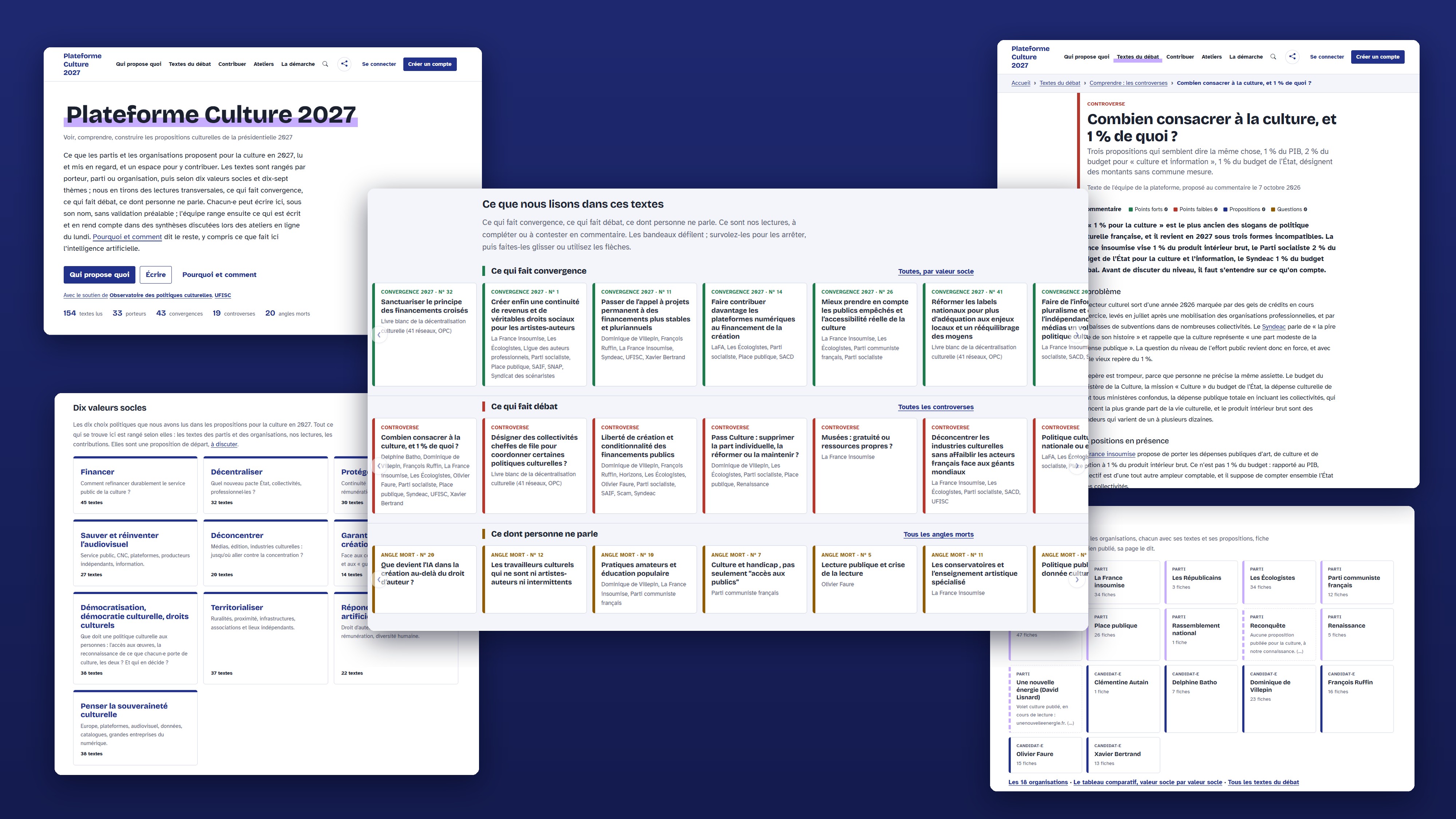
The parties have so far published little on culture for the 2027 presidential election, while professional organisations, local authorities and researchers have written a great deal, each on their own. We have gathered nearly a hundred and fifty of these texts on the culture2027.fr website, so that people can see who is proposing what and discuss it. In my view, this is how a debate is prepared: by starting from an overview that everyone can read, and correct if need be.
A hundred and fifty texts, each in its own corner
In the autumn of 2026, several parties have not published, as far as we know, any programme for culture, and there is not yet any tool comparing the presidential programmes. Professional organisations, local authorities, authors’ societies, voluntary-sector networks and researchers write a great deal: op-eds, white papers, reports, proposed amendments to the finance bill.
But who reads them side by side? Back in 2022, each organisation had published its ten or twenty proposals on its own, and no one could see where they overlapped. If you want to know today who is proposing what, you have to read dozens of documents, from a list of ten proposals to the White Paper on Cultural Decentralisation, which brings together contributions from some forty networks and which the Observatoire des politiques culturelles published in March 2026.
In September, we took the plunge
Juliette Bompoint and I had been talking about it for a long time, and we both wanted to do something before the presidential election. In September, we told ourselves we would do it: open a space before the programmes exist, so that these proposals can be read together. Juliette, who ran Mains d’Œuvres in Saint-Ouen, then Périféeries 2028, the bid by Saint-Denis, Plaine Commune and Seine-Saint-Denis for the title of European Capital of Culture, gathered the texts published for the 2022 presidential election, and those now appearing for the 2027 one. I built the site with free software, like the other digital tools for cultural democracy we develop at the agency, and with the help of artificial intelligence, which I discuss below.
I had already made tools of this kind in 2022, for a distance training course run by the Observatoire des politiques culturelles on culture, youth and digital technology, then for the Media College of Périféeries 2028. This time, the texts are of very different kinds (programmes, op-eds, white papers, reports), they needed to be set alongside one another, and everyone can respond to them.
Who proposes what, before our readings
The main entry point of the site is called Qui propose quoi (“Who proposes what”). The corpus is first of all Juliette’s work. She searches through her networks, among the people she knows and on the internet, and she will keep doing so until the presidential election. The site currently lists thirty-four contributors: eleven parties, six candidates speaking in their own name, and seventeen organisations (unions, authors’ societies, networks, observatories). Each has its own page, and when a party had published nothing, we said so.
From the programmes, Juliette also drew out ten “core values” (valeurs socles), such as “Funding” or “Guaranteeing freedom of creation”. We added our own readings: for now, forty-three points on which several contributors agree, nineteen on which they disagree, and twenty that hardly anyone mentions. If you disagree with any of these readings, say so!
Writing without having to file anything
Anyone can write on the site, under their own name, and the text is published straight away, without our approving it. We only ask people to respect a short charter. For our part, we read everything, and we never alter anyone else’s text. How it all works is explained on the page Pourquoi et comment (“Why and how”).
Every Monday at 5 p.m., until 21 December 2026, I also run a one-hour writing workshop by video call. On the first Monday, 12 October, we mostly confirmed the partnerships with the Observatoire des politiques culturelles and UFISC, so the writing really begins on 19 October. With the texts that come out of these workshops, we will write a dated summary for each core value, and send it to organisations, candidates and journalists.
The role of artificial intelligence, stated on the very first page
I asked Claude, the artificial intelligence model made by the company Anthropic, to read the source texts and turn them into summary sheets, to suggest points of agreement, disagreement and blind spots, and to draft the framing texts as well as some of the signed viewpoints. On analysing the texts, Claude is fairly accurate: who proposes what, where proposals overlap, where they clash. What we mostly correct is the angle, so that it stays democratic and open, and so that everyone can understand these texts without being from the field. When someone points out an error to us, in a comment or by email, we correct it by hand. We have said all this on the very first page of the site, because I know this choice bothers some people, and I would rather it be discussed openly.
Taking part in cultural life, a right to be exercised
Article 27 of the Universal Declaration of Human Rights, adopted in 1948, states that “everyone has the right freely to participate in the cultural life of the community”. I have long worked on cultural rights, which the Fribourg Declaration brought together and spelled out in 2007. In my view, culture is also what people do, not only what is offered to them, so a cultural policy is judged by the place people find in it. That is why the 2027 debate cannot remain a matter for sector professionals and candidates alone.
In The Public and Its Problems (1927), John Dewey describes how a public forms, as I recalled in Inquiring in the spirit of cultural rights. People suffer the consequences of actions in which they do not directly take part; they then recognise that they are concerned and organise to deal with them. Dewey stresses the role of inquiry and discussion in this recognition. The finance bill for 2026, for example, announced a cut of 216 million euros in the budget of the French Ministry of Culture, as I noted in Is Culture Serving the Public ?. The artists, residents, public employees and elected officials who bear the consequences form, in Dewey’s sense, a possible public; but they still need an overview they can read and correct, with its sources and its disagreements. That is what we are trying to offer with this platform, and the method comes from the contributory platforms I have built in the field of screen literacy education, where people take stock together before deciding, as in Nouvelle-Aquitaine for the collaborative assessment of screen literacy education.
We do not count votes. On the home page, counters show how many texts have been read and written, and for each proposal you can see how many contributors support it. On participation platforms such as Decidim, you can also “support” a proposal, or vote, and this encourages people to contribute. But what would a vote say with so little material? Not much, in my view. So we have left the question open, and said so on the presentation page.
Read, report, write, come on Mondays
We do not know what the contributions will bring. If it does not catch on, the overview will remain useful, and we will at least have opened up this possibility. We will report on what happens and change what does not work.
The platform is not linked to any candidate or any party. It can be used by anyone who wants to know what others are proposing: organisations, campaign teams, journalists, etc. The Observatoire des politiques culturelles and UFISC support the project, share it and contribute their sources; if other organisations join them, we will name them with their agreement.
To take part, read, report an error, write, or come to the Monday workshop, at culture2027.fr!


