In a little over a month, thirty-two high school students shot eight films on animal rights, then led the audience of the War on Screen festival through the streets of Châlons-en-Champagne to project them onto the walls, from one station to the next. This year, more than half of the images were made by the students themselves. I describe the working sessions, the two night rehearsals and the evening itself, because it is during these weeks that students become the hosts of a show, and that this show found its place in the programme of a film festival.
More than half of the images shot by the students
The theme was chosen in July, at the launch meeting (War on Screen : the students’ night walk is in preparation). The festival, organised by La Comète, the national theatre of Châlons-en-Champagne, was holding a retrospective on animal rights in conflicts this year, and Laurent Gauthier and Yann Barrière chose the subject without hesitation. “Animal rights, when I saw the focus themes, it spoke to me straight away,” Laurent Gauthier told me in September. Last year’s theme, ecology, had a geopolitical dimension in which it was easy to get lost. This time, we were talking about concrete things: food, pets, farm animals. And since the school brings together students from town and from the countryside, not everyone has the same relationship with animals.
The teachers set two rules. More than half of the images had to be created by the students: filming their daily lives, interviewing people, shooting fiction, etc. And each group, of about four students, mixed première students, who were discovering the project, with terminale students, who had taken part the year before. There were thirty-two of them (“we’ve never had so many students,” Laurent Gauthier remarked), hence eight groups and eight stations. The two classes worked together on Fridays, from 4 to 6 pm, from 4 September onwards, and I came three times, on 18 September, 2 October and 9 October.
The first rule has a history. In 2021, for the first of these walks, the students had chosen extracts from films about conflict on screen, and one student had made a very short animated film (War On Screen Film Festival 2021). That is when Laurent Gauthier and I said to each other that the students could make what they showed themselves. In the following editions, they still presented extracts from war films, in a theatrical way. Last year, they edited films from mostly television images, then agreed to say “I” in front of the audience (War on Screen Film Festival 2025). This year, they made their own images.
A pico projector passed from hand to hand
On 18 September, I met the première students in the school’s conference room, while Laurent Gauthier worked with the terminale students. Yann Barrière switched off the light and I turned on the pico projector, a battery-powered portable video projector that plays films from a USB stick. I passed it from hand to hand: “You can project onto the ceiling, you can project onto the floor, really, you can do whatever you like.” It gives 300 lumens, where the room’s video projector gives 3,000. In the street, a single streetlight is enough to make the image disappear, which is why the teachers insist so much on scouting locations at night.
I then told the students what, in my view, good films have in common: they express something that matters to the person making them, and they use cinema to share it. “Often, when you make a film, you don’t really dare to show yourself […] the more you expose yourself, the more sincere you are in what you share, and the more it touches people in their own sincerity.” I also talked to them about television news images, which are one point of view among others. You can film the Châlons town hall without the homeless man sitting in front of it, or with him, and it is not the same film. Their way of seeing had value, and “this is a film festival, not a journalism festival”: voice-over, the music-video form and the poetic film all have their place in it.
Since the theme lent itself to it, I told them that I became vegetarian after watching the videos filmed in slaughterhouses by the association L214, adding that I do not judge people who eat meat: “these are personal paths.” Yann Barrière added that the teachers were not there to tell them what to do, and he reminded them of “the responsibility of the person who creates and also of the person who watches. What do I agree to watch?”
I then went from group to group. One student had photographed the zoos his film would talk about himself, and his group also wanted to mention human zoos, of which traces remain in the Bois de Vincennes. Four students were leaving to shoot, in the school cellar, the dystopia that would close the route. The circus group was preparing street interviews, and I pointed out that their questions were leading: you could hear their point of view, which is their right, but it was more of a statement than a question. Another group had written a text on the animals killed in the Gironde forest fires, built on the repetition of “imagine,” and I suggested they pass the microphone at each “imagine,” letting each sentence resonate. With the fiction group, we worked on diction by separating the syllables, because speaking dialogue is, I believe, the hardest thing in cinema. At the end of the session, I told the teachers that I found the students “solid, honestly, compared with other years.”
Hens on a wall, for three seconds
On 2 October, the films were nearly finished, made “in record time.” I talked mostly about the opening of each film. In the street, people arrive without being focused, and they need a kind of airlock, a few seconds to enter an atmosphere. Seeing hens on a wall is very surprising; if it only lasts three seconds, it is almost too short.
The last film, the dystopia, showed archive footage of the concentration camps, “the most extreme images there are.” One of the teachers felt they came too early and without context, and we discussed it at length with the group. The students cut down these images, replaced some of them with images in which no dead are seen, and built their film in three parts: forced labour in today’s clothing workshops, then slavery, the camps and wars, and finally, very briefly, chicks. That day, the student who plays the film’s heroine suggested being present throughout the walk, hidden under a big hood, apart from the audience, and only revealing herself at the end. She described her character like this: “Someone who has been through something very traumatic […] a rather discreet person, but who in the end does reveal herself, because it’s important to talk about it.” I told her it was an excellent idea, which gave a thread to the whole evening.
In the animal shelter group, one student had another idea: to tell the report from the point of view of someone wondering whether they are ready to adopt an animal, because the audience “aren’t journalists.” The group investigating a plan for an industrial chicken farm ended their film like a journalist who takes no side, and I told them they had the right to give their point of view. One student answered that, even though they were against the project, they did not want to be aggressive towards the farmer, “because the poor guy can’t do anything else.” I agreed with her. The activist they had interviewed said the same thing in their film: “it’s not the farmer we’re targeting, actually, it’s the system.”
Fifty metres further on, the cathedral
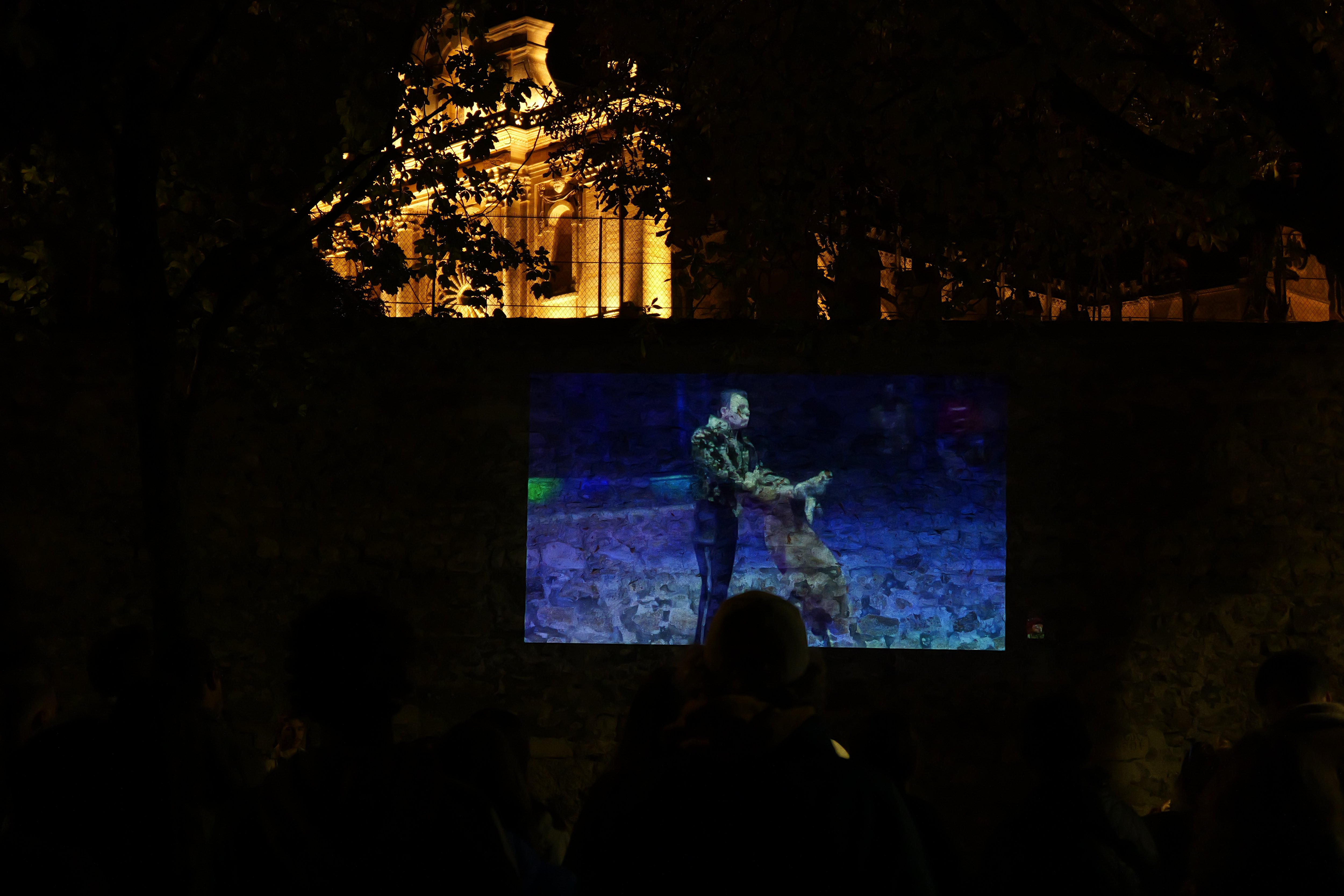
That same evening, we walked the route at night to test each wall. Laurent Gauthier had drawn up an almost entirely new route; only the rue des Juifs remained from last year. At each station, a student tried out the projector, and I showed how to hold it without shaking: elbows tucked in, leaning against a wall, at a right angle, so that the image does not get distorted into a trapezium. One student held the image perfectly still on the first try; she had done four years of archery. I photographed each spot and put the photos online as I went, in the shared folder where the students uploaded their films.
At the Jard marina, I suggested we stop at the first wall, which was closer. Laurent Gauthier went on ahead and called us towards a darker wall, fifty metres further on, which he had spotted while cycling past, with the illuminated cathedral above it. He was right, and I told him so on the spot. The last station, at the exit of the Jard, runs along a building whose windows have real bars, which suited a film about confinement.
Later that evening, one of the two teachers was telling a documentary filmmaker what he had seen in the students that night: “they saw the route. They imagined the people. They imagined themselves speaking in front of them, with the town, the noise, the cars.” Those who had written five-line sentences understood that they would never work in the street. “From time to time, you have to come back to orality.”
Sheepdogs
On 9 October, the day before the evening, I had reworked all the films: a little more sound on the voices, a little more light and contrast in the image, three seconds of black at the beginning, and a minute of black at the end so that the projector would not run straight into the next film. In class, we rehearsed the texts, then the handovers of equipment, station by station: who takes the microphone, who carries the speaker, who runs ahead to set up the next station. I asked them to always think one step ahead. It is the people about to speak who go and fetch the microphones, because the person who has just projected still has their head in their film.
To lead the audience, I used an image that went with the theme: “given the theme, we are sheepdogs.” A sheepdog is attentive all the time, nothing it does is disorderly, and it has no need to bark. The audience of a walk lets itself be carried along; if those at the front walk slowly, the others will walk twice as slowly. You also have to tell people exactly where to go. “Follow my classmates” is not enough, since nobody is wearing an armband. It is better to say “we go back thirty metres and take the first street on the left,” and point the way. Laurent Gauthier added a simple rule: “One announcement, one person.”
I also showed them how to speak in the street, with the microphone resting on the chin, and twice as slowly as usual, because the street echoes and people there do not have the concentration they would have in a cinema. I demonstrated by leaving a very long silence in the middle of an ordinary sentence, “right, now… we’re going to watch the film,” and everyone went quiet, waiting for what came next. That silence was not natural at all, and that is why it worked. When you are moved, you tend to say your text as fast as possible to get it over with. It happens to me all the time too, and you can always stop and start again more slowly. They were also allowed to make a little joke while leading people from one station to the next, to create a sense of complicity: that evening, we would all be hosts.
The student announcing the last film wanted to warn that some images “might shock the sensitivity” of the audience. I suggested she say more simply that some images are hard to watch, since they inevitably shock, and we agreed to make sure that no child was in front of the screen. The teachers, for their part, did not want to speak, except at the end to say thank you. “You are the light, we stay in the shadow,” Laurent Gauthier had told the students the week before. I insisted that he at least introduce himself, since the audience does not know who is speaking. I described in The artist as guarantor how, in a project like this, the credit goes to the outside artist whose name appears in the programme, whereas the route, the eight locations and the theme were all imagined by the teachers.
In the evening, we held the dress rehearsal along the whole route, in the rain and the wind. The speaker’s battery ran out twice, and we made a note to leave it switched on throughout the following evening. The hooded student tried out her appearances, sitting in a patch of light that the audience walked past, and since we kept finding her in different places without seeing her move, the effect was slightly supernatural. At the end, I was seeing all the films one after another for the first time, and I found that they worked very well together, with a real progression from one to the next. I told the students: it made you want to become vegetarian, and if I were not one already, it would have made me want to.
Eight walls on the night of 10 October
On Saturday 10 October, it was cold, but it was not raining. Just before we set off, I told the students: “Mistakes are part of the principle, everything’s fine. Mess up, my friends, let’s all mess up together, it’ll be wonderful.” At 8 pm, in front of La Comète, I showed the audience the pico projector I was holding in my hand, with the films inside it and a speaker plugged in. I recalled that cinema, at its beginnings, was “a fairground art, a street art, an art of simple encounters,” and that it too was a new technology. We wanted to put the phones used for filming and the pico projectors used for showing “at the service of connection, at the service of meaning.” A student then spoke on behalf of the group, repeating last year’s wording almost word for word: “We are going to present 8 projects that convey our view on a question that matters to all of us: animal rights.”
For an hour, the audience followed the students along this route:
- on the forecourt of the town hall arcade, a cat projected on the wall, then the question of whether we still saw a defenceless living being there, or food, followed by a dialogue on the place of animals in India, France and Azerbaijan;
- behind the tourist office, on the quai des Arts, a fiction filmed by the students, an argument between two friends, one of whom has become vegetarian; one of the students had not been able to come, and one of his classmates warned the audience that, in the silences, they would have to “imagine the lines for yourselves”;
- in the rue des Juifs, an investigation into a plan for an industrial chicken farm near Châlons, with an interview with a local resident who is challenging it in court, and a square metre marked out in the middle of the audience to make the density of intensive farming felt;
- in the rue de la Trinité, zoos told through the photographs of “a friend” who, as we learned at the end, did not exist, since this friend, the students said, “is us, is you”;
- near the entrance to the cathedral, the animals killed in the Gironde forest fires, told in several voices, each student taking the microphone in turn, then proposals for moving away from monoculture, such as replanting hedgerows or rotating crops;
- against Saint-Étienne cathedral, the investigation of a student who wonders whether he is ready to adopt an animal, and who goes to question the manager of a cat café and the head of an animal shelter in the area;
- at the Jard marina, beneath the illuminated cathedral, animals in circuses, with this question: how can the circus change so that animals are respected?
- at the exit of the Jard, beneath the barred windows, the dystopia, introduced with a warning: some images were hard to watch.
At several points along the route, a hooded figure had stood apart, at a street corner, on a step, without a word. During the last film, while a student hidden in the audience spoke the heroine’s text (“I was 16 when it all began”), the figure stepped forward beneath the image and raised her head: it was the young woman from the film. The text ended with these words: “We are humans, we are animals.”
Congratulating the students on their hesitations
At the end of the last film, Laurent Gauthier took the microphone and invited all the students to come and stand in front of the image. He thanked them for a project “that demanded a lot of work and very little time to achieve it,” then added: “I wanted to congratulate them on their fragility, their hesitations, their little mistakes. I think that, well, it’s being human not to be perfect all the time.” He turned to the audience: “the students were there, they had something to express, and adults came to listen to them. In times like these, that is very much appreciated.” He thanked the festival, La Comète and “our venerable establishment,” the school.
I recognise myself in these words. One student hesitated at the start of her turn to speak, another launched into her text, and the audience followed them all with the same attention. Last year, a student lost his thread in front of everyone; the audience applauded him, his classmates joined him, and he finished his text. Since then, the teachers have told this story to their new students, to tell them that you can make a mistake in front of the audience and carry on.
After the screening, Laurent Gauthier pointed out to me that the stations where the students had made their images themselves, even imperfect ones, were those where their words carried most. I had said it the day before on a regional radio station, announcing the evening: these are not just students presenting a school project, they are young artists presenting their creations to the public. Amateur practice is not a less accomplished version of professional practice. You find something else in it, which has its full value for those who watch it, and I argued in What Professional Artists Can Learn from the Amateur Model that professionals have a great deal to learn from it.
From a sideline activity to an evening of the festival
The first walk, in 2021, took place on the festival’s closing night, as one more cultural outreach activity. This year, it was in the official programme. On Monday 5 October, Laurent Gauthier went on stage with two students at the launch evening to present it, and on Saturday, the festival director was there. In Six years to get into the programme, I describe how this project found its place, step by step, in the festival’s programme, budget and communication.
I connect this movement with cultural rights. Since 2015, article 103 of the French NOTRe law has provided that responsibility for cultural matters is exercised jointly by local authorities and the State “in accordance with the cultural rights set out in the convention on the protection and promotion of the diversity of cultural expressions of 20 October 2005” (my translation). The Fribourg Declaration on Cultural Rights, made public in 2007, sets out these rights in more detail, following on from the Universal Declaration of Human Rights, whose article 27 recognises everyone’s right “freely to participate in the cultural life of the community.”
I often come back to the difference between two approaches. In cultural democratisation, an institution brings to audiences works it considers important. In cultural democracy, everyone has their own culture, and cultures are exchanged without looking down on anyone else’s, which does not mean that everything is of equal worth; I proposed definitions in Cultural democratization, cultural democracy : situated definitions. In Châlons, you can see what the second looks like: teenagers create, and the audience of a film festival comes to hear what they have to say about the world. Nobody decreed it. This place was built year after year, thanks to the students’ work, the teachers’ constancy and the choices of the festival team. At the same time, public funders of film education are beginning to include young people’s participation in designing projects among their criteria. It is from the meeting of these two movements, one coming from the ground and the other from public policy, that the legitimacy we did not have at the start is born. I discuss this at greater length in Legitimate participation as the horizon of cultural events, and my texts on these questions are gathered under the keyword Cultural rights and cultural democracy.
Eight films in a little over a month
The students did all this in a little over a month, in two-hour slots on Fridays, thinking at the same time about the images, the sound, the texts, the equipment, the running order and the audience’s route. The teachers say it plainly: it is the pace imposed on the students that they find hard. Many texts, written to be read, were only trimmed at the last moment, when the students spoke them in the street and heard what did not work.
I believe the next step is to give more time: to know the theme well before the start of the school year, so that ideas can mature, and so that the ones that seem wonderful on the first day but do not last two weeks are dropped early enough. The festival team wants this too, to keep in touch with the students from one October to the next. Recognising amateur practice in a festival programme also means giving it the conditions for creative work that is not always done in a rush.
Laurent Gauthier retires at the end of this school year. He has carried this project with me since the first edition, and this year, for the first time, two teachers ran it together, so that it can be handed on. It was he who found, while cycling past, the wall in the Jard above which the illuminated cathedral rises.


