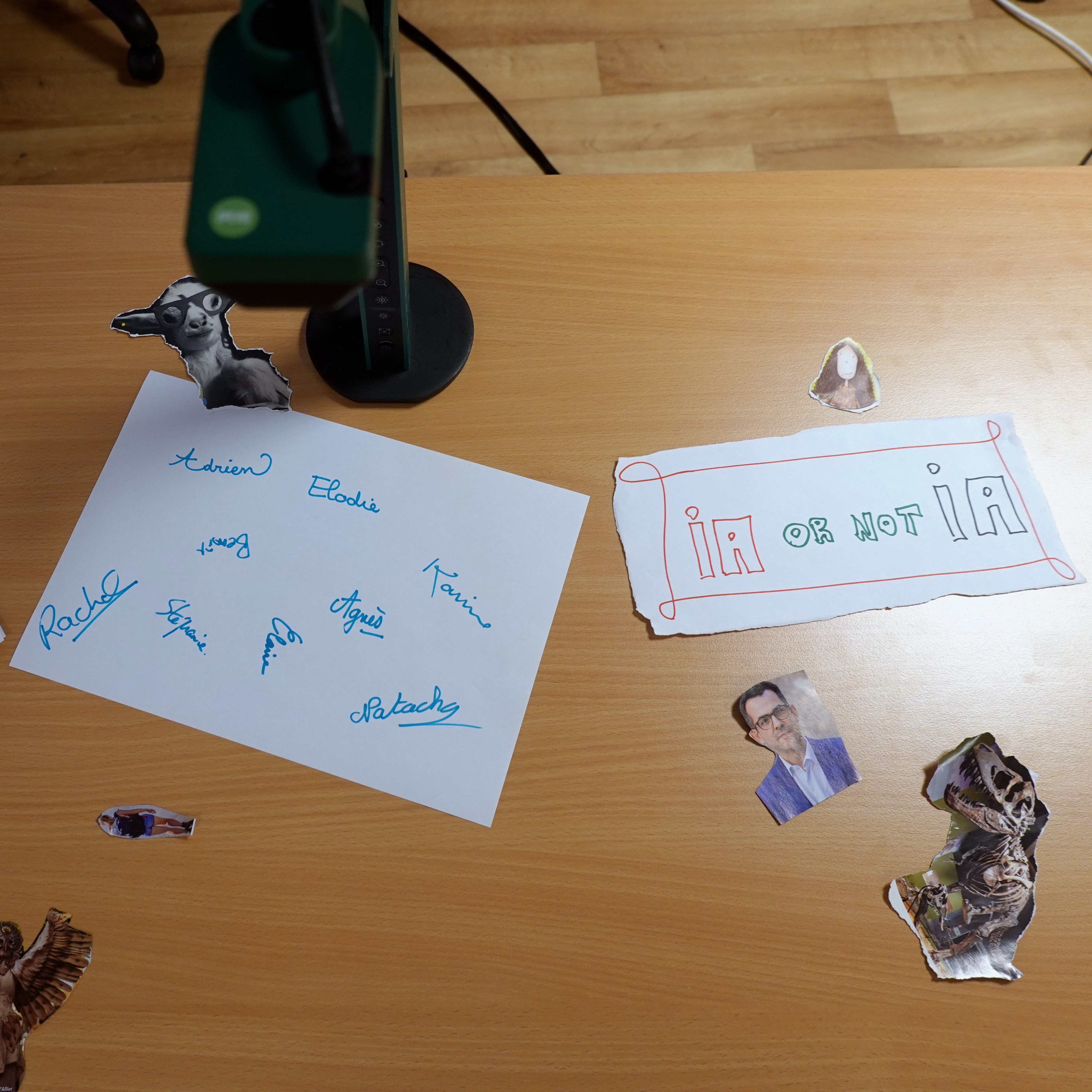
A training day on artificial intelligence, with about fifteen secondary school teachers, ran up against the wifi, against accounts that had to be confirmed by email and apps that had to be installed, and in the end that became part of what the day had to pass on. Artificial intelligence can only be approached in class with the real means of digital technology in schools, equipment included. The day was also made of input on the history and workings of these machines, of methods to repeat in class, of tools the participants shared with one another, and of two films.
A day that starts by listening
The Collège au cinéma programme is coordinated in the Allier by Ciné Bocage, the association that also runs the Festival Jean Carmet in Moulins. Catherine Cuvelier, who coordinates it, had invited me to devote a training day to artificial intelligence, which I had announced in the article Artificial intelligence and creation : a training day for secondary school teachers in the Allier. We had prepared a fairly precise schedule together, and I warned everyone in the morning that it would shift according to what the people in the room wanted to work on.
I chose not to use a slideshow. I no longer run training sessions with PowerPoint, I’ve banned it quite strictly. I said so to a participant as she arrived, exaggerating a little (“it’s against the law now”), and she asked me whether it was banned at school too. What I hold against slideshows is that they freeze things and send everyone the message that, whatever happens in the room, everything has already been decided. Whereas in a training session we’re trying to build each person’s own path. People often use it to reassure themselves rather than to create interaction, and the problem lies in that use, not in the tool. She replied that for the oral exam of the brevet it’s handy all the same, more of an outline really, and she’s right. So that day there was no slideshow, I showed film extracts when we needed them, we built a mind map live, there were books on a table, and I went to websites as the conversation went along.
To start with, a little two-minute game, the sit-stand. If the answer is yes you stand up, if it’s no you stay seated, and I had prepared about ten questions. “Who has the TikTok app on their phone?” Three of us ended up standing. It was funny, and when you think of how much time their pupils spend on it, it says something. For “who has ever suspected a piece of homework of having been done with AI?”, the whole room was on its feet. And for “who has ever followed their GPS while sensing that it was getting it wrong?”, almost everyone, me included. GPS is artificial intelligence, and has been for a long time, except we no longer call it that. I stand up with the others, because what you ask of people you have to do as well, and that’s what allows them to answer without watching themselves.

What teachers are already doing
The round of introductions that followed went on much longer than planned, a bit disorderly, and I let it run because that’s where everything was happening. The week before, one teacher had asked her Year 9 pupils (quatrième) for a reading alphabet book. Almost all of them had done it with AI, some entirely, others to find ideas for words, and instead of punishing them she asked them how they had gone about it, and why. She found it fascinating, and she concluded, and I’m quoting her, “I have to stop demonising it”. In her school, in a priority education network, there’s a boy for whom putting together sentences that make sense is hard, and at home people don’t talk much. He explained to her that he asks AI for a way to start a fantasy story, and that it helps him get going at home. A colleague who teaches newly arrived pupils who don’t yet speak French has worked out with them a way of writing their requests to the machine, starting from the tools they already have, and he keeps AI for the end, to check, once the pupil has searched first.
Another teacher remembered a Year 8 pupil (cinquième) who came to see her last year with her physics exercise, completely lost: she had given it to AI, and the machine had come up with formulas she didn’t understand at all. A teacher told us that his son, at high school, asked AI to write his essays while deliberately slipping in a few clumsy mistakes matching his profile, and that he himself had been taken in. “Did you write this?” “No.” He was amazed, and he laughed about it: “they’re very subtle, the kids we have”. Someone ended up saying out loud what quite a few people were thinking, so what are we for, then? He already had a good part of the answer. He keeps telling his pupils that method means path, and he can see that for those who have no parents or older brothers and sisters to help them at home, AI can play a democratic role. I told him I found his stance rather exemplary, because these are questions of professional identity, who am I, what am I for, and the image of the schoolmaster as the village notable, who holds knowledge and hands it down, is still very much alive, you only have to listen to certain ministers. One colleague refuses AI in her classroom for now, she’s waiting to see more clearly, which hasn’t stopped her from having her pupils compare answers given by a machine. A French teacher who has been teaching for thirty-four years (“I won’t say how many, although”) subscribes to ChatGPT and uses it to rework her old lessons and to prepare adapted versions for pupils who have a support plan. She doesn’t see the point of fighting it, “we’re not Don Quixote”. The coordinator of an ULIS unit, for pupils with special needs, has pupils who often have no internet at home. And the two civic service volunteers who support the programme were at opposite ends, one uses these tools every day, the other never, and she says that what makes her learn is the relationship with passionate people.
None of this was in my schedule, and the rest of the day was built from there. To take this question of the teacher’s role further, I told the story of Joseph Jacotot, which Jacques Rancière recounts in “The Ignorant Schoolmaster”, a book from 1987 that I really recommend. In 1818, Jacotot is teaching French at the University of Louvain to Flemish students, and he doesn’t speak a word of Flemish. He gives them a bilingual edition of Fénelon’s “Télémaque”, leaves them to work it out, and they learn French very well. What Rancière says, roughly, is that when you know something and explain it, you diminish the other person’s competence a little, you bring them back to what they don’t know. Jacotot, for his part, couldn’t do anything other than let his students organise themselves and build their skills on their own. I think that with AI something similar is happening in teaching as in many trades, graphic design, software development, editing, and that teachers and pupils are discovering the tools at the same time. We’re all a bit like ignorant schoolmasters, and that’s not necessarily bad news. I also talked about Olivier Houdé, who has worked a great deal on what he calls cognitive resistance. We all have reflex thinking, automatic habits, and learning something new, seeing a film whose aesthetics we’re not familiar with for example, forces us to resist ourselves, to create new neural connections. That’s what takes the most energy, so the body isn’t particularly keen. And above all you mustn’t be afraid. If I feel threatened, if I’m afraid of being told off, I’m in protection mode and I can’t learn anything, neurologically it’s impossible. It shows how much the atmosphere of a classroom matters.
A longer history than ChatGPT
I very rarely make a timeline in a training session, but this time I did, because the history of these machines helps you see them differently. It all starts with Blaise Pascal, who took four or five years to build his Pascaline, because he wasn’t very good with his hands, and who finished it in 1642, at nineteen. It’s the first mechanical calculator, with gears and carries that jump from one wheel to the next. The philosopher Mark Alizart, in “Informatique céleste”, explains that it isn’t yet a computer, because it lacks a memory, an empty space that could be filled and drawn on again. Leibniz, who had himself built a more complete calculating machine than Pascal’s, published his “Explanation of Binary Arithmetic” at the Académie royale des sciences in 1703, and I showed the page. He suggests writing all numbers with 0s and 1s. You can see his table, 2 is written 10, 3 is written 11, 4 is written 100, and with that there’s nothing left to learn by heart, you make far fewer mistakes because it’s so simple that a machine can do it. Then at the beginning of the 19th century Jacquard looms were controlled by punched cards, in other words by a memory.

In the 1830s, the Englishman Charles Babbage designed an analytical engine, a sort of super Pascaline with punched cards, which never worked. But a young woman became passionate about the machine, far more than Babbage himself: Ada Lovelace, the daughter of the poet Byron (it’s anecdotal, but it was at Byron’s house that Mary Shelley came up with Frankenstein). In 1843 she translated an article about the machine and added notes much longer than the text itself. In those notes she lays the foundations of what a computer is, she writes a first program, with a bug in it, incidentally, since she was never able to run it, and she imagines that such a machine might one day work on something other than numbers, compose music for example. In 1950, Alan Turing was still discussing what he called “Lady Lovelace’s objection”, the idea that the machine only does what it is told. The expression “artificial intelligence” appeared in 1955, in a funding proposal written by John McCarthy and a few American colleagues for a research workshop at Dartmouth. They needed a name to get the money, they tried “artificial intelligence”, it sounded good, even though it’s almost an oxymoron. I find it useful to remember that, because in the end “artificial intelligence” means a bit of everything and nothing, like “digital”.

I also talked about Chris Marker, who himself wrote a conversation program for the Apple II between 1985 and 1988, Dialector, which you can still chat with online, and about the films that imagined these machines before they existed, from “2001: A Space Odyssey” to “Her”. On the technical side I kept it very simple. A language model guesses what comes next in a text, one piece, then the next piece, and so on. The “reasoning” modes now appearing in assistants are the machine running longer before it answers. I went back to the image of the GPS, the good one against the bad one, with the good one you get lost less often but it uses more.

Digital technology, with the means actually available
In the afternoon, the big difficulty was the connection. Usually, with 5G, you don’t get that kind of problem any more, but we were in a basement and nothing got through. The Département’s guest wifi threw us out roughly every twenty minutes, we had to reconnect, and so on. To use most image generators you need to create an account, and to confirm the account you have to click on a link received by email, except that without a connection you don’t receive the email, and you had to start the registration all over again. CapCut, the editing app, asked for a TikTok account for some effects. At one point, I told the groups who were stuck to go out near the entrance to connect over 4G. According to Catherine Cuvelier, the Département’s IT department has become very cautious since some local authorities were hacked. We talked about it again together, and next time we’ll test the connection beforehand, or choose a place where it works.
These hassles were interesting to go through, because they’re the ones classrooms face. In the evening, while taking stock with Catherine, we realised that the obstacles of the day weren’t artificial intelligence problems, since everyone already used it, often without thinking about it. They were digital problems, reading a QR code, connecting to a network, creating a Google account. You can’t approach AI in class without dealing with that, and without taking into account the divide between pupils, since some are very much at ease on their phones and don’t really know how to use a mouse.
Material resources came up all the time, especially over lunch. One teacher buys her own big wooden crayons for the board, and the spray bottle to wipe them off. Another wanted to do image analysis with her Year 10 pupils (troisième) using laminated colour sheets, on which the pupils would write with whiteboard markers, because colour photocopies are rationed. She was six markers short. “Oh dear, six, hang on, you’ll have to ask the boss”, and she found herself in the bursar’s office, where she got them by promising to bring them back at the end of the lesson. To go to the cinema, two coaches, 132 euros, and someone has to be found to pay. As for digital equipment, when there is any, it doesn’t always fit what you’d like to do with it, and it’s sometimes imposed without asking the people who use it. A colleague described the Éducation nationale as a very noble old lady who is gradually losing her titles of nobility, and who can’t chase after AI, where “billions and billions” are being spent. I couldn’t see how to talk about pedagogy without talking about that at the same time.
Tools shared by the participants
Many tools circulated during the day, and a good share came from the participants. The French teacher with thirty-four years in the job realised, as she talked about it, that she was already using tools in class that have AI inside them. Plickers first, for running quizzes without the pupils needing a device (each one turns a printed card to the side matching their answer, and the teacher scans it with a phone). Then Wordwall, which she subscribes to personally, for making quizzes, hangman games and anagrams to revise vocabulary or spelling. And SpeechNote, a voice dictation tool, because she types “with two fingers”. The colleague who teaches newly arrived pupils showed how he gets them to write their requests.
For my part, I showed alternatives to the big American assistants, such as Le Chat by Mistral, and Euria, which comes from Infomaniak, a fairly green Swiss hosting company whose data centre heats six thousand homes in Geneva. I also showed Poe, which lets you ask the same question to several models and compare their answers, and their biases. To film in class, I had brought simple equipment. A document camera, a visualiser as it’s called, which plugs straight into a screen, even without a computer, a USB microphone costing around thirty euros, and the free software OBS Studio to record. For sound, really, the most important thing is to speak close to the microphone.
From the morning I had put books out on a table, and the participants photographed them with their phones. The photos went into an online folder open to everyone through a QR code, with no registration, later joined by the films and the ideas written during the day. This folder of resources from the day is modest, but anyone can look at it, and it will grow.


A cut-out paper film over lunch

Before creating with artificial intelligence, we created without it. I hadn’t planned it at all, I didn’t have all my equipment, but I had the camera. Over the lunch break, everyone tore a character out of magazines by hand from a pile I had left by the entrance (we had no scissors), we set the camera above the table, connected to the big screen, and we improvised an animated film in a single shot, with the voices done live. We treated artificial intelligence as a subject, not as a technique. Each character came into the frame and said what it thought about AI. The instructions were simple: your character has to stay alive, clear-cut emotions, no dead time, no laughing during the take, a title and closing credits on paper with our first names. The film is called “IA or not IA”. One of the characters thinks it’s “letting the wolf into the sheepfold”, another announces that “the artificial won’t last long, what will remain is the intelligent”. We watched it straight afterwards.


If I had planned to do it, I would have brought skewers and tape so that fingers wouldn’t show, a better microphone, and small musical instruments so that those who don’t dare to play a character could make the soundscape. In this set-up, everyone is active at the same time, which is rare on a film shoot. I’ve done it a lot with ULIS classes, where some pupils only did the music or the title, and that was perfectly fine. I wrote about it in the article Making a film with AI before talking about it. Going through a creative experience before the discussion changes the discussion, and it also shows that a film can be made perfectly well without any artificial intelligence, with whatever is on the table.
A few images, a voice, a film

In the afternoon, in small groups, each made a film of about one minute with artificial intelligence, following the protocol I had tried out with the teenagers at Tumo Paris. You first write a script of two to four scenes, using AI as a kind of super internet search to enrich your own ideas (in the Middle Ages, what sort of settings, what costumes?), rather than to have it write the film. You generate one still image per scene. And that’s where you run into the problem of continuity, the character doesn’t look the same from one image to the next, which forces you to describe it much better, and it’s a very good exercise. You edit the images on a phone with CapCut, without creating an account, you apply effects that set them in motion, then you record the voices. I recommend using the participants’ own voices, because you commit yourself to it and give the film a body again, even though synthetic voices are possible.
Two films were finished. In “Cyber Lion et Tigertor”, two big cats in a futuristic savannah wonder whether a GPS would help them find their prey and the watering holes. In “Tournesol 2.0”, an artificial intelligence swallows the scientist who made it, in an open twist on Hergé. The third group didn’t get to the end, for lack of time and connection. Well, that’s how it goes, and I said so plainly, it happens in any project and it’s also something you need to know how to support with pupils. We projected the films on the big screen and talked about them. I was keen that we aim for small forms, see them through and show what we’d made, even if it’s partial. Technical prowess isn’t one of the teaching objectives. You don’t look at your work in the same way once you’ve shown it to others, and I think that’s where confidence is built. One participant suggested splitting the workshop up, one image per session, with editing and sound at the end. She’s right, it fits the school timetable much better than my format squeezed into one afternoon.

Two exercises I didn’t have time for
At the very end, while I was scanning the sheets of ideas under the camera, I described two exercises I had planned and that we didn’t have time to do. The first is what I call the collective filmography. You ask pupils for films or series they like that have AI in them, or robots, you note the titles on screen in a mind map, and then you look up the year, the country, the name of the director. It can take half an hour, sometimes more, because people remember a film but no longer its title, and you have to take that time. If we’re the ones who name Terminator or The Matrix, many teenagers don’t know what we’re talking about, they have other references, and those are exactly what we’re gathering. It makes a kind of diverse common ground that can be printed and put up on the wall, and it’s a chance to ask what exactly someone who directs a film does. One teacher already does it with Year 9 pupils on lovers on screen. Another feared that with Year 7 pupils (sixième) the word “AI” wouldn’t mean much, and we agreed that robots, or the future, would work better.
The second is the minute-and-a-half pairs. In pairs, one explains the risks of artificial intelligence to the other for a minute and a half, with a timer on the screen, the other only listens, then they swap, and the same pair does another round on the benefits. After six minutes everyone has spoken. We don’t know what they said to each other, since everyone is talking at once, and the person who doesn’t really know what to say only had a minute and a half to hold. It shouldn’t be done right at the start, rather after the subject has already been discussed, I could have placed it after the history. Before writing a script, each person has thus already worked something out. When I express myself, I’m not only telling what’s inside me, I’m making ideas and sharpening my thinking, which is what psychoanalysis calls symbolisation.
Ecology, in orders of magnitude
The ecological question always comes up at the end of the day, and it did. I pointed out that the biggest impact of digital technology lies in manufacturing the machines, phones, processors, with mining and extractivism, and that didn’t begin with AI. Data centres existed before it too. The International Energy Agency estimates that they used around 1.5% of the world’s electricity in 2024, perhaps twice that in 2030, except that the chips that run AI already use far less than a few years ago for the same computing power. I offered a calculation, which I know is biased since I’m vegetarian. A steak represents roughly as much water as four thousand requests to an AI, so that someone who makes fifty a day for a year, which is already a lot, gets to the equivalent of a few steaks. I myself, before I became vegetarian, used to ask myself ecological questions when writing a prompt, and none when eating a steak. I also said that I’m against building data centres on French territory, and that these questions are largely a matter of collective decisions and democratic debate. Why build data centres in France rather than in the far North, where it’s cold and few people live? For economic reasons, local taxes, and much less because of response time, which would hardly change. And then responsibility is often placed on each individual, whereas some industrial companies have every interest in our feeling guilty individually. It was BP that popularised, in the early 2000s, the personal carbon footprint calculator.
What a day like this can bring

In six months, the tools we looked at will have changed, some may even have disappeared. What I’d like to remain is above all a little more confidence, and having looked squarely, together, at the conditions in which each of us actually works. Teachers don’t need to master artificial intelligence to support their pupils. What they need are simple exercises, a framework, equipment that works, and the right to discover things at the same time as their pupils. At the end of the day, everyone took five minutes to write down ideas to put into practice in class. Reporting on a book to make another class want to read it, staging fables, remaking with AI the poster of a film seen through Collège au cinéma, telling a book from the point of view of each of its characters in cut-out paper. These ideas are in the online folder, and I have also written a synthesis of the day, which covers the exercises, the historical input and the participants’ proposals.


