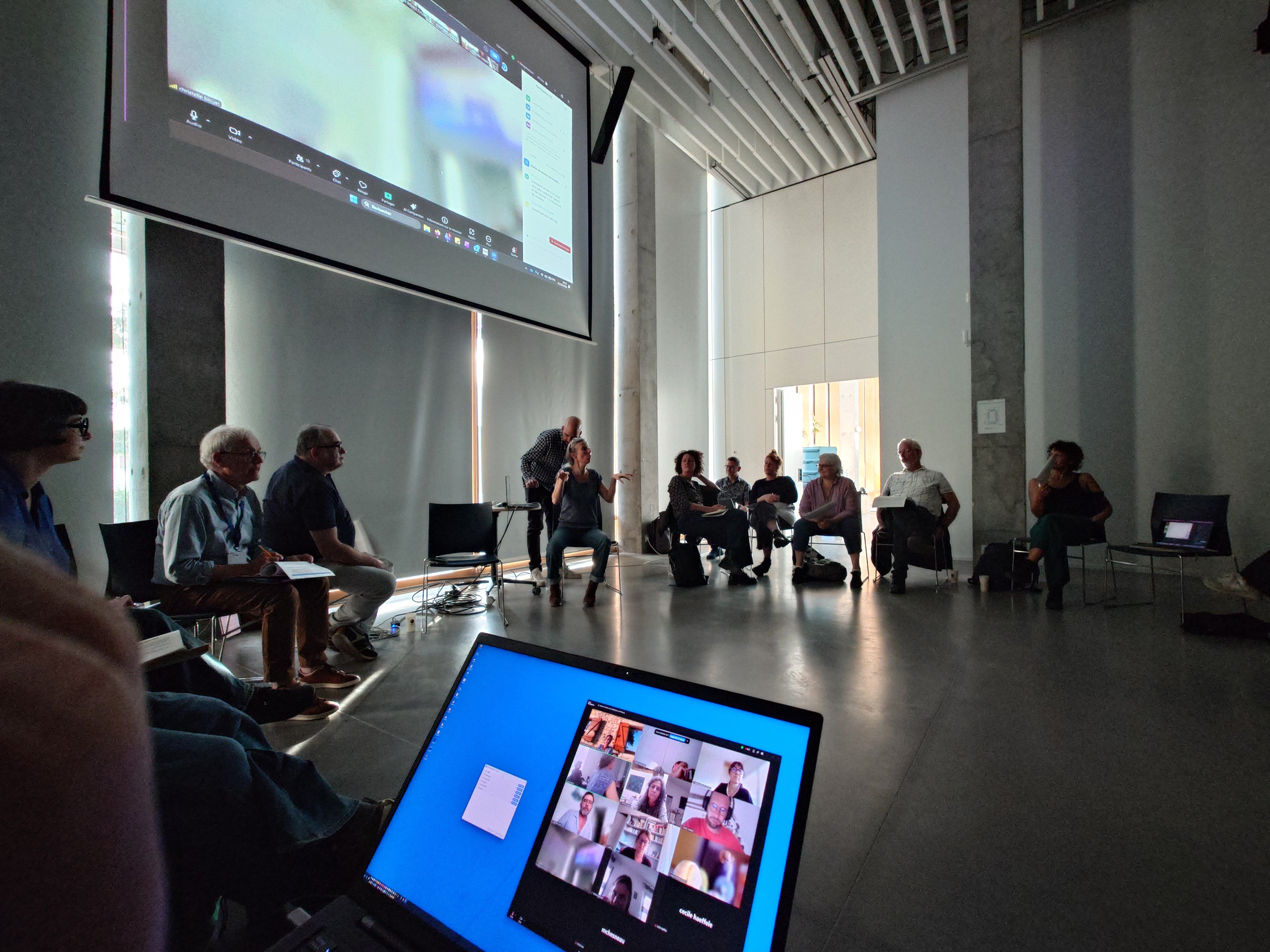
In our group, we found that the articles of the Fribourg Declaration that set out cultural rights already apply to digital technology, and that what the text mostly lacks are tools for thinking about governance. We proposed adding creation and contribution, and recognising the right to know and to govern the codes, algorithms and classifications through which institutions answer us. Our digital dependencies are the result of choices, and in the revised version, governance becomes everyone’s business.
A 2007 text rewritten by many hands
The Fribourg Declaration on Cultural Rights was adopted on 7 May 2007 by an international group of experts, after some twenty years of work. It brings together cultural rights that were already recognised but scattered across many international instruments, in order to make them more visible. The Observatory of Diversity and Cultural Rights, in Fribourg, now leads its revision, with the aim of completing it for its twentieth anniversary, in May 2027, at the Council of Europe in Strasbourg. Earlier stages took place at the seminars “Sens culturel(s) des droits humains” (the cultural meaning of human rights), held in Villeurbanne in 2023 and in Marseille in 2025.
The workshop of 6 October was held at Le 108, at the Métropole Rouen Normandie, during the national training course for organisers of local cultural rights groups. Réseau culture 21 had invited the local Paideia groups and everyone who knows and uses the text, on site or by video link, to work by theme: the relationship with the living world, childhood, gender, decolonial issues, governance, digital technology.
There were five of us in the group devoted to digital technology: Barbera, Jean-Damien, Marc, Mylène Bidault, a doctor of law who took part in drafting the Declaration in 2007 and who followed our discussions remotely, and me. We had in front of us the twelfth working version, dated 25 September 2026, and we wrote our proposals in green in the shared document, to distinguish them from the other colours.
In this working version, the structure of the text changes profoundly. In 2007, the eight articles setting out the rights were followed by four articles devoted to the obligations of the various actors. The drafters have removed this separation: articles 9 to 12 become the right to take part in democratic governance, presented as “the central axis of any democratic culture”. I noted that evening that, in this logic, responsibility for cultural rights can no longer be left to States alone, that it belongs to each and every one of us, and that this confirms the central place of participation in the text. I also noted that the revised text should “sound like a flag”.
By the end of the session, we had written the following proposals in green:
- In the preamble, speak of the “for-profit” sector rather than the “private” sector.
- In the first paragraph of article 9, add creation to the circulation and promotion of knowledge, and add the responsibility “to contribute” to that of “interacting”.
- In article 9 c, speak of “for-profit” rather than “private” institutions, and of “repeated, serious and multiple” discrimination.
- Add to article 9 a point f, on the right “to know and to be able to govern the components that determine the answer given by institutions”.
- Mark article 7 c as “to be reworked”, and enter in article 11 a debate on the appropriation of the commons, whose wording remains to be written.
Digital technology does not need to be named everywhere
Jean-Damien opened our work by recounting the work he has been doing since 2022 with Emmanuel Vergès on the Declaration and digital technology. They had first checked, by walking through the text, whether it already made it possible to think about action in the digital field. Their conclusion was that articles 3 to 8 did so as they stood, and that two places needed work. The first was the definition of culture, where they argued that technology is fully cultural; the definition now includes, alongside knowledge and the arts, “the sciences”, “sports” and “techniques”. The second concerned articles 9 to 11, on governance, the economy and the responsibility of public actors, which seemed weak to them compared with the rest of the text. Mylène Bidault explained that the drafting team had added mentions of digital technology to make it more visible, without being sure this was enough, and she asked for our opinion.
I share their reading of articles 3 to 8. I had done the same exercise in the article Cultural Rights and Digital Technology, proposing for each of the eight rights examples of how to put it into practice through digital tools. An article of the Declaration does not need to mention digital technology for it to be made effective in situations where digital technology is present. It even seems to me that we should be wary of writing a text of rights from our imaginaries of digital technology, which change within a few months. Catastrophism is one of them too, and it does not necessarily match reality. A declaration must still be usable in twenty years. So we spent most of our time on article 9.
From copyright to the right to be an author
Before turning to the text, Jean-Damien described how the question arises differently with generative artificial intelligence. With digital technology, the question was one of access to data, organised by algorithms but open to everyone. With generative AI, people no longer receive data, they receive an answer written in their place, by systems whose workings they can neither know nor question. He drew on Theodor Adorno, who in the 1940s described the standardisation specific to the culture industry, and on Jean Baudrillard, for whom the history of mass media is that of a message that cannot be answered. With digital technology, everyone had been able to answer, and even to become a medium themselves; the AI industry is seeking to take back control of the answer itself.
Hence his proposal to reread article 27, paragraph 2, of the Universal Declaration of Human Rights, usually associated with copyright and authors’ remuneration, as the affirmation of a right to be an author, open to every person. Emmanuel Vergès often speaks of “becoming an author”, as I recalled in the article Cultural Rights in Light of Personal History. Mylène Bidault connected this idea to “the freedom indispensable for scientific research and creative activity”, which States undertake to respect in the International Covenant on Economic, Social and Cultural Rights. Since 2009 she has supported the mandate of the United Nations Special Rapporteur in the field of cultural rights, Alexandra Xanthaki, who in 2025 presented a report entitled “Artificial intelligence and creativity”. Within that framework, she told us, the right to create was conceived across the whole field of human activity, not only within the artistic freedom to which it is often reduced, and it was set against AI as a space of human autonomy.
This idea is close to my heart. From the open screenings I ran in the early 1990s to the Pocket Films Festival, founded in 2005 with the Forum des images for films shot on mobile phones, I have always sought to make it possible for spectators to become authors. I offered an analysis of this in relation to AI in the article The notion of authorship in the era of generative artificial intelligence. In the first paragraph of article 9 of the working version, we read that the realisation of cultural rights “guarantees […] the participation of all in the circulation and promotion of the diversity of knowledge”. Barbera pointed out that the creation of knowledge was missing, and Mylène Bidault proposed adding “creation”. In the same spirit, I proposed that “to contribute” be added to the list of each person’s responsibilities, “to interact and, where necessary, to take initiatives”. Jean-Damien recalled that enabling everyone to contribute was the starting point of many digital tools. At the end of the session, I remarked that our first additions to article 9 concerned creation and contribution, without the word digital appearing in them, whereas digital technology has made creating and contributing ordinary practices for a very large number of people.
Microsoft, a choice we made
Barbera was worried about everyone’s ability to remain a stakeholder in digital life, when most people do not know what data is taken from them or how it can be exploited. She mentioned the proposal by Baptiste Morizot and Laurent Neyret on habitability, which reverses the reasoning: looking for what needs to be protected rather than piling up restrictions. I explained in the article Inhabiting before habitability why I resist the form of this proposal. But it was above all on the question of dependency that I did not share her view. Our subjection to Microsoft, and therefore to the United States, was not imposed on us by all-powerful corporations. It is the result of choices, made by people and institutions who were not aware they were making choices, for lack of tools for thinking about these questions. Barbera replied that it was the State that made this choice, by entering into agreements with Microsoft, not citizens. Jean-Damien pointed out that these agreements fall under articles 9 and 10, and I think so too. A few public institutions have made other choices, such as the French Gendarmerie nationale, which equipped its workstations with free software.
The technical choices of institutions have major political and democratic consequences, which is why tools for thinking such as the Declaration will no doubt be necessary for us tomorrow. I recounted in the article Cultural Rights and Digital Technology how difficult it was, some fifteen years ago, to send partners documents in an open format, only to be asked straight away to send them back “in Word”. We ourselves are caught up in these dependencies, and that evening we experienced it: our notes were being taken in a Google Doc. When I wanted to strike through a word, I could not find the command because, for the very reasons we were discussing, I almost never use this software, and it was Mylène Bidault who helped me find it. I pointed out this small contradiction in our practices. If governance becomes a right of participation for everyone, then the choice of tools, in an institution as in a working group, falls within the scope of that participation.
Public space or interface
The first paragraph of article 9 also refers to “maintaining and developing public spaces”. I asked whether we should specify that digital spaces are among them, because many people do not think of them as public spaces. Jean-Damien explained that he and Emmanuel Vergès avoid speaking of digital spaces or environments, just as we do not speak of a television environment: for them, digital devices and interfaces are techniques that connect people, not environments. Marc objected that, unlike television, digital technology leaves traces and builds up resources, with a before and an after, and he suggested speaking of public spaces that are both physical and virtual. I preferred “digital”, because the word “virtual” seems to me unsuited to these spaces, and I added that digital technology is also a technique of memory, in the same way as archives. Barbera put forward the word “socio-material”, increasingly used to designate the intertwining of the social and digital materiality.
The examples did not all point the same way. The infrastructure almost always belongs to someone, but you can host your data at home, and Wikipedia is a regulated public space spread over many places. Jean-Damien compared an open social network, even one owned by an industrial group, to a shopping mall that has become a place where people meet. He also recounted that as early as 2013 and 2014, secondary school heads were telling him that most of the incidents they handled in their schools came from exchanges on social networks. The public space of the school was therefore already being played out through digital interfaces, whereas in the common imagination public space has nothing to do with them.
French law, which I looked at more closely after the workshop, supports the shopping mall comparison. It has no single definition of public space, but the law no. 2010-1192 of 11 October 2010 gives one for its own scope: public space “consists of public roads and places open to the public or assigned to a public service” (my translation). A cinema or a shop is part of it, even though it belongs to a private person. The public domain is a different notion, which concerns the property of public bodies. In this sense, privately owned premises can be a public space, as long as they are open to the public. We did not get to the bottom of this question. The same difficulty arises in the preamble, which refers to “all transnational spaces, including digital ones”, and we agreed that it would have to be settled in both places at once, by articulating the notions of space and interface. Mylène Bidault thought the question of the privatisation of public spaces could find its place in the commentary that will accompany the revised text.
“Repeated, serious and multiple”
Article 9 c provides for developing, “in all institutions, whether public, civil or private”, ways of consulting the people concerned and enabling them to take part, in particular those prevented from doing so by “serious and multiple” discrimination. Marc proposed adding repetition, by analogy with sexist and sexual violence, where the seriousness of an act is distinguished from its repetition: small acts of bullying, which are not serious in themselves, become so because they are repeated. Jean-Damien recalled that a cultural policy seeks to change behaviour, and that a repeated act becomes a behaviour. Mylène Bidault observed that repetition can be one of the elements of seriousness, without opposing the addition, and we wrote “repeated, serious and multiple”.
The phrase “public, civil or private” took longer. Jean-Damien could not see what a civil institution is. Mylène Bidault reminded us of the distinction between three sectors, to which Patrice Meyer-Bisch is very attached, and which has appeared in the preamble since 2007: the public sector, that of the State at every level, the civil sector, that of civil society organisations, and the private sector, that of businesses. I pointed out that “civil” and “private” are not on the same level, and that what is private is not necessarily commercial. Jean-Damien added that an association, even Amnesty International, is a structure governed by private law. Marc proposed distinguishing between the public, the non-profit and the for-profit, and we preferred “for-profit” to “commercial”, because what distinguishes organisations is their purpose: an association can engage in trade without being for-profit, since it reinvests what it earns in its purpose and cannot redistribute it to those who run it. Jean-Damien noted that this word also makes it possible to think about semi-public companies and the commercial activities of the public sector, which we did not know where to place. Mylène Bidault pointed out that the boundary is not always clear, with the example of non-profit private schools whose directors grow rich through their salaries, and I replied that similar abuses can be found in public institutions. Jean-Damien remarked that this is precisely what the Declaration is for: helping us think about these abuses differently.
Codes, contexts, algorithms, classifications
Marc was surprised that article 9 says nothing about the information institutions must give about what they do. I first thought of article 7, on the right to information, before agreeing with him that it concerns information in general and dialogue, without engaging the responsibility of institutions. The 2007 text already provided, in article 9, for ensuring “the interactive exercise of the right to adequate information”. Jean-Damien read us one of the recommendations he is preparing with Emmanuel Vergès, according to which knowing and being able to govern what determines an answer is a condition for exercising cultural rights in the digital field, and knowing how an answer is produced is not enough if one cannot challenge its effects.
Mylène Bidault wondered whether this was too specific for a declaration, while acknowledging that it is the issue of the moment. Jean-Damien replied that this requirement applies as much to archivists organising a classification scheme as to a company writing the code of an artificial intelligence. In my view, if we do not have access to this information, we cannot exercise our rights. Article 7 d of the working version already recognises the right to know which content is produced by an AI and to request the conditions under which algorithms are produced, but it does not concern institutions, whereas it is they who exploit our data. Barbera would have preferred a separate article on transparency, but that word has already given rise to long debates in the revision work, as Jean-Damien recalled, and we kept to “adequate information”.
We added a point f to article 9, whose wording remains provisional: “To know and to be able to govern the components that determine the answer given by institutions through their digital interfaces (codes, contexts, algorithms, classifications…)”. I broadened the initial list, which seemed to me too tied to AI, and I insisted on keeping the word “digital”, without which our commentary would not be understandable. Barbera pointed out that almost all interfaces are now digital, the person at the reception desk having more or less disappeared. This question links up with the one I raised in the article The Land We Cultivate, on the ownership of computing resources.
Disinformation, access, public data: the work still to do
In the working version, article 7 c recognises “the right to protect oneself and to be protected from all disinformation, and to respond to false or erroneous information”. I challenged these words. Writing them presupposes that we know where truth and falsehood lie, and who decides, and they are words that dominant powers exploit; I have explored this question in the article Political Fiction. Mylène Bidault recalled that what matters is the right of reply, the possibility of taking part in the debate, and Marc that public freedoms are at stake, in a debate as old as freedom of the press. We marked the paragraph “to be reworked”, because it calls for a real debate. I made a note to myself of a lead on vocabulary to prepare for this debate: speaking of “critical respect” rather than “critical thinking”.
We could only touch on articles 10 and 11. For article 10, on the economy, Barbera raised the inequalities of access to digital technology. For article 11, on the responsibility of public actors, I stressed that public data entrusted to private actors leaves the realm of public law, while still appearing to be public. Barbera mentioned the case of the Netherlands, where the company that hosts DigiD, the digital login residents need for their administrative procedures, was to be bought by an American firm; the Dutch government banned the sale in May 2026 to protect the public interest, and the buyer gave up in August. Mylène Bidault saw this as an instance of the wider debate on the appropriation of the commons, which also applies to water, as Jean-Damien recalled. Marc emphasised a particularity of the digital: our data are both a commons and something personal, so that when they are captured, they escape the commons like water or air, and each of us suffers a personal harm at the same time. We entered in article 11 a debate on the appropriation of the commons, whose wording remains to be written.
Another question, raised by Marc, goes beyond our group: that of the phrase “alone and in community with others” (in French, “seule et en commun”), which recurs throughout the text. To him, the word “alone” evokes an isolated person, and “a person in common” did not mean much. Mylène Bidault explained that the phrase takes up that of international instruments which speak of exercising a right “individually or in community with others”, and Jean-Damien that the “and” means a person cannot be locked into a community: they join in common with some, then with others. This philosophical debate has accompanied the Declaration since its origins, and I suggested taking it up again with Patrice Meyer-Bisch.
When we rejoined the other groups, we had entered what the text was missing, the governance of digital technology, and we still had a great deal to write.


