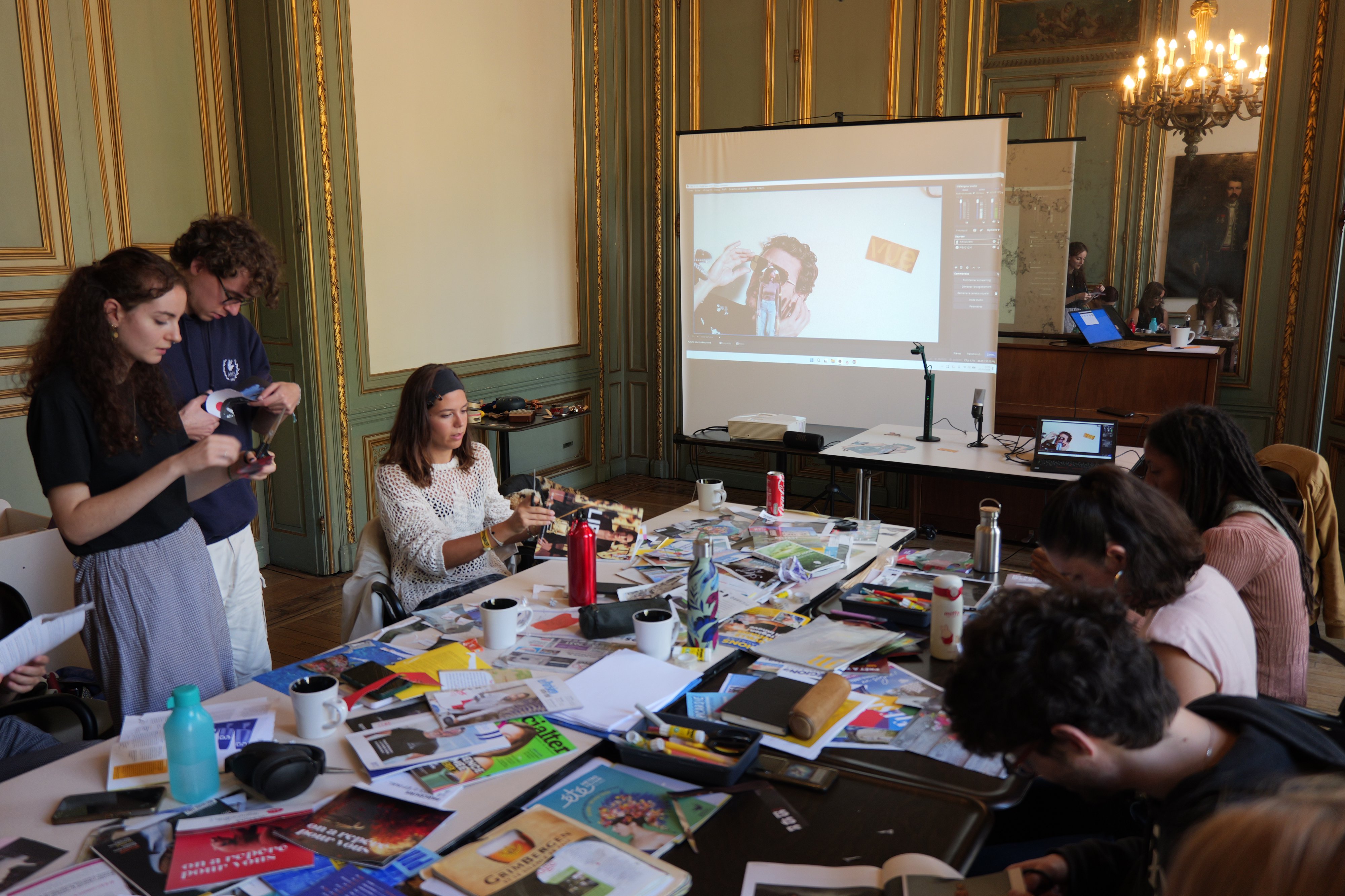
For about ten years, I have worked every autumn with the students of the Master’s programme in Exhibition Design and Museography in Arras, at the invitation of Serge Chaumier and Isabelle Roussel-Gillet, who run it. The first-year students have just arrived, they do not yet know one another, and we spend two days in a museum in the region making films. This year it was at the MUba Eugène Leroy in Tourcoing, with eleven students. I would like to recount these two days here, but above all to explain why I give them this form, and what place they hold in a Master’s programme whose teaching has long been a teaching grounded in reality.
A Master’s programme with no fictional projects
The Master’s programme in Exhibition Design and Museography at the Université d’Artois welcomed its first cohort in September 2011. It trains people for the professions of exhibition-making and museography, in the broad sense, in museums and beyond: designing and managing an exhibition project, writing a museographic brief, knowing the requirements of conservation, working with contractors and partners, and developing mediation tools, especially with audiences far removed from what culture has to offer. In recent years it has made room for eco-responsibility, to the point of putting it in its name: it is now the Master’s programme in Eco-responsible Exhibition Design and Museography. What sets it apart fits into one sentence that its directors have repeated from the start: “No fictional project is carried out in the Master’s programme.” Students work on real commissions from cultural institutions, in supervised projects, in apprenticeships and in workshops, and what they produce (exhibitions, installations, cultural activities) is presented to a real public. The programme has received a teaching innovation label, in 2019 it created an exhibitions festival, which has taken over various venues in Arras, and it relies on the MuséoLab, a university fablab housed at Louvre-Lens Vallée, of which Serge Chaumier is the scientific director.
This way of teaching bears the mark of those who built it. Serge Chaumier, professor of museology, is the author of many books on museums and mediation, including La Médiation culturelle, with François Mairesse (2013), and Altermuséologie. Manifeste expologique sur les tendances et le devenir de l’exposition (2018); one finds in his books, as in his way of teaching, the conviction that the exhibition is a living form, to be invented with audiences rather than designed for them. Isabelle Roussel-Gillet, university professor, doctor of literature and exhibition curator, had devoted a book to project-based learning as early as 2002, co-written with Sylvie Scoyez-Van Poppel, Vivre, accompagner un projet. Du questionnement à l’expérience et de l’expérience à la compétence (Living and guiding a project: from questioning to experience and from experience to competence), whose title already sums up the approach of the Master’s programme. Together they edited Pratiques de commissariat d’exposition. Récits d’expériences pour une réflexion incarnée (2017) and compiled the anthology Le Goût des musées (2020). In 2020 I made a presentation film for the Master’s programme, and when I introduced it I was already writing what I still believe, that this programme rests on active teaching and creativity, so that each person gains autonomy, in their work as in their life.
Making films and helping others make films
Serge Chaumier and Isabelle Roussel-Gillet built video-making into the programme from the outset, and not as one technical skill among others. They had spotted the Musées (em)portables festival, which invites museum visitors to make a three-minute film with their phone about their experience of the visit, and they had made it a highlight of the year. The students presented their films there, and until two years ago they also ran workshops in schools and retirement homes, to help other people make films of their own. In this programme, then, both ends of the chain have always been held together, creation and the mediation of creation. That is how I arrived, about ten years ago, to teach video, and in what I offer I still hold the two together, making films and helping others make films.
The start-of-year workshop is the first stage of a three-part course. Two days in a museum, at the beginning of the year, to create. Then the students shoot their festival films without me. Then I come back for one day, to work with the group on these films, and to take up what they will need later: the short mediation videos that museums produce more and more, some technical knowledge about the equipment, filmed ethnographic collection, which we carried out last year at the LAAC in Dunkirk on the carnival, and video mapping, which they will discover then. The first two days, for their part, are not a video course.
People who do not yet know one another
When the first-year students arrive at the workshop, they have known one another for a few days, they do not know me, and most of them have never made a film. During the round of introductions on the first morning, I was struck to see that a good part of the group was wondering how to welcome people who are not used to coming to the museum, how to open the place to people who do not feel expected there. That became the theme of our two days. And for me there was a twofold aim: that eleven people should become a group able to create together, and that each of them should discover that they are able to create, in two days, without anyone having to tell them so.
Everything I put in place serves that purpose alone. The point is not to pass on techniques, which will come on the third day, but to build a framework that gives permission. I arrive with equipment: a small compact camera passed from hand to hand without ever being stopped, a visualiser that films a table, microphones, musical instruments, crates of magazines and catalogues to cut up, scissors, felt-tip pens. I arrive before the students and spend time arranging the tables of the museum’s reception room, between the wood panelling and under the chandeliers, so that people walk into a prepared space. And I give instructions that always concern the framework, never the content: a short time, a formal constraint, a single shot, and, within that, complete freedom.
Day one: a photograph, then eleven objects that speak
The first proposal, on the first morning, is the simplest. In teams of three, visit the museum for a quarter of an hour, and take a single photograph on the theme of openness, with one constraint: a hand must appear in the picture. Visit first, decide afterwards: I ask people not to look in the museum for what they already have in their heads, and to stop where a spot holds their attention. The four photographs brought back each started from a detail of the MUba that nobody had known twenty minutes earlier, such as a door left ajar or a thick impasto of paint. We looked at them together, with all the lights off, with one rule: the authors stay silent, and the others say what they see in them. This reversal, in which one discovers that one’s image says things one did not put into it, is the first moment when the group takes shape, because each person is looked at attentively by the others.
In the afternoon we shot a collective film. Each person chose, in one of the museum’s rooms, an object, a work, an architectural feature, and lent it their voice; the camera passed from hand to hand, with no editing, and the film was finished when it stopped. A chair complained that people walk on it, Ghislaine, the air vent, said she was afraid of being forgotten, an empty frame had the last word. The film is called Access, a title found in a minute by one student; we shot it twice and watched it ten minutes later. We also showed it, without telling her anything about it, to a person who had seen nothing of the day, to find out whether it stood on its own. Then, in small teams, the students shot short fiction films in a single shot, whose characters do not speak but whose thoughts we hear in voice-over, on the theme of the day. These films were online that same evening, in a shared space opened from the first photograph onwards, where everyone could download and show them. The museum’s director came at the end of the day to talk about her institution, a museum on a human scale, about what can be invented there, and about the place held in it by the invisible work of the teams; that meeting fed into the next day’s films.
Day two: paper, a camera, a microphone
On the second day I set up in the reception room the cut-paper animation set-up I have been using for more than ten years in museums, community centres and drop-in centres. There is a large table covered with magazines, catalogues and scissors, in one corner the visualiser, whose image is projected live onto the screen, with a microphone, and in another the instruments. People cut without knowing what they are going to make, and it is the paper that gives them ideas. Three films came out of that day, a tale in which a grey planet gets its colours back, a museum visit that gradually transforms a visitor, a series of encounters between characters found in the pages of the magazines; the voices, recorded very close to the microphone, had an intimacy that the students noticed at the screening, without my having to point it out. We spent the end of the afternoon preparing their films for the festival, with the few notions of audiovisual language they would need: the difference between surprise and suspense, sound before image, and the title and credits as a reading contract.
None of this required knowing how to film. Each proposal was simple enough for everyone to have a go without wondering whether they were capable of it, and open enough for those who wanted to go further to do so. In two days, the group produced four photographs, a collective film in two takes, four fiction films and three animated films, all signed and put online. Above all, though, eleven people who did not know one another agreed to look ridiculous in front of the others by lending their voices to a chair or an air vent, played, cut out, watched together what they had made, and left knowing that they could create. That is what I mean by a framework that gives permission.
Before the first commissions
I believe this workshop belongs at the beginning of the year because, in a programme where no fictional project is carried out, students very quickly have to act as professionals facing real institutions and a real public. That requires autonomy, confidence in one’s own abilities, and an aptitude for inventing in contact with a place and with people, rather than applying what one has learned. The two days of creation give a foretaste of this, on a small scale and with no obligation to produce results. People learn there that ideas are found in a place rather than in one’s head, that a group can think without deliberating, that a constraint frees, that what one makes is addressed to people who are not there, and that one can expose oneself in front of others without being judged. These are lessons in mediation as much as in creation, and that is why video, in this programme, has never been a separate subject.
From these two days I drew a series of methodological articles, published in the audiovisual cultural animation tools section of this site: Don’t look in the place for what’s already in your head, Going all the way, Layer upon layer, It’s not a private joke, Ghislaine, the air vent, A good pretext, Voice first, Putting Yourself on the Line, Writing “The End”, Setting the table and Keeping the Trace. None of them is only about Tourcoing; in each one, I start from what happened there to describe a way of working that I have used for a long time, with all kinds of audiences.


