Training on how to teach about violent images.
East Image, Regional Centre for Arts Education and Training in Cinema and Audiovisual, organized on November 9, 2016, with the support of the Conseil régional and the DRAC d’Alsace Champagne-Ardenne Lorraine, a training day on the theme “Appreciating images that make violence happen”. This day was intended for all those involved in cultural action, transmission, arts education and image training (teachers, animators, educators, trainers, socio-cultural mediators, librarians, etc.).
How to teach on a taboo and yet essential subject?
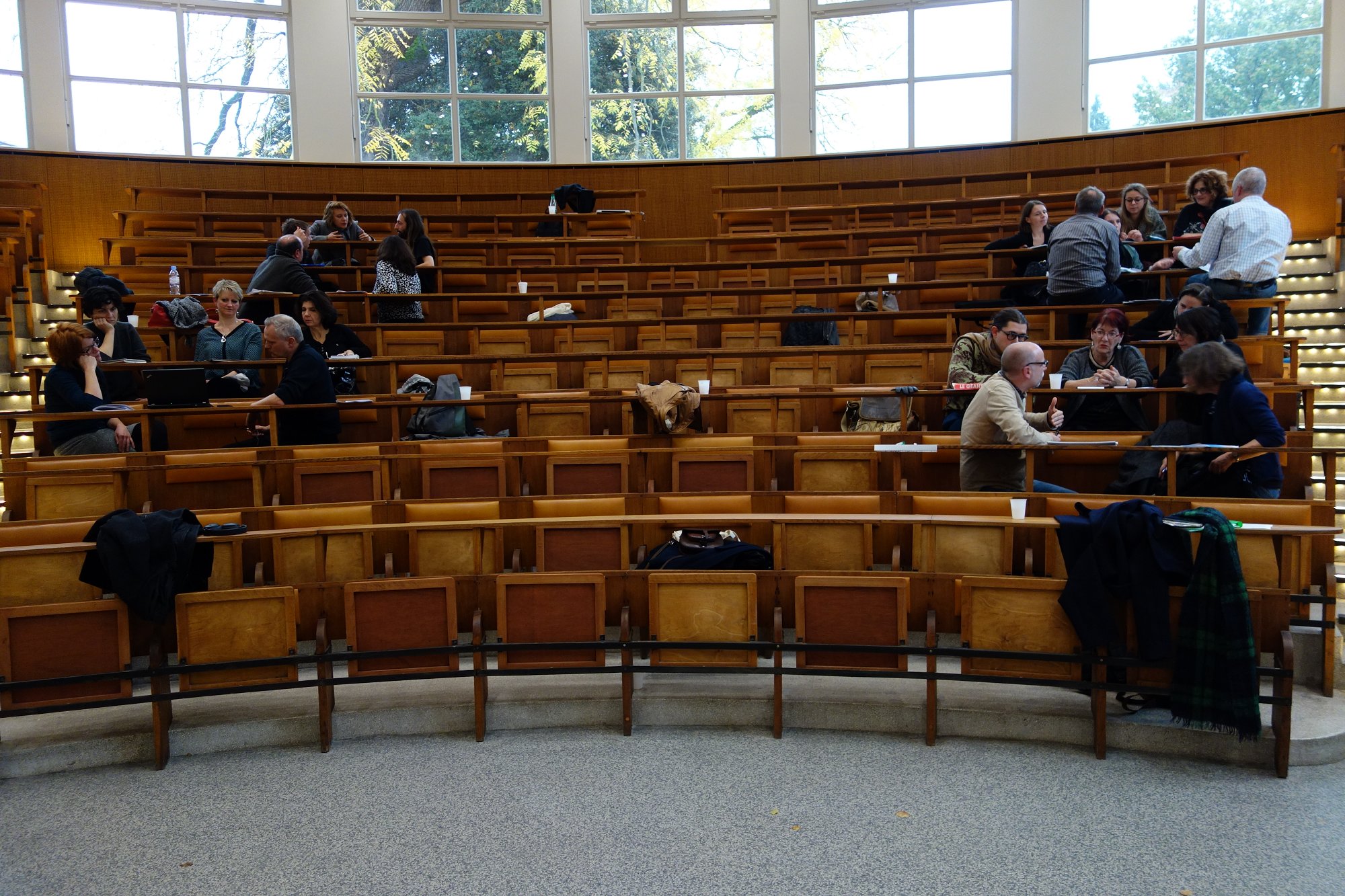
In this context, I facilitated an afternoon of practical workshop so that the participants could design their own image-education tools adapted to the subject of violent images / violent images.
These images are in fact linked to a taboo, that of violence. It is particularly difficult to work on it with students, precisely because of this taboo. Since, in the context of education, which aims at citizenship, violence must not be advocated, it is also very difficult to show this type of image. It’s a real ethical question (and the reaction of parents...). But if we do nothing out of fear, we do not fulfil our educational mission.
So how do we approach a forbidden and yet crucial subject? Because these images are at the centre of many of the essential issues for young people (self-representation, violent radicalization, etc.). Being normative and giving moralizing discourse has no effect, as we know.
It is therefore necessary to build appropriate and unique pedagogical tools to help young people progress towards a finer awareness of the power of manipulation and intimate nuisance, so particular to these images. But how?
Seize
A first approach is to question the nuance of violent images / images that make violence. A decapitation is a violent image. The image of a naked girl circulating in a college is an image that makes violence.
It seemed to me that in order for this day to be truly constructive for the participants, everyone had to risk for these taboo images. To put this risk-taking into practice as part of the training in order to be better prepared to take it with students.
So I proposed a workshop in small groups. Each group had to invent, design and then present to the others an educational tool to work with young people on the subject of violent images.
The workshop was conducted in three stages
- First of all, I suggested to everyone that they write on a piece of paper ten words evoked by the word “violence”. Looking at these associations of ideas collectively, one can already see how diverse the representations are.


- Then, in small groups, design a pedagogical action on the question of violent images. Some groups had difficulty getting started, finding the topic too difficult to address. This difficulty was the very object of the training: it is a question of making the participants make a journey, so that everyone works to overcome their fears, and dares to approach the subject. Seek and find by oneself ideas and solutions.
 >
> - And finally, each group publicly presented their project to the others. I was taking live on-screen notes in a mindmap, here. Download proposals in PDF.


