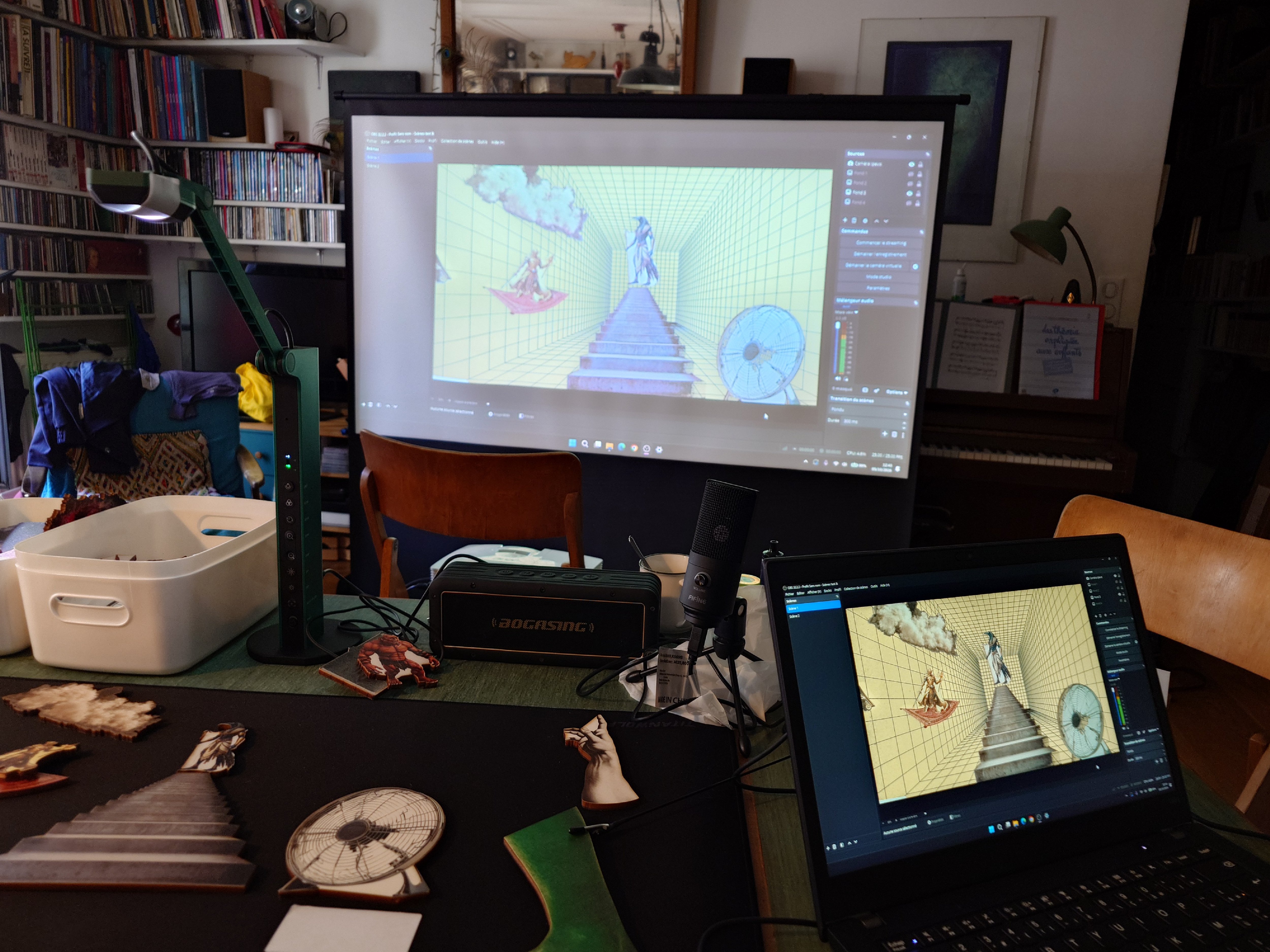
So that the mediation team can run the filmmaking workshop of Le Voyage de Kristoffer on its own, I built the day of 5 October in three stages: the team handling the final equipment itself, role-played sessions in which I took the part of a pupil, then a 48-page methodological guide written from the recording of the day. I then reread the day with a text by the researcher Pierre Pastré, “Apprendre à faire” (Learning to do), published in 2006 in a collective volume from PUF.
A workshop designed by two, run by others
Since June 2025, I have been designing with Émilie-Anna Maillet the filmmaking workshop of the immersive journey that accompanies her play Le Voyage de Kristoffer, based on Kant by Jon Fosse. In this journey, classes of children aged 7 to 12 go through a bedroom in virtual reality, a cosmogonic labyrinth in augmented reality, and this workshop, where groups of six to eight children make an animated film in a single take in twenty minutes, by handling objects under a camera placed above a table. I had announced this stage in « Le Voyage de Kristoffer » : the mediation team trains for the creative workshop. The Ex Voto à la Lune company goes on tour in early November at the Théâtre Nouvelle Génération in Lyon, then at Les Gémeaux in Sceaux and at the MC2: Grenoble, and in each venue the company’s mediators will run the workshop without me.
The objectives I had set for the day came from this situation. First, the team had to be able to fix, on its own, a camera that stops responding or an unplugged microphone. Next, to lead a group of children from drawing the objects to the screening, in twenty minutes. There were also choices left to settle with Émilie-Anna (the music, when to find the title, the change of background, etc.). Finally, everything we decided had to be written down, to be used throughout the tour. There were four of us around the final equipment, Émilie-Anna, Flore and Mélik, who will run the workshop, and myself: the computer, the document camera, the microphone, the projector, the screen, and the two hundred objects printed on wood and cut out, which Émilie-Anna designed with a graphic designer.
Settings made by the team, with their own hands
We spent the morning on the technical side, and I made a point of having every setting made by the team itself, on its own computer, while I guided. You find a setting more easily when you made it with your own hands than when you watched someone else make it, and it is the team who will be alone in front of the computer, one morning, in a theatre they do not know.
First example, the display. The camera image appeared tiny in OBS Studio, the free software we use to record the films, because Windows was enlarging everything to 150%. We brought the scaling back to 100% (right-click on the Desktop, then “Display settings”). We then turned off sleep mode. Mélik had switched the computer on for the first time the day before, and a Windows update was already pending: so we agreed to run the updates the day before each workshop. In OBS, we set the file format (MP4, 1920 × 1080 pixels, 25 frames per second) and arranged the panels along the sides of the window. The children will see this window projected large on the screen, with the “Start recording” button. Mélik sees two moments of the session in it: the “studio” during the shoot, with its buttons, then the final full-screen screening, where everyone becomes a spectator.
The best moment of the morning was the keying. The children film their objects on a black mat; in OBS, the black is made transparent by a filter, and a background of cosmos, matter or light appears behind the objects, which seem to float in space. Flore found the filter setting that we kept. While handling the camera, Mélik discovered that once this filter is set, there is no need to touch the computer any more: from one room to another, you just adjust the brightness on the camera until the black is truly black. We made it the rule of the workshop. In training, I try to bring about this kind of discovery, because we remember well a rule we found ourselves.
We also had two real incidents. During a test, the microphone disconnected, and the sequence was recorded without sound. While looking for the microphone, I unplugged the camera by mistake, and it disappeared from OBS. To get it back, you open the camera source, choose another device (the computer’s webcam), confirm, then go back to the IPEVO camera. For the microphone, you select it again in the list, instead of “Default”. We fixed these breakdowns together, on a day with no pupils, and each now has its own line in the troubleshooting table of the guide.
By the end of the morning, Flore and Mélik knew how to record a sequence, file it, and screen a class’s sequences one after the other. For filing, I suggested naming each folder by the date in reverse order, year first (26-10-05 Tests, for example). Flore and Mélik found this order confusing. I explained that the computer sorts names alphabetically: with the year first, that order also becomes the chronological order, and the tour runs over 2026 and 2027. “Like the Americans,” Mélik summed up. To screen, you drag the four files into a VLC playlist and watch them one after the other, with no editing at all.
During the morning, Mélik noticed that I took the time to explain everything “step by step, without making fun”, and Émilie-Anna added that there was “no condescension”. I do it on purpose, for a practical reason. Flore told us in the afternoon that she found “nothing obvious”, and that she was taking notes for that reason. A person afraid of looking ignorant soon stops asking questions. And on tour, the team will be alone, with nobody there to answer them. So I thank people for every question (“thank you for your question, it’s important”, I replied about opening the video files). I give the reason for every rule, and I repeat a manipulation as many times as needed. About the order of the dates, Émilie-Anna put it in her own way: “Now that you understand the reason, I think it’s much easier.” This attentiveness is prepared and worked on, like the rest of the job. I described how it works in Trust as a Technical Act.
Silence, rolling, and a hand signal
During our first test shoot, we said “Attention, rolling. Action!” before starting the recording. I then explained the protocol I use in my workshops, and I give it to you as is. You say “Silence”. You say “Rolling” while clicking “Start recording”. You wait two or three seconds. You give the start with a hand signal, without speaking, because the word “Action” would be heard in the film. At the end, you wait a few more seconds before stopping. Thanks to these seconds of margin, you keep the children’s first gesture, and you can make a fade when assembling the film.
Mélik was planning to shoot the four groups of a class “in one shot”, in a single file, pausing the recording between two groups. I suggested one file per group. Why? With a single file, a group that misses its take, or a wrong move on the pause button, means redoing everything, and the first group will not come back to shoot. With one file per group, only the failed sequence has to be redone. The team adopted this rule.
Three role-played sessions, with one extra pupil
In the afternoon, we played three shooting sessions. Mélik led the first and the third, Flore the second, and the other one played the pupil with me. We followed the sequence planned for the classes: reading the rules, drawing objects blindly, a few minutes to imagine, rehearsal, shooting. After each take, we watched the film on the big screen, then talked about it. During the welcome of the first session, I asked Mélik to go “four times faster”: in a real session, other groups are waiting while you explain.
The first session dealt with the first chapter of the story, the origin of the world. Music accompanied the take, and Mélik adjusted its volume while we played. Our sequence lasted a minute and a half, and the session ten minutes. Émilie-Anna pointed out a “soft belly” in the middle of the sequence. She suggested building each sequence in three stages (a starting state, what happens, an end state) and having the group repeat them before shooting. I had been reserved about the music earlier in the day, because I am wary of anything added to the set-up. After the take, I found it “stabilising”, and I told the group so.
In the second session, Flore was leading, and Mélik and I played the second chapter, the arrival of a transforming agent. Our starting point was the last image of the previous group, a staircase. In our story, Chewbacca climbed the staircase, then a ladder, and turned into a rocket. Before shooting, Flore had us summarise our plan. During the take, she showed us the stages with her fingers, without a word. Mélik said afterwards never having looked at them, and Émilie-Anna remarked that you feel the signal without seeing it. The sequence lasted a minute. I then said that I had felt “quite well taken care of”, and Flore summed up the lesson: “you have to frame, frame, frame”.
The third session, led by Mélik, combined the transformation and the resolution. Mélik warned us that the background would change during the take. We had set in OBS a two-to-three-second crossfade between two background images, and Mélik brought in the second one in the middle of the sequence. We ended on a bed, where all the characters were going to “sleep for eternity”. The group found its title: Le sommeil (Sleep).
I played the pupil in all three sessions, and I sometimes stepped out of the role to speak as a trainer. During the welcome of the first session, Mélik wanted to keep the surprise and not tell the pupils what the objects would be used for. I paused the session for a moment. The pupils draw their objects while Mélik sets up the virtual reality headsets of another group, which takes five minutes. Yet, as I said that day, “choosing 15 objects doesn’t take 5 minutes, it takes a minute and a half”, and a group that does not know what to do with its objects spends the rest of the time fidgeting. So you have to give the goal from the start: “you’re going to take objects and you’re going to start thinking about a film on the origin of the world”. At the end of the day, I talked about roles. In a group of six children, each one must have a task, even a modest one: making the sound of the wind with their mouth, preparing the objects and handing them to the others, etc. I have often seen it with SEGPA classes (adapted general and vocational education): a child who is given a useful task, matched to their level, is happy to do it. And as I told the team that evening, “the devil is boredom”.
What Pierre Pastré calls learning to do
Pierre Pastré, one of the founders of professional didactics, studied how adults learn in and through their work. In “Apprendre à faire” (in Étienne Bourgeois and Gaëtane Chapelle, eds., Apprendre et faire apprendre, PUF, 2006), he distinguishes productive activity, through which we transform reality, from constructive activity, through which we transform ourselves by acting. He explains that learning by doing benefits from being completed by an analysis, after the fact, of one’s own activity (a debriefing). He also suggests drawing problem situations from real work, and having people live them through simulation.
Our three role-played sessions were simulations of this kind, and our discussions in front of the screen, after each take, were debriefings. Pastré also notes that experienced professionals often become laconic. Their knowledge serves to guide action (he speaks of an operative form), and they apply it without stating it. The knowledge we write and teach belongs to another form, which he calls the predicative form. The “Silence, rolling” protocol is an example. I have been using it for years, and I explained it on 5 October because we had said “Action!” before starting the recording.
A 48-page guide for the tour
Émilie-Anna had prepared in the company’s Drive two sections to be filled in that day, “Installation tech atelier” (workshop technical set-up) for the venues’ technicians and “Tips tournage atelier” (workshop shooting tips) for the mediation team. At the end of the day, I offered Flore to paste all the screenshots into a Word document, with little headings. In the end I turned it into a 48-page methodological guide, in 17 parts, which takes up these two uses. To write it, I used the transcript of the day (more than 85,000 words), 31 screenshots, 11 photographs, the company’s two project files and a table by Guillaume Duprat on traditional cosmologies.
It contains, for example, the four values of the keying filter set by Flore (the last one is 0.0502), the plan of the shooting table, the “Silence, rolling” protocol, the file naming, three ways of assembling a film (with Shutter Encoder, LosslessCut or CapCut), the course of a session and a seventeen-line troubleshooting table. We will reread this guide together after the first classes, at the Théâtre Nouvelle Génération in Lyon, in November.
What the agency offers: Training professionals.


