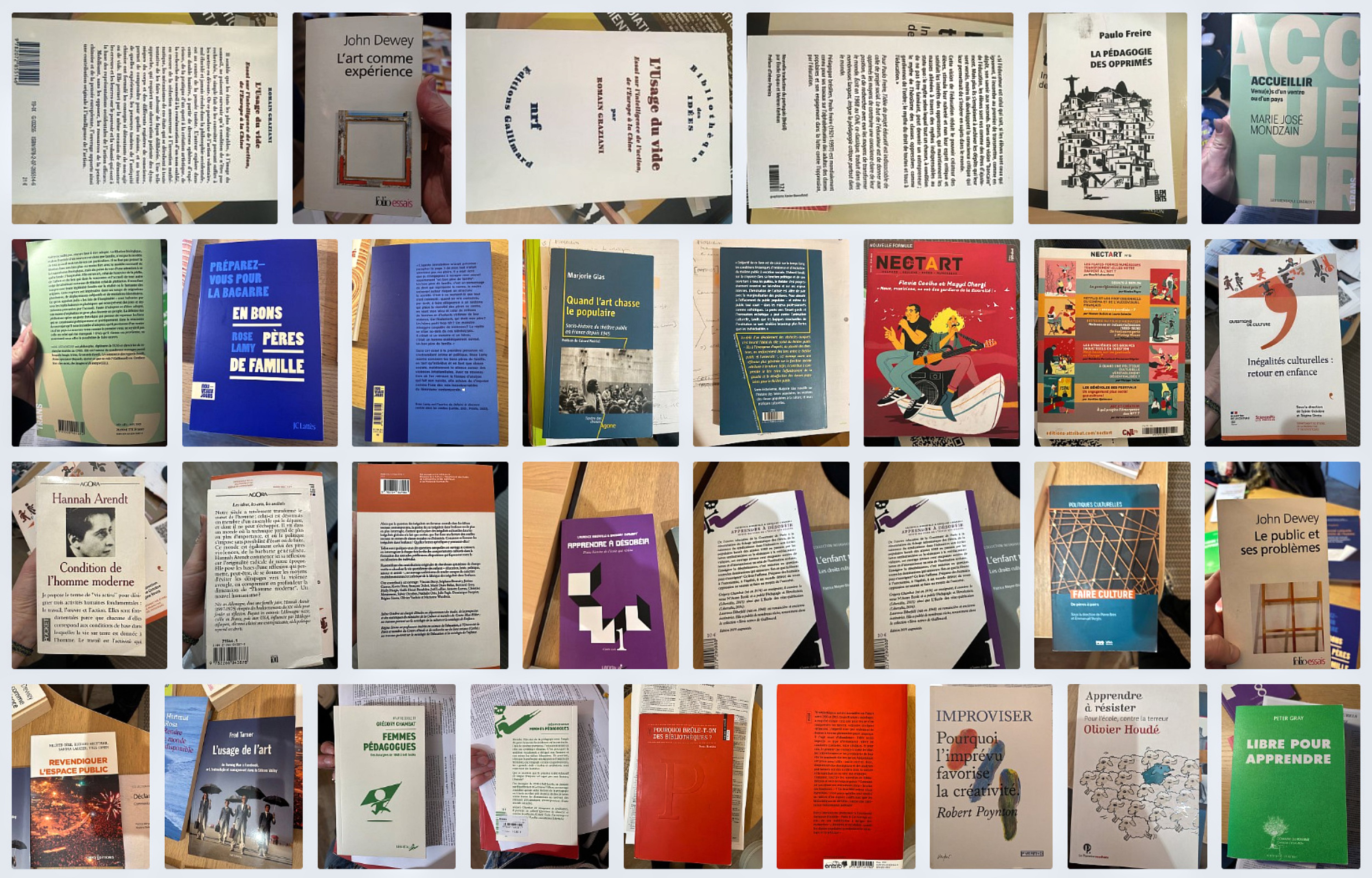
Training people in cultural rights means transmitting knowledge to people while affirming, at the same time, that their culture and their knowledge are legitimate. The way one facilitates (the layout of the room, the instructions, the room left for people’s voices, the programme one is willing to let go of) therefore matters as much as the content. I show this through a one-day awareness session that I facilitated for the team of a performing arts production office.
The paradox of transmission
The expression “training people in cultural rights” has something paradoxical about it. To train, etymologically, is to give form, to shape. It is a gesture that goes from those who know towards those who do not yet know. Yet cultural rights start from the opposite idea: every person carries a legitimate culture, knowledge does not descend from above, and richness is born from the encounter between different cultures, not from imposing one culture on others.
How can we transmit cultural rights without betraying them? How can we transmit (since there are indeed legal, philosophical, and historical bodies of knowledge to share) while respecting the cultural rights of those we are addressing?
This question arises in practice, at every moment of facilitating a working day: in the arrangement of the space, in the way instructions are given, in the choice of what we show, in the room given to each person’s voice, and above all in the ability to abandon one’s own programme when the group needs something else. The pedagogical methods we use are the first message we send to people. Before we have even uttered the words “cultural rights,” we are either putting them into practice or contradicting them.
I recently had the opportunity to facilitate a day of awareness-raising on cultural rights for the team of a performing arts production office. The team was made up of seven people, most of whom were discovering the subject, and we had a single day. In recounting it, I would like to share a few principles of method which, I believe, hold beyond this particular day, for any transmission of cultural rights.
Staging the space before saying a word
I arrived early. The day was taking place in the organisation’s own premises, that is, in an everyday workspace. We work differently in a familiar place than in a neutral one. So I began by staging the space, transforming it enough for people to feel, on arriving, that something unusual was about to happen, while still being at home.
On the table, I had laid out about a hundred books. Not only works on cultural rights in the strict sense, but a deliberately eclectic collection: American pragmatist philosophy with John Dewey, progressive pedagogy with Célestin Freinet, anthropology, contemporary sociology, non-violent communication, feminist works, essays by Hartmut Rosa, Ivan Illich, Hannah Arendt, Romain Graziani, and others. Journals, articles.
On arrival, before they had even sat down, I asked them to choose two books, leaf through them, and photograph whatever interested them: the cover, an excerpt, the back cover…
I chose this entry through books because in this way, without needing to state it, one makes it clear from the outset that each person will build their own path. There is no required route, no book one “should” read. Each person’s autonomy in their relationship to knowledge is recognised from the first minutes. Choosing a book is an intimate gesture: it says something about our curiosities, our intuitions, about what attracts us without our always knowing why. It is already an exercise of cultural rights.
Through the diversity of the books, I also wanted to make it clear that cultural rights are not a closed subject, a sealed body of work. They draw on philosophy, pedagogy, sociology, feminist thought, reflections on digital technology, and more. This crossing of disciplines is part of the subject itself. Showing it from the very first gesture, rather than explaining it in a speech, makes it tangible: participants discover it by leafing through very different books, without having their ideas formatted for them.
Identifying communities before theorising them
Communities are much discussed in cultural rights. The Fribourg Declaration devotes one of its articles to them (article 4, “reference to cultural communities”). But the word often remains abstract, even alarming for those who associate it with communitarianism. Rather than starting with a definition, I preferred to let people experience community directly.
The “sit-stand” exercise is disarmingly simple: you ask about ten questions, if the answer is yes you stand up, if not you stay seated. Who came by bicycle? Who likes coffee? Who is discovering cultural rights? Who is wearing second-hand clothing? Who has an artistic practice, professional or amateur?
It goes quickly, it makes people laugh, and communities appear. The community of coffee lovers. The community of those who have an artistic practice. The community of those who spend too much time on administrative paperwork. We discover that we share unexpected things, and that communities reconfigure with each question. This is a concrete enactment of what cultural rights mean by “community”: a multitude of shifting, interwoven affiliations, and not the identity enclosure that the word makes people fear.
In ten questions and three minutes, we have had a felt experience of something that would have required lengthy theoretical development to explain. And above all, we have learned things about each other. We now know that one person has already been trained in cultural rights, that another changed careers, that only a third of the group has an artistic practice. This information served me for the whole of the rest of the day.
Restating and drawing what one has just heard
After a more conventional phase of transmission (an introduction to the meaning of cultural rights, their history, the distinction between cultural democratisation and cultural democracy), it remains to allow each person to appropriate what has just been said. We know from neuroscience that learning requires the creation of new connections in the brain, and Olivier Houdé has shown, with “cognitive resistance,” that it also requires inhibiting one’s automatic responses. For this to occur, two conditions are necessary: that the person feels safe, and that they are in an active position.
So I put people in pairs, standing, walking around the room, and asked them to explain to the other person what cultural rights are and why they matter. One speaks and the other listens, with no discussion or debate, then they switch roles.
It is by explaining something to someone that we shape our own thinking. By saying it out loud, we put in order what was still hazy, we identify what we have understood and what remains unclear. The exercise works regardless of group size (you can do it with a hundred people) and it guarantees that everyone will have spoken, including the most reserved, who in a classic round-table might never have expressed themselves.
In the same spirit, I then invited each person to make, with felt-tip pens and coloured paper, a drawing, a diagram, or a short text summing up what they had understood of cultural rights. This is not a school exercise: you can draw a smiling face, a diagram with arrows, or write a single word. All of these productions, uploaded to a shared folder and viewed together on a screen, show in many voices what the group has understood, and each person sees that their contribution, however modest, counts within the whole.
A photograph with a hand in it, and its author who stays silent
I also proposed a creative exercise: not an “artistic” exercise that would require mastering a technique, but a simple, accessible gesture, connected to the subject.
The proposal was as follows: take a photograph, with your phone, in which a hand is visible, and which says something about cultural rights. People could go out into the street or use whatever they found in the offices. Then we put the photos in a shared folder and looked at them together, projected large in the darkened room.
For the feedback, I gave an unusual instruction: the person who took the photo is not allowed to speak. It is the others who reflect back what they received, felt, and interpreted.
In a conventional setup, the author explains their intention, and the “audience” listens. Here, it is the opposite: the gaze of others enriches the work, charges it with meanings the author had not necessarily envisaged. Several things then happen.
First, we observe that each image elicits very different interpretations. There is no single meaning, no “correct reading.” Here we have a concrete experience of the diversity of cultures: we do not see the same thing, and all these visions are legitimate.
Next, the person who created the image receives something unexpected. They took their photo quickly, they are not necessarily proud of it, they may find it unremarkable. And others see depth and beauty in it. This experience touches on what psychoanalysis calls symbolisation: something I place outside myself comes back to me enriched by the gaze of others, and participates in my construction. This is not a matter of “valorising” (which presupposes a hierarchy between the one who valorises and the one who is valorised), but of building oneself through encounter.
Finally, in this way we overturn the quintessential school question: “what did the author mean?” It is often impossible to answer, because the act of creation mobilises intuition as much as intention, and in any case it reduces the work to its conscious project alone. Welcoming the multiplicity of interpretations means recognising that creation exceeds its author, and that the person who receives is not an empty vessel but a person with a culture of their own.
Knowing when to abandon the programme
For this day, I had prepared a detailed, timed programme, with different sequences meant to follow one another. When the afternoon resumed, a conversation developed among the participants, about their trajectories, their doubts, their professional experiences, the connections they were making between cultural rights and their work. The conversation went far, people were speaking about themselves, and it did not correspond at all to the planned programme.
I could have “refocused,” recentred, brought the group “back on track.” This is what many facilitators do, out of concern for honouring the contract, for “holding” the programme. But cultural rights precisely presuppose that people can take their place, and that this place sometimes transforms the very framework of the encounter.
What people were saying to each other went beyond the programme, and brought it to life. They were making connections between cultural rights and their intimate experiences: their relationship to a performance that had marked them, the feeling of not being allowed into certain places, the evolution of their own criteria of judgement. They were discovering one another in a way that rarely happens in a work setting. Letting this conversation unfold meant recognising that this discussion served the objective (that each person find their own path with cultural rights) better than the sequence I had planned.
I then said so to the group: what happened this afternoon was not planned, but that is what cultural rights in action look like. You took your place, and the day was transformed by it. To modify the programme in this way without worry, and to sense that what is happening matters more than what was planned, the facilitator must trust the group, trust the subject, and trust the idea that transmitting cannot be reduced to transferring content.
Setting a framework means authorising
We often believe that a framework is what constrains, what forbids. Ask around: “what is a framework?” and you will hear about limits, rules, what you are not allowed to do. Yet for cultural rights, the framework is what authorises. A well-established framework makes expression, risk-taking, and encounter possible, because it puts people at ease.
In a training day, it is through an accumulation of small gestures that one builds this framework: the staging of the space, the diversity of the books offered, the instructions that recognise each person’s autonomy, the exercises that put everyone in a position to contribute, the feedback that welcomes the diversity of interpretations, and the ability to let go of the programme when the group needs it. Each of these gestures says the same thing: you are legitimate, your culture has value, and we are going to enrich one another.
There is nothing naive or demagogic in this: there are indeed bodies of knowledge to transmit (the history of the Ministry of Culture and its colonial construction, the Fribourg Declaration, the distinction between the eight rights, case-study methods, the resources of Réseau culture 21 or of the Observatoire des politiques culturelles). But this knowledge is only fully absorbed when the manner of transmitting it is itself respectful of people’s cultural rights. Otherwise, people receive information, but do not make it their own.
“There is a coherence between what you say and what you do”
At the end of the day, a member of the team said to me: “There is a coherence between what you say and what you do. Your facilitation methods and tools are in harmony with the subject you are addressing, and that is too rarely the case.”
I do not take this remark as a compliment, but as an observation, and a worrying one: if it is “too rarely the case,” then something is wrong with the way cultural rights are usually transmitted. Perhaps it is because we still too often separate content from form, knowledge from relationship. Perhaps it is because training sessions are still designed according to a top-down model (one person who knows speaking to people who are learning) even though they deal with a subject that contradicts this model.
Cultural rights are not a theoretical body of work that could be poured into heads that would receive it without doing anything; they are a way of being in relationship with people, practised continually. Transmitting them means practising them. Not in order to make a demonstration of it, but because it is the only way to allow each person to grasp them, by making their own path from their own culture.
It is in this sense that cultural rights oblige us: they engage what we do and how we do it, as much as what we say. The same demand applies to a one-day training session, to the programming of a cultural season, to the reception at a performance venue, to the management of a team, to the building of a partnership. Working methods are in no way secondary: it is through them that we respect people’s cultural rights, or contradict them.


