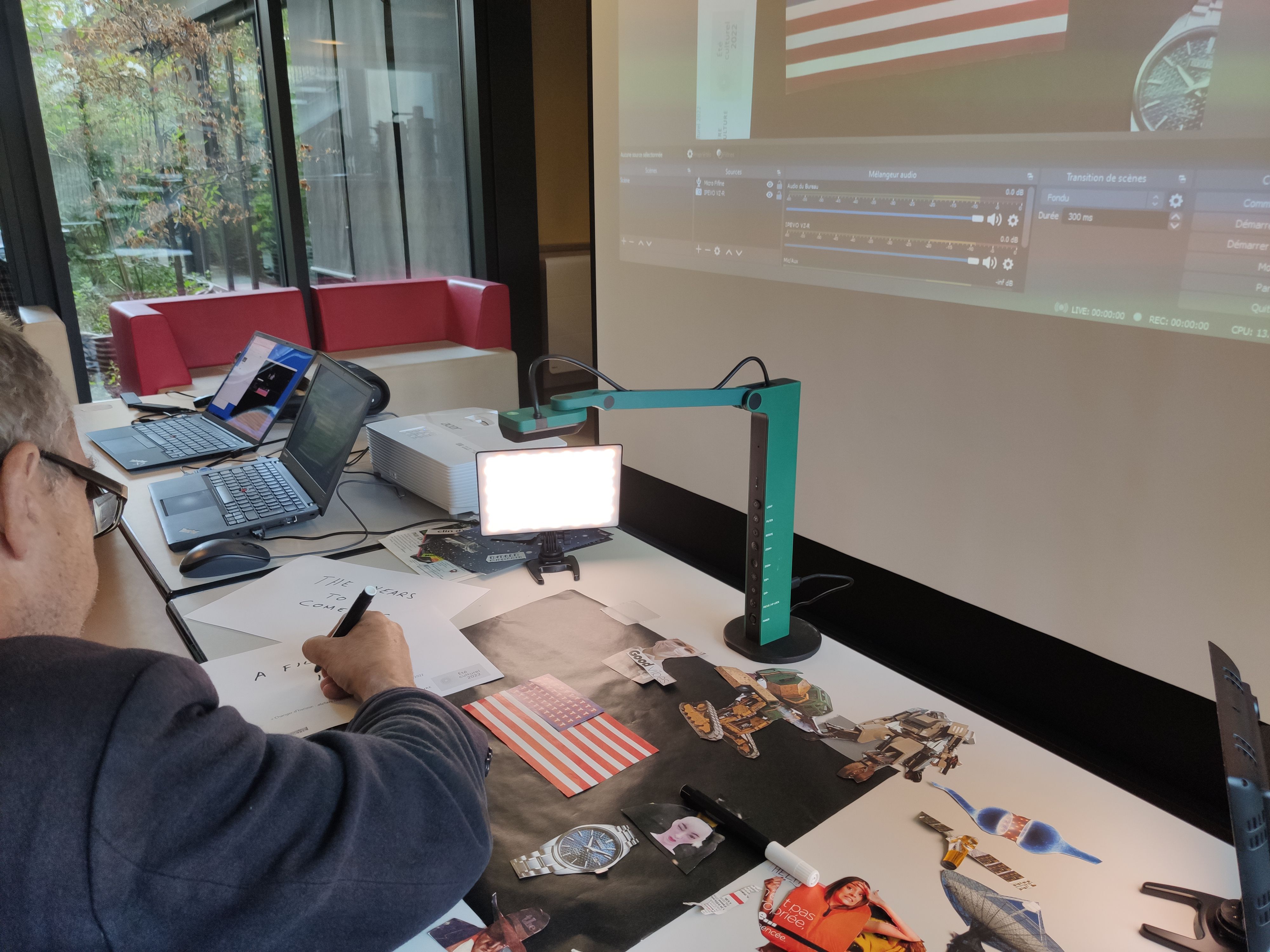
In the field of cultural mediation, long-term projects, with their repeated sessions and their progression accompanied over time, are often held to be the accomplished form of the work, while one-off actions, imposed by budgets or by the difficulty of mobilising people, are seen as its impoverished version. My experience leads me to argue that the single encounter has laws of its own, that the series of sessions has its own as well, and that one same requirement runs through them both: welcoming the people who cannot be there every time.
The long project held up as the ideal, the one-off action as a lack
In the professions of cultural mediation, the assumption goes roughly like this: the ideal would be the long-term project, with repeated sessions and a psychic progression accompanied over time; single or short actions would be, by their very nature, less constructive; and if they are multiplying today, it would be under duress, because budgets are tightening and because people, young people in particular, are less willing to commit to long journeys. Our actions would thereby lose their depth.
Yet a large part of mediation is, in fact, practised in a single occurrence, with people we will never see again, and this situation is almost always experienced as a lack. The practitioner who runs a one-off group finds herself with tools designed for something else, and she almost always concludes that she is doing a degraded version of the real work. It is this assumption that I want to examine, because my experience contradicts it. I have nothing against projects carried out over time, I run many of them. What I contest is the idea that duration would be, by nature, the condition of depth.
The group illusion takes shape as the sessions go by
The assumption of duration has scholarly foundations. The authoritative writers on group phenomena described processes that unfold from session to session. In 1971, Didier Anzieu created the concept of the group illusion (l’illusion groupale ; “L’illusion groupale”, Nouvelle revue de psychanalyse, no. 4, later included in The Group and the Unconscious, 1975): a collective psychic state that the members of the group express more or less as follows, “we feel good together, we make a good group”. Anzieu identified it by analysing his own counter-transference in training groups. This fusional euphoria, in which the group imagines itself to be one, is a moment in the group process, not an instantaneous state, and it has its counterpoint, which Anzieu calls the fantasme de casse, the breakage fantasy, the anxiety that the group will break apart. René Kaës, for his part, described unconscious alliances (Les alliances inconscientes, Dunod, 2009), pacts that bind the members of a group without their knowledge and that are formed in a shared time, with a history, crises, reworkings.
This is not a reproach addressed to them. They were describing the settings in which they worked, and those settings were long-lasting ones. They were also describing real possibilities. The series of sessions makes it possible to accompany a process, to see a person come back to what they have made and take it up differently; it allows slowness, detours, the hollow moments that are often the most fertile; it sometimes allows repair, because repairing takes time. This is what successive workshops specifically bring into play, and it is a great deal.
But I have searched for a literature on single-occurrence groups, and I have found almost nothing. The available categories describe another form than this one. So the laws of the workshop we will only run once have to be formulated by ourselves. I propose three.
Fifteen minutes or four hours, in a drop-in day centre
In 2022, during the “Été culturel”, the cultural summer programme of the French Ministry of Culture, Cultures du cœur entrusted me with a tour of cut-paper animation film workshops, on the theme “Changing horizons”, in nine social-field organisations across France; I gave an account of this tour and of the 77 films made in Cultural summer 2022 with Cultures du cœur : « Changing horizons ». One of these organisations was a drop-in day centre (accueil de jour), one of those places where homeless people come to take a shower and charge their phone. They had not come for a workshop, they had not signed up for anything, they did not know what they were going to find.
In such situations, I take particular care over the scenography. I set up a large table with coloured paper, scissors, felt-tip pens, a phone mounted on a stand above it. I want every person who comes near to feel, from the outset, that they are welcome and under no obligation. It is on this condition that they can, little by little, enter their own path; and accompanying people as they enter their own path is, in my eyes, the very purpose of mediation.
What happens then resembles nothing described in the manuals of group facilitation. People pass by, look, don’t quite understand, sometimes sit down. Some cut out two or three shapes, move them under the camera, and leave after fifteen minutes with a film. Others stay four hours. Families settle in and spend a long time preparing something very elaborate. The same table, on the same day, welcomes fifteen-minute experiences and four-hour experiences, and I have no reason to hold the ones as more valid than the others.
Nobody has built an alliance. Nobody will come back the following week. And yet something has taken place, whose effects I regularly observe, and which the categories forged for long-lasting groups do not allow me to think.
The words we only confide to people we will never see again
The first law I believe I can formulate is that the single occurrence lifts defences instead of thickening them.
A confidence made to someone we will meet again in a week’s time commits us to a sequel: we will have to own it, we will be looked at through what we have said, the relationship will be changed by it. Nothing of the sort in a single encounter. The listening group will dissolve within the hour and will never form again. Because the relationship has no future, we allow ourselves a freedom that duration does not offer. In one-day workshops, I have seen people say and make things of an intensity I have not found in groups followed for months. I see in this less an effect of trust than an effect of risk: saying something to people we will see again carries a higher social cost.
Psychotherapists encountered this phenomenon before we did. In the late 1980s, the psychologist Moshe Talmon, who worked at the Kaiser Permanente medical centre in California, discovered while examining the records of his department that the most frequent length of a psychotherapy there was a single session, and he verified this finding across more than one hundred thousand consultations. Fearing he had disappointed those patients who had never come back, he re-contacted two hundred of them: the great majority replied that this single session had been enough for them and that they were doing better. From this he drew a book, Single Session Therapy (1990), and a method: treating every session as if it might be the only one, without ever forbidding the next. I do not confuse therapy with mediation. But Talmon’s gesture seems to me transposable: instead of regarding the single encounter as an accident of the frame, regarding it as a form in its own right, and designing for it.
A practical consequence follows from this, and it is not a comfortable one. A single-occurrence setting can bring heavy things to the surface very quickly, and it will have no following session to accompany them. This does not mean we should refrain from it. It means we must build, within the session itself, what other settings build in the return of the appointment.
“What is this for?”
The second law is that the question of meaning necessarily arises, and that it belongs to the setting rather than to the people.
In a group that meets every week, the question of usefulness arises at the beginning, then dissolves into habit. We come back because we come back; the appointment proves itself through its repetition. In a one-off group, this proof does not exist, and someone always ends up asking what all this is for.
For a long time I heard this question as resistance, and I now believe I was wrong. The person who asks it is not defending themselves; they are formulating the real problem of the setting: nothing guarantees that it will serve any purpose, since it will have no sequel. They are right. They are telling the truth of the situation, and the fact that they say it is rather the sign that they have understood where they are.
What to do with this question, I do not entirely know. I know that it should not be treated as a symptom, nor answered with a justification. It seems fairer to me to acknowledge it as shared, including by the person facilitating, because it is.
A film finished within the hour, watched together straight away
The third law is that the object each person takes away replaces, in my practice, the promise of meeting again.
A group that lasts holds together through that promise. It contains, in the sense psychoanalysis gives to this word; it makes it possible to leave things in suspension without having to say everything today. A one-off group does not have it. In its place, there is the film the person has made, the picture they have taken, the file they have on their phone. This object does not prolong the relationship, it is not a bond with me, and that is precisely why it works: it exists independently of us and will go on existing when I am no longer there. At the end of my workshops, I put the productions online and hand out a QR code. People sometimes ask me how long they will have access to it. I answer that I set no end to it. What was made there does not expire with the relationship that made it possible.
From these three laws follows a constraint of the setting that seems to me absolute: the sharing of the work must take place within the very time of the workshop. In a long project, one can make for weeks and show at the end; the editing happens between sessions, a professional takes care of it, the screening is a separate event. None of this is possible in a single occurrence, and this impossibility led me, long ago, to work in single takes, with no editing afterwards. This constraint, which I first endured, has become a principle. The film is finished when the people have finished making it. Nobody improves it afterwards. We watch it together, straight away, in the state it is in. The ratio of time between making and reception is inverted compared with the customs of cinema, where one spends months making a film that will be watched in an hour; here one makes a film in an hour and watches it in two minutes, several times, together. The collective gaze on what has just been made becomes the heart of the session, and not its epilogue.
A theatre company I work with uses, incidentally, the same technical setting, a fixed shot, cut paper, a phone, for very short workshops and for projects carried out over several weeks in the classroom. What changes is the preparation time, and therefore the elaboration of the film. These are not two qualities of work; they are two different kinds of work, with different laws, and each demands to be thought for what it is.
At the mission locale in Elbeuf, people came when they could
Between the one-off workshop and the followed project, there is a third situation, perhaps the most common: the regular project in which people cannot take part regularly. People have their lives, their problems, their impediments. Our workshop adds itself to their life; we cannot set up its logic as an injunction, nor make attendance a condition of access.
At the mission locale in Elbeuf, a youth support agency, I ran a weekly digital workshop for young people who were paid as part of their support programme; I described this project in Involving young people in summer cultural projects. At each session, each person set themselves a personal goal, a video CV, a logo, a piece of music, a website, and my role was to make sure this goal led to something, even partial. The young people came, or not. But every session left digital traces: each person had their own online folder, added to week after week. Those who had not been there for the first sessions could catch up, and so could those who had missed some. Every week, I had more people.
I find the same necessity in the collective intelligence sessions I facilitate, many of them by videoconference since 2022, backed by a digital contribution platform; I detailed this method in Activating collective intelligence with digital tools. We cannot expect everyone to be there all the time; that is not the reality of people’s lives. It is therefore our responsibility, as facilitators, to produce traces of what has been said and made, delivered as we go, in the present, so that the people who were not there can connect, and those who come back always find themselves welcomed. Digital tools make this possible at little cost, and I see in it one of the contemporary keys to respecting people’s dignity.
The social field has a name for this: unconditional welcome
The social field named this requirement long before me: l’accueil inconditionnel, unconditional welcome. It is a founding principle of the emergency social sector, written into the French Social Action and Family Code, which guarantees to any homeless person in distress access, at any time, to emergency accommodation; in 2012, the French Council of State even made it a fundamental liberty. Welcoming without condition: without any requirement of status, administrative situation or expected behaviour. The day centre where I set up my cut-paper table worked according to this principle: the team of the place received people without asking anything of them, and I did the same at my table, on my small scale.
Transposed into our mediation settings, unconditionality bears in particular on attendance. Welcoming all people in their diversity, with their irregular presences, their late arrivals, their early departures, without making full participation a condition of access to what we offer. The sociologist Anne Gotman, in Le sens de l’hospitalité (The Meaning of Hospitality, PUF, 2001), showed that hospitality, often ranked among the moral virtues, is first of all a social practice. It presupposes owning a place devoted to reception, but it only succeeds if we truly share that place and let ourselves be touched by the person we receive; and its rules do not pre-exist the encounter, they are built within the encounter itself. I recognise my own experience there: I cannot write the frame of a workshop in advance, once and for all; I adjust it to each person who arrives, at the moment they arrive.
Welcoming in this way in no way diminishes the value of what we do. It prevents our work from becoming a parenthesis reserved for those who have the privilege of being able to take part all the time. Our requirement of respect for the dignity of the other is also at stake here, in the possibility, for each person, of taking part from their real life, and not from the ideal life our calendar presupposes.
Clues, not proof
There remains a question I have not resolved, and I would rather ask it than pretend to have resolved it. I do not know what becomes of the effects of a one-off workshop. I see what happens during the workshop, the faces, what is made. I do not know what remains of it a week later, or a year later. In long-lasting settings, one can know; one sees the people again. In mine, no.
I have clues. People who write back to me, teams who tell me that someone kept talking about their film for months. The most recent one was brought to me on 1 July 2026, in Villeurbanne, where I was facilitating for Réseau culture 21 workshops on the power to act in cultural mediation; I had proposed a photographic creation so that the participants could experience this power to act, and I gave an account of these workshops in Why the power to act is so often experienced as a transgression. At the end of the workshop, a participant came to talk to me. Four years earlier, near Marseille, she had spent a day in an intergenerational film-making workshop I was running. She wanted to tell me that this day had been transformative for her: she had learned there a way of trusting others, a shared joy, a space of autonomy, and her way of working had been lastingly changed by it. That day was a one-off action. It is her testimony, it speaks only for her; of the other people present that day, I know nothing, and it is not proof. My hypothesis is that the object taken away plays a part in this persistence, because it is the only material element that travels through time. I cannot establish it.
This uncertainty does not seem to me a reason to give up. It seems to me a reason to keep observing, and to stop measuring each form of workshop with the instruments of another. The one-off workshop has its laws, the followed project has its own, and both stand to gain from being designed to welcome people as they are able to come.


