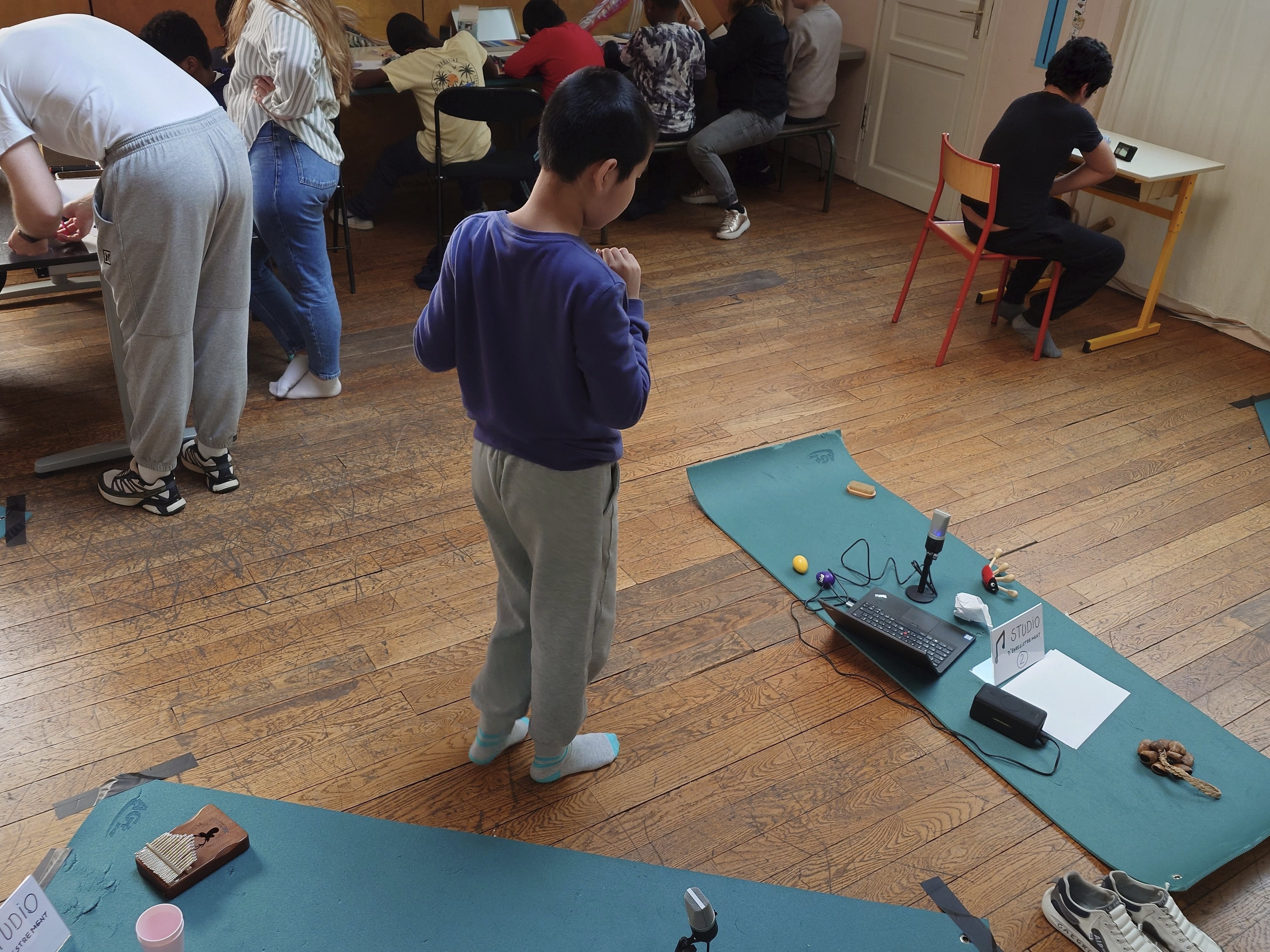
The way the time of a workshop is organised largely determines whether people can get involved in it, and bring their energy and their desire to it. To my mind, it is the facilitator who keeps time, so that participants can abandon themselves to their creativity, then see through what they have started, even if it is not perfect. For a three-hour session, I suggest starting from three sequences of about forty-five minutes, announcing from the outset when the group will come back together, and planning collective breathing spaces. It is a starting point, which I adjust to what I observe, paying even closer attention when people are very fragile, and remaining wary of the time we organise first of all to reassure ourselves.
The time it takes to cook rice
When I prepare a workshop, I ask myself less how many sequences I will run than how people will be able to commit to it: finding the moment when they get going, having enough time to see through what they have started, without it lasting so long that they lose interest. Depending on how time is organised, three hours can go by very fast or seem endless, for participants as well as for the facilitator.
The British historian Edward P. Thompson published in 1967, in the journal Past & Present, a long article, “Time, Work-Discipline, and Industrial Capitalism”, translated into French in 2004 by La Fabrique. In it he distinguishes two ways of counting working time. Before the factory, it was often counted by the task: the day grew longer or shorter according to what there was to do, the harvest, the tide for fishermen, the milking of animals. He reports that in Madagascar, a length of time could be measured by “a rice-cooking”, about half an hour, or by “the frying of a locust”, a moment. With industry came labour measured by the clock, paid by the hour, where time becomes a currency that is spent. Thompson notes that time counted by the task is more humanly comprehensible, and that, for those who have grown used to the other kind, it has a bad reputation:
“To men accustomed to labour timed by the clock, this attitude to labour appears to be wasteful and lacking in urgency.”
Edward P. Thompson, “Time, Work-Discipline, and Industrial Capitalism”, 1967.
It seems to me that a workshop needs both. Clock time makes it possible to announce, to find one’s bearings, to know when we will come back together, and it is this time that I suggest dividing up further on. But what happens for people belongs to task time: the time it takes to get into a proposal, for a drawing to find its shape, for a voice to dare to make itself heard. That time cannot be known in advance. I wrote in Engagement in Time that what matters is not the length of time spent together but the quality of that time, and that we never know when something will “take” for a person, in thirty seconds or after several sessions. The only thing that belongs to us is to work to make that time as good as possible for the people we welcome. The division I describe further on is one way of working at it, and I change it as soon as people need me to.
“Never mind, now let’s finish it”
Keeping time often has a bad name in mediation, as if it were a constraint imposed on people, or a way of controlling the session. I believe it is the opposite, and that it is even one of the reasons the facilitator is there. When we engage people in a creative process, we invite them into a state somewhat different from the ordinary one, in which they get in touch with their creativity, let themselves be guided by their intuitions, and do things they did not know they were capable of. I described this state in The State of Openness. To enter it, you have to be free, and you are not free if you have to keep an eye on the time. So it is the facilitator who keeps time, so that the others can forget it.
Yet creativity can also wander off towards things that never get finished. You start one idea, then another, you start again, you improve, and you can leave a workshop with ten beginnings and nothing completed. This is where the facilitator has a part to play. When a proposal takes longer than planned, I often say: “Never mind, you have made something, now let’s finish it.” As a rule, nobody experiences it as frustration, since we are helping people bring to completion what they have found.
At the day hospital I talk about further on, we often went through the screening room, where we watched together, on the screen, what the children had just made. What they had been searching for became a little film, which could be watched, shown to others and taken away. This is what psychoanalysts call symbolisation: what we have lived through takes on a finished form, outside ourselves. A finished film, however clumsy, allows this. A film left unfinished, on the other hand, remains inside us as something still open.
That is why I keep an eye on my watch throughout the workshop. Looking at my watch does not stress me: it gives me an awareness of the time remaining, and therefore of what is still needed for each person to have seen something through. In March 2026, during a class, it was five o’clock sharp and we still had eight photographs to look at together. I told the group the time and suggested two options: stop and finish the following week, or take another quarter of an hour. Several people had to leave, so we finished the following week, all together, and I kept my comments on method for that moment. Viewing the last photographs had been announced, it took place, and no one lost out.
Conversely, it often happens that the facilitator is carried away by what is going on. They are impressed by what people are doing, they live the situation with them, and that is a beautiful thing. But they then forget that they are there to provide a framework, and they stop looking at the time. The session overruns, and the planned screening does not take place; people leave with an open piece of work that they will not take up again. What had been a very strong moment can become destabilising, and even, in the end, violent for them, because they were brought into a state of creation without being given the time to come out of it with something finished.
Keeping time is therefore in no way castrating. Our role is to open the way to creativity, then to make symbolisation possible, that is, to make sure that everyone sees something through, even if it is not perfect.
Three hours ahead
Many workshops are scheduled over half a day, a morning or an afternoon, roughly three hours. When you are preparing, that length of time seems comfortable. When you arrive in front of the group, it can become dizzying, because you have to hold three hours at a stretch, with people you do not yet know, and a programme you do not know how will be received. The participants, for their part, do not know where we are going or when we will get there.
To begin with, I often suggest dividing this time into three sequences of about forty-five minutes, with a break between each. The first effect is for the facilitator: they no longer have three hours to hold, but forty-five minutes, and in those forty-five minutes there is what they propose, what people make of it, and the way each person positions themselves in it. Then comes the break, and a new sequence, which can be very different from the previous one. Each sequence has its end, and so its moment for finishing.
I experienced this very clearly at the day hospital for autistic children where I ran a video workshop for several months (Letting autistic children make images). For the first session, I had built the schedule in two phases that did not resemble each other. First a disorderly exploration, with all the materials available, music, paper to cut out, where everyone went off in every direction. Then a break, and after the break a focused, collective moment, where each child came in turn to place a character under the camera, before going to sit in the screening room. In this second phase there was no problem of understanding or of discipline, and I had written that “the calm was Olympian”. With the break between the two, the children were able to see the first way of being together through to the end, then enter the second.
Saying when the group will come back together
In most workshops, times when each person works on their own alternate with times when we come back together. It seems essential to me that people know, from the start, when the collective time will come. I say it very concretely: “Write wherever you like, at the table or in a corner of the room, and at eleven o’clock we all meet back here to read.” After that sentence, people do not write in the same way: they know how much time they have, and whom they are writing for. Otherwise, some people rush, and others stay alone with their sheet of paper without daring to ask how much time they have left.
This moment of coming back together may last only ten minutes. It just has to have been announced, and it has to actually take place at eleven o’clock.
The collective intelligence methods I use also rely on this announcement. In the World Café, each group spends about twenty minutes at a table, then moves on, and everyone knows in advance how long a round lasts. Since everyone knows when the round will end, no one looks at their watch, and the groups commit fully to the discussion. It is the facilitator who announces the end of each round, and this is what I was describing earlier: someone keeps track of the time so that the others can forget it.
On your own, you end up going round in circles
With the autistic children at the day hospital, I organised moments of collective breathing space fairly regularly. Working alone is fine, but after a while you go round in circles, and coming back to the group, even briefly, gets something going again. It was often a visit to the screening room, where we all sat down to watch what had just been made. These landmarks came back at every session, always the same ones, and it was because the children were reassured by what came back that I could propose, between two visits, new things.
Fernand Deligny had an experience with autistic children that was very different from mine, but which helps me think about this rhythm. From the late 1960s, in the Cévennes, he lived with autistic children entrusted to him, surrounded by adults who were not care professionals and whom he called “close presences”. The day there was made up of tasks that came back every day, washing up, lighting the fire in the bread oven, feeding the goats and the ducks, and so on, and he called this whole the “customary”. No one asked the children to take part, but they could join in. On the maps the adults drew over ten years, following the children’s paths, and which were published in 2013 under the title Cartes et lignes d’erre, these paths can be seen returning to certain points of the place. What I take from Deligny, for a workshop, is that moments that come back reassure more than a clock does: you know that after the time alone comes the time when we come back together, then the time alone again, and this alternation becomes a landmark, from one sequence to the next and from one session to the next. The customary, incidentally, is time counted by the task in Thompson’s sense: you do the washing-up for as long as it takes to do it.
Twenty-five minutes instead of forty-five
Forty-five minutes is only a starting point. At the first session, you may realise that after twenty-five minutes people are no longer there, and that with three sequences of forty-five minutes you are heading for difficulties. You then have to shorten, add more breaks, change proposals more often. You may also discover the opposite. At the day hospital, during the session when we recorded sounds, it was towards the end of the first half hour that everyone really got going. And in The State of Openness, I noted that a group often needs about fifteen minutes to emerge from the inertia of the start.
You often hear that attention lasts no more than ten or fifteen minutes. In 2016, the physiologist Neil Bradbury looked into where this figure came from, much repeated in higher education, in an editorial in the journal Advances in Physiology Education. He found that first-hand data did not confirm this limit, that the most cited source barely dealt with students’ attention, and that attention varied most from one teacher to another. I conclude from this that there is not, to my mind, any length of attention that could be known in advance: it depends largely on what we propose and how we propose it. That is why I do not fix the length of the sequences once and for all. I observe how people are, and I adjust.
This means accepting that things do not go as planned, which almost always happens. You have prepared three sequences, and the group has taken hold of the first to the point where it would be absurd to interrupt it; or a proposal falls flat after ten minutes. I can then extend the sequence, but it is a decision I make, with an eye on my watch, keeping the time it will take to finish what has been started. I wrote in When the instruction is not followed that departures from the instruction are contributions rather than mistakes, and the same goes for time. The division helps me hold the session, but if I think only of it, I no longer see what is happening in the room. Basically, what I am after is for people to be happy to be there!
A time on the facilitator’s scale
We think of dividing up time for the participants, and rightly so. But it also protects the facilitator. Forty-five minutes can be prepared and held. Three hours at a stretch are often spent running after one’s programme. I told in Receiving, or the difficulty of doing nothing of the anxiety of a facilitator, in training with me, who was waiting, for forty-five minutes, for the return of young people who had gone off to film on their own, and who said to me: “But we’re not working!” She was counting that time the way it is counted in a factory, to follow Thompson: without visible activity, it seemed wasted to her. For the young people, it was the time of the shoot, and for us, the time to prepare ourselves to receive their films. When time is divided up and announced, these moments of waiting take their place in the session, and you can make yourself available in them instead of enduring them.
Filling every minute
When you facilitate, you are often afraid of empty time, and so am I. When a silence lasts or a group is searching, I want, like many people, to step in, to explain again, to move on. Is it for the people? I am not sure. I think that, very often, it is first of all to reassure ourselves. We stretch out the introduction, plan one more activity “just in case”, talk while everyone is searching, insist on finishing the programme, and so on. I already discussed this in Putting Yourself on the Line: many set-ups do more to reassure the facilitator than to accompany people. In the way time is filled, this shows straight away.
If I do something to reassure myself, I would rather not do it. In the moment, it is not easy to tell. So I ask myself a very simple question: do people need what I am about to do, or is it me? Very often, they move faster than the programme (the group has already started before I have finished explaining), and if I keep talking, I am only holding them back. It is even clearer with autistic people, many of whom move into action faster than we do. If they have already started something, it is better to let them carry on than to ask them to wait for the end of my presentation.
The division itself can become a way of reassuring yourself, and that is no bad thing, since you facilitate badly when you are anxious. But why do we look at our watch? Sometimes it is to check that we are “keeping to” our programme, and then we cut off a group that has got going because the time has come, or we drag out a proposal that is not taking. Looking at the time to know how much time each person has left to finish is something else: it is keeping time for the people.
The same thing can be seen among participants. At open-mic readings, I have seen people scheduled for “a few minutes” each read for twelve or fifteen minutes; after an hour and a half, no one was really listening any more, and I felt for those who were listening. No one was doing it on purpose; each person was caught up in their own text. So I suggest five minutes per person, announced and kept to: with five or six readings, that makes half an hour, and each text is far better received. Giving time to someone also means taking it from the others, and it is up to the facilitator to keep that balance.
First the images, then the music
With very fragile people, I believe we need to pay even more attention to time, because each person’s energy changes from one hour to the next, and it can run out very quickly. A few years ago, I ran a workshop with very elderly people, severely affected mentally, accompanied by art therapists. They made cut-paper images under the camera, and asking them to make the sound at the same time would have been impossible. So we made the film in two stages. First they made the images; then, while watching the film a second time, each person had an instrument, and we made the music together over the images we were watching. It was the same film, but divided up to match what each person could give at each moment.
In a workshop, we spend our time giving and receiving. We give a proposal, an instruction, attention; people give what they make, and we receive. Receiving takes a great deal of energy, as I told in Receiving, or the difficulty of doing nothing: I get people doing things all day, I feel I have not done much myself, and in the evening I am exhausted, because I have put myself in a state of receiving. With fragile people, what we receive is often very strong, and what they give costs them. This is also what breaks are for. During the break, everyone, the facilitator as well as the others, has time to take in what has just happened. And we avoid asking someone for more than they can give that day. With these groups, I prefer a sequence that is too short, which can be extended if the desire is there, to one that is too long, which ends in exhaustion.
The points not to miss
- I keep time so that the others can forget it. People can give themselves over to their creativity because someone in the room has an eye on the watch.
- I get people to finish, even if it is not finished. “Never mind, you have made something, now let’s finish it”: seeing something through, even imperfectly, makes it possible to symbolise what one has lived.
- I start from sequences of about forty-five minutes. With a break between each, and a proposal that can change from one sequence to the next. It is a starting point, not a rule.
- I announce from the start when the group will come back together. A precise time, said out loud, and kept to.
- I plan regular collective breathing spaces. Even short ones, so that no one stays alone with their sheet of paper for too long.
- I keep the same alternation from one session to the next. Time alone, time together, then time alone again: this return becomes a landmark.
- I observe the first session and adjust the lengths. Twenty-five minutes, an hour: no length suits every group.
- I extend a sequence when the group has got going, keeping the time to finish. It is a decision I make, with an eye on my watch, and I change what follows accordingly.
- I ask myself whom I am doing what I am about to do for. One more explanation, an added activity, an introduction that drags on: if it is to reassure myself, I refrain, and I let the group that is already ready get started.
- I watch the time each person takes from the others. In a reading or a round of speaking, five minutes announced and kept to are better than “a few minutes” that become fifteen.
- With fragile people, I also divide up the effort. First the images, then the sound, for example, and shorter sequences, which can always be extended.
- I leave time for receiving. Breaks and the moments when we watch together what has been made are not wasted time: it is then that each person receives what the others have given.


