We tend to speak of mediation at a distance as a stopgap, what we do when we cannot meet in a room. My experience has taught me something else. When I put films online as a workshop goes along, when participants can look at the gallery of their works at home, when I answer by email someone who does not yet dare to create, people then come to the screening or the opening, and keep for longer what they lived through together. I believe this comes from something we often forget: people do not travel to discover a work, they come to gather around an object that gives value to the fact of being together. The question remains of the tools we do this with, when the platforms where everyone meets belong to companies that live off the surveillance of their users.
A Saturday evening in Les Sentes
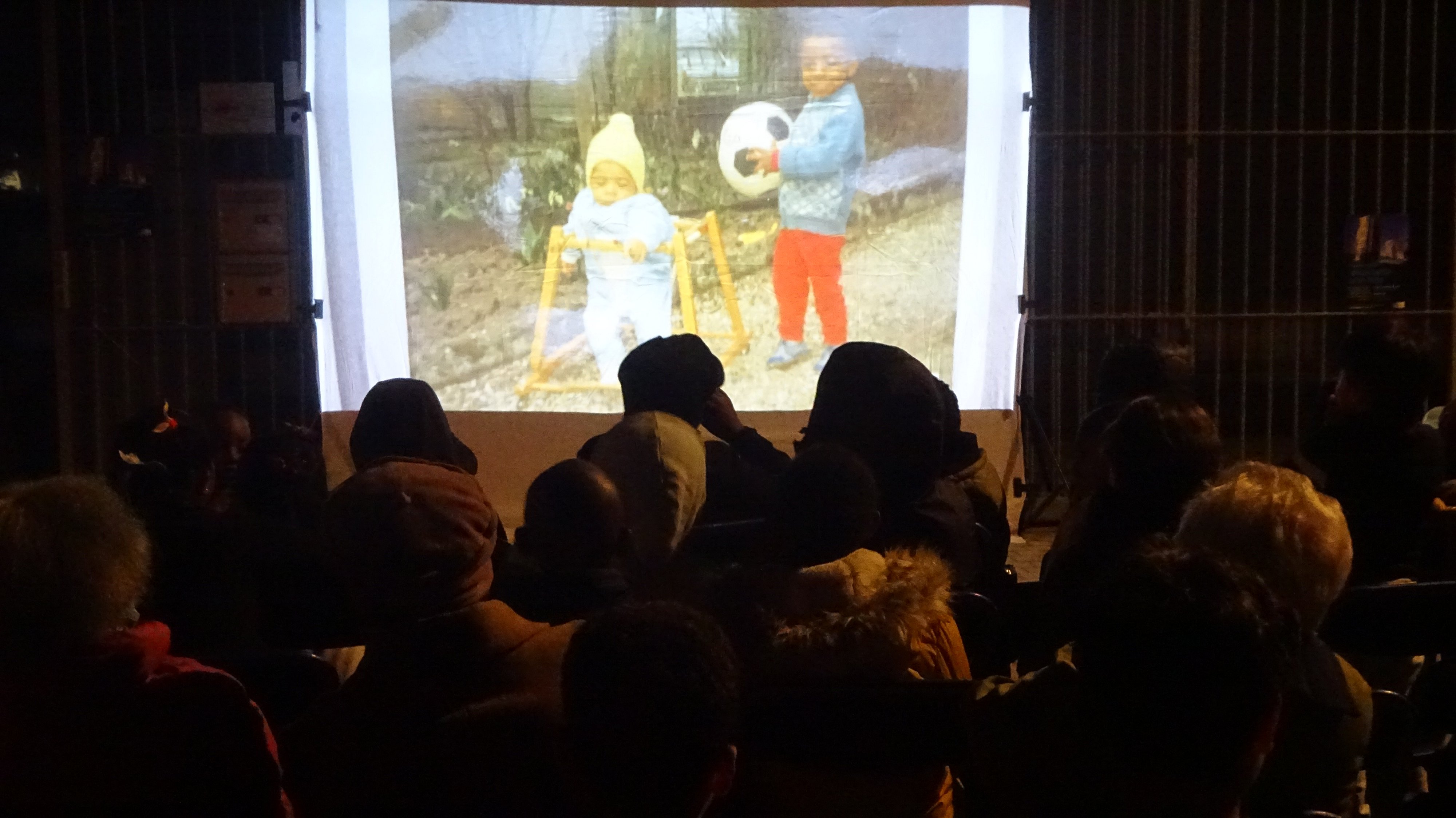
In April 2022, in Les Lilas, in Seine-Saint-Denis, we set up a travelling workshop for four afternoons in a lane of the Les Sentes neighbourhood. Children, elderly people, parents and people on their own made very simple films there, from photographs and recorded voices, about the memory of their neighbourhood. I recounted this work, and the seven years of support for the town that it is part of, in Experimenting together to become autonomous. An open-air screening was planned for the Saturday evening, during Ramadan, and the odds were not in our favour: the team feared that nobody would come.
On the evening of each workshop, I put the films online on the town’s video platform, and every participant who had made a film left with a QR code. The films circulated during the week, in families and among friends. Adults had made films too, and parents had seen their children’s. On Saturday evening the screening was full, and many in the audience had already seen the films.
That evening there was also a very important encounter. A young woman who lives in the neighbourhood had come across a plaque in memory of a young man murdered in Les Sentes a few years earlier, and she had wanted to make a film about it, because the workshop invited people to work on the memory of the neighbourhood, a citizens’ memory. The young man’s father saw the film during the screening, and he absolutely wanted to meet this young woman. The film, L’arbre de l’histoire, is still online on the town’s platform, along with all the others from the workshop.
Gathering around a legitimate object
We believe that people come to a screening to discover an object. I think this is not the case at all: they come to gather around an object that is legitimate for them, and that gives a symbolic value to the fact of gathering. It seems to me completely naive to believe that people travel to discover works. Works are symbolic objects that give value to their experience, the experience of being together to receive the work.
Now a film made in the street by a neighbour or a child is not, a priori, a legitimate object. Its publication on an identified, edited platform, the town’s, gave it that value, and it was parents and those around them who recognised it by watching it at home. When they came to see it again on a big screen, with the neighbourhood, it was already legitimate for them, and they wanted to see it all the more because they knew what it was.
I observed something similar at the Musée de la Grande Guerre in Meaux, in the summer of 2024, and I analysed it in The work of art in the age of digital mediation. Participants made photographic collages there, which we digitised with them, taking care over the lighting, before projecting them large in a small cinema set up in the middle of the workshop. I expected the original to keep its aura, in Walter Benjamin’s sense, and the reproduction to have less. The opposite happened. The collage was small and fragile, and it was on seeing it projected in front of the others that the person who had made it took it seriously, to the point of wanting to exhibit it and take care of it.
In this respect I often speak of a symbolic third. When two people face each other, one making a proposal and the other invited to do something, there is a power relationship, even with the best will in the world. An object placed between them, a camera, paper to cut out, a drone flown in the middle of a housing estate, allows them to meet through it. A digital tool can play this role, and I said so during a webinar on involving young people in summer cultural projects: I do not know what people do with it, but I know it is potentially a factor of connection.
A gallery of images before the opening
In Meaux, I was afraid that people who had taken part in the workshop for two hours, three weeks earlier, would not come back for the opening. For children, the question arises differently again. Their parents have to come with them, so they must themselves value what their children have made, and most of the time they do not know what they have made. Each participant had left with a QR code leading to the workshop’s mini-site, a simple gallery of images and sounds, where one could find, in very good quality, one’s own works and those of others, as the three weeks went by. On the day of the opening, people told us they had spent time looking at them at home. There were many people, and they came to celebrate creations they already knew. I recounted this project in Memory of sport in the Great War.
In both these situations, we extended online a mediation that had taken place in person. This was again the case in Tours, in October 2026, in the shelters of Entraide et Solidarités, where people being housed made twenty-seven films in three days, in four languages, to explain to those who will arrive after them their rights and how to assert them; I recounted this in Twenty-seven films so that rights don’t end up in a drawer. I put the films online as the day went on, on the association’s website, and a printed QR code, handed out to everyone, made it possible to find them. Participants shared them widely, and there were hundreds of views during the very week the films were made. Franck, housed by one of the association’s services, said in his filmed testimony that this way one can, “quietly at home”, “watch them again” and “understand them again”. On the first evening, a support worker was already imagining showing them to people when they arrive, because “it’s better to show a video than to read the whole thing”. These films were made together, around a table, and they will be used at a distance, at home or at reception, by people who were not there.
Memories that fade
Why does what we have lived through together need this extension? Émile Durkheim asked the question about rites, in The Elementary Forms of Religious Life. He describes the effervescence of gatherings, and the way it subsides once everyone has gone home:
“Besides, without symbols, social feelings could have only a precarious existence. Very strong as long as people are assembled and influence one another, they survive, once the assembly has ended, only in the form of memories which, if left to themselves, grow paler and paler; for, since the group is then no longer present and active, individual temperaments easily regain the upper hand. […] But if the movements through which these feelings were expressed come to be inscribed on things that last, they themselves become lasting.”
Émile Durkheim, “The Elementary Forms of Religious Life”, 1912 (my translation from the French).
The films of Les Sentes, the gallery in Meaux, the twenty-seven films in Tours are things of this kind, things that last. In workshops I often see people do remarkable things without knowing it, and what they have lived through gets lost in the routine of the following week. I explained in Keeping the Trace why, at the end of each day, I put everything we have done in a shared space, and in Digital traces as a link how these traces link sessions together, and allow someone who missed one to rejoin the group.
Should we then choose between presence and distance? I do not think so. In Les Sentes, the films would not have existed without the four afternoons spent in the lane with people, and the screening would probably not have been full without the town’s platform. The two complemented each other, and I now build my projects by thinking of both together, from the start.
When distance comes first
Sometimes we start at a distance. On 1 April 2020, during lockdown, I opened the platform By my window, which invited people to film what they see through a window of their home and to tell an important memory. I had been offering this in workshops since 2009. One might think a platform is enough, with a call text and a form. Most people, however, did not upload their film directly. They wrote to me by email that they wanted to try, or that they had tried and it had not worked, or that they had only taken a photograph and recorded their voice. I answered them, advised them, sometimes did the editing for them. I spent my days on this, and it took a lot of time, but it was this time that gave them confidence. Without it most of these films would not exist, and the platform became a commons because people who would not have dared found their place there. I described what it made possible in classrooms in Pedagogical use of the « By my window » platform.
Videoconferencing raises another difficulty. We no longer perceive others with our bodies, and people, often at home, do not feel the presence of the group either. The relationship to time changes too. When we are at a distance, at home, in our own time, a video call that drags on gives the feeling that someone is stealing that time from us. In a place outside the home we can also feel taken hostage, but we live things with others there, and we remain free to leave if we want. Of course we can cut a video call, and yet, very paradoxically, we feel more confined in it.
For the training course “Culture, youth and digital” of the Observatoire des politiques culturelles, held by videoconference and first run in 2022, I therefore divided each day into six one-hour sequences, each on a precise theme, rather than making it a training tunnel. Each hour comprises twenty minutes of presentation, ten minutes of discussion, then twenty minutes of individual writing by the trainees on a contribution platform, and the times are strictly kept. Trainees can thus picture their day very clearly, they feel autonomous in it, and this precise timing encourages contribution. Mediation at a distance requires, I believe, great respect for the other person’s time, and a much more rigorous organisation than in person. During the discussion, I note what people say in a mind map displayed on screen, because seeing one’s words taken up and connected to those of others legitimises them, as I explained in Activating collective intelligence with digital tools. I presented the programme of this course in « Culture, youth and digital » : designing new modalities for cultural and educational projects, and gathered my principles for working by videoconference in Running a professional training course by videoconference.
In November 2026, I supported at a distance students from the Université d’Artois and the Académie des beaux-arts de Tournai, who were making films and podcasts with artists exhibited at the Musée de Folklore et des Imaginaires. Two supports seemed essential to me. Before each video call, the pairs put their location photographs in a shared folder, so that I had in front of me the images of what they were talking about. And Isabelle Roussel-Gillet, who co-directs their master’s programme, was in the room with the group: she gave people the floor, kept time, showed on screen the display case we were talking about. At a distance I can neither move between the tables nor sense that a pair is losing interest, and the person in the room does it for me.
The networks where people already meet
For some fifteen years, many gatherings have been organised through social networks. During the Arab revolutions of 2010 and 2011, it was often said in the West that Facebook and Twitter had allowed people to connect freely, and I came back to this reading, which has varied a great deal since, in Presence in the unknown. The techno-sociologist Zeynep Tufekci, who observed protest movements from the inside, from Tahrir Square in Cairo to Gezi Park in Istanbul, shows in Twitter and Tear Gas (2017) that these tools make it possible to gather many people very quickly, but that these movements, often without structure or leaders, can then fall into what she calls a “tactical freeze”.
In France, since 21 September 2026, a movement that started at the Lycée Saint-Exupéry in Créteil has spread to many cities, against the shortage of teachers, overcrowded classes and the state of school buildings. The sociologist Matthieu Demory writes in AOC, on 11 October, that TikTok, Instagram and messaging apps are not only used there to spread calls for blockades: secondary school students share tutorials, information about their rights, accounts of their actions. He concludes: “Ordinary digital practices thus become resources for learning to act politically” (my translation).
I do not think that cultural, educational or social work can ignore these spaces where people already meet, nor judge the uses they make of them. I explained in Not judging people’s digital practices how much this judgement damages the connection we are trying to create, and in The reinvention of the collective cinema screening on TikTok how live streams recover the experience of the shared screening.
Without serving surveillance capitalism
But these platforms belong to companies. The question for cultural, educational and social work is therefore how to use digital tools as a factor of connection without becoming subservient to digital capitalism, which is also a surveillance capitalism. Shoshana Zuboff, whose book made this expression known, defines this capitalism as “a new economic order that claims human experience as free raw material for hidden commercial practices of extraction, prediction, and sales” (The Age of Surveillance Capitalism, 2019). When we put a workshop’s films online on a commercial platform, we entrust it with the experience of the people we support, and with a memory it will keep for as long as it finds it profitable.
I have no general answer, only ways of working that I have tested. I host myself, on a space I rent by the year, the traces of most of the projects I have led, on pages that are not indexed by search engines but remain accessible to anyone who has the link. On these pages I do not count views, although the tools allow it, because what each person does with these traces is a matter of their freedom. The collective intelligence sessions I run most often rely on a free software contribution platform. These choices assume that we take digital technology for what it is, material objects written on disks, in buildings that belong to someone, as I recalled in Digital is not immaterial. They are also political, at the scale of our everyday tools and not only of the big platforms, which I argued in Sovereign Digital, a Micropolitical Choice.
Using tools in a singular way also means choosing them for a precise situation, instead of letting a platform decide the form of the relationship. An email one answers oneself, a printed QR code handed out to everyone, a gallery of images with no counter and no advertising are modest tools. In each of these cases I took time for a person, to answer them, to digitise their collage with care, to give them an object to take away. Ivan Illich called tools of this kind convivial:
“Tools foster conviviality to the extent to which they can be easily used, by anybody, as often or as seldom as desired, for the accomplishment of a purpose chosen by the user.”
Ivan Illich, “Tools for Conviviality”, 1973.
Five questions before working at a distance
I ask myself these questions when I prepare a project part of which will take place at a distance, and I suggest you ask them too:
- Where will people find what they have made, that same evening, and who guarantees it will still be there in five years?
- Who among their relatives will be able to see it, and will that make them want to come when we gather?
- Who will answer those who do not dare to upload what they have made on their own, and how much time can we give to this?
- On a video call, who is in the room with the group, how is time divided, and at what moment does each person write or speak?
- Who owns the tools we use, and what do they do with people’s traces?
I find the last question the hardest, because the most widespread tools pass for neutral, and changing tools takes time for a whole team.


