Showing finished films at the start of a creative workshop, whether they were made by the person leading it or by other participants, gives people a result to aim for before they have done anything, and introduces the facilitator through the most polished thing they have. I suggest showing only how the tool works at the outset, letting the content be invented through doing, and watching together only the films that have just been shot.
“You could open with your films”
When an organisation invites me to run a workshop, I am often asked to begin by showing a few of my films, so that the participants know who I am. I always decline. If I play one of my films before anyone has touched the camera, people leave with a model in their heads that they will reproduce without meaning to, and there is now a gap between them and me that I will spend the rest of the workshop trying to close. Instead, I suggest doing the exercise with them, under the same conditions. I ask myself the same question about any finished film that someone would like to show before inviting people to create, including when it was made by other participants, and I had a very clear case of this in Tours this autumn.
The suggestion comes from good intentions. The person hosting me wants to introduce me, to give value to my visit, and to show the participants what can be done with a camera. In some writing workshops, the author leading the session begins in the same way by reading one of their texts: it is a way of revealing oneself, of making contact, and of inviting the others to do the same. It is an old mediation method, everyone leads in their own way, and I know that this reading is often pleasant to receive.
Personally, though, I never do it. I prefer to arrive in the present moment, with the people who are there, and for whatever happens between us to be made that day, by us. My reasons have to do with what a finished work produces when it is shown at the beginning, and I would like to explain them.
Creatures with antennae
In 1993, three American psychologists, Steven Smith, Thomas Ward and Jay Schumacher, published an experiment that I find very illuminating. They asked students to invent, in twenty minutes, as many imaginary creatures as possible for a planet similar to Earth. Part of the group first saw, for a minute and a half, three example drawings, all of which had four legs, two antennae and a tail. The creatures these students then drew had antennae, tails and four legs far more often than those of the group that had seen nothing. When the researchers explicitly asked them to depart from the examples, the effect did not diminish. They concluded that this conformity was not intentional: people were reproducing the examples without realising it. In the years that followed, experiments with engineers and designers found the same phenomenon, which David Jansson and Steven Smith called “fixation”, including when the example shown was presented as faulty.
In those experiments, the examples were simple anonymous sketches. When I open a workshop with one of my films, the example is edited, has a soundtrack, my name is in the credits, and I am the one who will then accompany the group for two hours. Participants take ideas from it, a way of framing, a type of subject, a length, and so on, and they also see in it the authority of the person who made it, with a level that most of them know in advance they cannot reach in the time of the workshop. In Where rigor belongs I described the place that mastery of an art takes up in a workshop when the facilitator has it in their ear; showing one’s films at the start puts it in front of everyone’s eyes as well.
An edited film, facing people who have prepared nothing
There is a second reason, which has to do with positions. Right after the screening or the reading almost always comes the moment when participants are asked to introduce themselves. Yet the facilitator has just introduced themselves through a work, that is, through a form they have had weeks or years to work on, cut, rewrite, and which they chose among others. The participants, for their part, have to introduce themselves out loud, on the spot, with nothing between them and the group. Introducing oneself is difficult for many people, and it is difficult for the facilitator too; reading a text or showing a film is a handy way out. But it is a privilege, since most of the people present have no film or text to show.
In Training a company in participatory mediation I noted a similar asymmetry: the visiting artist is named, announced, introduced, while the pupils listening are named nowhere. If I open a session with one of my films, I double that asymmetry, since I introduce myself with the best I have and then ask the others to introduce themselves with whatever they have to hand. Organisations have spoken to me of this screening as a gift to the group; I find it a heavy one to receive, because it invites people to take over a form that is not theirs.
Reading a page by another writer does not have quite the same effect. In Apprendre l’invention (2012), which gathers his texts on writing workshops from 1994 to 2008, François Bon says that each workshop is for him “an encounter with the singularity of an author and a voice” (my translation). When you read someone else’s text to a group, the facilitator is, like everyone else, someone receiving that voice. When you read your own text, you occupy both positions at once.
If it is to reassure oneself
Before playing a film or reading a page of one’s own at the start of a workshop, I suggest asking oneself a question: am I doing this for the people, or for me? If we are honest, it is often for ourselves. I usually arrive in a room I don’t know, in front of people I have never seen, and I fully understand the urge to show what one can do, because it is reassuring and one feels legitimate before even starting. In Putting Yourself on the Line, I wrote that many setups serve less to accompany people than to reassure the person leading them, and I would readily put the opening screening in that category. If it is to reassure myself, I think it is better not to do it.
This is not a moral rule. I simply believe that the facilitator’s fear passes into the setup, and that a group senses it very quickly. If I need to prove that I am a real artist before starting, I am saying, without meaning to, that there are “real artists” in the room and the others, and the workshop will play out between those two categories of people.
“We could show them yesterday’s films”
From 27 to 29 October 2026, in Tours, I ran three days of workshops with the artist Rosalie Lescure, with people housed by the accommodation division of the association Entraide et Solidarités. They made short films to explain their rights to those who will come after them, twenty-seven in all, in four languages; I wrote about it in Twenty-seven films so that rights don’t end up in a drawer. The first two days took place at the CHRS Albert Camus, in Tours Nord, and the third at the Cherpa, a shelter in the town centre, with other people.
The films from the first two days were really successful. The director of the accommodation division, who led the project, was proud of them, and she had good reason to be. On the morning of the third day, while we were setting up the room at the Cherpa, she suggested screening them to people as they arrived, to show them what could be done.
I explained to her why I preferred not to. These films were not mine. They had been made by people in the same situation as those who were about to arrive, also housed by the association, and one might think there was no cultural domination involved, no artist imposing their level. But a finished film is still a finished film. When you watch it before having done anything, you don’t see the hesitations, the failed takes, the laughter that produced it, you see a result, and you often tell yourself you will do worse. The people about to arrive would no longer have had quite the room to invent, in their own way, what they were going to make, and that is precisely where mediation lies. If we show them examples of things we think are good, we send them back to what they believe is their inability, since they are faced with a finished product when what we are offering them is a process. The director understood this well, and we screened nothing.
I don’t think this is specific to people in emergency accommodation. Most of us, in front of a camera or a microphone, have no sense of having any competence, and seeing a successful example, in my view, rather confirms us in that idea. At the Cherpa, some of the participants actually began by joking, asking whether they were being sent back to nursery school.
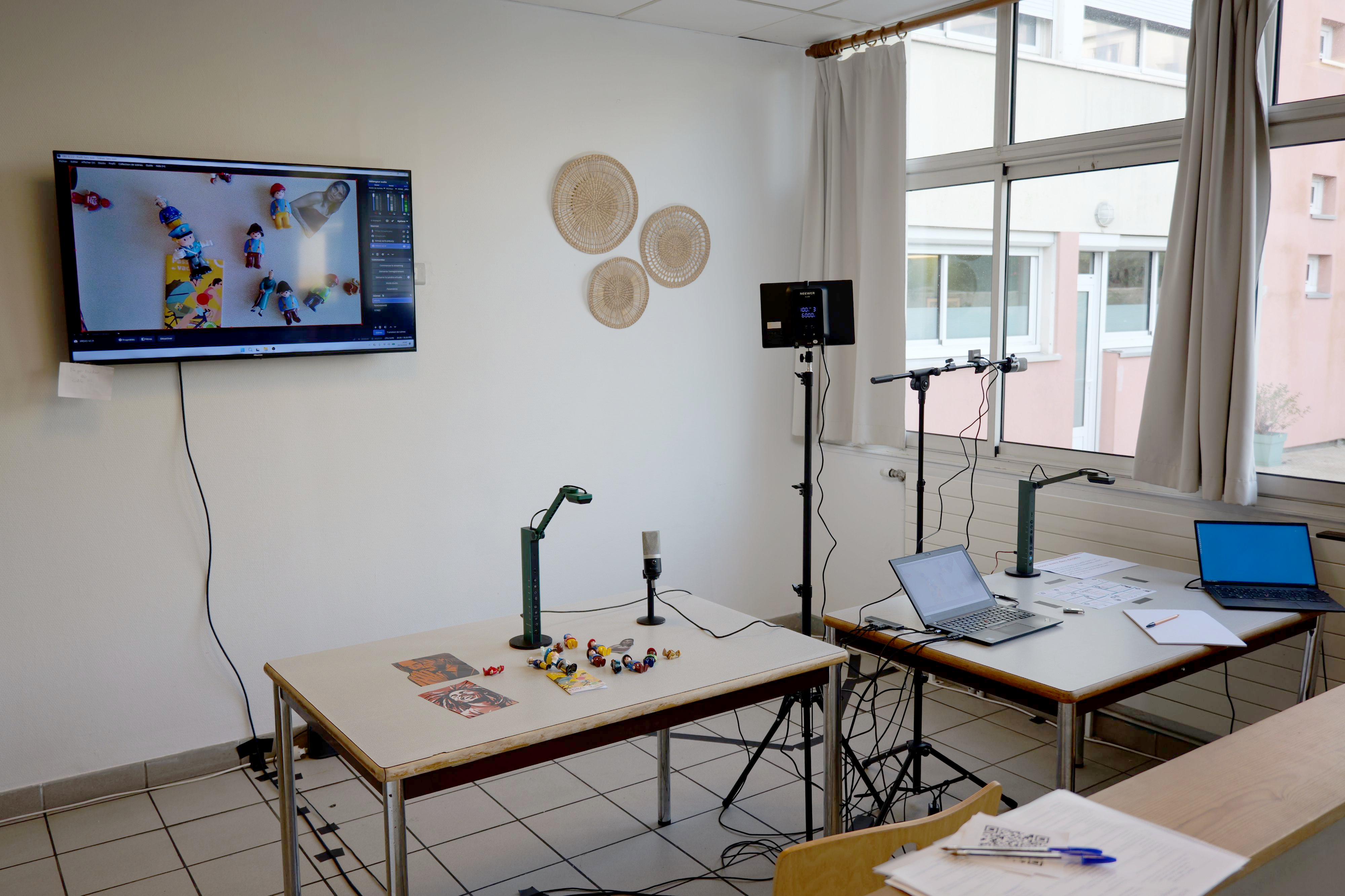
The films from the third day do not look like those of the first two. The place was different, so were the people, and so was the subject: the charter of rights and freedoms of people in care, whose twelve rights the participants illustrated with collages on photocopied cards. Bruno made a film with Playmobil figures that he called “Le fil de la vie” (The thread of life). The Arabic version of the charter was made without a voice, with music and text on screen, because the person who was to read it did not come back. I cannot know what would have happened if we had screened the previous days’ films; I only know that it was not the same energy, and that these forms came from the people who were there that day.
A form you would have in mind before touching the paper
The British anthropologist Tim Ingold devoted a book to the question, Making. Anthropology, Archaeology, Art and Architecture (2013, published in French by Dehors in 2017). In it he discusses a way of thinking about making that goes back to Aristotle and is known as hylomorphism, from the Greek hyle (matter) and morphe (form): to make something would be to have a form in mind first, a project, and then to impose it on inert matter. Ingold argues that this is rarely how things are made. Among the craftspeople, artists and architects he studies, and in the exercises he sets his students, form emerges along the way, through gestures, in what the material allows or refuses, and he calls this relationship between the maker and their materials a correspondence. From the introduction onwards, he invites his readers to know for themselves.
It seems to me that a finished film, shown before starting, plays the part of that form one would have in mind before touching the paper. People have magazines, scissors, an object, their voice, a few instruments in front of them, and it is with these things that a film could be invented. But they now also have a result to reproduce, and they will lean towards it, just as Steven Smith’s students drew antennae.
Ingold has also written about the way we learn by watching others, in a text entitled “From the transmission of representations to the education of attention”, published in 2001 in The Debated Mind, a volume edited by Harvey Whitehouse. In it he challenges the idea that knowledge passes from one generation to the next as a stock of representations. The novice, he writes, “watches, feels or listens to the movements of the expert”, and seeks, through repeated attempts, to attune their own movements to what they perceive. Copying, for him, is not the automatic transfer of mental content from one head to another, but a way of following what others are doing. And what each generation contributes to the next is not an accumulated stock of representations but an “education of attention”.
This is what I saw happen in Tours, from one film to the next. During a shoot, the others were there, around the table. They saw someone place a cut-out piece of paper under the camera, someone else play a few notes on a kalimba, a third person speak into the microphone. They saw people like themselves in the act of making, with the same means, in the same reality, and those gestures made their own possible. Everyone could take part in someone else’s film, play a little music, hold a piece of paper, suggest an idea, and so on. What passed from one person to another was gestures, which could be taken up in one’s own way, not a result to be matched.
A camera, an object, a button
I am not saying that nothing should be shown. At the start of a cut-out paper animation workshop, I give a demonstration of about thirty seconds: here is the little camera, fixed above the table, you place an object under it, you press the button, and it films. Everyone has understood that whatever is placed under the lens becomes a film, and everyone sees that it is within their reach. We have seen how the system works. The content of the film, on the other hand, its structure, what it will tell, I show none of that: it is what people will invent little by little, by trying, by making mistakes, by watching what the person next to them is doing.
The question of the example therefore depends on what we are asking people to do. When we invite them to create, we often confuse explanation or the model with doing, as if seeing the result helped to produce it. Yet in making a film, a person gives form to something of themselves, they symbolise it, in the sense psychoanalysts give the word (I described this work in The writing being), and they build themselves by building the object. If the form is given to them in advance, a good part of this work no longer takes place: they execute. It is better to make a small something oneself, even clumsily, and it is from there, little by little, that one begins to see oneself in one’s own place, in the act of making.
Writing a word, me too
What to do instead of opening with one’s works? In my view, apply to oneself what one asks of the others. When the facilitator adopts, throughout the setup, the same posture as the participants, it reassures the group far more than any work could.
For example, in a writing workshop where everyone has an object in front of them, you can suggest that each person write a single word about that object, and write your own word at the same moment, on the same paper, with the same pen. Then you read yours aloud, first, and someone will have written “full”, someone else “alone”, and so on. You have taken the same risk as the others, with the same means and the same uncertainty. Only then can you ask: “Would you be willing to say your first name?” We are no longer in the model, we are in practice.
This is what I do in collective sequence-shot films, where I make my object speak in front of the camera like everyone else; I wrote about it in Putting Yourself on the Line. When I do the exercise in front of the group, I expose myself, whereas when I show my film, I expose a work protected by editing and by time, and it is that protection the participants do not have.
Watching together the film we have just shot
Watching is also a practice, with its own demands, and I care about it a great deal. But it is not the same practice as making. When we invite people to create something and begin by showing them finished results, we put them in the energy of watching at the very moment we would like to put them in that of making.
In Tours, we watched all the films together, but each time it was the film that had just been shot. After each take, everyone sat down in a small room set up as a cinema, we watched, and the group decided whether to keep the take or redo it; it was often the participants themselves who suggested changes. Rosalie Lescure said of these workshops that they gave people the chance to be “both the spectators and the creators”. We exercised our eye on what we had just made, with those who had made it, and what we saw there was immediately useful for the next film. In Building, Not Valorizing I described how a group builds itself by watching together what it has produced.
It is the sequence shot that makes this possible, and that is why I am so attached to it. We shoot in one go, without editing: when the take stops, the film is finished, and we can watch it straight away. If a film doesn’t work, we redo it entirely. The music, played live on instruments chosen so that anyone can get a sound out of them very quickly (kalimbas, a tongue drum, a Tibetan bowl, small synthesisers), runs through the whole film and connects the people to one another. On this site you can see collective films in sequence shot made in this way.
Images that appear as they are made
I am not against examples, provided they are in the process of being made. I have often seen groups stimulated by what other people had just done, under the same conditions. In 2017, at the Paul Langevin secondary school in Mitry-Mory, we installed a video projector in the entrance hall to loop, while pupils were arriving, the drone films shot in the ongoing workshop, that is, films that other pupils at the school were in the process of making; I wrote about it in Town of Mitry-Mory : drone workshop at Paul Langevin College. The same year, at the Filmer le travail festival in Poitiers, images accompanied by a short text written by passers-by were projected on site, as they were made, so that others could imagine what they in turn might do; fifty-eight people took part over two days (Poitiers film festival : writing workshop « Écrits sur Images »).
These images do not have the same status as films made before, elsewhere, by others. A pupil entering the hall sees a film, wonders what it is, and very quickly understands that it has just been made, here, by pupils like her. She may at first be impressed, and tell herself she would not be capable of it. But she immediately discovers the tools that were used to make what she has just seen, and this puts her, on the contrary, in a position of capability. The film does not remain outside her experience: it becomes an object that creates a link, between those who shot it and those who discover it, including people who arrive and were not there at the beginning.
The films from the first two days in Tours, by contrast, would have been shown in another place, as an introduction, to people who had not yet done anything. They had been made by peers, but before, and elsewhere: they would have become models.
In front of images that appear as they are made, you see that people like you are doing this, here, now, with the tools you have in front of you, and you understand that it is possible, without anyone telling you what you ought to achieve. As for works by other artists, or films made by other groups, I do sometimes show them, but afterwards. Once you have made something, you have gained confidence, and you look at other people’s work without feeling dominated by it: you discover that there are other people, other forms, and they add to your own instead of crushing it. In image education, the opposite is often done, starting with reference works; I prefer to reverse the order.
Points not to miss
- I don’t show my films at the start, even when asked to. I explain why to the organisation, and the participants can discover my work in other ways, if they wish.
- Nor do I show, at the start, films made by other participants. Even when made by people in the same situation, finished films become models. In Tours, on the third day, we did not screen those from the first two days, and the Cherpa films took other forms. I explain this to the organisation, even when it is proud of these films, and rightly so.
- I show how the tool works, and nothing of the content. You place an object under the little camera, you press, it films, and in half a minute it has been shown. What we will put under it, and what it will tell, I say nothing about; that will come through doing.
- I ask myself the question before opening with something of my own. Is it for the people, or to reassure myself? If it is to reassure myself, I don’t do it.
- I drop the introduction if the group has already started. Sometimes I never give the one I had prepared, because people started cutting or filming in the first few minutes and I don’t want to stop them.
- I do the exercise with the group, under the same conditions. The same paper, the same time, the same object, and I read or show what I have made first.
- I introduce myself the way I ask the others to introduce themselves. If I ask everyone to say something about themselves out loud, I say something too, in the same way, without leaning on one of my films.
- I let people see themselves making. I don’t send everyone off to shoot in their own corner. The others stay around the table, and you can always play three notes on a kalimba or hold a piece of paper for someone else’s film before getting started yourself.
- I watch each film with the group as soon as it is shot. Because we shoot in sequence shot, without editing, the film is finished when the take stops; in Tours, we went to see it straight away in the small room set up as a cinema, and decided together whether to keep it or redo it.
- I show what is being made as it happens, and other people’s works afterwards. In 2017, in Mitry-Mory, pupils entering the hall saw the drone films that other pupils at the school were in the process of shooting play on a loop, and this showed them it was possible. Works by other artists or other groups I tend to show once we have made something, when they can be watched without feeling crushed by them.


