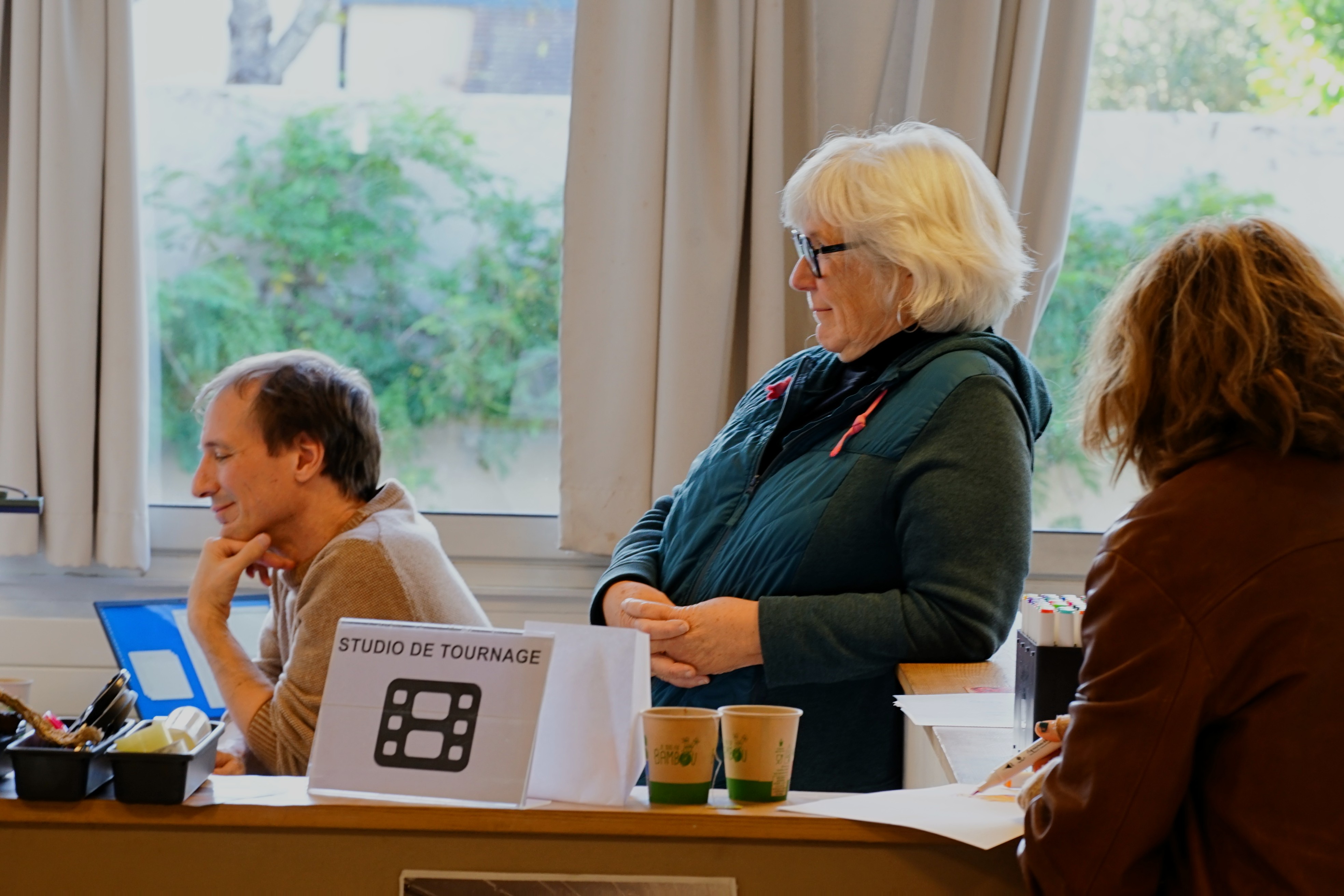
In the creative workshops I offer to the public, I prepare places and objects that people can take hold of on their own: a table named “Recording studio”, a board with their first name, a booklet, a QR code. Here I describe how these symbolic places are made, with an A4 sheet or a magnet, why the first gesture one makes there authorizes the following ones, and what I do when a place I have proposed is not recognized.
Workshops where nobody is obliged
I am talking here about creative workshops offered to the public, within what is called participatory cultural action. People make a cut-out animated film, a podcast, music, photos, a text. This happens in a classroom or a media library, but also in places where people did not come for that: at the exit of an exhibition at the Museum of Man, in leisure centers, in a street, and in October 2026 in emergency shelters in Tours. Nobody has signed up. People pass by, look, and they are obliged to do nothing; I described this in Setting the table.
Most of these people have never made a film or recorded their voice, and many think it is not for them. I can tell them that it is open, that it is free, that they have the right. I know that it is not enough. Everyone has the right to enter a museum, and many people never do; I wrote about this in Instituting oneself in one’s rights. And on 1 July 2026, at the Rize in Villeurbanne, when I asked teams to photograph “the power to act”, they photographed a great many prohibitions (Why the power to act is so often experienced as a transgression). What blocks people, most often, is not that they do not know how, it is that they do not feel legitimate. So how do we make it possible for someone to feel entitled to do something they have never done, in front of people they do not know?
Between people and me, a third
My answer is that something has to be placed between the person and me, and that this something has to belong to them. We often believe that it is enough to be welcoming, to encourage, to reassure. It helps, of course. But when there is only the person and me, everything goes through the face-to-face: I propose, they accept or refuse, and what they do, they do a little for me, under my gaze. Psychoanalysis calls this a dual relationship, and it is a relationship of power, even when we are full of good intentions. To get out of it, a third term is needed, a common object between us. In 2024 I wrote an article on this third (The symbolic third, a tool to connect), with the example of a child in front of a pile of magazines and a pair of scissors, and I will not go over the theory again here.
I would like to be more concrete, and talk about places. A third can be an object, and it can be a spot. I call symbolic place, or symbolic space, a spot in the workshop that has a name and a function everyone recognizes: the recording studio, the drawing workshop, the cinema. It is a space of welcome, because on entering it one knows what one can do there. And it is a space of qualification: the person who sits down at the recording studio becomes, for a moment, someone who records. They can project themselves into this position because they already know it, from films, from the radio, from school.
As a result, they are no longer dealing only with me, they are dealing with a place. They can look at it from a distance, come closer, settle in, leave, come back, without asking me anything. They have a grip on it, and that is how they become autonomous. As for me, I do not have to convince them or give them permission. I have prepared the place. This is what I call a framework, and I developed it in The framework that authorizes: for me, a framework serves to authorize people far more than to contain them.
A pair of scissors, somewhere to sit
What there is between the person and me can be a pair of scissors. It can be paper to cut out, musical instruments that are easy to use, somewhere to sit. In the animated films I propose to make, I show people how the film-making system works, which is very simple: a camera above a table, you put papers down, you move them, you speak. Once you have seen that, you can do it without me.
All this only exists for someone if they have a grip on it. I see it when people choose which piece of cardboard they are going to take, a white one or a brown one, and which felt pen. I simply told them: “Take some felt pens and take a table.” I am not the one who told them which. They chose, they did it on their own, and from then on the object is theirs.
The clearest example I have is the moodboard. In the summer of 2023, with Cultures du cœur, I led with Loussiné Villelegier a tour of workshops in eight social-sector organizations, a supported housing residence in Bordeaux, a boarding house in Mantes-la-Jolie, a shelter in Dreux, etc. (Cultural summer 2023 with Cultures du cœur : « The machine that travels into the future »). I had planned to bring boards, and it was Loussiné who had the idea of making them into moodboards. On entering, each person took theirs: a small magnetic whiteboard on which you could stick whatever you wanted with magnets, draw, and which could be photographed. The first thing to do was to put your first name on it.
Cutting out a small piece of paper, writing your name on it, placing it on the board with a magnet: everyone can do that. If you cannot write, you make a drawing. We are given magnets, and even if we have not yet stuck anything with them, we have them. If there are newspapers in front of us, we can take a whole page and stick it on without even cutting it out. And there it is, we have begun to inhabit our space. It belongs to us, and it commits us, because we have already been able to take it in hand and put something on it. What follows comes from there. In Bordeaux, Guillaume did not wish to speak. He built his moodboard under the camera, and we discovered with him that what he had made was an ecological story. Over the eight workshops, one hundred and five people made sixty-two moodboards.
A table that bears a name
The board is a place you carry with you. There are also the places you go to. In 2017, at the Museum of Man, at the exit of the exhibition “Us and Them, from prejudice to racism”, I led for eight days a workshop where visitors made cut-out films; they made one hundred and ninety of them (Museum of Man : Animated Cinema Workshop). There was already a corner that was the cinema. But at the time I named nothing. The spaces existed through the way I had set out the tables, the chairs, the camera and the screen.
What I have discovered since is that a written word changes a great deal. Today, before people arrive, I place on each table a small plastic display stand with an A4 sheet folded in two, on which I have written in large letters “Recording studio”, “Drawing workshop”, “Cinema”. On the studio table there is a microphone, a computer and a small speaker, that is all. It looks a little childish, a table with three objects and a piece of paper. On another table there are paper, scissors and felt pens, and elsewhere a few chairs turned towards the wall where the video projector sends its image. And every time I am surprised by how well it works: people go to the studio to record, they know where they are, and they behave as one behaves in a studio.
I have done it in very different forms. In 2017, in the leisure centers of Île-de-France, the workshop was signposted from afar by a large inscription, “Make your own cartoon”, and people decided to come in for a quarter of an hour or for three hours (Ile-de-France leisure centers : cartoon workshops). In Bordeaux in 2023, we had signs with pictograms, and I had written in my account of the day: “These are not simply felt pens and paper, this is a ’drawing workshop’.” In Tours, in October 2026, in the shelters of the association Entraide et Solidarités, residents made films about their rights, about the social life council and about the charter of rights of the sheltered person; next to the camera, there was the small sign “Film studio”. In 2024, at Studio 13-16 of the Centre Pompidou, each station of the “CinémA.I” workshop had its name, script, characters, music, podcast, video (« CinémA.I » in Studio 13-16 at the Centre Pompidou).
A line of stones
For a long time I wondered why a piece of paper was enough. I found an answer in the American philosopher John Searle, in The Construction of Social Reality (1995). He tells the story of a tribe that builds a wall around its territory. At first, the wall stops people because it is high. Then it crumbles over time, all that remains is a line of stones, which one steps over effortlessly, and yet everyone, the inhabitants as well as their neighbours, continues to respect it as a boundary. Searle says that many things work this way, a banknote, a marriage, a president: they have a status because a group agrees to give it to them, and only as long as it agrees.
In his book, he calls these institutional facts. He distinguishes them from brute facts, which exist whatever we think of them, and the example he takes is the snow at the summit of Everest. A twenty-euro note is first of all a piece of paper, and it is worth twenty euros because we all accept it. His formula is “X counts as Y in context C”. I read it like this: this table counts as a studio in this workshop, on this day. He also speaks of “status function”, to say that the thing does its job thanks to the status we recognize in it, and not thanks to what it physically is, like the line of stones that no longer stops anyone by its height.
My table is the same. It has not changed, nor has the microphone, nor the computer, but everyone agrees to say that it is the studio. And since a status only holds as long as people accept it, I decree nothing with my sign. I propose, and it happens that the group does not take it up; I come to that further on. If people agree so quickly, I believe it is because the word already speaks to them: everyone has seen a studio on television, everyone has been to the cinema, and with the word come ways of behaving that I do not need to explain. The studio belongs neither to me nor to the person, it is between us. It is the third I was speaking of above.
I write only names of places, never prohibitions. With the same display stand, I could write “Do not touch the equipment”, and the person would understand that they are not trusted.
A minute and a half, a booklet, a QR code
On 12 November 2026, in Nantes, I led the afternoon of a professional day at Mixt on welcoming teenagers, with about a hundred teachers and staff from the music and dance schools of Loire-Atlantique, seated in the tiered seating of a theatre. I wanted everyone to write, and there too, asking is not enough.
I began by putting them in pairs, without moving, with the person sitting next to them. For a minute and a half, one answers a question (“Do you remember a discussion with a teenager that taught you something?”) and the other listens without discussing. Then they swap. It is very simple: say something to someone for a minute and a half. Even if I do not quite know what to say, in any case it only lasts a minute and a half. And I know nothing of what was said. I explained to them why I was doing this: what interests me is their skills, and when you formulate something, you are not simply putting on paper what you had in your head. It is by searching for the formulation that you work out your thought. Psychoanalysis calls this symbolization.
Then everyone wrote. At the entrance, people had taken a booklet, an A4 sheet folded in two with four printed boxes (“What I retain”, “What I disagree with”, “What was not said”, “What I propose”), a support I had cut out so that they could write on their knees, and felt pens. They had chosen their colours, and choosing the colours took a moment. In less than ten minutes, a hundred people wrote at the same time. For me, the symbolic place was there in the hand: a sheet already printed, with boxes waiting, and a fine felt pen. I had spent time cutting out these supports, and I believe people sense it.
Then they left in groups of seven at most, to tables where they had signed up at lunchtime with their phones, by scanning a QR code. On the screen, they saw the twelve numbered themes, they could unfold each one to read its questions, and I had told them to sign up where they thought they had something to bring to the others. There, the symbolic place was in the phone. Then they found the same number and the same title on the table, on a folded paper tent card (“1. The welcome. Who opens the door to them?”), and a third time at the top of the large A3 sheet that guided the discussion. The groups settled in and worked for three quarters of an hour without me. When I photographed their sheets, I was very impressed by all they had written in so little time.
Since the morning, there had been on the stage a table with a camera on a stand and a light. It stayed there throughout the morning’s talks. There I photographed all the booklets, and they were put online straight away. This table also says something to people: what is needed to photograph what they are going to write has been set up before they have even written it, so it will be read. People left with a QR code that gives access to everything that was written during the day. For me, this QR code is also a symbolic place: everything we have done is there, right away. I make it a point of honour that it should be online right away, because it follows on from the gesture, and because it belongs to them. I am there so that what they have done truly belongs to them. During the closing speech, I looked at the room: people were reading one another’s contributions on their phones. At the end, I told them: “The framework is not what constrains, it is what authorizes.” (The framework that authorizes)
When the place is not recognized
A symbolic place can also be online. For several years, I have been running consultations with a web platform and videoconference meetings in which everyone writes at the same time on the platform, and then we talk about it. It worked very well for the Media College of Saint-Denis’s bid for the title of European Capital of Culture (A web platform for collective intelligence), for the collaborative assessment of screen literacy education in Nouvelle-Aquitaine, for the Silo (Enlarging the Silo) and for the training courses of the Observatoire des politiques culturelles (Web platform for professional training).
This autumn, I proposed it to an art school, for a consultation on digital technology, and I realized at the launch meeting that it was not going to work like that. The platform was empty, and nobody knew who was behind it. I thought of Searle again: a status only exists if the group agrees, and there, the group did not. I did not persist. I proposed to come, one day a week, to talk with the students, the teachers and the staff, and to note down myself what they tell me. I will have in my pocket a bundle of flyers with a QR code. I really need that flyer. People have it in their hands, so it belongs to them, and without it the platform remains somewhat in limbo.
Building a symbolic space
How do I go about it, concretely? First I name. With the written name, people know what the objects alone do not say, that is, what this spot is for. An instruction I give out loud has vanished as soon as I have said it, whereas the word on the table stays there. You can come back to it whenever you want without asking anything, and so without having to show that you have not understood. This helped me a great deal with the autistic children of a day hospital where I led a workshop for several months. Talking to them at length did not work. I would arrive, transform the room, organize it into studios, and it was the room that told them what could be done there (Letting autistic children make images).
Next, I keep the same places from one session to the next. In that day hospital, there was always the same area where we gathered to watch the films, which I called the cinema, with the video projector and the screen in the same position, at the beginning and at the end of each session. For these children, it was an enormous support. Once that is stable, I can propose something else around it, podcast one day, drawing another, video another.
I also make several places, not just one. When there is a studio, a drawing workshop and a cinema, each person goes towards what speaks to them, settles in, watches the others, changes places. The group distributes itself on its own, I do not have to allocate people, and I can look after those who hesitate.
And I think about the threshold. What is true for a table is true for a whole venue. When you organize an exhibition, a week of encounters or a festival in a borrowed room, people need to understand, on entering, where they are arriving and what they can do there. There is no need for elaborate signage: a few words in large letters on a wall, small drawings, the graphic identity of the project repeated at the entrance and on the tables. I have written about the welcome in a theatre, where the architecture, the lighting of the forecourt and the signage are already part of the show (The Art of Hospitality).
None of this replaces me. It frees me from part of the explanations, and so I am available for people; I spoke of this in Receiving, or the difficulty of doing nothing. Basically, when we propose something to others, a workshop, a consultation, a training course, I believe we are always looking for the same thing: that people feel authorized to do what we propose to them. Symbolic places serve that purpose.
The points not to miss
- I ask myself what is going to act as a third. A named table in Bordeaux, a booklet in Nantes, a platform for the Silo, a flyer for the art school: it is never the same object.
- I set out the objects and let people choose. In Nantes, I said “take some felt pens”, and everyone took their colour, some two or three.
- I begin with the first name. On the moodboards of summer 2023, it was the first thing people wrote.
- I write the names of the tables before people arrive. In large letters, readable from afar, on a sheet standing upright. At the Museum of Man, in 2017, I did not yet do it. Since Bordeaux, in 2023, I do it everywhere.
- I use words everyone knows. Recording studio, drawing workshop, cinema: we have all seen these somewhere before.
- I never write a prohibition on a table.
- I make several places. In the Cultures du cœur workshops, there were the film studio, the recording studio and the music-making station, and people went of their own accord towards one or another.
- I put the same number on the phone and on the table. In Nantes, there were twelve themes, and the groups settled in without me.
- I keep the same places from one session to the next. At the day hospital, the cinema was always in the same spot.
- I give people something to hold. A moodboard, a booklet, a flyer: what you hold, you do what you want with.
- I put things online the same day. In Nantes, the booklets were online before the end of the closing speech, and people were already reading them.
- I change when it does not take. For the art school, I removed the videoconferences from the platform’s calendar, and put in the days when I come.


