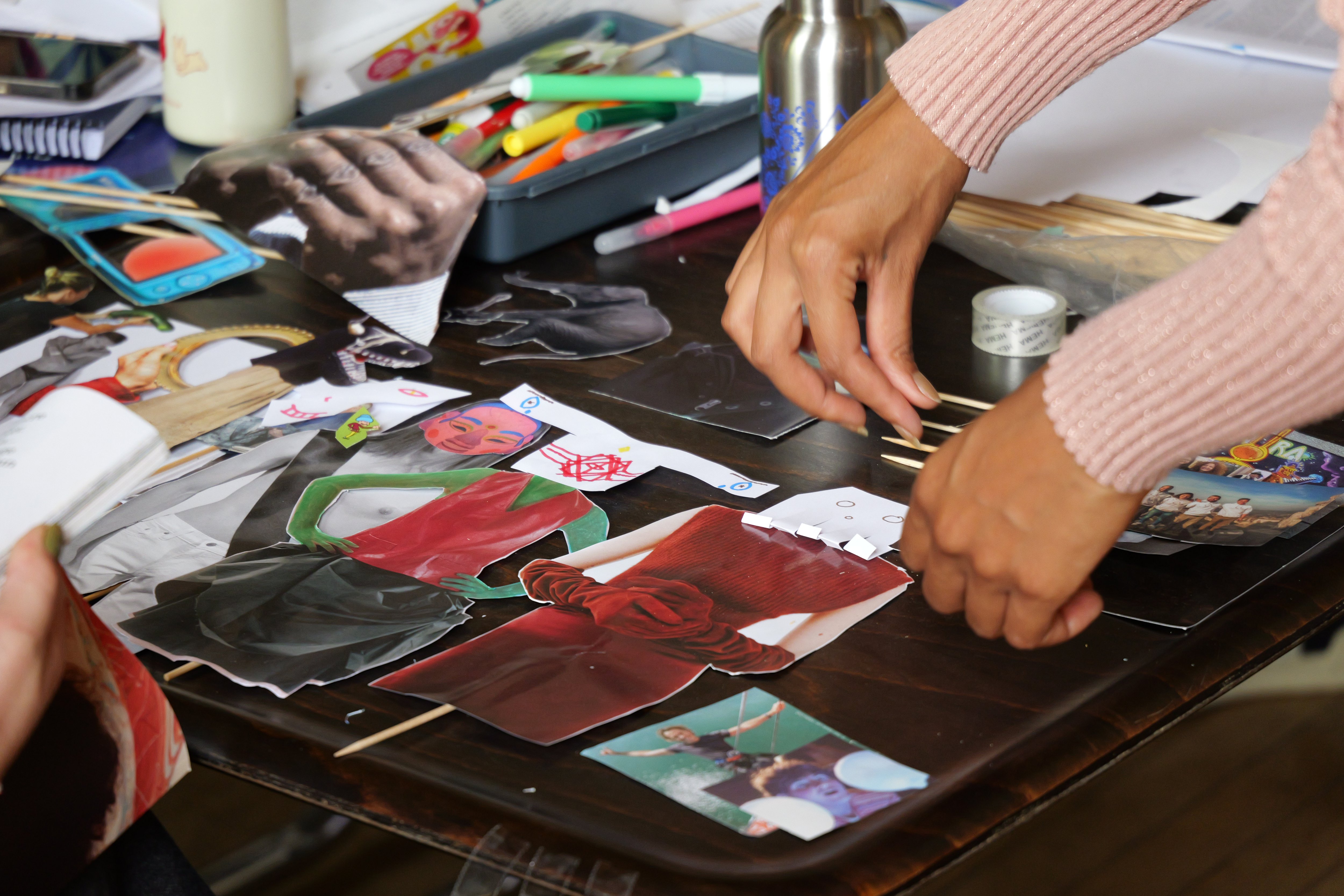
In every workshop film I have people shoot, even the ones that last a minute, I ask for a title at the beginning and credits at the end, written in felt-tip pen on a sheet of paper and filmed for three or four seconds. The instruction sounds schoolish, and yet the success of the exercise depends on it to a large extent. Gérard Genette’s paratext, Eliseo Verón’s reading contract and Roger Odin’s semio-pragmatics help us understand how, in a few seconds, an exercise becomes a film, and why the person leading the workshop has to prepare for it the day before, down to planning the sheets and the pens.
A recording becomes a film
When a group makes a film in a workshop, what is at stake for cultural mediation is that this experience should have strong symbolic value, for the people who lived it and for those who will watch the film. Sometimes such an experience is founding: people remember it years later as the moment they understood they could make something. Sometimes it is ordinary, it gets lost in everyday life and nothing remains of it. No one decides what will be founding for someone else, but we create, or fail to create, the conditions for it, and those conditions come down to an accumulation of details, each of which, taken on its own, seems negligible.
The title and the credits are among those details. They change nothing in the content of the film, but they change its status. A film without a title is a recording, something that happened and that a camera captured; a film with a title is an object made to be seen, which presents itself as such to someone. The difference is one of nature, and the people who made the film feel it at the very moment they see their title appear on the screen, with all the lights off, in front of the others: what they made has become a film. It is for that moment that I bring sheets of paper and felt-tip pens. Some teams still forget the title or the credits, so absorbed are they in their shoot, and I then see it above all as a sign of their commitment; I told this story in When the instruction is not followed.
A vestibule into the film
Gérard Genette devoted a whole book, Seuils (1987, published in English as Paratexts), to the elements that surround a text. In it he calls paratext everything that accompanies the text proper and presents it to the reader: the author’s name, the title, the subtitle, the preface, the dedication, the epigraph, the notes, the cover, the back cover. His definition fits in one sentence:
“For us, accordingly, the paratext is what enables a text to become a book and to be offered as such to its readers and, more generally, to the public.”
Gérard Genette, “Paratexts: Thresholds of Interpretation”, 1997 (translated by Jane E. Lewin).
What I take from this definition is the verb: a text becomes a book. It does not present itself on its own; it is through the paratext that it becomes a book. Genette borrows from Borges the image of the vestibule, which gives readers the possibility of stepping inside or turning back, and he speaks of an “undefined zone” between the inside and the outside, with no clear limit either on the side of the text or on the side of what the world says about it. The elements of the paratext are not ornaments; they are reading instructions, which prepare readers and orient what they will understand before they have read a single line. A workshop film’s title is a paratext in Genette’s sense. It turns what was shot into a film, and the end credits, which signal that we have reached the end, are its exit door. In a film built by juxtaposition, as most collective films are, for instance those I describe in Going all the way, nothing in the material itself indicates the end; without the words The End, viewers do not know whether the film is over.
A handwritten title, a contract
The semiologist Eliseo Verón coined the notion of the reading contract in 1985, in an article on the written press, “L’analyse du ‘contrat de lecture’ : une nouvelle méthode pour les études de positionnement des supports presse”. His starting point is a distinction from the linguistics of enunciation, that of Émile Benveniste and Antoine Culioli: a discourse cannot be reduced to what it says, its statement; it also involves a way of saying it, its enunciation, through which the speaker constructs an image of themselves, an image of the addressee, and a relationship between the two. What distinguishes a magazine from its competitors, Verón shows, is not the information found in it, often the same, but the relationship the editorial team offers its readers, and this relationship is built through the layout, the typography, the tone of the headlines, the place of the images, in other words through everything that is not the content. He writes that the study of the reading contract bears “on all aspects of the construction of a press medium, insofar as they construct the bond with the reader”.
To speak of a contract is to say that readers, when they open the paper, accept a proposed relationship and adjust their reading to it; it is also to say that an editorial team that breaks this contract loses its readers, even if its information remains accurate. Transposed to our films, this means that the title, the words The End, the hand writing in felt-tip pen, the length of time the title stays on screen, are not elements of content but elements of enunciation: through them, viewers learn who is speaking to them, who is being addressed and what relationship is being established with them. With a handwritten title, we offer viewers a precise contract: people made this film with their own hands and are giving it to them. If the title stays on screen for only a second and disappears before it can be read, we break the contract at the very moment we offer it.
Beyond the family film
Roger Odin (1939-2023) founded in 1988, at the Sorbonne Nouvelle, the Institut de recherche sur le cinéma et l’audiovisuel (IRCAV), of which I am an associate member, and directed it until 2004. From the 1980s onwards he developed an approach he called semio-pragmatics, set out in De la fiction (2000) and in Les Espaces de communication. Introduction à la sémio-pragmatique (2011). Compared with classical semiology, he shifts the question: the meaning of a film is not in the film, it is produced by the viewer, according to modes of meaning production that the context makes available or not. Odin describes several: the fictionalising mode, in which we let ourselves “vibrate to the rhythm of the fictional events narrated”; the documentarising mode, in which we take what we see as a testimony about reality; the private mode, in which we watch a family film to find our own people in it; the spectacularising mode, the aesthetic mode, and others. The same film can be read in several modes, and the mode depends less on the text than on the constraints of what he calls a space of communication, “a space within which the bundle of constraints pushes the actants to produce meaning along the same axis of relevance”. Institutions, the cinema, television, the family living room, weigh both on the person who makes the film and on the person who watches it, and push them towards one mode rather than another.
Odin applied this approach to the family film, in the collective volume he edited, Le Film de famille. Usage privé, usage public (1995), and this is where his work directly meets mediation workshops. A family film watched in the private mode does not need to be good; it moves the people who watch it, because they recognise their own lives in it. The same film shown to strangers, in another space of communication, means nothing to them, because the private mode is no longer available and no other mode has been prepared. A workshop film is in the same situation: made by a group, it constantly risks being readable only in the private mode, by the people who were there. The title and the credits are, to use Odin’s language, constraints inscribed in the film itself, which prevent us from stopping at a private reading and make a fictionalising or documentarising reading possible: this is a film, to be watched as a film, even if you know no one in it. With them, the film moves from one space of communication to another, and I examined in Framed, autonomous, vernacular : a typology of the regimes of images how the same object changes status in this way when it changes space of communication.
Everything in a workshop says it is an exercise
Genette, Verón and Odin worked on the book, the press and the cinema, and it seems to me that they say the same thing from three angles. What makes an object received as a work, read in a certain mode, establishing a certain relationship with whoever watches it, depends less on its content than on its apparatus of enunciation, that is, on a set of peripheral signs, thresholds and conventions that we only notice when they are missing. Taking care of the title and the credits is therefore not, to my mind, about making things look nice, and if it works so well, it is because the status of what has been made is decided there.
In mediation, this status matters first and foremost, because the people who come to a workshop usually have no reason to believe that what they make could be a work. They made something in an hour, with a phone, in a room; everything in the situation tells them it is an exercise. It is through the details of the apparatus of enunciation that we can make them feel the opposite, provided those details accumulate. A title, but too short; credits, but filmed with a shaky hand because no one had planned a sheet of paper and they were written on the corner of a table; a screening, but on a laptop in the middle of the noise: each shortcoming, taken on its own, seems like nothing, but together they are enough to make the experience ordinary. Conversely, when everything is there (the legible title, the hand writing it, the words The End, the first names, the darkness, the silence, the applause, the films online the same evening), people leave with the certainty of having made a film, and that certainty, which is well founded, is what I had to give them.
From the day before to the same evening
Here are the points that practice has taught me not to neglect, most of which are settled before the workshop:
- Mediation begins the day before. We think that leading a workshop is what happens in front of the group; in reality, we prepare the encounter with people well before. Gathering the equipment, checking that the camera records, planning the sheets and the pens, thinking about the screening room: this is already mediation, because it is at that moment that we picture the people who are going to come and what we want them to experience. I presented my way of preparing equipment in The invisible art of material organization.
- The title is handwritten, on a sheet of paper, in felt-tip pen. Not on a screen, not in printed letters. The writing hand is part of the contract: people made this film. It is filmed in the same shot as the rest, by the same hand, without trying to hide that it was made with little.
- Three or four seconds, and rather too long than too short. Those who film their own title find it interminable, because they already know it, as I explained in It’s not a private joke; viewers, for their part, need one second to understand that something is beginning and another to read. A few seconds too many bother no one, whereas a title that could not be read in time is lost.
- The words The End and the credits matter as much as the title. The first names of those who made the film, written on a sheet that each person has signed, filmed for as long as the title. This is the second door: viewers understand that the film is over, and the authors that their work is signed.
- The film begins and ends on a clear image. An image that starts out of focus or that cuts off in the middle of a movement suggests a technical incident, and viewers look for what is wrong instead of watching. Between the title and the first shot, and between the last shot and The End, we move from one to the other without rushing.
- It is up to the group to find the title. I never suggest it myself. When it has to be found, proposals come quickly, and the group almost always recognises within a few seconds the one that is right, because it is both inside the subject and slightly outside it, a little mysterious.
- No one laughs off camera during the shoot. Laughter beside the camera tips the film into a private reading, to use Odin’s terms: viewers who were not there hear people having fun without them. This is one of the instructions I develop in It’s not a private joke.
- The screening is the last threshold. We turn off all the lights, fall silent, the group sits facing the screen, watches the film from beginning to end without comment and applauds at the end. This moment is to the film what the cover is to the book; without it, the title and the credits will only have done half their job.
- Everything goes online the same evening. The films, named, dated and accompanied by the first names, are placed in a shared space where each participant can download them and show them to whomever they like, as I explain in Keeping the Trace. The film has a title and credits, and it exists outside the room, so the reading contract is honoured to the end.
- The person leading the workshop is the first guarantor of the contract. If they treat the title as a formality, the group will do the same. If they film it with care, watch it attentively and present it for what it is, the group will understand that what it is doing has value.
None of these points requires resources. They require attention, and an understanding of why they matter, which film theory and semiology shed light on better than intuition alone. That is the price at which a one-hour exercise can become, for someone, the first film they have ever made.


