For years now, at the end of every workshop day, I have been uploading everything we made to a shared digital space, the films, the photographs, the recordings, the images of the work in progress, and giving participants a link and a QR code so they can find these files, download them and share them freely. This practice is often seen as a technical chore, on the margins of mediation. I consider it fully part of mediation work, because the trace, and above all the trace of the process, lets people measure how far they have come, provided it really belongs to them and someone hosts it over time, which means taking digital technology for what it is, a material object. Almost everything is prepared before the workshop.
Recognising the value of what you have made
In workshops, I often see people doing remarkable things without realising it, because nobody has ever told them that what they do has value. They came on a Wednesday, made something in two hours, went home, and what they experienced gets lost in the routine of the week. The trace makes it possible to hold on to it. When the film is online the same evening, named and dated, next to photographs showing hands at work, attempts, hesitations, the person who made it can go back to it, show it, and above all measure how far they have come, which one almost never does with nothing in front of one’s eyes. In the article The Trace as Artistic Act I explained how I use the trace to recognise a gesture as an artistic act, and to help people make the experience they have lived their own. I had not insisted enough there on the trace of the process, which matters as much as the trace of the result, and sometimes more. The finished film shows what was achieved, whereas the photographs of the workshop show the path taken to get there, and it is by looking back over that path that people recognise the value of what they have done.
This trace belongs to them. I make it available, and I do not try to find out what they do with it. I could count views and downloads, the tools allow it, but I refuse to, because that is not the point. My evaluation of my own work on this matter comes down to one question: have I made the traces available, in a way that is accessible, complete and lasting? If so, I have done my part. What each person then does with it, showing it to their family, publishing it, keeping it to themselves, doing nothing with it, is up to them, and leaving them that freedom is part of what I have to give in a workshop. In Digital traces as a link I told how a teenager, in a video workshop, had logged all the footage from the previous week on his own initiative, without anyone asking him to, because it was there. I could not have foreseen this use, and it was only possible because I had planned nothing.
Our images are somewhere
This method rests on a conviction I have defended in several articles, Digital is not immaterial, Our fragile memory, Liability and computer backup: digital data are material objects, written on hard drives, in buildings where people who are paid look after them, and they disappear when nobody pays any more. A commercial platform keeps a film as long as it suits its interests; a free service closes a sharing space as soon as it changes its terms; the archives of a festival, an association or a workshop, which used to fit into boxes that could be found again thirty years later, now evaporate when a subscription ends. Digital technology gives us the impression that our images are everywhere and always available, and makes us forget that they are somewhere, and that this somewhere has an owner.
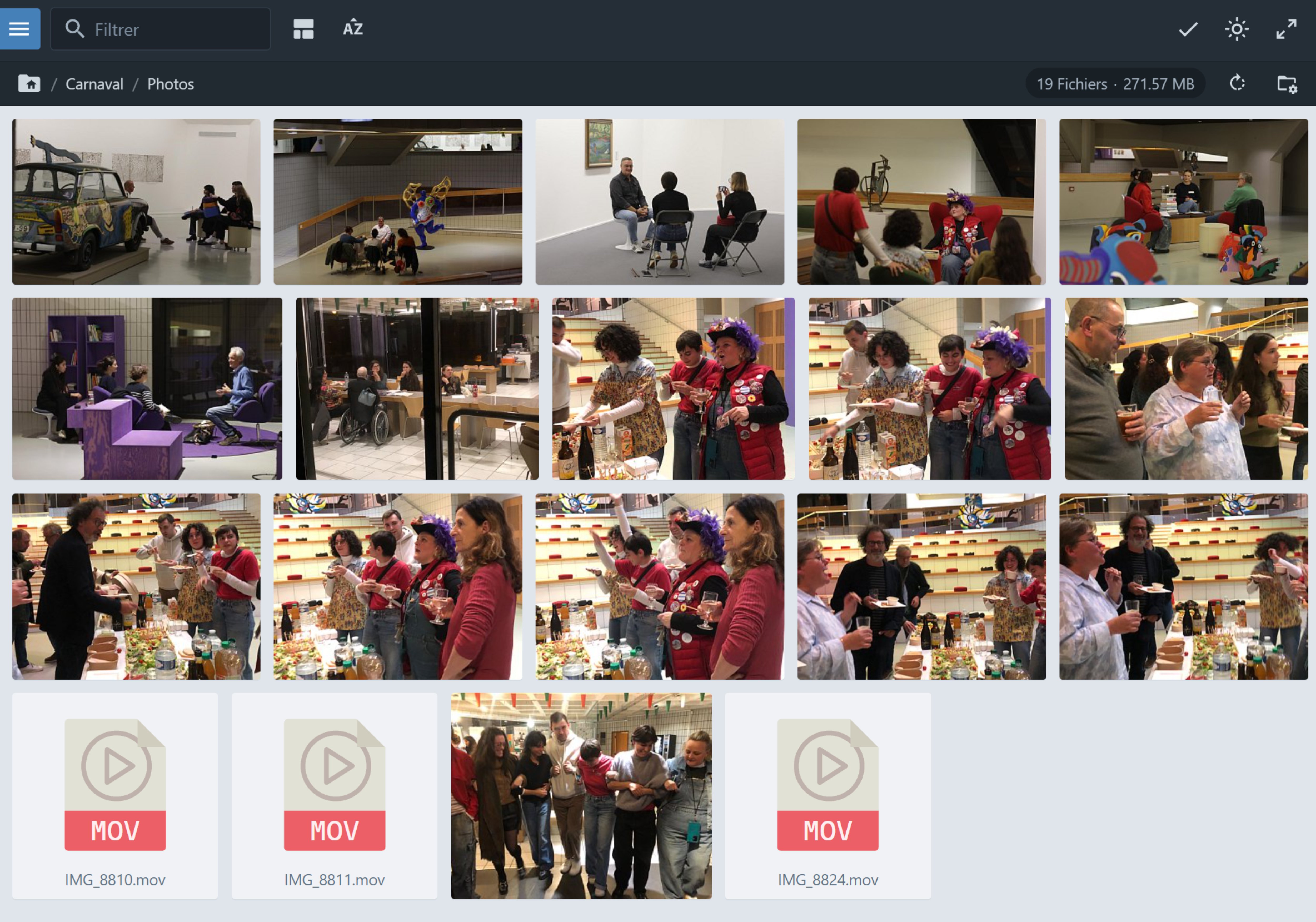
Taking care of the traces of a workshop therefore means taking care of an object, as one would take care of a box of archives, and that takes time and money. I host myself, on space I rent by the year, the traces of most of the projects I have led, in areas of my website that are not indexed by search engines but remain accessible to anyone with the link. This means managing hosting, making backups, converting videos so they play online, naming and filing the files. It is a little work and a little attention, and today it is no longer a question of disk space, which costs almost nothing. It is a question of responsibility: when I tell a group that their films will be there, I commit to their still being there in five years, and I am the one who guarantees it, not a company whose plans I do not know. The digital workshops I ran for years with Cultures du Cœur have their own platform, which brings together the participants’ films and creations; a filmed collection on the Dunkirk carnival, made in 2025 at the LAAC, the city’s contemporary art museum, with students of the Master’s in Exhibition Design and Museography (Écoresponsable) at the Université d’Artois, is entirely online, viewable, downloadable, and it will stay that way because I host it.
A memory that does not depend on me
In the article The Trace as Artistic Act, I drew on André Leroi-Gourhan, who shows in Gesture and Speech (1964) that human beings entrusted their memory to external supports, from the engraved tool to machines by way of writing, and that this movement is part of the very process through which our species became human. Keeping a trace of what we have lived, so as to come back to it later, therefore belongs to culture in the sense anthropologists give the word. Bernard Stiegler, who extended this analysis, calls these memories deposited in technical objects tertiary retentions, and he stressed the risk of seeing them captured by the industries that hold them. My concern is more modest and stays on the side of practice: hosting traces where we know they are, and using digital technology in a virtuous way, depending as little as possible on the tech industry. In Digital traces as a link I called these shared traces an equipped memory, and that is the status I try to give them: a memory deposited in an object, which can be consulted without asking my permission, and which depends neither on my presence nor on my own memory.
I believe this externalisation is the condition for participants to make what they have done their own. As long as the images are on my computer, they are mine, whatever I may say, and the group knows it. When they are in a space that everyone can enter without me, they change owner. It also happens that the participants themselves produce the traces. In a workshop I led for several months with autistic children at a day hospital, which I recounted in Letting autistic children make images, three children eventually picked up the compact cameras I had left on a piece of furniture without introducing them, and photographed and filmed the workshop while it was happening; their images were among the photographs in the final exhibition, which the children hung in the corridors of the hospital. The folder of this workshop contains these photographs, and you can see the children at work in them, which no finished film shows.
The process leaves no trace of its own
In mediation, the result is rarely what matters, and in The process, not the result I wrote about how the expectation of results threatens every form of accompaniment. But the process leaves no trace of its own. The trace has to be made while it is happening, and that is where everything is decided. Photographing the hands cutting, the table covered with paper, the group around the screen, the failed attempts, the preparation sheets; recording a take that will not be kept; keeping the first version and not only the last. These images show no result, but they make it possible to tell the story of the workshop, and this story serves three kinds of people.
It serves the participants, who find in it what they went through and can tell others about it. It serves those who were not there, a person who missed a session and catches up with what was done, a family who understands what their child experienced. And it serves supervisors and funders, who see concretely what happened instead of reading a report about it, and can thus evaluate the project on its process, which is where evaluation should lie. In a project run in 2022 over several weeks with a youth employment centre (mission locale) in Elbeuf, I built the folder session after session: it holds the films, each named with the first name of the person who made it, and, in “La fabrique des films”, the sounds, the photographs of hands at work, the making-of. In the end, the story of the project was there without anyone having had to write it, and the young people could see where they had started from.
From the day before the workshop to the years that follow
As with the rest of facilitation, the essential work is done beforehand. Here is what I have learned, workshop after workshop, not to neglect:
- The space exists before the first image. I create it the day before, put a first dated folder in it, prepare the QR code, and show the space to the group in the very first minutes, before anything has been made. Participants thus know, while they are making things, that what they make already has its place.
- Each session has its own dated folder, with sub-folders for films, photographs, sounds and documents. The structure is the same each time, so that people can find their way without explanation.
- I name the files in front of the group, with the title of the film, its version and the first names of those who made it. You no longer manage your files for yourself: others must be able to find their way around, tomorrow and in five years’ time, and naming a file in front of people tells them it is meant for them.
- The photographs of the process are there, not only the results. I take photographs during the work, the hands, the table, the screens, the faces when people agree, and I upload these images with the films. They are what we use to tell the story of the workshop.
- Everything is online within the hour after the session, that same evening at the latest. A week later, the trace no longer extends the experience; it is merely an archive.
- Access is easy, the link is enough. There is no complicated password and no account to create. I recommend a space that is not indexed by search engines, accessible to anyone with the link; in the years I have been working this way, I have never had a problem, because we are in a space of mutual responsibility. If access is too difficult, the trace becomes a border instead of a link.
- Everything can be downloaded, and everyone does what they like with it. I say so explicitly, and I do not try to check.
- I convert the videos so they play online. A file straight from a phone is too heavy to start without waiting. Free software such as HandBrake reduces it with no visible loss, and the film then plays on good and bad connections alike; for the person watching, quality is first of all a film that starts as soon as you click, and then nobody counts the pixels.
- You host the space yourself, or entrust it to your organisation, and back it up, rather than leaving it on a platform whose lifespan and terms you do not control. I use a very simple script, a file manager and gallery in a single file, Files Gallery, which I install in a sub-folder dedicated to each project; other tools would do just as well, what matters is knowing where the files are and being able to back them up with everything else. I described the reasoning behind this kind of hosting in Best practices for putting videos online.
- You commit for the long term, and you keep your word. Telling a group their films will be there is a promise; keeping it means paying for hosting every year and not clearing out old projects. That is the price of the method, and it is a modest one.
- You mediate the trace. At the end of the session, I show the space on the screen, go through what it contains, and explain how to find it again. A link sent by email with nothing else is a link nobody opens.
- I judge my work by what I have made available, not by the number of views.
Here are several of these spaces, which anyone can browse, to see what they look like from the inside: the folder of the 2025 session with students of the Master’s in Exhibition Design and Museography, a workshop at the Palais des Beaux-Arts de Lille followed by a collection on the Dunkirk carnival at the LAAC, the one from the workshop with autistic children at the day hospital, the one from a project run with a youth employment centre, and the platform of the Cultures du Cœur digital workshops. I did not make them to be beautiful, but so that people can find what they made there, and so that it stays there.


