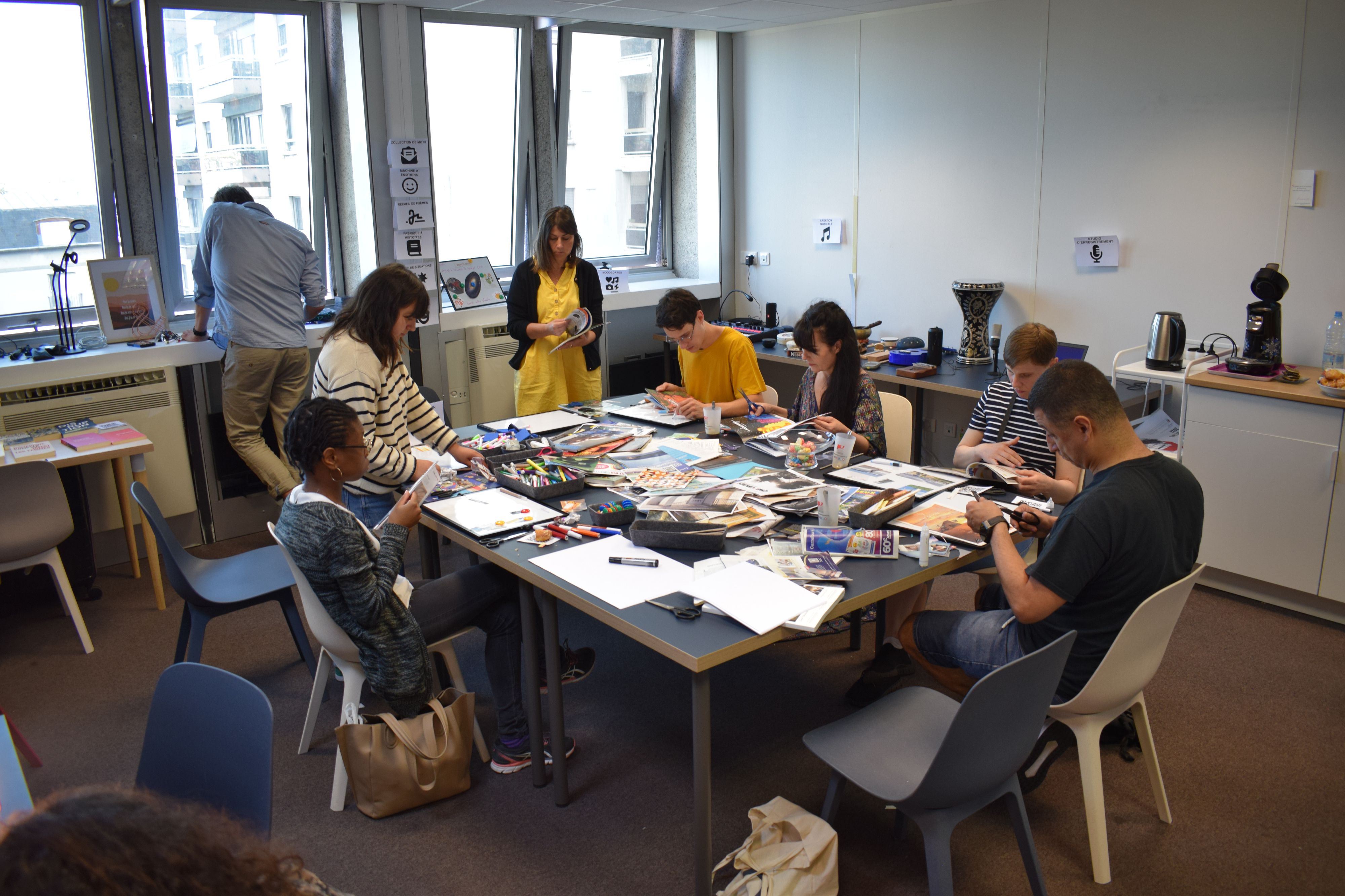
Before a workshop begins, I spend time arranging the tables, the scissors, the camera and the microphone. Whether people who were under no obligation sit down, pick up the tools and discover along the way that they are capable of making a film depends to a large extent on that time.
I always arrive at least an hour before a workshop begins, and I spend that time moving tables around. The people who welcome me often find this care excessive, and I understand that it may look like a quirk. This quirk comes from a conviction I would like to set out here: in an audiovisual creation workshop, people’s involvement, whether they feel they belong there and want to get started, is largely decided before a word has been said, in the way the space and the means of creation are offered to them.
People who did not have to be there
I often offer this workshop to people who did not come for it. In a day centre for homeless people, people are there to eat, wash and rest; on leaving an exhibition at the Musée de l’Homme, visitors are getting ready to go home; in a media library in Villetaneuse, at the seniors’ centre of the same town, in a community centre in Port-de-Bouc, people walk by, look, hesitate. No one has to take part. And yet they sit down, they cut out a little, then, little by little, they get caught up in it, and some of them experience something important there. Sometimes people stay all day and make a whole film, which they would never have imagined when they came in.
This is what I call open creative workshops, several of which are described on this site: in Villetaneuse, about the women who made the town, in the workshops Create your own film about imaginary disasters, and, in a more closed form, in a day hospital with autistic children. The time spent taking part is free, the degree of involvement is free, people arrive as they come and leave when they want. But everyone gets a result, every result has its value, the films are all different, and no one imposes a way of doing things. This is the whole challenge of mediation: how can people who asked for nothing take hold of the means of creation offered to them, and make them their own? I answer with the image of the title: we set the table. The cutlery is ours, it is our proposal; but people have the full and complete right to take it, and they sense it.
A professional from Cultures du Cœur who had taken part in 2022, during the Cultural Summer, in an intergenerational day in Port-de-Bouc, where we had made films in this way, told me four years later what had struck her most: the trust I placed in people, the way this trust led them to go far, to express themselves, to do things they did not think they were capable of, and to take enormous pleasure in it. I believe that this trust, which I discuss in Trust as a Technical Act, can be seen first in the table, before I have even shown it to anyone.
A table that invites
James J. Gibson, a psychologist of perception, coined a word in the 1960s, affordance, to designate what an environment offers to whoever is in it; his French translator, Olivier Putois, renders it as invite, an invitation. Gibson took it up again in his last book, in 1979:
“The affordances of the environment are what it offers the animal, what it provides or furnishes, either for good or ill. [...] I mean by it something that refers to both the environment and the animal in a way that no existing term does. It implies the complementarity of the animal and the environment.”
James J. Gibson, “The Ecological Approach to Visual Perception”, 1979.
A horizontal, flat, rigid surface offers somewhere to sit or to put something down; a handle lends itself to being grasped. Gibson argues that we perceive these offers directly, without having to infer them, and that perception is first of all perception of what one can do. He recalls that Kurt Lewin had spoken, as early as the 1920s, of the Aufforderungscharakter of things, translated into English as their invitation character, that by which an object calls us to act. A table covered with magazines, scissors and felt-tip pens has a very strong invitation character: you can see straight away that you can sit down, pick up a magazine, cut out, and that none of this commits you to anything. A camera set up in a corner and connected to a screen, and a microphone, have something more mysterious about them, but once you are sitting at the table, you already have one foot in the door. The scenographic work I do before a workshop consists in building invitations: arranging things so that people of all ages and all walks of life can see, without anyone having to explain it to them, what they can do there.
Maria Montessori had drawn a related idea from her observations. She called a prepared environment a setting designed to the child’s measure, where the material is accessible, orderly and beautiful, and where the adult steps back; in The Absorbent Mind (1949), she makes the teacher the keeper of this environment. What I take from Montessori is less the pedagogy than this shift: the essential part of the adult’s work takes place before the child comes in, in the preparation of the place, and what happens afterwards depends on what the adult has prepared.
Donald Winnicott has a word for what this means psychologically. Holding refers to everything the environment does to hold a person, to spare them ruptures, to give them the continuity they need in order to dare something. I showed, in Letting autistic children make images, that the permanence of the place, the same area where one sits, the same screen in the same spot, is part of this holding. Jean Oury and the practitioners of institutional psychotherapy thought of something similar for collective places, under the name of ambiance: a quality of space and relationships that must itself be cared for, because what can, or cannot, happen for people depends on it.
Ivan Illich called convivial, in Tools for Conviviality (1973), the tools that do not impose a set of instructions and a purpose on their users: “Tools foster conviviality to the extent to which they can be easily used, by anybody, as often or as seldom as desired, for the accomplishment of a purpose chosen by the user.” A camera filming a table, a microphone, and whatever you want to slip under the lens form a convivial tool in the strictest sense. The complexity or simplicity of what is made with it depends on each person’s ability, not on the tool; everything in it is within everyone’s reach, and everyone makes their own way through it.
A set-up that asks for nothing
Here is the set-up, as I invented it in 2012 or 2013 with the Maison des Métallos in Paris and as I have been putting it together ever since. In the centre, a large table, or several tables pushed end to end, covered with magazines, catalogues and papers, with scissors and felt-tip pens spread out in several places so that no one has to ask for them. Around it, enough chairs for everyone to sit down at the same time. In one corner, a second table with a camera on an articulated arm, which films the surface of the table and whose image is projected live onto a screen, and a microphone. In another corner, musical instruments, a tongue drum, percussion, a small synthesiser, laid out so as to make people want to pick them up. And a few smaller tables in the corners, so that teams can prepare their film away from the others. In Villetaneuse, the exhibition on the women of the town was present at every workshop, with nine boxes of documents to cut out, one per woman; at the Musée de l’Homme, the panels of the exhibition visitors had just seen were reprinted and laid among the magazines; in shelters, administrative documents in several languages. What goes on the table depends on the place, and that is how the place enters the films.
This apparent simplicity is the fruit of long technical work. It took me years to find this camera, years to find this microphone; the transport cases, the two computers, one used for filming and the other for broadcasting, I have been putting all of this to the test in the field for more than ten years. For people to have simple tools in their hands takes far more technical work than one might think, and returning to the job again and again. And everything has to be set up on site. In Villetaneuse, each time we took a lot of time to rearrange the rooms, so that the place itself would take part in the mediation. At the day hospital, I would arrive an hour early, set up on my own and turn the room into a studio, with clearly separate areas, lighting, sets, and spotlights I did not always need but put up to mark the place where images are made. During a day with fifty professionals, I took three quarters of an hour to try out layouts and move chairs, because when people arrive in a prepared room, they feel they were expected. Most facilitators take rooms as they are given to them, which is understandable when it is only a matter of passing on knowledge. When the aim is to experience something together, the place is part of what is being offered, and it has to be prepared as such.
Thirty seconds of demonstration
When they arrive, people do not know what they are going to do, and making a film, let alone an animated film, seems out of their reach. They can see that they can sit down, pick up scissors, try out a percussion instrument. That leaves the camera, the most mysterious thing in the room. Each time new people arrive, I begin with a very short demonstration. I take two or three volunteers, give them some elements that have already been cut out and ask them to put their hands under the camera; their hands appear on the screen, and everyone understands that the camera films the table. I then suggest that they improvise anything at all, for example one character who says hello and another who comes in. It takes thirty seconds. Then we watch together what it has produced, with the sound amplified and the image large and beautiful; there is a beginning, a middle, an end, the hesitation of the person who was searching for words makes the whole room laugh, and there is a film. The others have seen the result, they have understood, and they can get started.
I make a point of keeping this demonstration short, and of having two or three people do it in front of the others. The day I had the idea of asking everyone to cut out a character before the demonstration, it became long, the group drifted apart, and the first attempt failed: I had put the cart before the horse. The demonstration is nothing like an exercise, it is one more invitation, like the scissors on the table, which must show in an instant that it is simple and that the result is beautiful.
This set-up has another quality: everyone gets involved as much as they wish. You can cut out two characters and have them say hello to each other, and the film exists. You can spend three hours building a city, a scrolling frieze, a tale in several scenes, and the film exists too. Between the two, every degree is possible, and no one has to justify their choice. This is fairly rare in mediation. In most workshops, there is a precise idea of what people are supposed to do, and that idea suits some and not others, for whom it is too much, or not enough, depending on the moment in their lives, their tiredness, their skill, their desire. With papers to cut out, the question settles itself: you pick up ideas in them, cutting out is already choosing among a thousand images, and you can make something very simple or very elaborate out of them. Because it is easy to get into, everyone can then go as far as they want.
Points not to miss
- Arrive an hour early, and expect nothing from the venue in terms of equipment. Arriving early means arriving available, and the preparation is already part of the mediation.
- The large table in the centre, the chairs around it, enough for everyone. It is the first thing people see, and when they see it, they understand that they can sit down without yet knowing what they are going to do.
- Scissors and felt-tip pens in several places, never to be asked for. Having to ask for a tool is already an obstacle; finding it close at hand is an invitation.
- The camera and the screen visible, switched on, the image live. You can see at once, without anyone having to say it, that what you cut out will be used for something.
- The instruments laid out to make people want to play. Not in a bag, not in a pile: set out, within reach, as on a market stall.
- Islands set apart for preparation. A team building a film needs a quiet corner.
- On the table, papers that come from the place. The panels of the exhibition, the photographs of the town, the documents people need. It is through the material that the place and the people enter the films.
- More material than you expect to use. A table of drawing material next to the main activity, beautiful papers, so that everyone can, at any moment, do something else on the side.
- A thirty-second demonstration, by two or three people, in front of the others, each time new people arrive. No explanation, no preliminary exercise: you see, you understand, you get started.
- The degree of involvement and the time spent taking part are free, and this is said. Two characters or three hours, a short visit or the whole day. No one has to justify themselves.
- Everyone leaves with a result that has its value. The shortest film is watched with the same attention as the longest, put online in the same way, and also signed with a first name.
- The permanence of the place when the workshop is repeated. The same area to gather in, the same screen in the same spot. For some people, finding the room as they left it is considerable support.
- Looking for the right object from one workshop to the next. The boxes too small at the first workshop, better at the second, right at the third; being able to buy, try out and improve along the way is part of the work.
- Putting the room back as you found it. It is a lot of carrying and lifting for one day.
In The framework that authorizes, I looked at what space, time and the institution do to a mediation session. Setting the table is the humblest and most material part of that framework. What is at stake is that the means of creation should be within everyone’s reach, and that people should feel, as soon as they come in, that they were expected, that there is a place for them, and that they have the right to take it.


