You launch a contest, and nobody cares. Most cultural organisations that have run one have found this out, and so have I. The few contests that work owe it to something quite other than the prize or the rules: someone used them as a pretext for forming bonds. I would like to examine this notion of pretext, which I use without irony, starting from a festival of films made on mobile phones in museums, which a university master’s programme took up for more than ten years, and then to look, with anthropology and sociology, at how a list of winners manufactures a hierarchy, and at what can replace it when one organises the end of a project oneself.
A call the general public does not hear
The Musées (em)portables festival has existed since 2012. It is run by Museumexperts, the company that organises SITEM, the international trade fair for museums, cultural venues and tourism, and it invites museum visitors (today young people aged 13 to 25) to make a film of three minutes at most, with their phone, about their experience of the visit; the winning films are screened at the Carrousel du Louvre during the fair. The idea meets a conviction I have long defended: visitors’ audiovisual production is part of a museum’s mediation, just as much as the films the museum produces about itself. Yet such a call, if nobody passes it on, gets almost no response. The general public does not rush to send films to a trade fair.
What kept this festival alive for years was the Exhibition Design and Museography (eco-responsible) master’s programme at the Université d’Artois, in Arras, whose heads had spotted the contest before I joined their programme and had made it a yearly fixture. The students made films, and above all, for a long time, they ran workshops in high schools, secondary schools and care homes for the elderly, to help other people make films and enter them in the contest. One year, the master’s programme supplied, I believe, the vast majority of the films received. And since these students are closely supported, by me, within the programme, for about ten years now (I recounted one of these workshops in The creative unconscious, a method for collective creation), they have far better chances than the other participants, and win almost every time. One may wonder what sense there is in a contest where it is always the same people who win. The heads of the programme had found an answer from the outset: if a film from the programme wins, the prize, which is a sum of money, goes to the whole year group, not to the team that made the film. It is a clever trick, and I find it beautiful. It brings equality into a device designed to rank, and with it, the contest becomes a pretext: what matters is no longer winning, but having made films, together, and having had others make them.
Enduring a contest or organising one
There are two very different situations. In the first, the contest exists, we did not invent it, and we can either make use of it or endure it; this is the case in Arras, and the case of many institutions that like contests. In the second, it is we who organise the end of a project, and we have a choice. My position fits in one sentence: when there is no choice, turn the contest to other ends; when there is a choice, no contest, no ranking, but a diversity that the participants themselves bring to light.
I came across this question again during an eighteen-month project carried out with the Institut pour la photographie in Lille and the association Hors Cadre, in which I trained youth justice educators (Protection judiciaire de la jeunesse) in photographic practice (I describe the method in Participatory reverse photography workshop), and ran one of the workshops with young people myself, other photographers running the others. Youth justice services like contests, and readily organise them. When I say that the problem with a contest is ranking, winners and losers, people object that the mere fact of entering a contest, of allowing oneself to do so, has value in itself for these young people. That is true. But in this project it was the services themselves that organised the contest, and everyone was to receive a prize. At that point, it is no longer a contest. The word itself is a problem, with everything it carries along, and that problem is not erased by handing everyone a prize.
In the article An incredible talent I presented the social psychology research on the effects of putting creative works in competition, including on those who win, and I will not return to it here. I would rather come at the question from the other end, from the side of cultural institutions that organise contests without meaning any harm. Film festivals are the most visible case. At the smallest festival, films are screened, a jury meets, sometimes several, and the jurors name the best film or crown a few. It goes all the way up to Cannes. The media talk about the winning films, much less about the others, and in the end the former are not necessarily more successful than the latter. The César awards and their equivalents are recognition among peers: people from the profession judge the profession’s films and the work of each of its crafts. I believe this serves no purpose and does only harm, and I would like to support this judgement with something other than my irritation.
From potlatch to prize list
Marcel Mauss, in The Gift (1925), described societies where the gift, far from being peaceful, serves as a weapon. He calls potlatch, from a Chinook word, those exchanges in which chiefs vie with one another in generosity to the point of ruin:
“Yet what is noteworthy about these tribes is the principle of rivalry and hostility that prevails in all these practices. They go as far as to fight and kill chiefs and nobles. Moreover, they even go as far as the purely sumptuary destruction of wealth that has been accumulated in order to outdo the rival chief as well as his associate […].”
Marcel Mauss, “The Gift”, 1925 (trans. W. D. Halls).
Mauss also speaks of total services of an agonistic type, and he shows that what is at stake there, beyond the goods exchanged, is a hierarchy: who stands above whom is established publicly, and the festivity is merely the form this ranking takes. I am not comparing a festival prize list to the destruction of blankets in the American Northwest. I note that the structure is the same: a ceremony, apparent gifts, and, beneath these gifts, the establishment of a hierarchy among people who are at once rivals and associates, and who need one another for each one’s rank to be visible.
Pierre Bourdieu analysed ceremonies of the same kind in our own societies. In “Rites of Institution” (1982), he takes up van Gennep’s rites of passage to show that their function is not so much to move people from one state to another as to separate those who pass from those who never will:
“To institute, in this case, is to consecrate, that is, to sanction and sanctify a state of things, an established order, as a constitution does, precisely, in the legal and political sense of the term.”
Pierre Bourdieu, “Rites of Institution”, 1982 (my translation).
To institute, he adds, is “to impose a right to be that is an obligation to be”, and an arbitrary boundary thus ends up passing for natural: what was a social ranking appears, after the ceremony, as a difference of nature or of talent. A prize-giving follows the same mechanism. The jury does not measure a value that would exist before it: it institutes that value, by publicly separating the winning films from all the others, and the operation succeeds all the better when nobody, neither the jury nor the audience nor the winners, sees how arbitrary the choice is. James F. English studied, in The Economy of Prestige (2005), the proliferation of cultural prizes over the past century. He shows that it is now largely through them that cultural value is manufactured, and through them that it is converted into other forms of capital, economic, social, media: juries do not record the value of works, they produce it.
Finally, Roger Caillois, in Man, Play and Games (1958), describes agôn, competition, as “a combat in which equality of chances is artificially created, in order that the adversaries should confront each other under ideal conditions”, so that the winner owes the victory to merit alone. Yet this equality almost never exists in creative contests. The Arras students win because they are supported; films that win prizes at festivals have producers, press officers, networks. When chances are unequal, the jury does not measure merit: it ratifies the starting conditions and passes them off as a verdict. Jacques Rancière formulated the principle opposite to all this machinery in The Ignorant Schoolmaster (1987): “Equality was not a goal to be reached, but a point of departure, a supposition to be maintained in every circumstance” (my translation). To say there is a hierarchy among the films of a workshop is to signify that some people are less capable than others, which is false. Each person does things in their own measure, and the task is rather to look for the way in which each person is capable, in their own way, and how they can enrich the others.
The pretext, in the weaver’s sense
The word pretext has a bad reputation: in everyday use, it is a false reason given to hide a true one. I use it in a sense closer to its etymology, what is woven in front, what comes first and gives shape. A good pretext is an external occasion, with a date, a rule, an audience, which allows people to do together something they would not have done without it, and to do it for real, that is, for others than themselves. The contest is not the goal, and nobody works to win a prize. Thanks to it, the work becomes real: the film will be seen, screened in a place, on the appointed day, and the shoot takes on a substance that no exercise would have.
I tested this long ago with the Pocket Films Festival, which I created in 2005 with the Forum des images in Paris, just as video was arriving in phones. Audiovisual professionals found the object of no interest, and yet the festival had an international impact, because hundreds of people found in it a legitimate pretext to explore the possibilities of this new object (traces remain in the Catalogs of all editions of the Pocket Films Festival). It has since come to an end, but it was the first of its kind, and many festivals of phone-made films were born after it; the organisers of Musées (em)portables had in fact consulted me when they started. I must also say that Pocket Films awarded prizes, and that a screening without a prize list would have done just as well: what mattered was not the winners, whom nobody remembers any more, but that people had filmed and that their films had been shown.
Around a modest pretext, the students and heads of the Arras master’s programme wove strong bonds: between the students and the museums that host them, between the students and the high school pupils they supported, between the museums and audiences that would not otherwise have come. None of these bonds was written into the rules. And since the workshops in high schools have become rarer, the number of films has fallen, a sign that the festival lived on these bonds, and not on the call for entries. Screenings without a contest could have given rise to the same bonds, and that would have been just as good.
Showing diversity, through those who created
When one organises the end of a project oneself, the question is therefore not how to organise a good contest, but how to show without ranking. In the article Building, Not Valorizing I explained why the word “valorise” seems to me a trap. My answer is to involve the participants in the showing itself: they design the scenography, put up the exhibition, organise the screening and choose how to present the films, and they show the process, the photographs of the making, as much as the results.
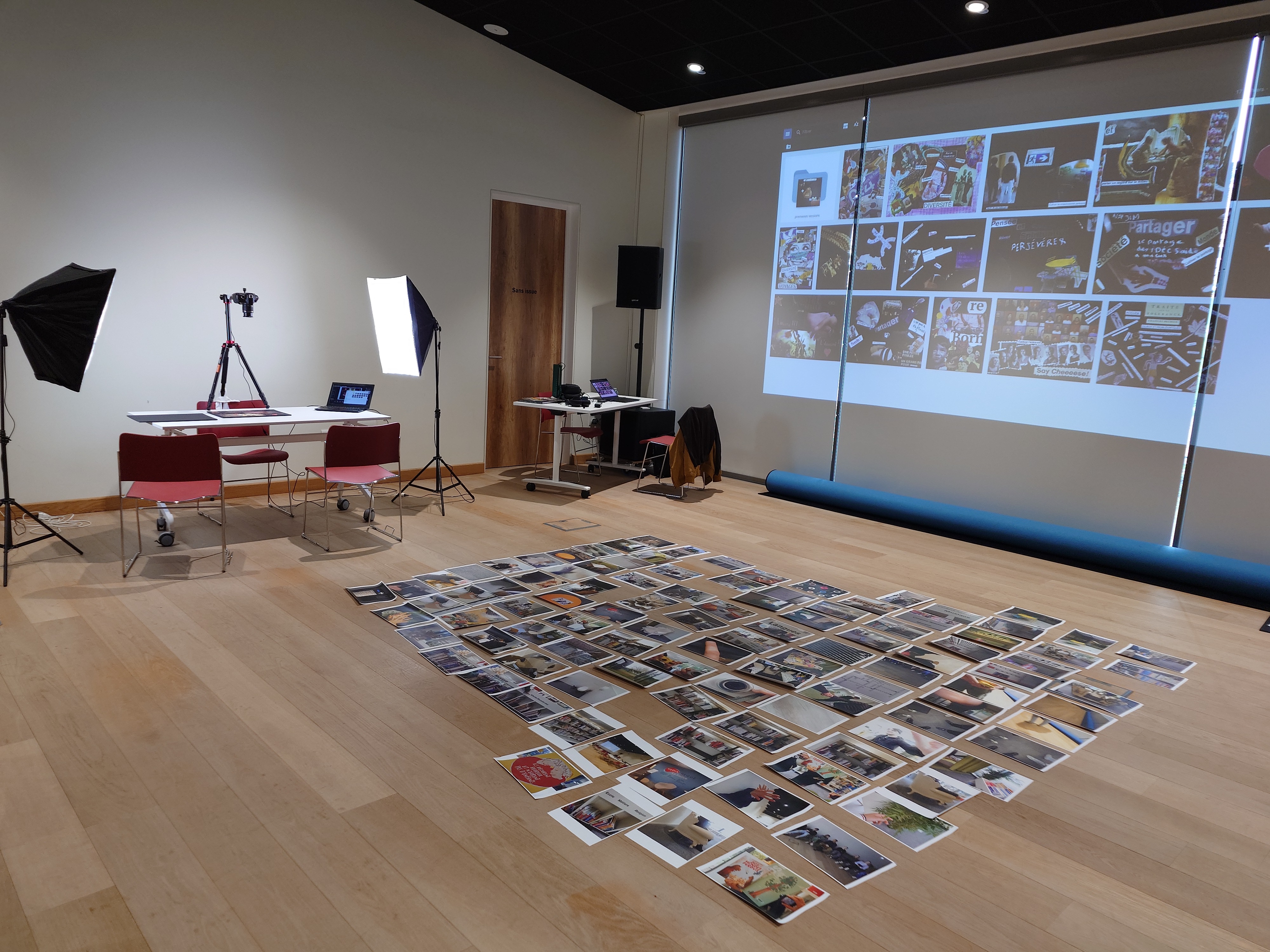
In Making virtual reality a ground for student autonomy I recounted the closing day of a project carried out with three secondary school classes, who had shot six 360-degree films. We could have, and others would have, organised a vote or convened a jury to name the best of the six. Each group presented its film, projected large, then the pupils put on the headsets, group by group, to see the films in virtual reality; meanwhile, the others cut out and glued onto cardboard the photographs I had taken during the workshops and had printed for the occasion, and each of them made a panel tracing their own path through the project. Once all the panels were on the wall, the room had become an exhibition, which we visited together, passing the microphone around so that the pupils could tell what they had done. There was no need to say which films were the best. On their panel, each pupil told their own path, and paths are not something you rank.
Some young people still ask the question: “Which one is the best?” I answer that there are interesting things in each one, that they are all different, and that ranking makes no sense, because each person does things in their own measure; what matters is to see how we can enrich one another, each with their own particularities. If some go on seeing the world as a hierarchy, that is their perfect right. But they will have lived through a moment when people did not reason that way, and when there was nonetheless a showing, recognition, an audience, applause, without any contest. It is this experience that mediation allows us to offer them, and it is worth more than a prize.
Points not to miss
- Knowing which of the two situations you are in. The contest exists and you did not choose it: use it as a pretext and turn it to other ends. You organise it yourself: no contest, no ranking.
- Turning the contest around with a collective rule. If the prize goes to the whole group rather than to the winning team, the contest has lost its driving force. This is the Arras trick, and it can be transposed.
- Making the contest an occasion to have others make films. When you help other groups take part, what is at stake shifts from the prize to the bonds. The festival’s vitality depends on these bonds, and it fades as soon as you stop supporting other groups.
- Making the work real through a date and an audience, not through a ranking. An announced screening, a venue and invitations are enough to give the work the substance people expect from a contest.
- Entrusting the showing to the participants. Scenography, hanging, screening order, presentation at the microphone: they are the ones who show their work, and the way of showing it is part of what they have learned.
- Showing the process as much as the films. Show the photographs of the making, the drafts, the notebooks; faced with the account of how something was made, there is nothing left to decide between. I developed this practice in The process, not the result.
- Showing everything, with the same attention. The most modest film is screened in the same conditions as the most accomplished, presented by its makers, applauded like the others.
- Welcoming the question of the best without dismissing it or settling it. Say what you saw that was singular in each one and how the films differ, and leave everyone the right to see the world as a ranking, while having let them experience something else.
- Being wary of prizes handed out to everyone. A contest where everyone wins is no longer a contest, and yet the word, the jury and the prize-giving are kept; better to call things by their name and throw a party.
I am not asking anyone to boycott Cannes. I am asking that we know what we are doing when we give a prize to a workshop film in front of the people who made the others, and that we realise that with the same energy, put into a screening where everyone presents their film and tells how it was made, we get what the contest dangles without ever delivering: people proud of what they have made together.


