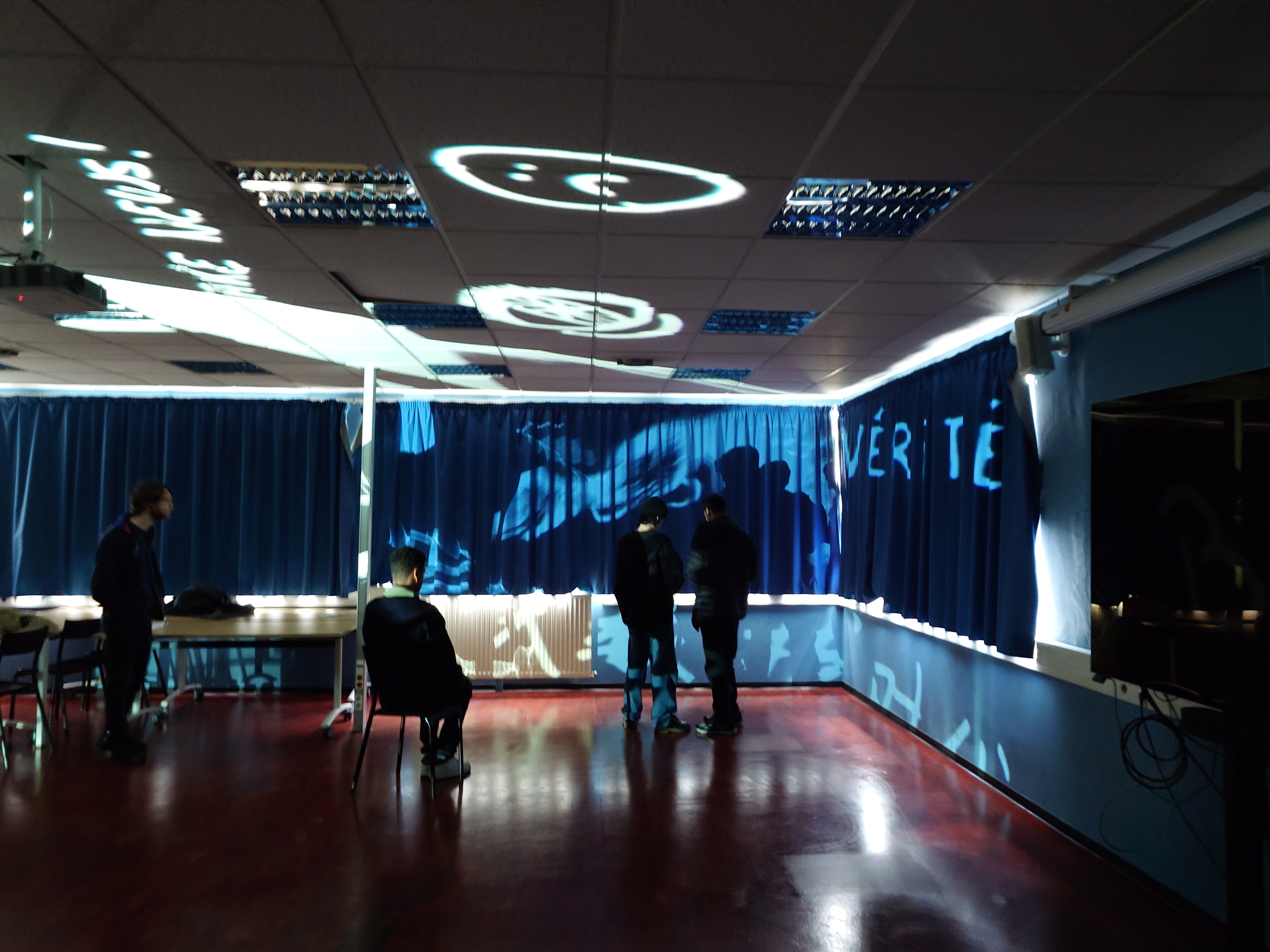
Lying to a child « for their own good » is an ordinary gesture, practised by nearly every adult. I argue here that this well-meaning lie spares us a discussion at the cost of the child’s trust in others and in the world, and that sincerity, despite the risk it poses to the relationship, builds lasting foundations. I ground this reflection in Michel Foucault’s parrhesia, in Janusz Korczak and in developmental psychology, before proposing concrete ways of taking the risk of truth.
The truth I am talking about
At first sight, truth does not seem to have much to do with pedagogy, except for the accuracy of the information we pass on. I explained in the article Truth and lies why this accuracy of content is a receding horizon, since what we transmit is first of all a matter of collective beliefs, in history as in economics and even in science, and I argued in Presence and truth that truth is necessarily complex, partial, bound to our experience of the world. The truth I am talking about here is of another nature. It is lived truth, the truth of oneself in the relationship with the other, the sincerity of the words that the teacher or facilitator addresses to the people in their care.
I had not imagined it at first, but I realise that these two truths hold together. The Palo Alto school established that every message carries both a content level and a relationship level (Paul Watzlawick, Janet Helmick Beavin and Don D. Jackson, Pragmatics of Human Communication, 1967). When I lie about a content, I also define, silently, the relationship in which I place the other person. The question of whether the information I give is true therefore meets the question of whether, in my relationships with others, I am sincere, or whether I lie to obtain things from them.
The lie about the bakery
A child asks for a sweet. We think it is bad for their health, and we know that a bakery sells sweets fifty metres away. So we tell the child that there are no sweets in the neighbourhood, that we cannot buy them any. The goal is commendable, the child’s health, and the lie seems to us a legitimate tool to reach it.
My point is not to single out culprits. This gesture is one of the most widely shared there is. Gail Heyman and her colleagues have shown that about four American parents out of five admit to lying to their children in order to steer their behaviour, and the proportion comes close to the totality in the Asian samples studied since (Gail D. Heyman et al., 2013; Peipei Setoh et al., 2022). Researchers have given this practice a name, « parenting by lying ». It is a deep, widely transmitted cultural habit, and it is as a habit, never as a personal fault, that it seems useful to me to look at it.
What interests me is what this lie allows us to avoid. It spares us the argument, that is, the work of accompanying the child towards an understanding of what would be better for them. If we lie, it is at bottom because we are convinced that we are not capable of persuading them, in other words convinced that truth does not have enough strength to reach our commendable goal. We also fear that the child, caught up in their emotions, will not make the right judgements, so we make those judgements in their place. Janusz Korczak, whose thought inspired the International Convention on the Rights of the Child, already described this attitude in his manifesto The Child’s Right to Respect (1929): the adult mistrusts the child, denies them judgement on the grounds that they would lack the capacity for it, and deals with the man of tomorrow instead of respecting the person of today. Korczak writes that age creates no hierarchy among human beings, and that the child must be involved in the decisions that concern them. Deciding in their place, on criteria that we alone have laid down, amounts to denying their dignity.
The title of the best-known book by the psychoanalyst Alice Miller, For Your Own Good (1980), repeats word for word the justification we give ourselves in front of the bakery. Miller analyses in it what she calls poisonous pedagogy, an expression she borrows from Katharina Rutschky, that is, the whole range of educational violence inflicted on children in the name of their own good, and I have detailed her thought in the article Supporting Young People on What Is Theirs to Live. She is most often read as a thinker of violence, and yet truth holds an equally important place in her work. Compiling the child-rearing manuals of past centuries, she shows that this pedagogy only works on condition that it goes unperceived. The authors of these manuals recommend acting early enough for the child to keep no memory of it, and obtaining obedience without the child noticing the constraint. For Miller, the lie is thus the very condition of effectiveness of educational violence, which must remain invisible in order to inscribe itself in the child. I do not place the lie about the bakery on the same level as the mistreatment she describes. But the mechanism is shared: deciding on the child’s good in their place, and hiding from them that we are deciding.
The day the child discovers the bakery
It would be illusory to believe that the child will never realise. In the moment, the manipulation succeeds, since its very definition is to go unperceived. But one day, the child walks down that street again, discovers the bakery, remembers that we knew the neighbourhood. They will then be certain that we lied to them in order to « protect » them. At that moment, something comes undone in their confidence in themselves, in their trust in others, in their trust in the world. They learn that the voice of authority, the one that establishes the truth of the moment, can be deceitful. And they enter into a relationship of distrust towards that voice, ours first, then, by generalisation, that of the adults who teach and who decide.
Researchers in developmental psychology are now measuring this deferred cost. Peipei Setoh, Siqi Zhao, Rachel Santos, Gail Heyman and Kang Lee surveyed 379 young adults in Singapore, and observed that the more a person remembers having been exposed, as a child, to their parents’ educational lies, the more they lie to their parents themselves in adulthood, and the more they report psychosocial adjustment difficulties, anxiety and aggressiveness first among them (« Parenting by lying in childhood is associated with negative developmental outcomes in adulthood », Journal of Experimental Child Psychology, 2020). These authors propose the erosion of interpersonal trust as the mechanism, and remain cautious since these are correlations; I remain cautious along with them. What I retain above all is the reciprocity these studies outline, namely that children who have been lied to a great deal lie more themselves. Sincerity, too, is learned by imitation.
A truth-telling that commits the one who speaks
Michel Foucault devoted his last course at the Collège de France, in 1984, to a Greek notion that names what I am trying to describe: parrhesia, frank speech, truth-telling (The Courage of Truth, lectures of 1983-1984, published in 2009). For there to be parrhesia, Foucault explains, the person who speaks must state a truth they assume as their own thought, and must take, in stating it, a risk that bears on the very relationship binding them to the one who listens. The parrhesiast accepts the possibility of angering, of hurting, of provoking, and therefore of weakening the bond that makes their speech possible. Foucault stresses that this truth-telling presupposes a pact, between someone who takes the risk of speaking and someone who agrees to listen.
One passage of the course helps me think about the pedagogical situation. Foucault distinguishes there between the truth-telling of the teacher, who transmits knowledge and thereby weaves a filiation, without much risk, and the truth-telling of the parrhesiast, who puts the relationship at stake each time. The distinction is accurate, and it is precisely this distinction I would like to shift: reintroducing parrhesia into the teaching position. Telling the child « there is a bakery around the corner, I think this sweet is bad for your health and I don’t feel like buying you one » is a minuscule act of parrhesia. We expose ourselves to negotiation, to anger, to having to argue, perhaps to being wrong. We take the risk of cooperation, the risk of being enriched by the other, and also the risk of being destabilised. The place we refuse the other by lying is comfortable; it builds much less, and it destroys in many respects.
The bakery, years later
We overestimate the immediate cost of truth, the discussion it opens, the train we might miss, and we never see the cost of the lie, because it is deferred and diffuse. The gain of truth, too, is deferred. The child who has been told the truth knows that there is a bakery in that spot. Imagine them as an adult, passing through that neighbourhood again by chance, coming across a person in hypoglycaemia who needs sugar as fast as possible. They will know where to run. The example verges on the fable, and I keep it for that reason. Knowledge acquired in truthful situations forms foundations with which one can compose all one’s life, in autonomy and in responsibility. This is what I call solid ground, and it is built thanks to the risks that educators will have taken with truth.
Taking the risk of truth, without heroism
Pedagogical parrhesia does not require telling everything to everyone in every circumstance. It requires that what we say be true, and that we assume its relational price. Here are concrete ways of practising it, on a small scale:
- The first is to give one’s real reasons, including the less noble ones. Saying « I don’t feel like buying you one » is giving a true reason, more modest but more solid than the false reason of the neighbourhood without sweets, because it shows the child that our word commits us.
- Keeping one’s word on small things is another. If a pupil asks us for a document for the next session and we accept, write the commitment down and honour it. If we sense that we will not be able to, it is better not to make it. If we fail, start the next session with apologies and a renegotiation. The value of one’s word is forged in these details.
- Admitting that we do not know is also part of it. Answering « I don’t know, I will look it up », then actually looking it up, is grounding one’s authority on reliability rather than on omniscience.
- It is also possible to return to a past lie rather than sink deeper into it. If the child discovers the bakery, the temptation is to lie again, to say that we did not know, that it was closed. Acknowledging the lie and naming the fear that motivated it repairs the relationship, and the child discovers through this that repair is possible.
- Welcoming negotiation as the pedagogical moment itself changes a great deal. The debate that opens when we tell the truth, about health, about desire, sometimes about something else entirely, is the place where the child exercises their judgement. I described a related logic in When the instruction is not followed, where departures and objections are received as contributions.
- Finally, there remains the work on one’s own fears. When we lie, it is most often because we are afraid of the other, of their anger, of their disappointment, of the disorder their freedom might introduce. I detailed in Trust as a Technical Act the inner work that allows a facilitator to trust people, and the same work makes it possible to tell them the truth.
None of these gestures requires heroism or perfection. It is a direction. In every situation where we choose the true word over the convenient word, we strengthen the trust that children, and the adults they will become, will be able to place in the words of others. The good conscience of the lie is a fear of risk. Taking the risk of truth means giving the other a full place in the relationship, the place Korczak claimed for children in 1929, and which each of us can offer as soon as the next conversation.


