Wondering what we would have done under the Occupation costs nothing, and that is how the retrospective position can be recognised. Inside a situation, the question is paid for before its content has even been examined. I lived through this between 2020 and 2022, in a country governed by fear, and I recount here what I saw, what I did, what it cost me and what it opened up.
During, I was making one calligram a day
From 5 July 2021 to 5 July 2022, I made one calligram a day, three hundred and sixty-five in all, which can be seen in the Calligrams section of this site. It was the period of the health pass, of vaccination campaigns, of checks at the entrance of cafés. I did not know how it would end, nor how long it would last, nor what would be said about it afterwards.
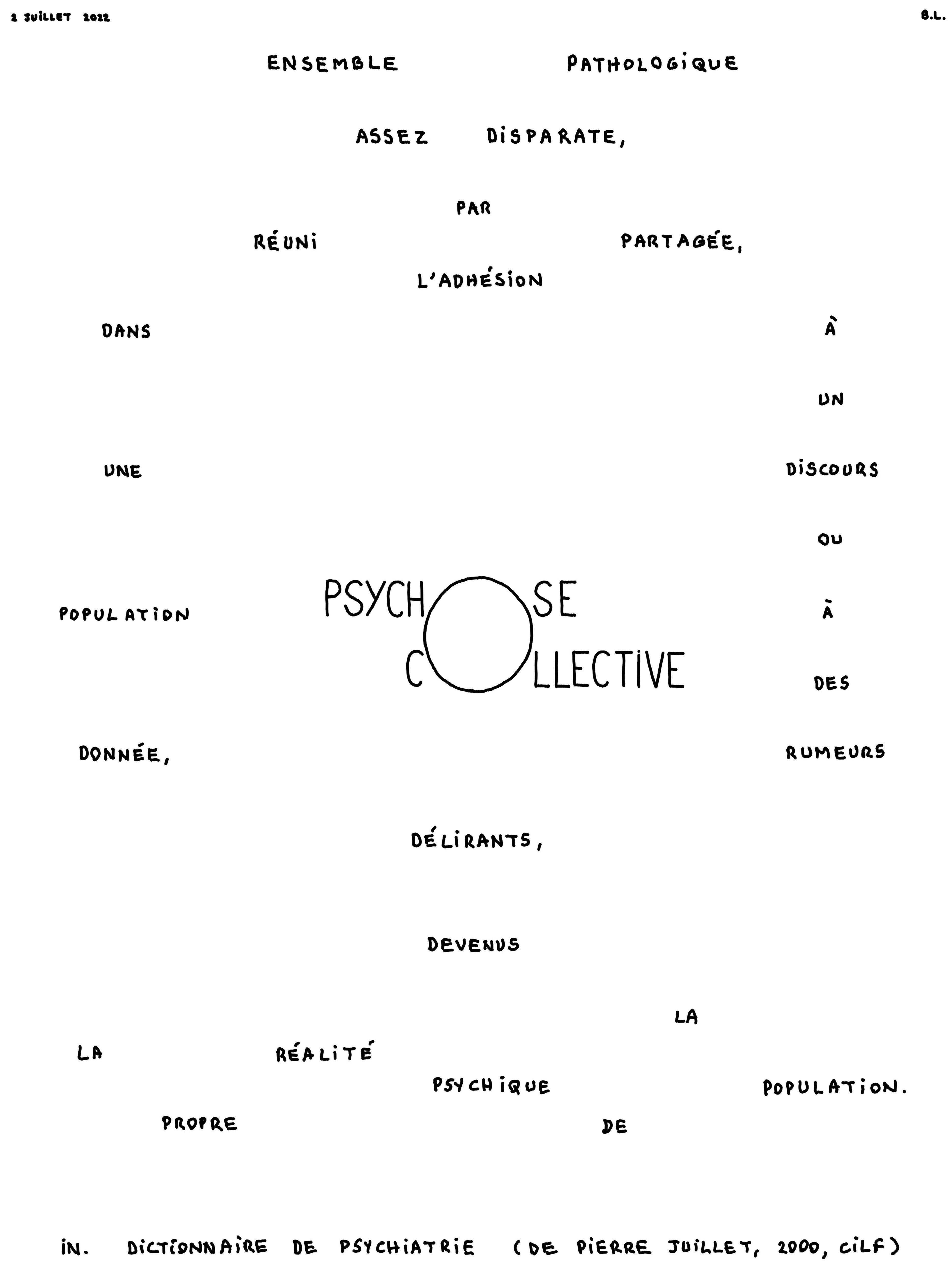
On 2 July 2022, I made the one I called Collective psychosis. In it I calligraphed the definition given by Pierre Juillet’s Dictionnaire de psychiatrie, published by CILF in 2000, a rather disparate pathological ensemble united by shared adherence, within a given population, to delusional discourses or rumours that have become the population’s own psychic reality. The words turn around the title, which sits at the centre of the page.
I do not present this as proof. A definition copied out by hand demonstrates nothing, and I could have been wrong from start to finish. What these sheets establish is something else. They are dated. I made them without knowing what came next. They document the position of during, and that position, nobody can reconstruct it after the fact, not even the person who occupied it.
Paralysed, then 11 September 2020
In the spring of 2020, I was afraid like everyone else. The President of the Republic had repeated six times in a single address that we were at war, and I thought lockdown was a bad decision but perhaps the least bad one. I was paralysed, and I did not yet see that this paralysis was produced, maintained, administered.
What opened my eyes was an open letter. On 11 September 2020, thirty-five scientists, academics and health professionals, at the initiative of the physiologist Jean-François Toussaint and the sociologist Laurent Mucchielli, published in Le Parisien a text entitled “Covid-19, we no longer want to be governed by fear”. They wrote that government communication amounted to the display of a protective posture rather than a health strategy, and that it divided and infantilised citizens instead of uniting them and giving them responsibility. Within a few days, the signatories went from thirty-five to two hundred. And almost nothing happened. The letter remained barely visible in the other media, and I discovered on that occasion that a collective scientific voice can be rendered more or less invisible.
Reading it, I understood that I had been manipulated, and that the instrument of this manipulation was my own fear. From then on I looked for information elsewhere, I read the literature and the controversy, both, and I formed my own opinion.
Le Monde, in the first months, was still conducting independent investigations, and some things we know, we know thanks to that moment. We know, for instance, through an investigation by the American magazine Science relayed in France, that on 8 October 2020 the European Commission signed with the Gilead laboratory a contract for five hundred thousand doses of Remdesivir, for more than a billion euros, while Gilead had known since 23 September the results of the WHO’s Solidarity trial showing that this drug reduced neither mortality nor the length of hospital stays, and did not disclose them during the negotiation. The Commission was informed the day after the signature. Then I watched that newspaper, from the summer of 2020 onwards, relay government discourse with a servility it had not shown at the start. That shift in the media remains for me one of the striking facts of the period, because it reproduced the configuration I had believed was confined to history books, a State discourse and a press discourse become indistinguishable.
Danto’s sentence about the Thirty Years’ War
Arthur Danto isolated in 1965, in Analytical Philosophy of History, a category of statements he calls narrative sentences. These are sentences that describe an event by relating it to a later event. His example has remained famous. The Thirty Years’ War began in 1618. The sentence is true, and nobody could have uttered it in 1618, because one would have needed to know the date of the end in order to name the beginning. Danto draws from this a general property of historical knowledge. We routinely describe the past with descriptions that were not available to those who lived it.
I draw from this analysis a good part of the answer to the retrospective question. When I wonder whether I would have been a “resister”, I use a word that belongs to the vocabulary of afterwards. The person I claim to identify with could not have thought of themselves under that word, not because they lacked lucidity, but because the description did not yet exist. I am asking them to answer in a language they did not have.
Pierre Bayard went to the very end of this difficulty in Aurais-je été résistant ou bourreau ?, published by Éditions de Minuit in 2013. He begins by admitting that the question, as we ask it, has no answer. Then he refuses to leave it there and reconstructs an entire existence, the one he would have had if he had been born thirty years earlier, in the place of his father, born in 1922, eighteen years old in 1940. He restores the information this young man had and the information he did not have. The question becomes serious again as soon as its ignorance is given back to it.
One can see, moreover, still today, how much this question circulates without its ignorance. Evelyne Pieiller introduces it in the editorial of the issue of Manière de voir, Le Monde diplomatique’s special edition, devoted to the strategies of fear in the summer of 2026, observing that many people like to ask it at least once in their lives, and she immediately calls it a gratuitous question. She is right. And this issue, which travels through five centuries of manufactured fears without a word about the Covid period, is not an isolated case. The same gesture could be found in many publications, and that is precisely what makes it interesting.
Law of 5 June 1943
There is a second reason to distrust the word “resister” when used in the past conditional. It was not the word in use.
On 14 August 1941, the Vichy government created, by a law published in the Journal officiel of 23 August, the special sections, exceptional courts charged with judging, without prior investigation, offences committed with an intention of communist or anarchist activity. The special section of the Paris court of appeal was installed on 26 August and held its first hearing the following day. Three men were tried and guillotined in the days that followed. The powers of these courts were then broadened, and a law of 5 June 1943, published in the Journal officiel of 24 June, carries in its very title the repression of communist, anarchist, terrorist or subversive activities.
The word “terrorist” is therefore in French law, in the Journal officiel, in June 1943. The Affiche rouge, which is always cited, dates from February 1944, and it comes late, when the designation had been in place for at least two years. The vocabulary does not come from the poster. Those who designed it put into images a designation already inscribed in law.
The person who was doing at that time what we today call “resisting” was, in law, a terrorist. Not figuratively, not in the rhetoric of one camp. In the text of the law of their own country, with the corresponding courts and penalties.
Above all, it must not be known
Olivier Wieviorka, in his Histoire de la Résistance 1940-1945, published by Perrin in 2013, recalls two things that commemorative usage erases. The Resistance rested on secrecy, and it remained a minority from beginning to end. Of the two hundred thousand to three hundred and fifty thousand who evaded compulsory labour service, resisters formed only a minority.
One could not defend one’s position publicly, nor convince one’s neighbours, nor argue at the dinner table. Saying it endangered one’s family, and it would have produced within families divisions from which nobody would have emerged. Entry into resistance therefore gave rise to no public debate, and to no controversy of opinion. It was not a position one upheld, it was an act one hid.
I say this clearly for what follows in this text. A term-for-term comparison between that period and the period 2020-2022 does not hold, and making it would be to commit exactly the anachronism I am talking about. What was at stake under the Occupation was the firing squad, hostage-taking, deportation. Between 2020 and 2022, it was social exclusion, the loss of a job, a fine. Anyone who puts the two situations on the same level is talking nonsense, and cheaply grants themselves the role they dreamed of having. What carries over from one situation to the other is much narrower, and it must be named with precision. In both cases, the sanction precedes the examination of content. What differs, and differs enormously, is the nature of that sanction and its scale.
The question was the offence
During the Covid period, there was generalised fear. Everyone was afraid, myself included. Fear of dying, fear of causing one’s parents to die, fear of the police, fear of losing one’s job. That fear was real, and one does not judge people who are afraid. But it was also cultivated, methodically maintained, by the daily count of deaths, by the vocabulary of war, by making children feel guilty towards their grandparents, by prohibitions whose very absurdity made power felt, such as the ban on walking alone on a beach or in a forest.
In that climate, it was not this or that conclusion that was stigmatised, it was the act of asking the question. Asking whether the ban on walking alone in nature was proportionate, asking what exactly the vaccines had been tested on, asking why no comparison was made with the countries that had not locked down, this called not for an answer but for a label, “conspiracy theorist”, whose mechanics I have described in Inside the Mind of Conspiracy Theorists. It is used to close before examining. The sanction was secured in advance, it bore on the fact of having opened one’s mouth, never on the substance, since the substance was never addressed. Under these conditions, most people asked no questions, and I do not believe this was cowardice. When the question itself is the offence, keeping silent is a sound calculation, and that is precisely what makes the apparatus effective.
The clearest example is that of promises. On 29 April 2021, Emmanuel Macron declared to the regional press that the health pass would never be a right of access differentiating between the French, and that it could never be required to access the places of everyday life such as restaurants, theatres and cinemas. On 12 July 2021, he announced its extension to all these places, applied from 21 July and then broadened in August to cafés, restaurants, trains, shopping centres, hospitals. Those who had announced this extension before it happened, because it was predictable for anyone looking at the logic of the apparatus, had been sent back to the label. They were plotting nothing. They were describing what was going to happen, and what happened.
The same goes for transmission. The public message was that one got vaccinated to protect others, and it was on this message that the exclusion of the unvaccinated rested. Yet the information that the trials had not measured the vaccine’s effect on transmission was accessible from the start, in the trial protocols themselves, for anyone who looked. Those who relayed it in 2021 received the label. On 10 October 2022, before the special committee of the European Parliament devoted to Covid, Janine Small, an executive of Pfizer, confirmed to MEP Rob Roos that the vaccine had not been tested on this point before being placed on the market. The same sentence, conspiracist in 2021, is official information in 2022. The delay between the two moments measures exactly what I am talking about.
Meanwhile, the greatest fortunes grew as never before. In May 2021, Oxfam and the People’s Vaccine Alliance established, on the basis of the Forbes ranking, that the vaccines had produced nine new billionaires, with a combined fortune of nineteen billion dollars, and that the pre-tax profits of Pfizer, BioNTech and Moderna would reach thirty-four billion dollars for the year 2021 alone. The fear of some was the market of others, and that too is not an opinion.
I was also observing language. During this period I reread LTI, the Language of the Third Reich by Victor Klemperer, that philologist’s journal kept between 1933 and 1945, in which he shows how a power installs itself less through ideas than through words, through their repetition, through acronyms, through superlatives, until language thinks in people’s place. I am not comparing the regimes, I am comparing Klemperer’s attention with our own. We saw a whole lexicon born in a few months, social distancing, barrier gestures, contact cases, pass, doses, complete vaccination schedule, and we heard one thing said and then its opposite with the same assurance, masks useless then compulsory, two weeks to flatten the curve then two years. A language that changes at this speed and forbids one to notice it is an object Klemperer taught us to look at.
What I did, and what it cost me
From September 2020 onwards, I decided to speak. Not to write, at first, but to speak. Around me, to the people I worked with, in cultural organisations, I said that I did not agree, that these measures were destructive of freedoms, and I asked why nobody was asking questions. At the time, I was speaking somewhat into the void. Afterwards, once the period was over, several of these people came back to tell me that they had been docile and that they had been wrong to be. At the time, not one of them said so.
When the health pass arrived, in August 2021, I was not vaccinated and I looked for someone else’s pass. I lost a friend over it, someone I asked and who refused, out of fear of the police. Another, to whom I was simply describing my difficulty, sent me his within the hour. I learned later that others were circulating in this way, photocopied, distributed, by people some of whom held very established positions. There existed in this way a hidden circulation of passes, silent, among people who boasted of nothing.
Before I had that pass, I walked through Paris knowing that I could enter no café and no restaurant. I found the experience instructive. Being outside, in good health, solvent, and forbidden every threshold, teaches in a few days what years of reading about segregation leave abstract, while reminding me that others live through exclusions far more lasting than mine, which lasted a few weeks.
I had a single cloth mask for two years, I washed it three times, and it was always falling down. In the Paris metro, where I did not wear it, nobody ever said anything to me, and that silence taught me a great deal. Among all those masked faces, how many wore the mask out of conviction, and how many because the social risk of not wearing it was too high for them. I could afford to let it fall. I am self-employed, I have my own company, I work with dozens of different organisations, and losing one of them does not endanger me. Someone who depends on a single employer cannot afford that gesture. The risk one can take is a social privilege, and I do not forget it when I speak of those who obeyed.
In the stations, I saw the division of the labour of fear. Train conductors who refused to check health passes, considering it was not their job, and to whom I remain truly grateful. And on the platforms, young people hired to scan the QR codes, who carried out the sorting at the train doors without measuring what they were doing, because they were finally being given work. The agents of the worst are rarely villains, they are people who have been handed a vest and a scanner.
I went to a few demonstrations against these measures. There were considerable numbers of people, which was almost never shown. And there was also the far right, which instrumentalised the period by posing as an opposition, which then made it possible to assimilate to the far right all the people who rejected these measures. That assimilation persists, and it is false. I met there health workers, libertarians, people of the left, people of no affiliation, whom this shortcut has erased.
And I must tell the truth about what I felt. I felt myself a resister, with full awareness of the disproportion of that word, and I felt myself at the same time a collaborator every time I went to lead a cultural workshop in a place where people had been turned away at the door for lack of a pass. Both feelings were accurate, and it is their coexistence that is instructive. Inside a situation, one is not all of a piece, one is traversed.
Speech reopens speech
Out of this contradiction, I made something. I decided that at the start of every cultural workshop I led in a place subject to the pass, I would say what I thought. I said that I did not agree with these conditions, that people had been prevented from being among us, that I myself was carrying a pass that was not mine, that I was not seeking to launch a debate and that we were going to do together what we had come to do. Then we did it.
The effect was quite different from the one I expected. At the cinema of Saint-Michel-sur-Orge, in a group that included teenagers, a girl said, after this preamble, so here we can say what we want. It was not a question, it was a statement. She was confirming the authorisation I had just given, and I answered yes. I understood at that moment what this small risk I was taking really produced. It convinced nobody of my positions on Covid, which was in any case no longer the subject. It established something else, namely that in our little circle, for two hours, freedom of expression existed, since someone had just exercised it in front of everyone and nothing had happened. Risked speech does not propagate an opinion, it reopens the possibility of speech. It is perhaps the most important thing I learned during this period, and it is exactly the opposite of what fear does, fear which closes speech down step by step, each person keeping silent because the others keep silent.
There were hidden words too, and I want to tell of one. I know a doctor who continued to treat Covid patients, adapting his prescriptions to each person as this profession requires, at a time when doctors who departed from the official protocol exposed themselves to disciplinary proceedings, and when that protocol amounted essentially to paracetamol and monitoring. He did not say for which illness he was prescribing. When he told me about it, he was not proud of it, because he had not opposed publicly. He had done what others did eighty years ago, acted in secret, telling nobody, never boasting of it afterwards. I am not settling here the question of whether he was medically right. I note that a doctor, in France, in the 2020s, had to choose between his professional conscience and his professional safety, and that this choice took the form of secrecy.
They could not do otherwise
There remains the question the past really asks, which is not what I would have done but what makes some people capable of doing it. Samuel and Pearl Oliner asked it empirically in The Altruistic Personality, published in 1988, on the basis of more than seven hundred interviews conducted in occupied Europe with people who had rescued Jews and people who had not.
Their result contradicts what one expects. The rescuers were distinguished neither by their political opinions, nor by any particular religiosity, nor by any measurable courage. Two traits stood out. They had been raised by parents who explained instead of punishing, and who attached much less importance than others to obedience considered as a value in itself. And they displayed what the Oliners call “extensivity”, a wider circle of people towards whom they recognised obligations, without belonging to the same group being the condition of that obligation. What made the act possible was in place well before the situation. These people had the habit, acquired in childhood, of granting themselves the authorisation to ask whether a rule was just.
Ariane Bilheran, in Psychopathologie du totalitarisme, says something complementary about those who obey. Those who could not resist, she writes in substance, are people who depend on the gaze of others to feel that they exist, who lack sufficient inner anchoring to bear the group’s disapproval. This is not a vice, it is a fragility, and it is all the more understandable in that everything in the period worked to aggravate it, fear, isolation, the threat to employment, the methodical division between vaccinated and unvaccinated.
I draw from this a consequence that matters to me. Those who compromised themselves with the worst of this period, those who excluded, denounced, applied with zeal, I think they could not do otherwise, in the precise sense that nothing in what had built them gave them the means to do otherwise. There must be clemency for them. One must be able to talk to them, not judge them, not reproduce in reverse the division one has suffered. Clemency is not forgetting, it is the condition for speech to become possible between us again, and I have shown above what a speech that reopens is worth.
But clemency for persons does not cancel the responsibility of citizens. Democracy does not rest on leaders, it rests on what people do. Between 2020 and 2022, the great majority obeyed, and that obedience is what made the apparatus possible, which takes nothing away from the responsibility of those who designed it. Obeying perpetuates the system, every time.
Tolerant towards my oppressors
I must recount the path this clemency followed in me, because there was nothing immediate about it. During the period, I was stigmatised. I was criticised, looked at askance, detested without people quite daring to tell me to my face, my social position protecting what my speech exposed. I say it again, I did not pay much compared with what others paid. I know a person who refused vaccination and who underwent, in order to keep working, repeated nasal tests. Her colleagues mocked her openly. Her vaccination status, which medical confidentiality protects in law, was known to all and commented upon, and some seemed to feel it almost a duty to humiliate her. She ended up obtaining a false vaccination and letting everyone believe she had fallen into line. The harassment stopped the day she lied.
And I, meanwhile, was angry. I resented all those people who did not inform themselves, who received without examining them the univocal messages of major media whose shareholders were among those profiting from the period, and who showed extreme violence towards anyone who did not think like the doxa. I called them, inwardly, collaborators. I held them to be people without critical minds, and I despised them.
Then I understood something that counts among the great lessons of my life. If I despised them, I was like them. Intolerant, and not a democrat. Democracy is not played out in the camp of power, which by definition does not need it in order to impose itself. It is played out in the person who suffers, in their capacity to respect the dignity of the very people who stigmatise them. It was therefore up to me to be tolerant towards my oppressors, precisely because they, from their position, would not be tolerant towards me. They had left democracy. It fell to me to hold it.
One can measure how harsh this demand is by recalling the discourses then circulating about the unvaccinated, who were to be kept out of hospitals, deprived of social life, held outside the common world. The President of the Republic himself declared to Le Parisien, on 4 January 2022, that he very much wanted to piss them off, and that an irresponsible person is no longer a citizen. A head of State who withdraws citizenship, even as a figure of speech, from part of the population, that has a name in political history, and it is not a pretty one. Well, even from the authors of these discourses, I do not withdraw their dignity as human beings. I am ready to talk with them as equals, without judgement, because each person is caught in their context, as I have tried to show throughout this text. This lesson holds beyond the period. It holds for extremisms of every kind, for all those who frighten us and whom we dream of excluding from dialogue. If we judge them unworthy of speech, we cease to regard them as human beings, and it is then we who have left democracy. When the majority closes itself, as it closed itself during those two years, it falls to the minority to open itself. I know this is paradoxical. I believe it is exact.
The perpetuator, in Michael Rothberg
Michael Rothberg published in 2019 The Implicated Subject, not translated into French, in which he takes on the categories available to us for thinking our relation to injustice. Victim, perpetrator, passive bystander, these three positions come from the post-war trials. They serve to distribute responsibilities in a completed crime, whose authors, victims and outcome are known.
Yet our ordinary situation does not have this form. We live inside arrangements from which we draw advantage without having instituted them and without controlling them. Rothberg calls the person who occupies this place the implicated subject. They are neither guilty nor complicit, both words are too strong and they belong to the vocabulary of the trial. And they become what Rothberg names a perpetuator from the moment they refuse to recognise their implication, because that refusal is enough to make what they benefit from endure.
This explains the appeal of the retrospective question. It offers three places, and all three are places of a spectator of history. One can occupy them mentally without risking anything, while feeling something that resembles moral gravity. The implicated subject, for their part, has no equivalent question available, for the reason Danto established. Their situation is not closed, they do not know its outcome, and the vocabulary that will describe it does not yet exist. Rothberg does not propose waiting for that vocabulary, he proposes changing the question. Not what I would have been, but what I benefit from at this moment, and what it would cost me to ask about it out loud.
Three hundred and sixty-five dated sheets
That question can be verified, and it can be verified at once. Each of us can look, in what we think at this moment, for something we do not say in our professional circle or in our family, and honestly estimate what it would cost us to say it. The answer tells us nothing about our moral qualities. It tells us what it costs to ask questions where we stand, and that can be measured without waiting for the period to be over.
I did not resist in the sense that word has taken on in history, and I maintain the refusal of the term-for-term comparison. But I did resist something, and I can name it. I resisted fear. I refused to enter into fear of the other, for that is what was instituted for two years, the other regarded as a potential danger to oneself, the neighbour as vector, the loved one as threat. Giorgio Agamben asked as early as April 2020, in the text “A question” included in Where Are We Now? The Epidemic as Politics, how we could have accepted, in the name of a risk it was not possible to specify, that the people dear to us die alone and be buried without funerals, something that had never happened in history, from Antigone to today. In France, a note from the Direction générale des collectivités locales documented local bans on funeral ceremonies and even cremations carried out systematically, regardless of the wishes of the deceased and their families. Resisting that, resisting the transformation of the human bond into a health risk, required no historic courage. It required keeping one’s own judgement, and that is what I did. I know what asking questions cost at that moment, I paid it, in friendships, in reputation, in labels, and each time the sanction arrived before anyone had looked at the content of the question. I also know what it opened up, a teenage girl in a cinema stating that here, we can say what we want.
I am left with three hundred and sixty-five dated sheets, made one a day while it lasted. They prove nothing of what I thought then. They attest only that I was thinking something, on that date, without knowing what came next.


