When an artist is invited into a collective project, we expect them to decide. I propose another answer to the question of what it means to be an artist: to be the person others follow and who helps them decide, because they know what creating is and because their presence inspires confidence. We mistake this opening for mediation, when it is an artistic act. I call the person who holds this place the guarantor artist.
Deciding, or opening an encounter
When we say artist, we hear a vision, choices, a signature, and people around who carry it out. In the article The heroisation of the artist, I analysed the narrative of vocation and genius that feeds this expectation, and that cultural institutions use to distribute power. This expectation has a practical consequence in participatory projects: the artist is measured by their ability to get people to do, a little less well, what they themselves would do much better, and the result is judged by how closely it resembles what the artist would have made alone. This myth seems to me ridiculous, and harmful, because with it shared creation becomes a poorer imitation, and the people who take part in it become the executants of an aesthetic that is not their own.
I propose to start from another idea. An artist is a person for whom creation is part of life, who knows what it is to search for a form, to get it wrong, to start again, to show what one has made and to see how it is received. When this person enters a collective project, their presence is first of all an encounter, and this encounter gives the others confidence, because they have in front of them someone for whom creating is a legitimate activity, who is not frightened by it and does not make a privilege of it. Their place is to open this world to the others, to make it possible for each person to create and decide on the basis of what is their own. We believe that this opening belongs to mediation, and that it would therefore be something other than art, as I explained in Creation as the energy source of cultural mediation from the mediators’ side. Seen from the artist’s side, it is an artistic approach in its own right, since it is to artistic expression that the others are opened, and since one must know what creating is in order to open them to it.
I call the person who occupies this place the guarantor artist. In French, to stand guarantor, se porter garant, is to answer for something before others, to guarantee that something will hold. The guarantor artist answers for what makes the creation hold, not for the choices that make it: that the conditions are in place, technically, for what the others make to reach an audience; that each person keeps a place to propose and to receive what the others propose; that the work remains open, that is, that nobody, the artist included, takes possession of it. These are precise responsibilities, which require craft, and which do not oblige anyone to decide in other people’s place.
Seminarians in a hurry and a musical instrument
What is at stake in this place is opening people to their creativity, and almost everything depends on the conditions in which they are placed. In 1973, the social psychologists John Darley and Daniel Batson published, in the Journal of Personality and Social Psychology, an experiment conducted with students of the Princeton Theological Seminary. Each had to go and give a talk in another building; for some of them, the set subject was the parable of the Good Samaritan. On the way, the researchers had placed a confederate, slumped in a doorway, groaning and coughing. Some had been told they had time to spare, the others that they were already late. Among the first, nearly two thirds stopped; among the second, one in ten, and several of those on their way to speak about the Good Samaritan stepped over the man to arrive on time. Neither personality, nor religious motivation, nor the subject of the talk explained anything; only the situation counted. What I take from this experiment is that how a person behaves depends far less on what they are than on the place they are given and the time they are allowed, and that a person who seems incapable of creating is most often, to my mind, a person placed in conditions that do not allow them to do so.
The opposite holds true as well, and in Trust as a technical act I showed how the trust we place in people is built, through work on one’s own fears and through the patient choice of objects. An object can make a person capable. During a recent workshop in a museum, I had brought, among other instruments, a very easy-to-use electronic musical instrument with which one gets a good result straight away, and I had chosen not to bring it out from the start, so as to leave full room to the acoustic instruments and to the people drawn to them. At one point, for one group, I sensed that I had to bring it to them. They discovered it on their own, drew sounds from it that nobody thought themselves capable of, and the film they were preparing for the next day was transformed by it. The same goes for time. When I set a group a very ambitious goal and very little time to reach it, people outdo themselves, whereas with more time they would have put up barriers of their own. The same goes for roles. I almost always say, at the start of a workshop, that I am the one leading it but that it could be somebody else, and that leading is a role, not a quality of the person, so that nobody considers themselves less capable than I am.
All this ties in with what Amartya Sen calls capability, that is, the extent of what a person is actually free to achieve, as opposed to the formal right they have to achieve it; I developed this distinction in Instituting oneself in one’s rights. Everyone has the right to create, and few people feel capable of doing so. The guarantor artist works on this gap, and it is there, between the right and the capacity, that their responsibility lies.
Answering for someone else’s obligation
The word guarantor has a precise meaning in law, and that is the meaning I have in mind. Until the reform of 2021, the French Civil Code said, in a wording dating from 1804, that whoever stands surety for an obligation “undertakes towards the creditor to satisfy that obligation, if the debtor does not satisfy it himself”. The first thing I notice in this definition is that the surety, most of the time, does nothing. The debtor pays, and nobody gives the surety a thought. The surety does not tell the debtor what to do with the money they were lent, does not pay for them as long as they can pay; the surety has only promised the creditor that the debt will be honoured, and is called upon only on the day the debtor no longer can. I find the same division in shared creation. The people who create commit themselves, to an audience, to a work to be made, and the commitment is theirs, not mine. I answer for it to those who will receive what they make, and I step in only on what they cannot yet do, most often the technical side, so that what they have decided reaches people.
Psychologists of learning have given a name to this way of helping. In 1976, David Wood, Jerome Bruner and Gail Ross observed a tutor helping children aged three to five to build a pyramid of blocks, and they called what the tutor was doing scaffolding. The tutor hardly touches the blocks. The tutor takes on the parts of the task that are still beyond the child, brings the child’s attention back when it wanders, leaves fewer choices open so that the child does not get lost in them, calms the child down when frustration sets in, and above all does less and less as the child gets the hang of it, until there is nothing left for the tutor to do. The scaffolding comes down once the building stands on its own. That is what I am really saying to groups when I announce at the start that somebody else could lead the workshop in my place: I am there so that people can do without me.
John Dewey was already saying this, in his own way, in Democracy and Education (1916): we never educate directly, but indirectly by means of the environment, and it makes a great difference whether we let chance environments do this work or whether we design them for the purpose. The guarantor artist does not act on people, they act on the environment: the table, the objects, the time, the rules, the way we will look together at what will have been made. In The framework that authorizes, drawing on Donald Winnicott, I described this environment, reliable enough for people to take risks in it. And Étienne Souriau, in “On the mode of existence of the work to be made” (1956), studied what happens, in such an environment, between people and the work. The work to be made exists before it is made, and the artist stands before it in a questioning situation, because, he writes, it never says what it must be but seems to say, almost ironically, “and now, what are you going to do?”. In shared creation, this question is put to everyone, and the guarantor artist’s task is to see that it remains so. When I propose something, I answer the question; when I give up my proposal because someone else’s is better, I guarantee that the question remains put to others than me. The invitation to contribute has a price, which I named in Contribution cannot be commanded, that of letting go of part of one’s power, and it is this price that becomes hard to pay when an artist is expected to decide.
The Matthew effect
The sociologist Robert K. Merton showed in 1968, in an article in the journal Science entitled “The Matthew Effect in Science”, how credit is apportioned in collective work. From interviews with Nobel laureates, he finds that, in collaborative research as in simultaneous discoveries, the already recognised scientist receives a disproportionate share of the credit, while the contributions of lesser-known scientists go all the more unnoticed. He calls this the Matthew effect, after the verse in the Gospel according to Matthew where more is given to the one who already has, and he observes that the effect feeds on itself, since the known name becomes better known with each attribution and the means follow the name. Howard Becker, in Art Worlds (1982), established for his part that no work is the product of a single person, and that dozens of people cooperate in it without being seen; I presented his analysis in Invisible artificial intelligence.
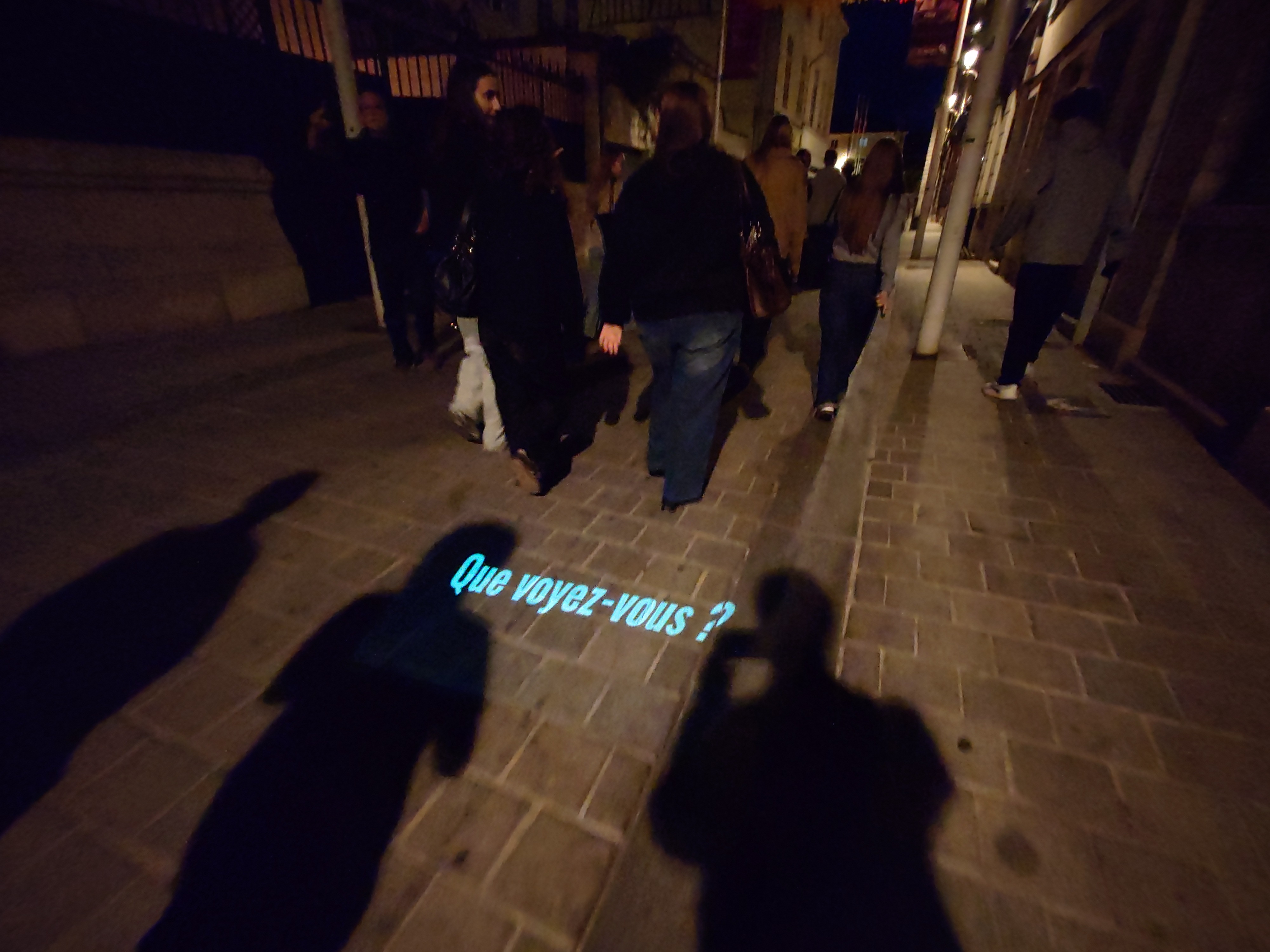
I find these two analyses borne out in the projects I accompany. For six years, I have been working with the teachers of a secondary school’s film option and with a film festival on a travelling projection, in which some thirty pupils make short films on a social theme, then design and lead a night walk during which their films are projected onto the walls of the town. This year, during the rehearsal, one of the teachers told the pupils that “he’s the one who created this show in the town”, speaking of me. I have been using this set-up for some fifteen years, and I did not invent it alone; this year’s route, the eight projection sites, their order, the theme of the films, were all imagined by this teacher, as they are every year. In a cultural project, the credit goes to the name on the programme, because it is the name of the person the organisation pays to be there. The festival pays me, whereas the teacher is paid by the Ministry of Education to be there anyway, and he puts himself in the shadow of his own accord, “you are the light, we are in the shadow”, he told the pupils. We all leave him there, the festival staff, the journalists, and I myself whenever I fail to set the record straight. The guarantor artist therefore has a first responsibility that is neither technical nor aesthetic: to give each person their due, to say who did what, and to refuse the share of invention wrongly attributed to them.
Six years ago, I brought to this festival the set-up and the guarantee that the pupils and their teachers would be capable of carrying it out, and I come back every year to give them that guarantee again. I do this as a guarantor artist, not as a demiurge artist who would decide or know better than the others. And the project has changed status. At the start, it was an outreach activity that the festival offered on the fringe of its programme, and the audience, to put it simply, was the pupils’ parents. Over the years, the night walk has entered the official programme, then the festival’s communication, its visuals, its trailer, because what happens in the town that evening is very powerful; this year, the festival asked the pupils to present it themselves at the opening night. A creation in which I had imposed my own route and my own theme would have matched better what is expected of an artist, and it would have been legitimate from the outset. I do not believe it would have lasted six years. The night walk has gone the opposite way: at the start it had no artistic legitimacy at all, since nobody in it plays the part of the dominant artist, and little by little it has become a legitimate work in the eyes of audiences and funders alike, a form offered to the public in the programme on the same footing as the films, and perhaps, paradoxically, more deeply rooted than others, because it took root, year after year, in the creativity of the people of the area, to the point of becoming part of the festival’s identity.
Ten years of the same workshop
For ten years, I have led each year, for the students of the Master’s in Expography and Museography at the University of Artois, an audiovisual creation workshop in a museum. I come as an artist, and it is in that capacity that I know what to propose. At the start of the latest edition, each student visited the museum for a quarter of an hour and brought back a photograph, without a caption, and we looked at them with one rule: the person who had taken the photo kept silent and the others said what they saw in it. Had the authors presented their picture, apologising as people almost always do, they would have narrowed our gaze; and what the others saw in the photo, its author had often not put there, and yet it was there. This is where the question of what makes a work arises, and I spoke of John Dewey, who writes in Art as Experience (1934) that art is not an object but the experience lived in relation to the object, and that the person who receives a work must create their own experience, through work comparable to the artist’s. What makes a work is the making, and it is also the receiving.
We then shot together a single-take film in the galleries, without a script, in which each person made an object of the museum speak, in the manner of an exquisite corpse; I presented this method in The creative unconscious. Then the students went off in small groups, without me, each to make a film of a few minutes, and we watched them the next morning. A woman looks at the portrait of a woman, and another, behind her, looks at her, until we no longer know which of the two is meant, nor who is in love with whom; a man comes and presses up against a visitor in front of a large canvas, and we will never know whether it is naivety or assault, everyone in the room saw it differently; a circle forms around the camera, which is a character, and friendship is treated in it as something that deserves recognition; a visitor takes a very close interest in the feet of a painted figure, and the museum turns out to be open even to fetishists. They had dared, and the films could have been submitted as they were to a competition. Nothing they made resembles what I would have made, and that is how I can tell that I was an artist during those two days. What I brought to it were constraints of creation, the single take, the talking object, the screening without explanation, patiently prepared equipment, and attention to my own intuitions, such as bringing the instrument to the group that needed it; and these people found in it a space in which to say things that are their own.
I find this place again in most of the projects I run. At the Louvre-Lens, in 2023, a small group of students from the same master’s programme proposed, after a video-mapping workshop I had led, to project unfolded ink blots onto bodies, and we designed the project together, with the museum’s mediation officers, then with young people from a second-chance school who ran the activity on the day; I told the story in Visio-corporal metamorphoses. The idea of the ink blots came from a student, the projection onto bodies from my own work, and the work belongs to all the people who made it. The biennial of participatory creation, organised by the Théâtre de la Poudrerie in Sevran, to which I have contributed since 2022, holds as a principle that participation is not a box to be ticked: it is not enough for a show to be about social issues, the people who make it must respect, in the way they go about it, the democratic principles the show stands for.
I proposed the concept of authorizing creation for works that, by their very form, make people want to do the same. The guarantor artist occupies the place from which such works are made, and from which others are led to make them, answering for what they make possible in others rather than for what they assert. He or she brings to it what they know of creation: that it needs a constraint and a risk, that it is judged by what it gives and not by who proposed it, and that it only exists once it has been received. This knowledge comes from their practice, and it is with this knowledge that they open to others a space in which to create and decide, without claiming any right over what the others do there. I have almost nothing to do with it, and it is by that almost nothing that I measure my work.


